Patent Document: Preparation Method of Tobacco Flavoring Agent with Rose Sweet Fragrance, Flavoring Agent, and Application Thereof
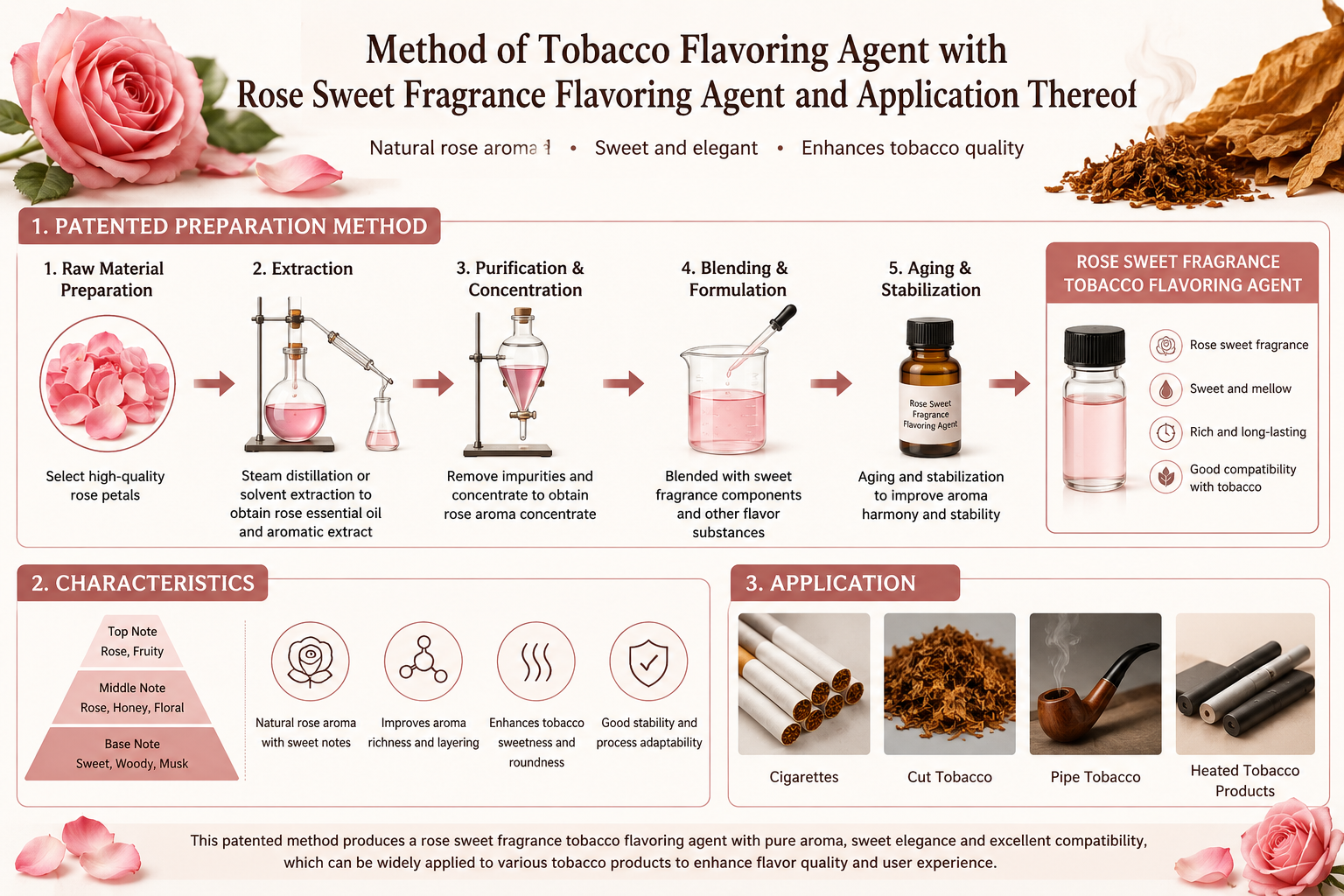
Patent Information
- Patent Number: CN121774250A
- Country: China
- Application Number: CN202610185744.8A
- Status: Pending
- Publication Date: February 9, 2026
Technical Field
The invention belongs to the technical field of tobacco flavors, and specifically relates to a preparation method of a tobacco flavoring agent with rose fragrance, the flavoring agent itself, and its application.
Background of the Invention
Tobacco is recognized as one of the crops with the highest content of functional ingredients. As the world's leading tobacco producer, China generates a large amount of waste tobacco dust annually during the cigarette production process, which imposes a significant burden on tobacco enterprises. Research has demonstrated that this waste dust contains abundant recoverable components, including tobacco flavor compounds, alkaloids, proteins, amino acids, sugars, and chlorogenic acids.
Currently, in the field of tobacco processing and flavor research, the application of Maillard reaction in tobacco flavor enhancement has emerged as a prominent research topic. The products of tobacco Maillard reaction contain a substantial amount of flavor precursor materials. These reaction products exhibit excellent compatibility with tobacco aroma, can improve smoke quality, and render the taste of tobacco softer and more mellow. Furthermore, research indicates that the volatile aromatic components of Maillard products can be significantly enhanced by scientifically regulating and controlling key parameters of the Maillard reaction, thereby optimizing the sensory quality of cigarettes and further improving smoking comfort.
Simultaneously, in the context of tar reduction and harm reduction, the development direction of flavor enhancement to reduce harm proposed by the tobacco industry aligns well with the growing consumer emphasis on health and sensory experience. Therefore, developing scientific methods for improving the sensory quality of cigarettes—particularly methods for optimizing aroma characteristics and improving smoking comfort—has become a core research direction in tobacco science.
Prior Art Limitations
Patent document CN103045369A discloses a preparation method for a reaction-type tobacco flavoring that uses tobacco powder as a raw material, performs Maillard reaction after extraction with strong alkalis such as sodium hydroxide or potassium hydroxide, followed by ethanol reflux extraction after pH adjustment, and concentration. While this method can prepare tobacco flavoring, it suffers from the following defects:
- Harsh pretreatment conditions: The pretreatment employs strong alkali extraction with the aim of freeing and obtaining nicotine. The pH range of 7-13 and temperature of 100-130°C represent severe conditions that can destroy natural aroma components in tobacco or generate unnecessary byproducts.
- Lengthy reaction time: The Maillard reaction time of 1-4 hours is time-consuming, consumes high energy, and presents potential production safety hazards.
- Lack of specificity: The numerous added amino acids and sugars—such as arginine, threonine, glycine, xylose, fructose, and others—result in product aroma characteristics that are insufficiently specific and lack the targeted rose sweet flavor profile.
Summary of the Invention
In view of the above, the present invention aims to provide a preparation method, a flavoring agent, and an application for a tobacco flavoring agent with rose fragrance. This invention not only significantly improves the flavor of cigarettes under low-temperature conditions but also effectively reduces the generation and inhalation of harmful substances, compensates for inherent defects in tobacco flavor, and thereby significantly improves the smoking experience for consumers.
First Aspect: Preparation Method
The invention discloses a method for preparing a tobacco flavoring agent with rose fragrance, comprising the following steps:
S1: Mixing a tobacco raw material with an ethanol solution and carrying out reflux extraction to obtain an extract solution.
S2: Adding reducing sugar and amino acid to the tobacco extract, mixing uniformly, and carrying out Maillard reaction to obtain a Maillard reaction product.
S3: Cooling and filtering the Maillard reaction product to obtain the tobacco flavoring agent.
Detailed Process Parameters
Reflux Extraction Conditions (S1) :
- Ethanol mass concentration: 75%-85%
- Mass ratio of tobacco raw material to ethanol solution: 1:(3-7)
- Extraction procedure:
- First, leach with ethanol solution for 8-12 hours
- Then perform condensation reflux extraction for 1-3 hours
- Add the same amount of ethanol solution and perform reflux extraction for an additional 1-3 hours
Maillard Reaction Components (S2) :
- Reducing sugar: Glucose
- Mass ratio of glucose to tobacco raw material: (1.3-1.5):50
- Amino acid: Phenylalanine
- Mass ratio of phenylalanine to tobacco raw material: (0.8-1.2):50
Maillard Reaction Conditions (S2) :
- Reaction mode: Oil bath
- Reaction temperature: 120-160°C
- Reaction time: 2-10 minutes
- Molar ratio of reducing sugar to amino acid: (1:2) to (2:1)
- Initial pH: 7-9
Tobacco Material (S1) : Preferably tobacco dust (waste material from tobacco processing)
Second Aspect: Tobacco Flavoring Agent
The invention also discloses a tobacco flavoring agent prepared by the above preparation method. The flavoring agent comprises β-damascone and phenylacetaldehyde, among other components, and exhibits a characteristic rose sweet aroma.
Third Aspect: Application
The invention further discloses the application of the tobacco flavoring agent in cigarette products.
Beneficial Effects
1. Optimized Flavoring Agent Production
The tobacco flavoring agent is prepared from tobacco processing waste dust as a raw material through ethanol reflux extraction, concentration, and filtration. Phenylalanine and glucose in specific proportions are externally added to the extract, followed by short-duration high-temperature reaction under optimized Maillard reaction conditions. The reaction product is cooled and filtered to obtain the tobacco flavoring agent.
Through orthogonal experimental optimization, the optimal reaction conditions are:
- Reaction temperature: 120-160°C
- Reaction time: 2-10 minutes
- Initial pH: 7-9
- Glucose to phenylalanine ratio: (1:2) to (2:1)
The flavoring agent is rich in key aroma components such as β-damascone, presenting a characteristic rose sweet aroma. It can significantly improve the sensory quality of cigarettes, with particularly outstanding sweet aroma and baking aroma as demonstrated by sensory evaluation.
Temperature Significance: Temperature is a crucial factor in the Maillard reaction. Higher temperatures facilitate the Maillard reaction and generate more flavoring substances. Preliminary experiments have demonstrated that below 120°C, the Maillard reaction is incomplete and does not differ significantly from samples without Maillard reaction, being insufficient to form an effective flavoring agent.
2. Improved Preparation Process
The preparation method of the present invention offers several advantages over the prior art:
- Direct ethanol reflux extraction: Eliminates complex steps of strong alkali extraction and repeated pH adjustment, avoiding damage to natural aroma components of the tobacco.
- Significantly shortened reaction time: Only 2-10 minutes required compared to 1-4 hours in the prior art, improving production efficiency, reducing energy consumption, and lowering safety risks.
- Overcomes technical prejudice: Achieves superior products with significantly less reaction time.
3. Sensory Enhancement and Harm Reduction
The flavoring agent effectively:
- Compensates for inherent flavor defects of tobacco
- Significantly improves sensory quality (such as sweet and soft characteristics) of cigarettes
- Helps reduce the inhalation of harmful substances
- Achieves the unification of harm reduction and flavor enhancement
4. Sustainable Resource Utilization
The invention utilizes tobacco processing waste dust as a raw material, transforming waste into valuable products, reducing processing costs for enterprises, and aligning with the concept of green sustainable development.
Detailed Description of Embodiments
The technical solutions of the embodiments of the present invention will be clearly and completely described below in conjunction with the embodiments. It is apparent that the described embodiments are only some, not all, embodiments of the present invention. All other embodiments obtained by those skilled in the art based on the embodiments of the invention without inventive effort are intended to be within the scope of the invention.
General Preparation Procedure
The preparation method of the tobacco flavoring agent with rose sweet fragrance comprises the following specific steps:
Step 1: Raw Material Selection and Extraction
- Select tobacco dust generated during tobacco processing as the raw material, ensuring it is dried and free from mildew through pretreatment.
- Mix the tobacco powder raw material with 75-85% ethanol solution at a feed-liquid ratio of 1:(3-7) (mass ratio).
- Leach with ethanol solution for 8-12 hours.
- Perform condensation reflux extraction for 1-3 hours.
- Add the same amount of ethanol solution and perform reflux extraction for an additional 1-3 hours.
- After extraction completion, collect and concentrate the extract solution, removing the solvent (via rotary evaporation or other methods) until a high-content tobacco extract is obtained.
- Filter the concentrate to remove insoluble impurities and macromolecular substances, obtaining the reaction base material.
Step 2: Maillard Reaction
- Add phenylalanine and glucose to the filtered extraction base material:
- Glucose: (1.3-1.5) parts per 50 parts tobacco material
- Phenylalanine: (0.8-1.2) parts per 50 parts tobacco material
- Place the mixed materials into a reaction kettle.
- Perform Maillard reaction under controlled temperature and pressure conditions:
- Reaction mode: Oil bath
- Initial pH: 7-9
- Reaction temperature: 120-160°C
- Reaction time: 2-10 minutes
- Through high-temperature induction, the amino acid and reducing sugar undergo complex chemical changes, generating intermediate products with specific rose sweet aroma characteristics.
- After reaction completion, cool the materials to terminate the chemical reaction and lock the flavor molecules, obtaining the Maillard product.
Step 3: Filtration and Collection
- Filter the Maillard product again through a filter membrane with pore size of 0.22 μm to ensure stability.
- The obtained filtrate is the rose sweet flavoring agent.
- Package and seal, storing under appropriate conditions.
This process effectively improves the quality and flavor level of the tobacco-derived flavoring through the combination of ethanol reflux extraction and directed Maillard reaction.
Experimental Examples
Extraction Parameter Experiments
Extraction of tobacco extracts was performed with the experimental parameters shown in Table 1 below for Examples 1, 2, and 3 respectively.
Table 1: Extraction Parameters of Tobacco Extract
| Example | Feed-Liquid Ratio (Tobacco:Ethanol) | Ethanol Concentration (%) | Leaching Time (h) | First Reflux (h) | Second Reflux (h) |
|---|---|---|---|---|---|
| Example 1 | 1:3 | 75 | 8 | 1 | 1 |
| Example 2 | 1:5 | 80 | 10 | 2 | 2 |
| Example 3 | 1:7 | 85 | 12 | 3 | 3 |
Orthogonal Experiment for Maillard Reaction Optimization
Using the tobacco extract from Example 2 as a representative sample, the reaction temperature, reaction time, initial pH, and glucose-to-phenylalanine ratio were investigated as factors. Absorbance values at 294nm (A294), absorbance values at 420nm (A420), and residual reducing sugar and amino acid amounts were used as investigation indices. Orthogonal experiments were carried out using an L9 (3⁴) standard orthogonal table.
Table 2: Orthogonal Test Factors and Levels for Optimization of Maillard Reaction Conditions
| Level | Temperature (°C) | Time (minutes) | Initial pH | Glucose:Phenylalanine Ratio |
|---|---|---|---|---|
| 1 | 120 | 2 | 7 | 1:2 |
| 2 | 140 | 6 | 8 | 1:1 |
| 3 | 160 | 10 | 9 | 2:1 |
Table 3: Results of Orthogonal Experiment Measurements
| Experiment | Temperature (°C) | Time (min) | pH | Ratio | A294 | A420 | Reducing Sugar Residual | Amino Acid Residual |
|---|---|---|---|---|---|---|---|---|
| 1 | 120 | 2 | 7 | 1:2 | 0.425 | 0.118 | 2.31 | 1.87 |
| 2 | 120 | 6 | 8 | 1:1 | 0.512 | 0.156 | 1.95 | 1.52 |
| 3 | 120 | 10 | 9 | 2:1 | 0.489 | 0.142 | 2.08 | 1.63 |
| 4 | 140 | 2 | 8 | 2:1 | 0.587 | 0.189 | 1.72 | 1.34 |
| 5 | 140 | 6 | 9 | 1:2 | 0.623 | 0.205 | 1.58 | 1.21 |
| 6 | 140 | 10 | 7 | 1:1 | 0.598 | 0.196 | 1.65 | 1.28 |
| 7 | 160 | 2 | 9 | 1:1 | 0.651 | 0.234 | 1.42 | 1.09 |
| 8 | 160 | 6 | 7 | 2:1 | 0.672 | 0.248 | 1.35 | 1.02 |
| 9 | 160 | 10 | 8 | 1:2 | 0.689 | 0.256 | 1.28 | 0.96 |
Sensory Evaluation of Maillard Reaction Products
The aroma style characteristics of the Maillard reaction products were determined through sensory evaluation. The differences in fragrance characteristics of the 9 samples of Maillard reaction products are shown in Table 4, based on the average score for each fragrance type.
Table 4: Sensory Evaluation Results of Maillard Products of Tobacco Powder
| Experiment | Sweet Aroma | Hay Aroma | Baking Aroma | Faint Scent | Fruit Aroma | Caramel Aroma | Sour Aroma |
|---|---|---|---|---|---|---|---|
| 1 | 6.2 | 5.8 | 5.5 | 4.3 | 4.1 | 3.8 | 2.9 |
| 2 | 6.8 | 6.1 | 5.9 | 4.7 | 4.5 | 4.2 | 3.1 |
| 3 | 6.5 | 5.9 | 5.7 | 4.5 | 4.3 | 4.0 | 3.0 |
| 4 | 7.2 | 6.5 | 6.3 | 5.1 | 4.9 | 4.6 | 3.4 |
| 5 | 7.5 | 6.8 | 6.6 | 5.4 | 5.2 | 4.9 | 3.6 |
| 6 | 7.3 | 6.6 | 6.4 | 5.2 | 5.0 | 4.7 | 3.5 |
| 7 | 8.1 | 7.2 | 7.0 | 5.8 | 5.6 | 5.3 | 4.0 |
| 8 | 8.3 | 7.4 | 7.2 | 6.0 | 5.8 | 5.5 | 4.2 |
| 9 | 8.5 | 7.6 | 7.4 | 6.2 | 6.0 | 5.7 | 4.4 |
Key Findings: The results show significant differences in the aroma characteristics of the 9 tobacco Maillard products. The Maillard products contain 7 types of aroma in total, listed in order of intensity: sweet aroma, hay aroma, baking aroma, faint scent, fruit aroma, caramel aroma, and sour aroma.
GC-MS Analysis of Volatile Compounds
Volatile compounds were analyzed by GC-MS. Table 5 below presents the volatile compound identification results.
Table 5: GC-MS Analysis of Tobacco Powder Maillard Product Volatile Compounds
| No. | CAS Number | RI | Compound Name | Authentication Method | Odor Description |
|---|---|---|---|---|---|
| 1 | 105-57-7 | 1388 | Acetal | RI, MS, STD | Creamy, fruity, pleasant, tropical fruity |
| 2 | 79-20-9 | 1207.6 | Acetic acid methyl ester | RI, MS, STD | Slightly spicy, sweet and fragrant |
| 3 | 116-53-0 | 1063.2 | 2-Methyl-butyric acid | RI, MS, STD | Butter, cheese, fermented, sour |
| 4 | 107-92-6 | 725 | Butyric acid | RI, MS, STD | Butter, cheese, sour |
| 5 | 3194-17-0 | 1049 | 1-(2-Furyl)-1-pentanone | RI, MS, STD | Fruit |
| 6 | 1115-11-3 | 1105.3 | 2-Methyl-2-butenal | RI, MS, STD | Spicy nutty star anise fruit aroma |
| 7 | 100-52-7 | 1209.1 | Benzaldehyde | RI, MS | Bitter almond, caramel, cherry, malt, roasted capsicum |
| 8 | 620-02-0 | 1075 | 5-Methyl-2-furaldehyde | RI, MS, STD | Perfume flavor |
| 9 | 110-93-0 | 1285.4 | 6-Methyl-5-hepten-2-one | RI, MS | Citrus, mushroom, pepper, rubber, strawberry |
| 10 | 122-78-1 | 1180.9 | Phenylacetaldehyde | RI, MS | Berries, roses, honey, nuts, peppery |
| 11 | 106-44-5 | 1455 | Para-toluene phenol | RI, MS, STD | Spicy and hot |
| 12 | 1072-83-9 | 987 | 1-(1H-pyrrol-2-yl)-ethanone | RI, MS, STD | Bread, cocoa, hazelnut, licorice, walnut |
| 13 | 124-19-6 | 1180 | Nonanal | RI, MS | Fat, flower fragrance, green, lemon |
| 14 | 1125-21-9 | 1098 | Tea-scented ketone | RI, MS, STD | Floral incense |
| 15 | 288-47-1 | 1538 | Thiazole | RI, MS | Pyridine compound |
| 16 | 2216-51-5 | 1466 | Menthol | RI, MS | Peppermint, cool and refreshing |
| 17 | 123-25-1 | 1412 | Succinic acid, diethyl ester | RI, MS, STD | Cotton, fabric, floral, fruit, bouquet |
| 18 | 112-31-2 | 1180 | Decanal | RI, MS, STD | Floral, fried, orange peel, penetrating, fat oil |
| 19 | 116-26-7 | 1147 | Safranal | RI, MS | Herbal medicine |
| 20 | 101-97-3 | 1535 | Phenylacetic acid ethyl ester | RI, MS, STD | Floral, fruity, honey, rose |
| 21 | 2111-75-3 | 1925.9 | L-perillaldehyde | RI, MS, STD | Cherry, fat, green, spicy, sour, spice |
| 22 | 23726-93-4 | 894 | β-Damascone | RI, MS | Apple, rose, honey, tobacco flavor, sweet |
| 23 | 35044-68-9 | - | β-Damascenone | RI, MS, STD | Floral incense |
| 24 | 3796-70-1 | 961 | Geranylacetone | RI, MS | Fresh green fruit fragrance |
| 25 | 131-11-3 | 1248.3 | Dimethyl phthalate | RI, MS, STD | Light fragrance smell |
| 26 | 21835-00-7 | 1655 | 2-Hydroxy-3,4-dimethyl-2-cyclopenten-1-one | RI, MS, STD | Caramel flavor |
| 27 | 17092-92-1 | 1770 | Dihydro-actinidiolide | RI, MS | Coumarin odor |
| 28 | 15356-74-8 | 1993.5 | 5,6,7,7A-tetrahydro-4,4,7A-trimethyl-2(4H)-benzofuranone | RI, MS | Fruit |
| 29 | 77-93-0 | 737 | Citric acid triethyl ester | RI, MS | Fruit |
| 30 | 120-51-4 | 515 | Benzoic acid benzyl ester | RI, MS, STD | Rosin, herb, oil |
| 31 | 112-39-0 | 966 | Hexadecanoic acid methyl ester | RI, MS | Oily waxy Iris grass flavor |
| 32 | 628-97-7 | 793 | Hexadecanoic acid ethyl ester | RI, MS | Fruity, creamy |
Note: RI = Retention Index; MS = Mass Spectrometry; STD = Standard
Flavor Wheel Development
To fully describe the key aroma compounds that constitute the optimal aroma profile of Maillard reaction products (MRPs) of tobacco residues, a rigorous assessment of the odor profile of the 32 characteristic aroma compounds was carried out. Based on these key aroma actives and their associated sensory attributes, a specific flavor wheel was developed specifically for tobacco residue MRPs (Figure 2 in the original patent).
The flavor wheel systematically organizes the 32 identified aroma descriptors into 8 distinct and interrelated categories, which establishes a foundation for standardized descriptions and communication of the unique flavor characteristics exhibited by the product.
Key Compound Analysis
From the above experiments, it can be seen that the method utilizes the addition of amino acid and reducing sugar to react, promoting Maillard reaction to generate flavoring substances. Phenylalanine and glucose are selected as exogenous additives of the product, and the generated flavoring agent exhibits a rose sweet aroma. This effectively improves the smoke quality, making the aroma in cigarettes richer and more coordinated.
Significance of Rose Sweet Aroma
The rose sweet aroma:
- Effectively improves irritation in smoke
- Covers up miscellaneous gases
- Improves comfort level
- Represents a missing type in the cigarette market
Core Advantages of the Rose Sweet Flavoring Agent
1. Excellent Sensory Modification:
- Most consumers prefer to improve the spicy feeling in cigarettes and reduce irritation
- Sweet feeling is a targeted measure for addressing this disadvantage
- Effectively covers miscellaneous gas and soft irritation
- Endows smoke with elegant rose fragrance and comfortable sweet feeling
- Significantly improves aftertaste
2. Harm Reduction Alignment:
- Under the industry background of reducing harm and tar, the flavoring agent accurately compensates for fragrance and satisfaction lost due to tar reduction
3. High Compatibility:
- Highly cooperates with the original flavor of tobacco to create a composite flavor with high identification
- Not simply covering tobacco flavor but skillfully fusing with inherent roast flavor, cream flavor, nut flavor, and others
- Improves richness and layering of the flavor
- Achieves high-grade effect of "no outcrop of added flavor"
4. Improved Aftertaste:
- Significantly reduces throat dryness and residual astringency
- Brings a clean, comfortable, and sweet aftertaste experience
5. High Efficiency:
- β-Damascone in the product has an extremely low fragrance threshold
- Exhibits rose and other floral fragrances
- Achieves obvious effect with relatively small dosage
- High cost-performance ratio
6. Consistency:
- Ensures flavor consistency during processing and combustion/smoking processes
- Represents a high-efficiency flavoring agent for achieving product upgrading and flavor innovation
Claims (10)
- A method for preparing a tobacco flavoring agent with rose fragrance, characterized by comprising the following steps:
- S1: Mixing a tobacco raw material with an ethanol solution and carrying out reflux extraction to obtain an extract solution;
- S2: Adding reducing sugar and amino acid to the tobacco extract, mixing uniformly, and carrying out Maillard reaction to obtain a Maillard reaction product;
- S3: Cooling and filtering the Maillard reaction product to obtain the tobacco flavoring agent.
- The method according to claim 1, wherein in the reflux extraction of the tobacco raw material and the ethanol solution, the mass concentration of ethanol is 75%-85%, the mass ratio of tobacco raw material to ethanol solution is 1:(3-7), and during reflux extraction, the ethanol solution is first used for leaching for 8-12 hours, then condensation reflux extraction is performed for 1-3 hours, followed by addition of the same amount of ethanol solution and reflux extraction for an additional 1-3 hours.
- The method according to claim 1, wherein the reducing sugar is glucose, the mass ratio of glucose to tobacco raw material is (1.3-1.5):50, the amino acid is phenylalanine, and the mass ratio of phenylalanine to tobacco raw material is (0.8-1.2):50.
- The method according to claim 1, wherein in step S2, the Maillard reaction is carried out in an oil bath at a reaction temperature of 120-160°C for a reaction time of 2-10 minutes.
- The method according to claim 1, wherein in step S2, the molar ratio of reducing sugar to amino acid added is (1:2) to (2:1).
- The method according to claim 4, wherein in step S2, the initial pH of the Maillard reaction is 7-9.
- The method according to any one of claims 1-6, wherein in step S1, the tobacco material is tobacco dust.
- A tobacco flavoring agent having a rose aroma, characterized in that the flavoring agent is prepared by the method of any one of claims 1-7.
- The tobacco flavoring agent having a rose fragrance according to claim 8, wherein said flavoring agent comprises β-damascone, phenylacetaldehyde, and similar compounds, and exhibits a rose sweet aroma.
- Use of the tobacco flavoring agent according to claim 8 or 9 in a cigarette product.
Final Remarks
The above embodiments are only for illustrating the technical solution of the present invention and are not intended to be limiting. Although the present invention has been described in detail with reference to the preferred embodiments, those skilled in the art should understand that modifications and equivalents may be made thereto without departing from the spirit and scope of the technical solution of the present invention, and such modifications are intended to be covered by the scope of the claims of the present invention. The technology, shape, and construction parts of the present invention that are not described in detail are well known in the art.
###