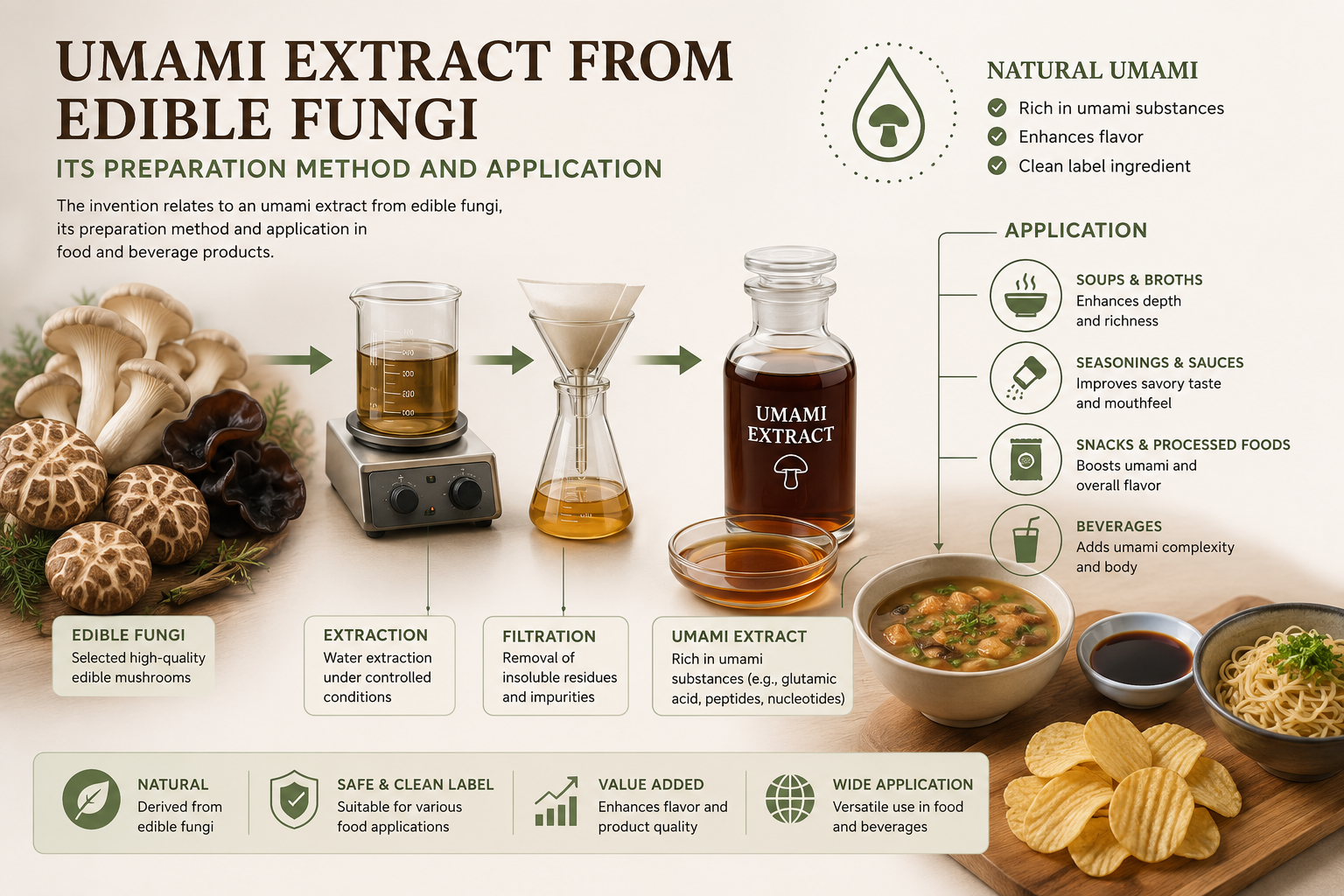
Patent Document: Umami Extract from Edible Fungi, its Preparation Method and Application
Bibliographic Data
| Field | Information |
|---|---|
| Patent Number | CN121890726A |
| Application Number | CN202610133488.8 |
| Application Date | 2026-01-30 |
| Publication Date | 2026-04-21 |
| Assignee | Luzhou Pinchuang Technology Co., Ltd.; Luzhou Laojiao Co., Ltd. |
| Inventor | Wu Qixiao (吴奇霄) |
| Status | Pending (as per original document) |
| Technical Field | Food seasonings, specifically umami extracts from edible fungi |
Technical Field
The present invention pertains to the technical field of food seasonings, specifically relating to an umami-rich extract derived from edible fungi, along with its method of preparation and its application in food products.
Background
In the traditional seasoning industry, enhancing umami flavor has primarily relied on optimizing fermentation processes, breeding specific strains, or directly adding exogenous umami substances like monosodium glutamate, inosine monophosphate, and guanylate. However, with rising living standards, there is a growing consumer preference for "zero-additive" or naturally brewed products. Prior art has attempted to boost the umami output of fermentation systems by breeding Aspergillus strains with high glutamic acid or guanylic acid production (e.g., CN109355212B, CN109897787B). Other methods involve adding seafood extracts (CN113397147A) or edible mushroom flavor compounds (CN106962884B, CN113647596B). Despite these efforts, limitations persist in coordinating the synergy and release timing of different flavor compounds, often resulting in monotonous flavor, insufficient duration, and the presence of bitter or off-notes.
For complex natural materials like edible fungi, umami substances (amino acids, nucleotides) and non-volatile flavor precursors coexist with various volatile aroma compounds. Conventional extraction or reaction processes often lead to the loss of volatile aromas during subsequent high-temperature or prolonged processing, failing to regulate the release sequence of different flavor components. This results in products with diminished aroma, thin flavor profiles, and short aftertastes, sometimes introducing raw or bitter notes from the raw materials.
Current separation and application techniques focus on single-component extraction or simple physical mixing. There is a lack of systematic methods for finely separating multiple flavor substances from edible fungi and enabling their staged, precise utilization based on their behavior during processing. Therefore, a key technical challenge is to achieve the separation and effective utilization of flavor components from natural edible fungi to simultaneously improve the intensity, complexity, and longevity of umami flavor in seasonings.
Summary of the Invention
The invention aims to solve the technical problems of insufficient umami taste, poor durability, and lack of flavor complexity in existing food seasonings like soy sauce.
First Aspect: Preparation Method
To achieve these objectives, the invention provides a method for preparing an umami extract from edible fungi, comprising the following steps:
- S1 (Drying and Crushing): Drying and crushing edible fungus raw materials.
- S2 (Maillard Reaction): Mixing the crushed material with water and sugar to carry out a Maillard reaction. After the reaction, perform solid-liquid separation to obtain a Maillard extract and a filter residue.
- S3 (Molecular Distillation): Subjecting the Maillard extract to molecular distillation. Collect fractions at condensation temperatures of -10°C and -20°C to obtain a first distillate and a second distillate, respectively.
Preferred Embodiments for the Preparation Method:
- Raw Material: In step S1, the edible fungus can be Lentinus edodes (shiitake mushroom) or Dictyophora indusiata (bamboo fungus).
- Drying: Drying is performed at 50-80°C until the moisture content of the raw material is 5-10%.
- Maillard Reaction Conditions:
- Mass ratio of crushed fungus to sugar: 1:0.1-2.
- Mass ratio of crushed fungus to water: 1:10-50 (preferably 1:10-30).
- Reaction temperature: 80-120°C; Reaction time: 30 minutes to 3 hours.
- Molecular Distillation Parameters:
- Incubation temperature: 60-75°C.
- Evaporation temperature: 50-80°C.
- Distillation pressure: 180-300 Pa.
- Scraper speed: 200-300 rpm.
- Feeding speed: 1-5 mL/min.
Second Aspect: The Umami Extract Composition
The invention also provides an edible fungus-derived umami extract comprising a first component and a second component.
- The first component consists of at least one edible fungus first distillate (collected at -10°C).
- The second component consists of at least one edible fungus second distillate (collected at -20°C).
Preferred Embodiments for the Extract Composition:
- The first component can consist of a mixture of shiitake first distillate and bamboo fungus first distillate, preferably in a volume ratio of 1-5:0.5-2.
- The second component can consist of a mixture of shiitake second distillate and bamboo fungus second distillate, preferably in a volume ratio of 1-5:0.5-2.
Third Aspect: Application
The edible fungus-derived umami extract can be used as a food flavoring, particularly for soy sauce.
Fourth Aspect: Brewing Method for Umami Soy Sauce
A method for brewing umami soy sauce is provided, which involves a staged application of the extract components.
- Front-Stage Fermentation: Mix the first component (from the extract) with the edible fungus filter residue (from step S2) and Daqu (fermentation starter). Ferment using a high-salt dilute-state process (as per standard GB 18186-2025) for 60-90 days.
- Post-Stage Addition: After fermentation, sterilize and stand the fermented mash to obtain a supernatant. Add the second component to this supernatant and mix thoroughly to obtain the final umami soy sauce stock solution.
Preferred Embodiments for the Brewing Method:
- Mixing Ratios for Front-Stage Fermentation:
- Mass-volume ratio of first component (mL) : filter residue (g) : Daqu (g) is 1-3 : 0.3-0.6 : 1.
- The edible fungus filter residue comprises shiitake residue and bamboo fungus residue, where the bamboo fungus residue constitutes 0.5-5% of the Daqu mass.
- Mixing Ratio for Post-Stage Addition:
- Volume ratio of second component to soy sauce stock solution is 1-5:100.
Fifth Aspect: The Product
The invention further provides an umami soy sauce produced by the brewing method described above.
Beneficial Effects
The method leverages the combination of Maillard reaction and molecular distillation to separate flavor substances based on their boiling points, yielding low-boiling-point and high-boiling-point fractions with distinct flavor profiles. By applying these fractions in stages, the invention optimizes flavor release over time:
- The low-boiling-point extract (first component) and filter residue are involved in the early fermentation stage, facilitating the conversion and integration of flavor precursors.
- The high-boiling-point fraction (second component) is added post-fermentation, better preserving heat-sensitive and volatile flavor components.
This approach significantly improves the overall flavor harmony, richness, and persistence of the final seasoning while effectively reducing the raw bitterness often associated with the raw materials, resulting in a mellow, well-balanced, and long-lasting flavor.
Examples
(Sensory Data from Examples 3-5)
- Compounding Ratio Evaluation (Example 3):
- Mixing shiitake and bamboo fungus distillates (first or second components) in ratios of 1:0.5 to 1:2 (shiitake:bamboo fungus) was found to enhance flavor harmony by reducing bitterness from the shiitake and adding complexity from the bamboo fungus.
- Ratios exceeding 1:3 resulted in overly dominant woody and spicy notes, decreasing overall flavor balance.
- Soy Sauce Brewing Evaluation (Examples 4-5):
- Samples brewed with the full staged process (front-stage fermentation with first component + filter residue, and post-stage addition of second component) showed outstanding umami, harmonious flavor, and good taste.
- Samples with omitted components or incorrect ratios showed:
- Weaker umami and increased bitterness when the second component was not added post-fermentation.
- Thinner, more dispersed flavor when filter residues were omitted from the fermentation stage.
- Reduced umami strength and duration when the proportion of bamboo fungus residue was too high (>6%) or too low (<0.5%).
- Time-Intensity (TI) Analysis (Example 5):
- Dynamic sensory evaluation confirmed that the preferred method (Example 4-1) provided a significantly higher maximum umami intensity (Imax) and a longer total duration of umami perception (Ttot) compared to samples with non-optimal parameters or omitted components.
- Statistical analysis showed a significant difference (p < 0.05) for TI parameters, with the full process (Example 4-1) outperforming all others.
Brief Description of Drawings
- Figures 1-3: GC-MS total ion flow diagrams for shiitake raw material, shiitake first distillate, and shiitake second distillate, respectively. These figures show the concentration of volatile compounds (like 1-octen-3-ol) in the first distillate and heavier, roasted aroma compounds (like pyrazines) in the second distillate.
- Figures 4-6: GC-MS total ion flow diagrams for bamboo fungus raw material, bamboo fungus first distillate, and bamboo fungus second distillate, respectively. These figures show the enrichment of floral and fruity terpenes in the first distillate and woody, spicy compounds in the second distillate, complementing the shiitake fractions.
Claims Summary
- A method for preparing an umami extract from edible fungi via Maillard reaction and molecular distillation.
- The method of Claim 1, specifying preferred conditions for drying, Maillard reaction, and molecular distillation parameters.
- An umami extract composition comprising a first component and a second component obtained via the method of Claim 1.
- The extract of Claim 3, wherein the first and second components are blends of shiitake and bamboo fungus distillates in specific volume ratios.
- Use of the extract for food flavoring.
- The use of Claim 5, where the food is soy sauce.
- A method for brewing umami soy sauce using staged addition of the extract's first component with filter residue during fermentation, and the second component post-fermentation.
- The brewing method of Claim 7, specifying precise ratios for mixing the components.
- The brewing method of Claim 8, specifying the composition and ratio of the filter residue.
- An umami soy sauce produced by the method of any of Claims 7-9.
###