Patent Summary: CHOCOLATE REPLICAS PRODUCED FROM INDIVIDUAL COMPONENTS
(19) United States (12) Patent Application Publication (10) Pub. No.: US 2026/0007144 A1
Tenney et al. (43) Pub. Date: Jan. 8, 2026
(54) CHOCOLATE REPLICAS PRODUCED FROM INDIVIDUAL COMPONENTS
(71) Applicant: Voyage Foods, Inc., Oakland, CA (US)
(72) Inventors: Kelsey Tenney, Oakland, CA (US); Adam Maxwell, San Francisco, CA (US); Ethan Charles Beswick, San Francisco, CA (US); Samuel Ryo, Singapore (SG); Daniel Assad Saad, Dallas, TX (US); Alec Kremonic Lee, San Francisco, CA (US); Mardonn Carl Chua, Ann Arbor, MI (US); Brandon Head, Oakland, CA (US)
(21) Appl. No.: 19/278,206
(22) Filed: Jul. 23, 2025
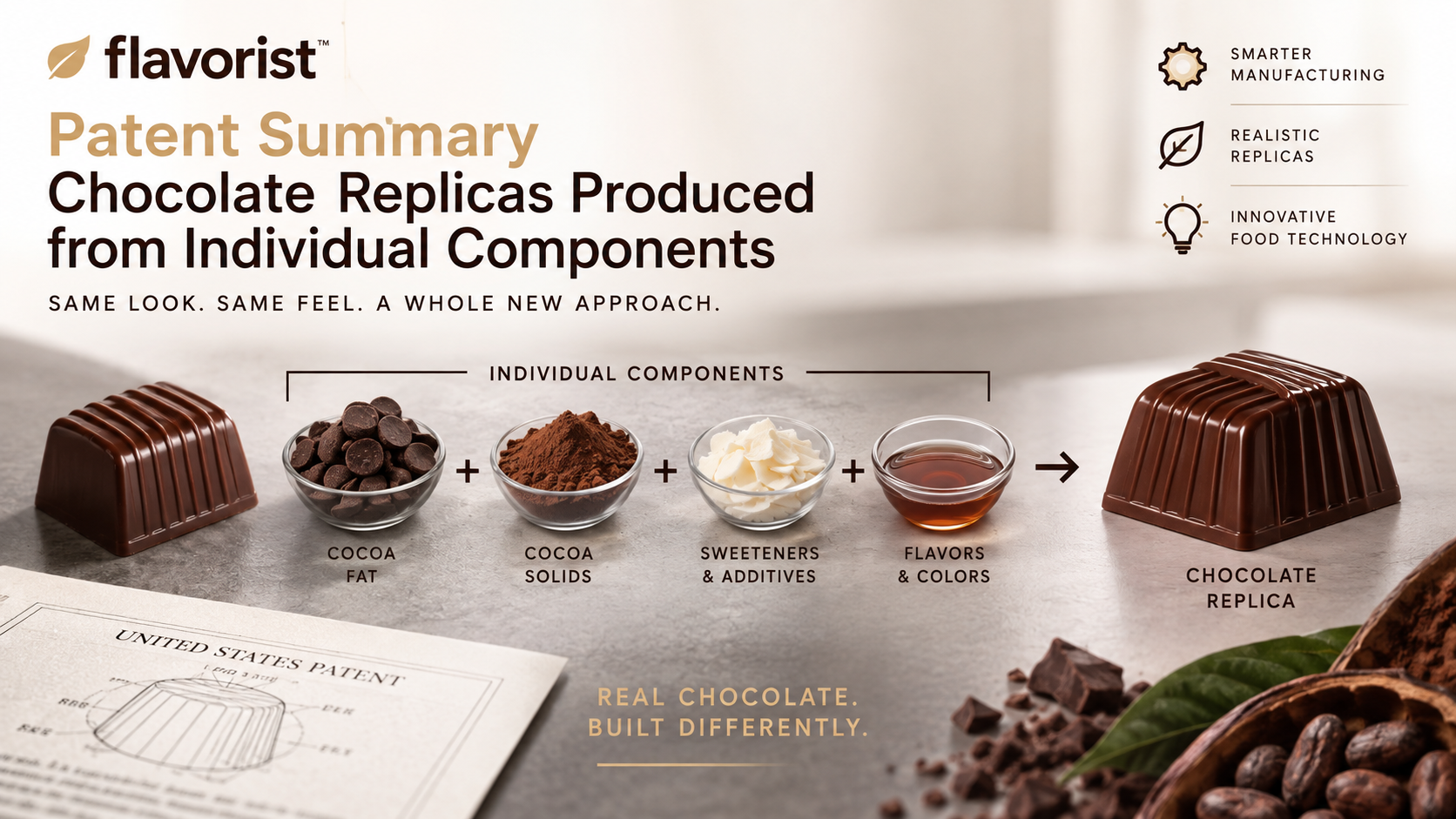
The patent document is extremely long. Here is a summary of the essential information from the patent document including key ingredients, formulation ranges, preparation methods, and expected results.
SUMMARY OF IMPORTANT INFORMATION
1. BACKGROUND AND OVERVIEW
Problem Addressed: Traditional chocolate production is lengthy, costly, and variable due to climate, crop disease, and contamination issues. Methods are imprecise and batch-to-batch consistency is difficult to achieve.
Solution: The invention provides chocolate replicas made by combining individual volatile organic compounds (VOCs) and non-volatile compounds in pure or isolated form. This approach offers:
- Infinite reproducibility
- Reduced risk and variability
- Unique flexibility in optimizing flavors, aromas, and textures
- Elimination of detrimental or undesired components
- Rapid, reproducible, and cost-effective production
2. DEFINITIONS
| Term | Definition |
|---|---|
| Chocolate Replica | Chocolate-like products (beans, bars, coatings, beverages) that mimic traditional chocolate taste, aroma, mouthfeel, and appearance |
| VOCs | Compounds measurable using GCMS |
| Non-volatile Compounds | Compounds measurable using LCMS |
| Traditional/Reference Chocolate | Chocolate produced through standard processes including farming, drying, grinding, and tempering of chocolate beans |
| About | ±10% for ingredient amounts; ±20% for measured characteristics or process conditions |
3. KEY INGREDIENT COMPOSITION
3.1 Plant-Based Solid Substrate (0.5-99.9 wt%)
Critical Feature: Does NOT contain cacao/cocoa solids. Derived from food stream waste products (at least 75% of starch, protein, sugar, fat-soluble components, and flavor removed).
Sources:
| Category | Examples |
|---|---|
| Fruit/Vegetable Seeds | Apple, breadfruit, cashew, citrus, date, grape, guava, mango, melon, olive, papaya, pumpkin, tomato, walnut, watermelon, berries, kiwi, passionfruit, dragonfruit |
| Fruit Pomace/Peel | Apple pomace, banana peel, grape pomace, tomato pomace/skins |
| Processed Fruits | Banana, breadfruit, date, guava, jackfruit, mango, papaya, pineapple, tomato |
| Legumes | Chickpea, lentil, bean varieties, peanut, soybean, carob, tamarind |
| Oil Plants/Seeds | Almond, sunflower, safflower, sesame, shea, coconut, palm kernel, grape seeds |
| Grains | Wheat, rice, corn, barley, oats, rye, sorghum, quinoa, millet |
| Roots/Tubers | Potato, sweet potato, carrot, cassava, sugar beet |
Preferred: Grape seeds are specifically mentioned as a preferred source.
3.2 Volatile Organic Compounds (VOCs)
Essential VOCs (Minimum Core Set - "Emperor" Compounds):
| Compound | Function | Typical Amount |
|---|---|---|
| 2,3-Diethylpyrazine | Burnt/roasted note | 0.0000001 - 10 ppm |
| 2,3-Pentadione | Caramel/buttery note | 0.1 - 14 ppm |
| 2-Ethyl-3,5-dimethylpyrazine | Nutty/roasted note | 0.000001 - 9 ppm |
| 2-Ethyl-3,6-dimethylpyrazine | Nutty/roasted note | 0.000001 - 9 ppm |
| 2-Methoxypyrazine | Peppery/earthy note | 0.000001 - 9 ppm |
| 3-Methylbutyraldehyde | Malty/fruity note | 0.0001 - 20 ppm |
| 5-Methyl-2-hepten-4-one | Fruity/musty note | 0.0001 - 25 ppm |
| Acetoin | Buttery/creamy note | 0.0001 - 55 ppm |
| Coffee Furanone | Caramel/coffee note | 0.14 - 14 ppm |
| Furfuryl Mercaptan | Roasted coffee note | 0.000001 - 5 ppm |
| Indole | Animal/floral note | 0.001 - 3 ppm |
| Propionic Acid | Sour/pungent note | 0.01 - 505 ppm |
| Pyrazine | Nutty/roasted note | 0.0001 - 10 ppm |
| Valeric Acid | Sweaty/cheesy note | 0.000001 - 40 ppm |
| Vanillin Propylene Glycol Acetal | Vanilla note | 0.0000001 - 550 ppm |
| Vanillyl Ethyl Ether | Vanilla/woody note | 0.01 - 510 ppm |
Secondary VOCs (Optional Additions):
Alcohols: 1-octanol, 1-octen-3-ol, 2-heptanol, 2-nonanol, benzyl alcohol, eugenol, geraniol, guaiacol, hexanol, isoamyl alcohol, phenethyl alcohol
Aldehydes: Vanillin, benzaldehyde, furfural, phenylacetaldehyde, nonanal, hexanal, decanal, isovaleraldehyde
Ketones: Beta-ionone, maltol, 2-heptanone, damascenone, acetophenone, gamma-valerolactone, 2-undecanone
Acids: Isovaleric acid, cinnamic acid, 2-methylbutyric acid, butyric acid, propanoic acid, isobutyric acid, hexanoic acid, acetic acid, phenylacetic acid
Esters: Ethyl laurate, diethyl succinate, ethyl butyrate, ethyl 2-methylbutyrate, methyl butyrate, ethyl hexanoate, ethyl isobutyrate, isoamyl acetate, ethyl acetate, ethyl octanoate
Furans: 2-methyl furan, 2-pentylfuran, furfural, furfuryl alcohol, 5-methylfurfural
Pyrazines: 2,3-dimethylpyrazine, 2,3,5-trimethylpyrazine, 2,5-dimethylpyrazine, 2,6-dimethylpyrazine, 2-ethylpyrazine, 2-ethyl-3-methylpyrazine
Sulfur Compounds: Dimethyl trisulfide, methanethiol, methional, furfuryl mercaptan
Others: Limonene, linalool, myrcene, beta-caryophyllene
3.3 Non-Volatile Compounds
Key Non-Volatiles:
| Category | Examples |
|---|---|
| Amino Acids | Phenylalanine, leucine, glucosamine, methionine, GABA, tyrosine, lysine, histidine, glycine, serine, aspartic acid, isoleucine, tryptophan, valine, proline, arginine, threonine, glutamine, asparagine, cysteine, glutamic acid |
| Sugars/Sugar Alcohols | Fructose, glucose, lactose, galactose, sucrose, xylose, arabitol, mannitol, sorbitol, inositol, ribose, rhamnose |
| Acids | Lactic acid, citric acid, tartaric acid, malic acid, succinic acid, fumaric acid, gallic acid, vanillic acid, syringic acid, D-glucuronic acid, quinic acid |
| Pyrazines | 2,3,5-trimethylpyrazine, 2,3-dimethylpyrazine, 2,3,5,6-tetramethylpyrazine |
| Tannins/Phenols | Catechin, epicatechin, gallic acid, quercetin, resveratrol, rutin, trans-ferulic acid, vanillic acid, syringic acid |
| Others | Caffeine, choline, pyridine, pyridoxine, vanillin, cinnamic acid, maltol |
3.4 Typical Formulation Ranges
| Component | Amount (wt%) |
|---|---|
| Solid Substrate | 0.5 - 99.9 |
| Sugars | 0 - 75 |
| Fats/Plant Oils | 5 - 50 |
| Seed Meal | 0 - 30 |
| Amino Acids | 0 - 3 |
| Salt | 0 - 1.5 |
| Root Powder | 0 - 5 |
| Liquid (water/milk) | 0 - 20 |
4. SOLID SUBSTRATE PREPARATION METHODS
Method 1: Ground Plant Seeds
Process:
- Grind seeds to 5-150 micron particle size
- Treat with caustic agent (NaOH, KOH, Na₂CO₃, Ca(OH)₂, KHCO₃) + water
- Temperature: 45-125°C (preferred: 70-80°C)
- Pressure: 0-10 bar
- Time: 15-60 minutes
- Target pH: 7.5-10.5 (preferred: 8.0-8.5)
- Method: High shear blending
- Dry (tray, spray, drum, falling film, freeze, or vacuum drying)
- Combine with plant oils (corn, sunflower, palm, coconut, shea, illipe, mango kernel, palm kernel, canola, avocado, or safflower oil)
- Mill (stone corundum or colloid mill) at <65°C to <75 microns
- Sieved through 100 micron sieve
Method 2: Whole Plant Seeds (Two-Stream Process)
Process:
- Sift seeds to remove unwanted plant material
- Treat with caustic agent + water
- Temperature: 55-95°C (preferred: 75°C)
- Pressure: 0-10 bar
- Time: 15-60 minutes
- Target pH: 8.0-8.5
- Method: High shear blending
- Separate into wet seeds fraction and liquid fraction
- Roast separately:
- Wet seeds: Air roast (300-450°F)
- Liquid fraction: Dry roast
- Grind wet seeds (burr, blade, hammer, stone, jet, air classifier, or high impact mill)
- Recombine fractions + plant oils
- Mill (stone corundum or colloid mill) at <65°C to <75 microns
- Sieved through 100 micron sieve
Method 3: Whole Plant Seeds (With Enzyme Treatment)
Process:
- Clean seeds (detonator, scalping deck, aspiration channel, sizing deck, optical sorter, sieve)
- Treat with caustic solution + water
- Temperature: 70-80°C (preferred: 75°C)
- Pressure: 0-10 bar
- Time: 15-180 minutes (preferred: 30-120 minutes)
- Target pH: 8.0-9.0
- Dry (tray, spray, drum, or vacuum drying)
- Optional: Separate into solid/liquid fractions and dry separately
- Enzyme treatment (optional): Cellulase, tannase, pectinase, xylase, or hemicellulose
- Roast (convection, conduction, infrared, or combination)
- Grind (crushing mill, burr mill, espresso grinder, stone mill, blade mill, or jet mill)
- Combine with plant oils, sugars, salts, seed meals/flours, amino acids, other non-volatiles → forms slurry
- Mixing temperature: ~35°C
- Pump into particle size reduction apparatus
- Refine to <25-30 microns
5. CHOCOLATE REPLICA PREPARATION METHODS
Method A: Ground Plant Seeds
Process:
- Treat ground seeds with caustic + water → dry → combine with plant oils → mill to <75 microns → sieve
- Add sugars (0-75 wt%), seed meals (0-30 wt%), plant oils (5-50 wt%), amino acids (0-3 wt%), salts (1.5 wt%), root powders (0.5 wt%) → mix at 35°C for 30 min
- Add VOCs, acids, other non-volatiles → mix at 35°C with/without vacuum for 10 min
- Emulsify using continuous ball mill (not exceeding 40°C) to <30 microns
- Solidify at 10-15°C in molds
- Demold and pack
- Melt at 28-42°C
- Temper to correct fat crystal structure
- Deposit into bar molds or onto cooling belt at 10-15°C
- Package
Method B: Whole Plant Seeds (Two-Stream)
Process:
- Sift seeds → treat with caustic → separate wet seeds from liquid
- Air roast wet seeds; dry roast liquid
- Grind wet seeds (burr mill)
- Recombine fractions + plant oils → mill (stone corundum or colloid mill) at <65°C to <75 microns → sieve (100 micron)
- Add sugars, seed meals, plant oils, amino acids, salts, non-volatiles → mix at 35°C for 30 min
- Add VOCs, acids, other non-volatiles → mix at 35°C under vacuum for 10 min
- Emulsify (continuous ball mill, ≤40°C) to <30 microns
- Solidify at 10-15°C in molds → demold → pack
- Melt at 28-42°C → temper → deposit into molds or cooling belt at 10-15°C → package
Method C: Whole Plant Seeds (Liquefier/Conch)
Process:
- Clean seeds (destoner, scalping deck, aspiration channel, sizing deck, optical sorter, sieve)
- Treat with caustic solution + water (75°C, 0-10 bar, 30 min-2 hr, pH 8-9)
- Dry (tray, spray, drum, vacuum)
- Optional: Sieve and dry streams separately, or vacuum evaporate moisture
- Optional: Enzyme treatment (cellulase, tannase, pectinase, xylase, hemicellulase)
- Roast (convection, conduction, infrared, or combination)
- Grind (crushing mill, burr mill, espresso grinder, stone mill, jet mill) → optional sifting
- Combine with plant oils, sugars, salts, seed meals/flours, amino acids, non-volatiles → mix at 35°C
- Pump slurry → 2-roll preline → homogenizing screw
- Homogenize (optional: add starch, lecithin)
- Refine to <25-30 microns
- Convey to liquefier or conch: Add fat, lecithin, volatile flavors at 28-42°C with agitation
- Optional: Pump into continuous ball mill for further particle size reduction
- Temper (optional) → solidify in large blocks at 10-15°C in molds or on belt slab
- Demold → pack bulk or wrap for industrial use
- For further processing: Melt at >30°C → temper → deposit into molds at 10-15°C → package
Method D: Chocolate Bean Replica
Process:
- Dissolve water-soluble VOCs and non-volatiles in water
- Form emulsion: Fat-soluble VOCs + non-volatiles in neutral oil (palm, shea, mango kernel, illipe, cottonseed, corn, sunflower, coconut)
- Use rotor stator high shear homogenizer or high pressure inline recirculating homogenizer
- Optional: Add emulsifiers, starches, gums, polysaccharides
- Blend water-soluble and emulsion fractions
- Separately blend large particle solid substrate (250-1500 μm particle size)
- Add liquid mixture from step 3 to blended solid substrate with mixing
- Optional: Add tableting aid (starch, sugar, gum)
- Tablet in pill press to form chocolate bean replicas
- Optional: Coat (shellac, zein protein, wax)
- Place into receptacle (e.g., bag)
Method E: Chocolate Beverage Replica
Process:
- Dissolve water-soluble VOCs and non-volatiles in water
- Form emulsion of fat-soluble VOCs and non-volatiles in neutral oil
- Rotor stator high shear homogenizer or high pressure inline recirculating homogenizer
- Optional: Emulsifiers, starches, gums, polysaccharides
- Blend water-soluble and emulsion fractions
- Process to commercial sterility using:
- Ultra clean processing
- UHT aseptic processing
- Fill and retort processing
- Fill then Ohmic sterilization
- UV/PEF inline sterilization and aseptic filling
6. FORMULATION TABLES
Table 1: Exemplary Ingredient Ranges (wt%)
| Compound | Range (%) |
|---|---|
| Isovaleric acid | 3.51E-03 - 1.40E-02 |
| 2-Methylbutyric acid | 1.21E-01 - 4.85E-01 |
| Butyric acid | 1.21E-02 - 4.85E-02 |
| Cinnamic acid | 9.58E-03 - 3.83E-02 |
| Propanoic acid | 2.43E-03 - 9.70E-03 |
| 3-Phenylpropionic acid | 7.78E-04 - 3.11E-03 |
| Amyl alcohol | 4.52E-02 - 1.81E-01 |
| Benzyl alcohol | 4.52E-03 - 1.81E-02 |
| Isoamyl alcohol | 2.92E-03 - 1.17E-02 |
| 1-Decanol | 1.95E-03 - 7.78E-03 |
| 3-(Z)-Hexenol | 1.76E-03 - 7.03E-03 |
| Furanol | 1.15E-03 - 4.59E-03 |
| 2-Nonanol | 9.73E-04 - 3.89E-03 |
| 1-Heptanol | 4.87E-04 - 1.95E-03 |
| 2-Methoxy-4-vinylphenol | 3.48E-04 - 1.39E-03 |
| Carvacrol | 1.73E-04 - 6.94E-04 |
| 3-Mercapto hexanol | 1.41E-04 - 5.62E-04 |
| Para cresol | 9.42E-05 - 3.77E-04 |
| Hexanol | 2.33E-07 - 9.33E-07 |
| 1-Octanol | 2.92E-08 - 1.17E-07 |
| Isovaleraldehyde | 5.49E-01 - 2.20E+00 |
| Vanillin | 3.45E-01 - 1.38E+00 |
| Cocoa hexenal | 4.52E-02 - 1.81E-01 |
| Benzaldehyde | 1.20E-02 - 4.79E-02 |
| Nonanal | 6.21E-03 - 2.49E-02 |
| Valeraldehyde | 3.29E-03 - 1.32E-02 |
| 2-Phenyl-2-butenal | 5.84E-04 - 2.34E-03 |
| 2-Methylbutyraldehyde | 4.87E-04 - 1.95E-03 |
| Decanal | 3.51E-04 - 1.40E-03 |
| 2-Methylbutyl isovalerate | 9.78E-03 - 3.91E-02 |
| Ethyl lactate | 9.52E-03 - 3.81E-02 |
| Ethyl laurate | 6.46E-03 - 2.59E-02 |
| Methyl butyrate | 6.07E-03 - 2.43E-02 |
| Isoamyl acetate | 3.77E-03 - 1.51E-02 |
| Ethyl heptanoate | 2.81E-03 - 1.12E-02 |
| Ethyl 2-methylbutyrate | 2.63E-03 - 1.05E-02 |
| Butyl butyrate | 2.11E-03 - 8.43E-03 |
| Isobutyl acetate | 1.95E-03 - 7.78E-03 |
| Butyl acetate | 1.95E-03 - 7.78E-03 |
Table 2: Exemplary Formulation (Complete)
| Component | Amount (wt%) |
|---|---|
| Sucrose/other sugars | 10.0 - 40.0 |
| Lecithin | 0.25 - 2.00 |
| Leucine | 3.33E-02 - 1.0E-01 |
| Phenylalanine | 8.3E-02 - 2.5E-01 |
| Glucose | 5.0E-02 - 1.5E-01 |
| Malic acid | 1.61E-05 - 1.61E-04 |
| Tartaric acid | 8.81E-06 - 8.81E-05 |
| Lactic acid | 1.76E-05 - 1.76E-04 |
| Citric acid | 1.00E-03 - 1.00E-02 |
| Naringin | 5.00E-03 - 5.00E-02 |
| Sodium chloride | 2.50E-02 - 1.00E-01 |
| Substrate (grape seed, sunflower seed, plant oils, seed meals, sugars) | 50.0 - 99.9 |
| Liquid (water, milk, plant-based milk) | 0 - 20 |
7. EXPECTED RESULTS
Sensory Characteristics
| Aroma Note | Score (Max 5) - Example Implementation |
|---|---|
| Fresh | 3.5 |
| Burnt | 2.5 |
| Baked | 2.0 |
| Sweet | 3.5 |
| Sour | 2.5 |
| Spicy | 1.0 |
| Fruity | 1.5 |
| Milky | 0.5 |
| Floral | 0.5 |
| Woody | 0.5 |
Comprehensive Quality Scores (Max 100)
| Parameter | Score (Max) | Example Implementation |
|---|---|---|
| Natural Tobacco Aroma | 10 | 8-9 |
| Aroma Intensity | 15 | 13-13.5 |
| Aroma Quality - Finesse | 15 | 13-13.5 |
| Aroma Quality - Roundness | 15 | 13-13.5 |
| Irritation - Nasal | 15 | 12.5-13.5 |
| Irritation - Oral | 15 | 12.5-13.5 |
| Impact | 5 | 4-4.5 |
| Off-notes (scorched, earthy, woody) | 10 each | 8-9 |
| Mouthfeel - Cleanliness | 10 | 8.5 |
| Mouthfeel - Moistness | 5 | 4.5 |
| Mouthfeel - Aftertaste | 5 | 4.5 |
| Total | 100 | 85.5 - 89 |
Key Observations from Panelists:
- Burnt and baked aroma notes are significantly enhanced
- Aroma quality is improved
- Smoke concentration and aroma intensity increased to a certain extent
- Off-notes (green, regional off-notes) are masked to varying degrees
- Overall evaluation: Applicable/suitable
Total VOC Content
Chocolate replica typically contains at least 100 mg/L of VOCs.
8. KEY FEATURES AND ADVANTAGES
| Feature | Benefit |
|---|---|
| Individual component addition | Infinite reproducibility, reduced variability |
| Pure/isolated compounds (≥90-99.9% pure) | Quality control, elimination of contaminants |
| No cacao/cocoa solids | Addresses supply chain issues, price volatility |
| Food stream waste substrate | Sustainability, cost reduction |
| Customizable VOC profiles | Tailored flavor/aroma optimization |
| Rapid production | Cost-effective compared to traditional methods |
| No traditional defects | Consistent quality, no mold, pathogens, pesticides, heavy metals |
9. QUALITY CONTROL AND STANDARDS
Non-Volatile Compound Identity
The one or more non-volatile compounds have less than 95% identity to non-volatile compounds in a single reference chocolate (in some embodiments, less than 85%).
Exclusion List
Chocolate replica does NOT contain:
- Pathogens: E. coli, Salmonella, Brettanomyces, Lactobacillus, Saccharomyces, various molds
- Contaminants: Insects, eggs, filth, rodent filth, mammalian excreta
- Chemical contaminants: Aflatoxin, pesticides (DDT, DDE, TDE, lindane, aldrin, dieldrin, heptachlor), heavy metals, methanol, ethylene glycol, dichloromethane
- Off-flavors: 2,4,6-trichloranisole, 2,4,6-tribromoanisole, hydrogen sulfide, dimethylnitrosamine
10. APPLICATIONS
Primary Application: Cigarette burnt flavor essence (Note: This document describes food chocolate replicas, but contains similar compositional approaches to the cigarette flavor patent.)
Specific Applications Include:
- Chocolate bean replicas
- Chocolate bar replicas
- Chocolate coating replicas
- Chocolate beverage replicas
- Chocolate concentrate replicas
- Cocoa powder replicas
- Dark chocolate replicas
- Milk chocolate replicas
Application Rate: 0.03-0.05% of tobacco leaf/cut tobacco weight (for cigarette application)
This summary covers the essential information from the patent document including key ingredients, formulation ranges, preparation methods, and expected results.