Patent Watch: Modifying or Enhancing the Flavor of Food and Beverage products with Rare Sugar Allulose
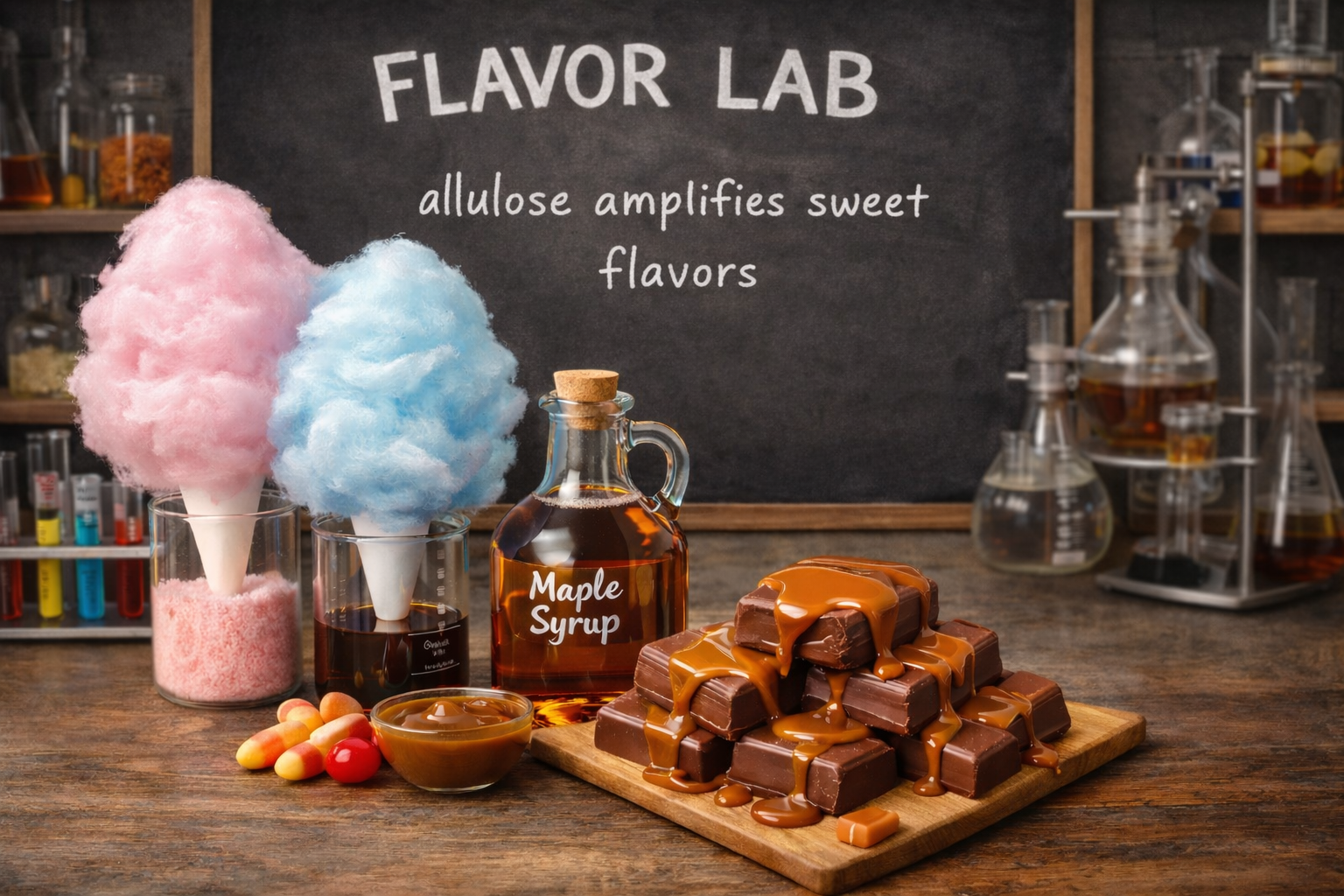
This Japanese patent (JP7622021B2) discloses a novel method for modifying or enhancing the flavor of food and beverage products using the rare sugar allulose. The key invention is that allulose can improve specific flavors even when used at concentrations too low to taste sweet itself.
🎯 Core Concept: Sub-Sweetening Levels
The fundamental discovery is that allulose possesses flavor-modifying properties independent of its sweetness. The invention focuses on using allulose at or below its "sweetness threshold"—the maximum concentration at which it is not perceived as sweet on its own.
- Defining the Threshold: Through sensory testing (a 2-Alternative Forced Choice test), the patent establishes that allulose's sweetness threshold in water is approximately 2.695% by weight of the total product. At this level and below, allulose does not contribute a sweet taste.
- Key Distinction: The invention leverages allulose's flavor-enhancing ability, not its function as a caloric or high-intensity sweetener.
✨ How Allulose Modifies Flavor
The method involves incorporating allulose into a product at sub-sweetening levels (≤ 2.695 wt%). This addition can:
- Enhance or strengthen specific flavor characteristics.
- Modify the flavor profile, for example by softening or sharpening it.
- Improve the overall consumer preference for the product.
The flavor modification is primarily linked to aroma, particularly the perception of "sweet aromatic" flavors that are detected retronasally (the smell perceived when food is in the mouth).
🍬 Specific Flavors Enhanced
The patent provides experimental evidence for the enhancement of specific flavors in beverages:
- Cotton Candy Flavor: A test beverage with 1.5 wt% allulose and cotton candy flavor was perceived as having a significantly stronger cotton candy flavor compared to a control without allulose. A majority of panelists also preferred the allulose-containing sample.
- Salted Caramel Flavor: Similarly, a beverage with 1.5 wt% allulose and salted caramel flavor was perceived as having a significantly stronger salted caramel flavor and was preferred over the control.
Other sweet aromatic flavors mentioned that can be enhanced include caramel, maple, and sugar flavors.
⚖️ Claimed Allulose Concentrations
The patent claims specific ranges for the amount of allulose in the final food or beverage product (by total weight):
- Core Range: From about 0.10% to 2.20%.
- Preferred Ranges:
- 0.50% to 2.20%
- 1.00% to 2.20%
- 1.20% to 2.00%
- Most Preferred: Around 1.50% (specifically 1.40% to 1.60%).
🔬 Experimental Validation
The patent includes detailed examples of sensory tests:
- Sweetness Threshold Test: A 2-AFC test confirmed that allulose solutions at 1.925%, 2.310%, and 2.695% were not perceived as sweeter than a 1.5% sucrose reference, defining the sub-sweetening levels.
- Flavor Enhancement Tests: Using the same 2-AFC method, trained panelists evaluated un-sweetened beverages (with only flavor and allulose or just flavor). The results were statistically significant, proving that allulose at 1.5% enhances the intensity of both cotton candy and salted caramel flavors.
💡 Practical Applications and Use
- Products: The method applies to a wide range, including beverages, baked goods, dairy products (yogurt, ice cream), confectionery, tabletop sweeteners, and more.
- Combination with Other Sweeteners: The invention can be advantageously combined with both synthetic (e.g., sucralose) and natural (e.g., stevia, monk fruit) high-intensity sweeteners to improve overall flavor profile.
- Formulation: Allulose can be added in pure form or as a syrup (like the Dolcia Prima™ used in examples) during product manufacturing. For concentrates or mixes, the amount is calculated for the final, ready-to-consume product.
💎 Summary
In essence, this patent protects the use of allulose as a flavor modifier or enhancer at concentrations where it provides no sweetness. By adding it at specific low levels (particularly around 1.5% by weight), the intensity and consumer appeal of sweet aromatic flavors like cotton candy and salted caramel in food and beverage products can be significantly improved.
Based on the patent document, here are the specific flavors mentioned, categorized and detailed.
🍬 Specific Flavors and Flavor Agents Detailed in the Patent
The patent extensively lists flavors that can be modified or enhanced, with a focus on "sweet aromatic" flavors. The core examples proven by experimentation are cotton candy and salted caramel, but the document provides a much broader list of related flavor agents.
1. Core Flavors Proven by Example
These are the flavors used in the sensory tests that demonstrate the invention's effectiveness.
- Cotton Candy Flavor:
- Context: Used in a non-sweetened beverage sample. The test proved that adding allulose at 1.5 wt% significantly enhanced the perceived intensity of the cotton candy flavor compared to a control sample without allulose.
- Source in Patent: The flavor used was "N&A Cotton Candy" from Givaudan (Product code YX-953-327-3). It is explicitly noted that this flavor contains no sweetener itself.
- Salted Caramel Flavor:
- Context: Also used in a non-sweetened beverage sample. Sensory tests showed that the addition of allulose at 1.5 wt% significantly enhanced the intensity of the salted caramel flavor and increased consumer preference for the beverage.
- Source in Patent: The flavor used was "N&A Salted Caramel" from Flavor & Fragrance Specialties (Product code YX-226E 032). Like the cotton candy flavor, it contains no sweetener.
2. "Sweet Aromatic" Flavor Categories
The patent specifies that the flavor to be modified or enhanced is often a "sweet aromatic flavor," particularly those perceived mainly through retronasal smell. The main categories listed are:
- Caramel flavor
- Maple flavor
- Sugar flavor
- Cotton Candy flavor
It states that the caramel flavor can specifically be a salted caramel flavor.
3. Detailed Lists of Related Flavor Agents
The patent provides extensive, non-limiting lists of known flavoring agents that impart or help impart these specific flavor profiles. These lists are provided in the "Detailed Description" section to illustrate the types of flavors the invention can work with.
| Flavor Category | Examples of Flavor Agents Listed in the Patent (Non-Exhaustive) |
|---|---|
| Sweet Flavor | Acetoin, Ethyl Maltol, Furaneol, Maltol, Maple Furanone, Methyl cyclopentenolone, Strawberry Furanone, Sucrose, Vanillin, and many more. |
| Caramel Flavor | Acetylpropionyl, Caramel Furanone, Caramel Pentadione, Cyclotene, Ethyl Maltol, Fenugreek Extract, Maltol, Maple Furanone, Methyl cyclopentenolone, Pentane-2,3-dione, Strawberry Furanone, 2-Acetyl-3,5(or 6)-dimethylpyrazine, 2-Ethyl-3,5(or 6)-dimethylpyrazine. |
| Maple Flavor | Caramel Furanone, Cyclotene, Ethyl cyclopentenolone, Fenugreek Absolute, Maple Furanone, Methylcyclopentenolone, 2-Hydroxy-3,4,5-trimethyl-2-cyclopenten-1-one. |
| Sugar Flavor | Brown Sugar Flavor, Burnt Sugar Flavor, Caramel Furanone, Ethyl Maltol, Maltol, Maple Furanone, Strawberry Furanone, Sugar Flavor, 2,5-Dimethyl-4-hydroxy-3(2H)-furanone. |
| Cotton Candy Flavor | Cotton Candy Flavor, Ethyl Maltol, Maltol, Raspberry Ketone, Strawberry Furanone. |
💡 In Summary
While the patent's claims and examples focus on the successful enhancement of cotton candy and salted caramel flavors, the specification makes it clear that the invention is applicable to a much wider family of "sweet aromatic" flavors, including caramel, maple, and sugar. It achieves this by using allulose at levels where it does not contribute any sweetness of its own (≤ 2.695 wt%), thereby acting purely as a flavor modifier or enhancer. d
Original patent document:
English translation version
###