Patent Watch: US 2026/0090576 A1, Flavoring compositions having a roast aroma profile
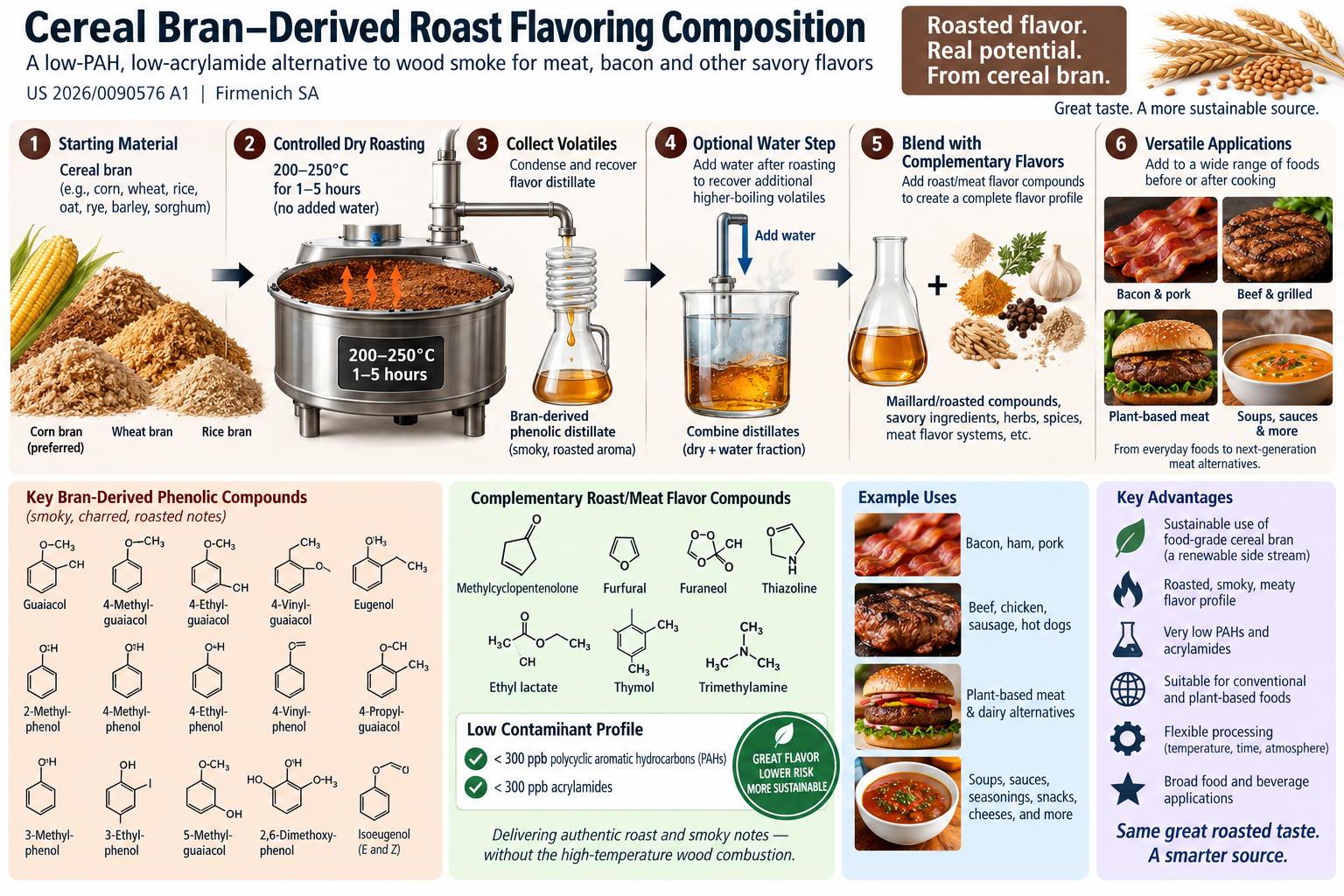
Below is a detailed technical summary of US 2026/0090576 A1, “Flavoring compositions having a roast aroma profile,” assigned to Firmenich SA. It has a September 21, 2022 priority date, was filed in the U.S. on September 14, 2023, and published April 2, 2026. The application is shown as pending. (Google Patents)
The important distinction is between the broad disclosure in the specification and the considerably narrower claims currently appearing in the U.S. publication.
1. Core inventive idea
The patent is essentially about making a natural-ish roast/smoke flavor from cereal bran instead of wood smoke.
Traditional smoke flavors are commonly produced by burning or pyrolyzing wood and condensing the smoke. That provides desirable smoky/roasted phenols, but high-temperature wood combustion can also generate undesirable polycyclic aromatic hydrocarbons, or PAHs, such as benzo[a]pyrene.
The inventors' alternative is:
cereal bran → controlled dry roasting → collect volatile phenolic distillate → optionally recover additional volatiles with water → blend the bran-derived phenols with other roast/meat flavor molecules.
The rationale is chemical. Cereal brans naturally contain ferulic acid, coumaric acid, sinapic acid and related phenylpropanoic acids. Heating these precursors generates phenolic compounds associated with smoke, char, grilled food and roasted meat aromas. Instead of wood-fire temperatures of roughly 600°C, the disclosed preferred treatment is around 200–250°C, particularly ≤235–240°C. (Google Patents)
The stated commercial objective is a roast flavor useful particularly for meat, bacon, pork and meat analogues while maintaining very low levels of PAHs and acrylamide. (Google Patents)
2. The flavor chemistry being protected
The patent divides the composition conceptually into two layers.
| Layer | Disclosed compounds | Function |
|---|---|---|
| Bran-derived phenolic roast/smoke layer | 2-methylphenol, 3-methylphenol, 4-methylphenol, 3-ethylphenol, 4-ethylphenol, guaiacol, 4-methylguaiacol, 5-methylguaiacol, 4-ethylguaiacol, 4-vinylguaiacol, eugenol, E-isoeugenol, Z-isoeugenol, 4-vinylphenol, 4-propylguaiacol, 2,6-dimethoxyphenol | Smoky, charred, roasted, cooked-meat aroma |
| Added second flavor layer | methylcyclopentenolone, “furfuryl” as stated in the patent, furfural, furaneol, thiazoline; additionally ethyl lactate, thymol and trimethylamine | Builds out or enhances the roast/meaty flavor |
The specification also says additional flavor materials can be incorporated, including dimethyl-, trimethyl-, ethylmethyl-, ethyldimethyl- and acetyl-pyrazines; furfuryl mercaptan; furfuryl thioacetate; methylfurfural; acetic acid; 2-methyl-3-furanthiol; tetrahydromethylfuranthiol; trimethylamine; and sotolone. (Google Patents)
So the disclosed concept is not merely “roasted bran.” It is more accurately:
a cereal-bran-derived phenolic smoke fraction used as a base and then augmented with known roast/Maillard/meaty aroma compounds.
An interesting detail is that the principal experimental analytical tables directly quantify 13 phenols, whereas the ultimate first-group list contains 16. The three additional listed compounds—4-vinylphenol, 4-propylguaiacol and 2,6-dimethoxyphenol—are part of the broader disclosure/claim language but are not part of the 13-compound principal experimental table. (Google Patents)
3. Contaminant limitation is central
The patent repeatedly emphasizes avoiding the toxicant profile associated with conventional smoke condensates.
The broad specification discusses compositions having less than 300 ppb PAH and/or acrylamide, with progressively preferred limits. It specifically discusses benzo[a]pyrene at:
<10 ppb, preferably <5, <4, <3, <2 or <1 ppb.
For acrylamide, preferred levels run from:
<300 ppb → <200 → <100 → <50 → <20 → <10 ppb. (Google Patents)
Importantly, the current U.S. independent claim is stricter than some of this descriptive language: claim 1 requires the composition to have both less than 300 ppb PAHs and less than 300 ppb acrylamides. It does not merely say “PAH or acrylamide.” (patents.google.com)
4. Bran starting materials
The disclosure is deliberately broad as to cereal source:
rice, corn, wheat, oat, rye, barley, sorghum and spelt bran.
The preferred group is rice, corn and wheat, with corn becoming the favored practical embodiment because it generated a strong phenolic yield, received the best sensory feedback, is widely available as a starch-industry side stream, and—unlike wheat—is not characterized by the inventors as a major allergen. (Google Patents)
At 235°C for five hours, the experiments reported total quantities of the 13 measured target phenols per 100 g bran of approximately:
| Bran | Total target phenols |
|---|---|
| Corn | 58.9 mg/100 g |
| Wheat | 32.4 mg/100 g |
| Rice | 27.3 mg/100 g |
| Spelt | ~18.9 mg/100 g |
| Rye | ~15.9 mg/100 g |
| Barley | ~11.0 mg/100 g |
| Sorghum | ~10.2 mg/100 g |
| Oat | ~4.2 mg/100 g |
Corn therefore generated more than twice the measured target phenols of rice under this particular experiment. It also had relatively substantial 4-ethylguaiacol and 4-vinylguaiacol, whereas guaiacol was especially dominant in rice-bran distillate. (Google Patents)
5. Disclosed manufacturing process
The principal process disclosed in the specification is:
| Stage | Disclosure |
|---|---|
| Starting material | Cereal bran |
| Initial treatment | Heat at 200–250°C |
| Time | 1–5 hours |
| Water during initial heating | No added/exogenous water |
| Volatile recovery | Collect resulting flavor composition/distillate |
| Blending | Add one or more second-group aroma compounds |
| Preferred temperature | 200–240°C; ≤235°C particularly favored |
| Atmosphere | Air or nitrogen flow can be used |
| Optional finishing step | After roasting, add water and recover a hydrodistillate; combine it with the earlier condensate |
| Recovery alternatives | Condensate, hydrodistillation or steam distillation |
The “no exogenous water” during the initial roasting is intentional. The inventors say water changes reaction chemistry and can affect both aroma generation and contaminant formation.
After dry roasting, however, water can deliberately be added. That later water addition is quite important experimentally: it strips out additional higher-boiling phenols that remained in the bran.
6. Why the post-roast water step matters
A representative experiment roasted 100 g of rice bran at 235°C for five hours.
During the five-hour dry heating period the researchers collected five sequential condensate fractions. They then added 20 mL water and continued distillation for another 30 minutes, generating a sixth fraction.
Total distillate was about 33 mL:
20.6 mL during the five dry-roasting hours, plus 12.4 mL after adding water.
The post-water fraction contained substantial additional 4-ethylphenol and 4-ethylguaiacol. The inventors attribute this at least partly to their relatively high boiling points and conclude that post-roast hydrodistillation can improve overall phenolic recovery. (Google Patents)
This is one of the more practically significant process teachings in the document: dry heat first to generate the chemistry, then use water afterward to strip otherwise poorly recovered flavor molecules.
7. Temperature and time findings
Phenol production generally increased with both time and temperature.
For rice bran heated for five hours, total measured target phenols increased from roughly:
7.6 mg at 200°C → 13.5 mg at 220°C → 23.2 mg at 225°C → 24.5 mg at 230°C → 27.3 mg at 235°C → 33.7 mg at 250°C, per 100 g bran.
Guaiacol was the main compound. At 235°C the guaiacol yield was approximately 17 mg/100 g, versus about 8.1 mg at 220°C. The other important contributors included 4-ethylphenol, 4-ethylguaiacol and 4-vinylguaiacol. (Google Patents)
Although 250°C gave greater chemical yield, the patent favors about 235°C, partly because the inventors wanted to remain below a temperature threshold they associated with “natural flavoring preparation” under the cited European regulatory framework. That is the patent's regulatory rationale, rather than an independent conclusion here. (Google Patents)
8. Effect of atmosphere and processing conditions
The researchers also tested atmosphere and pretreatment.
Gentle air flow and nitrogen flow both increased overall target-phenol formation relative to their reference trial.
Vacuum at roughly 100 mbar generally reduced overall production, but produced a striking exception: 4-vinylguaiacol increased roughly eightfold. The inventors hypothesize that the lower pressure allowed this relatively early reaction product to distill away before further degradation.
Pressure pretreatment with water or formic acid did not provide a sufficiently useful improvement and was not pursued. (Google Patents)
So the patent teaches not only a recipe but a means of shifting the phenolic profile through pressure and gas-flow conditions.
9. Toxicology/contaminant experimental result
The most important safety experiment used rice-bran distillates made at 235°C for five hours.
For the first five dry-roasting fractions:
benzo[a]pyrene: not detected, with a reported quantification limit of 0.5 µg/kg.
acrylamide: not detected, with a quantification limit of 10 µg/kg.
For the post-water hydrodistillate:
benzo[a]pyrene: again not detected.
acrylamide: 109 µg/kg, i.e. 109 ppb.
The patent contrasts that value with the cited 300-ppb EU benchmark for certain bran-containing breakfast cereals. It also reasons that because the flavor is added to finished foods only at relatively low levels, acrylamide in the final food would be further diluted. (Google Patents)
This data is the principal experimental basis for the patent's low-contaminant proposition.
10. Sensory results
Rice-, wheat- and corn-bran prototypes prepared by approximately 235°C/3-hour roasting followed by water addition and distillation were evaluated by flavorists.
All produced a recognizable roast character.
A tasting level around 500 ppm was indicated. Wheat and corn were preferred to rice, with corn overall preferred. (Google Patents)
The specification says these flavors can impart roast, charred or smoky notes to savory products, particularly meat flavors such as pork and bacon, but it also envisions uses such as whisky. (Google Patents)
11. Building the finished commercial flavor
Example 2 demonstrates that the bran distillate is intended as a platform rather than necessarily as the complete finished flavor.
The preferred corn-bran extract is supplemented with:
methylcyclopentenolone, “furfuryl,” furfural, furaneol, thiazoline, ethyl lactate, thymol and trimethylamine.
It can then be further formulated with yeast extract, organic acids such as tartaric/malic/citric/lactic acids or sodium diacetate/disuccinate, herbs, spices, garlic powder, onion powder and sugar-beet powder.
For target-specific applications, the roast base can also be combined with an existing ham, beef, chicken, turkey, hot-dog, burger or sausage flavor. (patents.google.com)
Conceptually, that gives a modular system:
bran smoke/char base + Maillard/roasted compounds + savory ingredients + target meat identity.
12. Food and beverage applications
The disclosure is extremely broad concerning possible end products. It encompasses seasonings and sauces, meat and seafood, soups, noodles/rice/pasta/potatoes, cheeses and fats, snacks, meat or dairy analogues, pet food and beverages.
The patent specifically contemplates both conventional meat and plant-based products.
For ordinary food incorporation, the specification gives extremely broad usage ranges from 0.001–1000 ppm, with 1–100 ppm stated as a most preferred range in one passage. Elsewhere, specific meat-substitute formulas use substantially larger percentages of a formulated flavor composition. (Google Patents)
The patent also prefers, in one embodiment, adding the roast flavor before the food itself is cooked, roasted or grilled, allowing the flavor to participate in the finished cooked sensory profile. (Google Patents)
13. Meat-alternative disclosure
A substantial portion of the specification supports meat-analogue applications.
It describes combining the roast composition with plant proteins such as pea, soy or wheat protein, plant fibers, non-animal fats, binders, umami materials, salts, masking/bitterness blockers, coloring agents and optional iron/heme systems.
Representative formulations include:
| Product | Disclosed formulation concept |
|---|---|
| Fillet/nugget/hot-dog analogue | 2–20% textured wheat/soy protein; 5–15% rapeseed/sunflower oil; 10–20% non-animal protein substitute; ≤2% salt; optional 0.3–1% cellulose fiber; 0.1–5% roast flavor composition; balance mainly water/additional flavors |
| Burger analogue | 10–20% textured wheat/soy protein; 5–10% rapeseed/sunflower oil; 5–15% coconut flakes; 0.3–1% salt; 0.1–5% flavor composition; balance mainly water/additional flavor |
Actual prototype examples include a vegan hot dog, vegan burger-type product and chicken nuggets. Products containing the roast composition were said to have more pleasurable roast aroma than corresponding controls without it. (patents.google.com)
14. What the CURRENT U.S. claims actually cover
This is probably the most important section if you are reviewing the document for patent scope.
The current U.S. claims shown on Google Patents run through claim 19, but many numbers are canceled. The operative claims shown are 1, 4, 7, 8, 9, 16, 18 and 19. (patents.google.com)
| Claim | Practical scope |
|---|---|
| 1 — Independent composition claim | A roast-like flavor composition having at least one specified first aroma compound obtained by roasting cereal bran, plus at least one second aroma compound selected from ethyl lactate, thymol, trimethylamine, methylcyclopentenolone, “furfuryl,” furfural, furaneol or thiazoline; and containing <300 ppb PAHs AND <300 ppb acrylamides. |
| 4 | Narrows claim 1 to <10 ppb PAHs. |
| 7 | Narrows the cereal bran of claim 1 to corn bran. |
| 8 | Narrows it to wheat bran. |
| 9 | Narrows it to rice bran. |
| 16 — Product claim | A flavored consumer product containing the claim-1 flavor composition. |
| 18 | Narrows claim 16 to 10–2000 mg/kg of the flavoring composition, equivalent to 10–2000 ppm by mass. |
| 19 — Method/use claim | A method of imparting roast aroma to a consumer product by introducing the claim-1 composition into it. |
Claims 2, 3, 5, 6, 10–15 and 17 are shown as canceled. (patents.google.com)
Why claim 1 is important
Claim 1 does not require all 16 first-group phenols. One qualifying bran-roast-derived member is sufficient as the minimum requirement, although a real composition can contain many of them.
Similarly, it does not require all eight second-group compounds. At least one qualifies.
But it does require a combination of the two categories. A cereal-bran phenolic extract by itself does not literally satisfy the wording of current claim 1 unless it also has the required second-group aroma compound.
It also contains what amounts to a product-by-process characteristic: the first aroma compound is specified as being obtained by roasting a cereal bran.
15. Broad specification versus current claims
This is where the patent becomes particularly interesting.
The international PCT version originally contained explicit claims covering:
use of the composition to provide roast aroma; a method of heating cereal bran at 200–250°C for 1–5 hours without added water; adding the second flavor compounds; heating under air or nitrogen; subsequent water addition and hydrodistillation; and condensate/hydro/steam-distillation recovery. (Google Patents)
In the current U.S. claim listing, claims 10–15 are canceled. Thus the detailed roasting/manufacturing process remains extensively disclosed in the specification, but there is no surviving independent U.S. manufacturing-process claim among the claims currently displayed. Instead, the main U.S. protection is centered on the resulting low-contaminant composition, consumer products containing it, and use of that composition to impart roast aroma. (patents.google.com)
That distinction matters greatly when reading the patent for competitive or freedom-to-operate purposes.
16. What I regard as the key disclosed inventive concepts
The patent's substantive technical teaching can be reduced to one integrated concept:
Use food-grade cereal bran as a renewable phenolic precursor source; roast it at controlled, relatively moderate temperatures without added water to thermally convert bran phenylpropanoic acids into smoke/roast phenols; collect those volatile products rather than generating smoke from wood; optionally add water afterward to recover residual higher-boiling phenolics; then augment the recovered phenolic fraction with complementary roast/Maillard/meaty flavor compounds to produce a low-PAH, low-acrylamide roast flavor suitable for meat, plant meat and other foods.
Several secondary ideas support that core invention: corn is the preferred commercial bran; gas flow can increase phenolic yield; pressure can manipulate the relative profile of specific compounds such as 4-vinylguaiacol; post-roast hydrodistillation boosts recovery; and the resultant base is intended to be modular, allowing formulation into bacon, pork, ham, beef, chicken, grilled, charred or smoke-type flavors.
Bottom line
This is not principally a patent on one bacon flavor formula. It is a platform patent around producing a smoke/roast phenolic flavor system from roasted cereal bran as an alternative to wood-derived liquid smoke, combining that natural roast fraction with additional aroma compounds, and keeping PAH/acrylamide levels low.
The potentially most commercially significant current U.S. claim is claim 1: bran-roast-derived specified phenol + one specified secondary aroma compound + <300 ppb PAH + <300 ppb acrylamide. Claims 7–9 specifically capture corn, wheat and rice versions; claim 16 reaches foods containing the composition; claim 18 captures the 10–2000 mg/kg usage range; and claim 19 reaches the act of using the composition to give a consumer product roast aroma. (patents.google.com)