Burn Risk - Part 3: Preventing Burning of a Reaction Flavor in a Production Environment
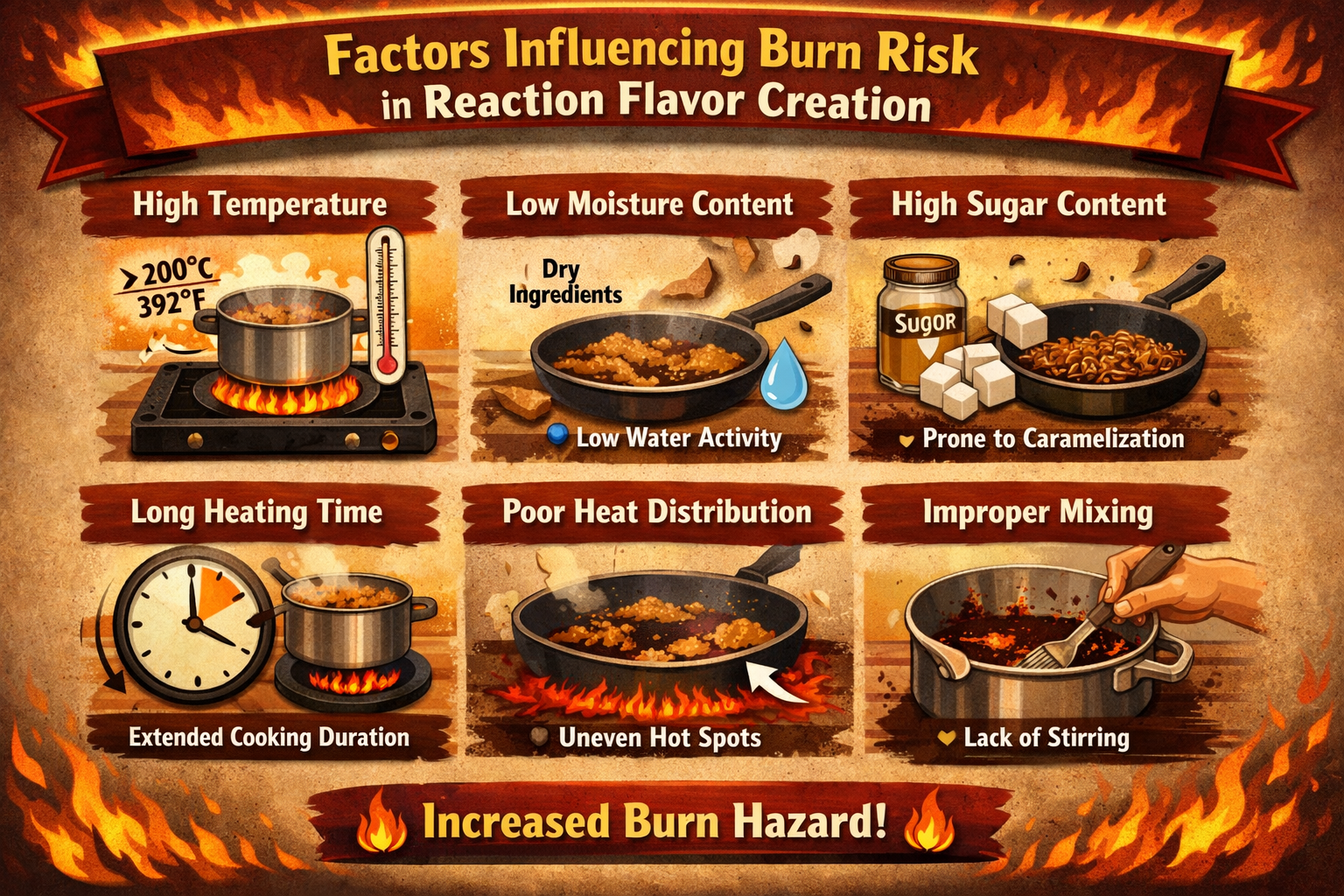
Refer to part 1 - model and part 2 - example model
 Editor
 Editor
Preventing Burning of a Reaction Flavor in a Production Environment
This production-focused guide is based on the roasted onion or savory sulfur reaction-flavor example, but the same logic also applies to meat, chicken, roasted vegetable, caramelized, and other thermal reaction flavors.
The goal is not merely to keep the reactor cooler. The goal is to control the system so that:
In plain language, prevent any small region of the reactor, especially near the wall, bottom, outlet, probe, or heat exchanger surface, from becoming hotter, more concentrated, and more stagnant than the rest of the batch.
1) Main causes of burning in production
In the onion reaction-flavor example, burning happens because of a combination of:
- high wall-film temperature
- high heat flux
- low mixing efficiency
- increasing viscosity
- local enrichment of sugars, amino compounds, and sulfur precursors
- excessive hold time
- possible oxygen ingress
- fouling that worsens heat transfer
Prevention therefore has to address both chemistry and engineering/process control.
2) Control wall-film temperature, not just bulk temperature
Operators often focus on bulk temperature because that is what the probe reads. But the bulk may be 116°C while the wall region behaves more like 128–132°C. Burning begins in that wall film.
What to do
- Lower jacket temperature, steam pressure, or thermal oil temperature
- Avoid sudden heating surges
- Use a smaller driving force instead of an aggressive jacket temperature
From the model:
If \(T_j - T_b\) is too large, heat flux rises, wall temperature rises, and film temperature rises. Since burn kinetics are Arrhenius-driven, even a small rise in film temperature can sharply increase burn rate.
3) Use staged heating rather than one aggressive heat-up
A reaction flavor should not normally be driven from ambient to final reaction severity in one fast ramp.
- Stage 1: dissolution / hydration of sugars, extracts, salts, buffers, and carriers
- Stage 2: controlled precursor development after the system becomes homogeneous
- Stage 3: finish reaction in a narrow high-temperature zone only as long as necessary
- Stage 4: quench or cool promptly
This reduces local concentration pockets, undissolved particles on hot walls, sudden exothermic bursts, sulfur degradation, and unnecessary burn-index accumulation.
4) Improve agitation so the wall film is refreshed continuously
In the predictive model, the wall film becomes dangerous when it is not refreshed fast enough. If fluid close to the wall sits there too long, it overheats and degrades.
What to do
- Use the right agitator for the rheology: anchor, helical ribbon, swept-wall design, or combination impeller systems
- Maintain sufficient agitation throughout the batch
- Pay attention to wall sweep, not just overall circulation
Improved mixing:
- increases \(h_b\)
- increases wall-film refresh rate \(k_m\)
- lowers \(T_w\) and \(T_f\)
- reduces local concentration enrichment
- reduces deposit buildup
A batch that looks well mixed from the top can still have dead zones near the bottom outlet, low-flow zones near baffles, stagnant material around probes, or hot films on the side wall.
5) Prevent viscosity from rising too early
Viscosity is one of the strongest burn-risk drivers because it reduces heat transfer and mixing.
- Avoid over-concentrating too early
- Delay concentration until after critical development stages if possible
- Track viscosity as a process variable, not just a lab property
As viscosity rises:
Create a viscosity map versus temperature, solids, time, and reaction extent, then define safe operating windows.
6) Prevent local concentration spikes of sulfur precursors and sugars
In onion and other sulfur reaction flavors, burning is caused not only by heat but also by local over-concentration of highly reactive components.
What to do
- Control order of addition
- Pre-dissolve or pre-slurry solids such as cysteine, methionine, sugars, and slowly wetting powders
- Add sensitive reactants only after the base is homogeneous
- Use dip pipes or submerged addition where appropriate
A common safe sequence is:
- water or solvent
- dissolve salts, carriers, and bulk solids
- hydrate proteins or extracts
- heat to an intermediate stage
- add sulfur precursor in a controlled way
- complete reaction development
The model uses a wall concentration term \(C_f\). Even if bulk concentration is acceptable, wall concentration can be much higher if addition is poor or if evaporation enriches the wall layer.
7) Keep oxygen under control
Some reaction flavors are mainly threatened by pyrolysis and over-Maillard development, but oxygen can worsen burning by promoting oxidative degradation.
- Use nitrogen blanketing where appropriate
- Reduce unnecessary headspace
- Avoid exposing hot finished flavor to air
Oxygen contributes to rancid-burnt side reactions, destruction of delicate sulfur balance, and formation of harsher oxidized volatiles.
8) Control hold time very tightly
A common production error is to assume the batch is safe once target temperature is reached. In reality, much of the burn damage accumulates during the high-temperature hold.
- Define a maximum safe hot-hold time
- End the reaction based on endpoint criteria, not habit
- Cool promptly after endpoint
In the model:
Even if \(T_f\) is only moderately high, a long hold makes \(BI\) accumulate until burning appears.
9) Build the process around safe heat-transfer limits
Production should define maximum acceptable values for variables linked to burn risk, such as:
- maximum jacket-to-bulk temperature difference
- minimum agitator speed at a given viscosity
- maximum safe solids before finishing stage
- maximum allowed hold time at final temperature
- maximum fill or minimum fill for proper mixing
- maximum steam pressure during sensitive phases
Theoretical models become useful only when translated into easy operating limits.
10) Prevent fouling before it starts
Burning and fouling reinforce each other. A small amount of burnt deposit on the wall becomes a seed for worse burning in the same batch and in later batches.
- Do not tolerate even light scorch film
- Validate cleaning thoroughly
- Inspect problem zones such as the bottom outlet, probe wells, baffle roots, upper wall splash zones, and recirculation heat exchangers
- Passivate and maintain stainless surfaces
A deposit layer changes local heat transfer, encourages stagnation, and increases the likelihood of repeated burning.
11) Manage reactor geometry and fill level correctly
A good formulation can still burn if run in the wrong vessel or at the wrong fill level.
- Stay within validated fill range
- Match vessel to batch size
- Evaluate dead zones through plant observation, trials, or CFD if needed
If vessel geometry defeats mixing, the model parameters worsen immediately.
12) Prevent problems during startup, interruption, and shutdown
Many scorch events occur outside normal steady-state operation.
Startup risks
- powders not fully wetted before heating
- hot wall before circulation is established
- reactive materials added too early
Interruption risks
- agitator stops while heat remains on
- power dips allow material to settle on hot surfaces
- delayed transfer leaves the batch hot too long
Shutdown risks
- slow cooling
- transfer to a hot hold tank
- exposure to air after vacuum concentration
Use heat-input interlocks tied to agitator operation, require full mixing before heat-up, specify response procedures for unplanned stoppages, and define maximum delay time before emergency cooling.
13) Use raw-material control to reduce burn sensitivity
Not all burning problems come from equipment. Some batches are more sensitive because raw materials vary.
Variables that strongly affect burn risk include reducing sugar profile, cysteine purity, sulfur source reactivity, metal contamination, yeast extract composition, particle size, moisture content, and oxidation state of raw materials.
- Tighten specifications
- Revalidate the process when suppliers change
The chemistry side of the model depends on \(k_b\), \(E_b\), \(n\), and precursor concentration, and raw-material variability shifts all of them in practice.
14) Control pH carefully
For many reaction flavors, pH shifts reaction speed and pathway balance dramatically. In onion and sulfur systems, high pH can accelerate Maillard darkening, sulfur breakdown, and harsh burnt or rubbery notes.
- Define a validated pH window
- Add acid or alkali slowly under strong mixing
- Verify pH after equilibration
- Watch for residual caustic after cleaning
15) Use endpoint monitoring, not only temperature recipes
Temperature and time alone are often too crude. Better endpoint tools include:
- sensory checkpoints on retained samples
- color or absorbance monitoring
- viscosity trend
- specific marker compounds
- online torque trend
- off-gas monitoring in advanced systems
Two batches with the same time-temperature profile may differ due to raw materials, mixing, fill, or heat-transfer performance.
16) Convert the predictive model into plant action
The model should drive practical decisions. For example, if bulk temperature is on target but viscosity rises above expected level, the jacket-to-bulk difference remains high, and color develops too quickly, then the system should reduce jacket temperature, increase agitation if possible, shorten hold, cool earlier, and avoid adding any remaining sulfur-sensitive ingredient.
If batch size is reduced below normal, mixing pattern changes and wall-film refresh worsens. Do not run the normal heat profile unchanged. Lower heat input and validate mixing first.
17) Example production strategy for the onion reaction flavor
Before heating
- pre-slurry or fully dissolve sugars and sulfur precursors
- confirm no clumps or settled solids
- verify correct fill range
- verify reactor cleanliness and no residual fouling
- verify calibrated temperature probes
During dissolution
- use moderate jacket temperature
- establish full mixing before aggressive heat-up
- do not add cysteine into a hot poorly mixed batch
During reaction development
- use staged ramping
- monitor bulk temperature, jacket temperature, viscosity, and color
- keep jacket-to-bulk difference within a defined limit
- maintain sufficient agitation as viscosity rises
During final hold
- keep hold as short as needed
- avoid production delays
- protect from oxygen if relevant
- use endpoint markers, not only clock time
At endpoint
- cool quickly
- transfer promptly
- do not leave hot product waiting
After batch
- inspect for wall film or dark residue
- treat any residue as a process warning, not just a cleaning issue
18) Most effective interventions, ranked
First-tier controls
- lower jacket aggressiveness
- improve wall mixing or agitation
- reduce final hold time
- control addition sequence
- prevent early viscosity rise
Second-tier controls
- improve oxygen control
- tighten pH control
- reduce local concentration spikes
- validate fill range and vessel suitability
- improve cleaning and fouling management
Third-tier controls
- refine kinetics model
- install more sensors
- use CFD or pilot heat-transfer studies for difficult systems
- automate alarms around burn-risk variables
19) What good prevention looks like
A plant has good burn prevention when:
- the reactor never develops visible scorch film
- batch-to-batch color and aroma are tight
- sulfur notes stay balanced, not rubbery or cabbage-burnt
- viscosity rise is anticipated and managed
- endpoint is reached consistently without long hot holding
- operators know which variables matter and what action to take
- formulation, equipment, and SOPs are aligned
20) Final principle
The best way to prevent burning of a reaction flavor in production is to manage the reactor so that heat is introduced gently, the wall film is constantly renewed, reactive components are never locally concentrated, viscosity is controlled, high-temperature exposure is as short as possible, and fouling is never allowed to develop.
In one sentence: