Refractometers: What flavorists need to know
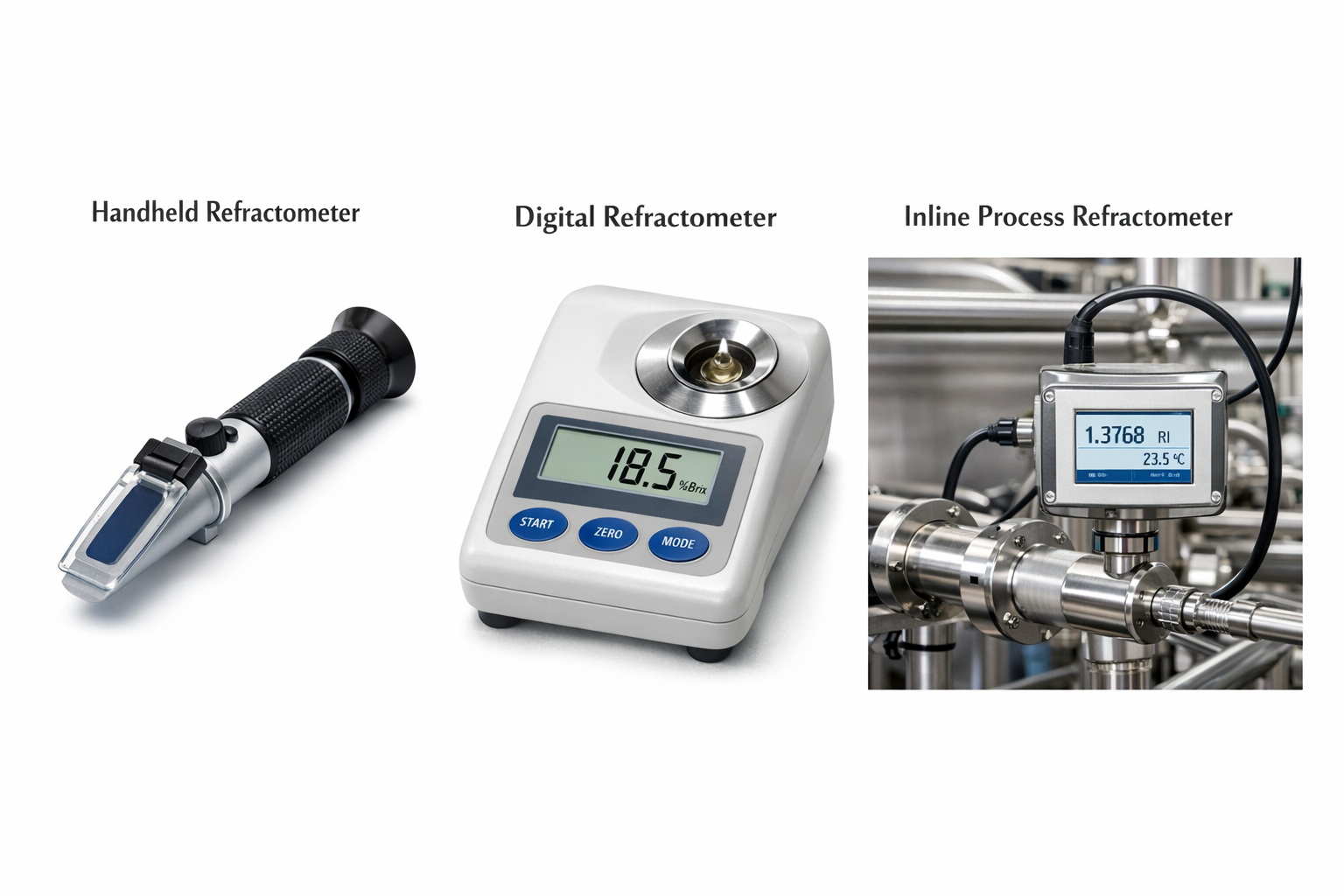
This article is intended for flavorist trainees or QC technicians who have not taken college courses such as Analytical Chemistry or Food Analysis, and who lack formal training in these areas.
The Society of Flavor Chemists requires certified flavorists to understand refractometers, including:their theory, function, and proper reporting;their relevance to the flavor industry; andtheir advantages and limitations.


It is important to note that refractometers are originally specifically designed to measure sugar solutions. A reading of 1 degree Brix corresponds to a 1% sugar concentration, as the instrument is calibrated to directly reflect the sugar content. However, refractometers can also be used to estimate the total dissolved solids in other types of solutions. In such cases, the reading does not directly represent the actual solids percentage, because the dissolved solids may consist of non-sugar materials with different refractive indices. To obtain the true dry solids content, the Brix reading must be converted using a material-specific conversion factor.
Refractometers measuring Refractive Index and Brix are essential tools in the flavor and food industry for quantifying sugar content . They work by measuring how light bends through a liquid, providing a rapid and reliable assessment of sweetness and overall quality.
Here is a detailed breakdown of their theory, relevance, and advantages and limitations.
| Aspect | Description | Key Details |
|---|---|---|
| Theory & Function | Measures the refractive index (how much light bends) to determine the concentration of dissolved solids. | Output: Measured in Brix degrees (°Bx), approximating the percentage of sugar by weight. Standard: Based on official ICUMSA methods tables. Temp Control: Often includes Automatic Temperature Compensation (ATC) to maintain accuracy despite temperature fluctuations. |
| Relevance to Flavor Industry | Critical for quality control , process management, and product development across various sectors. | Applications: Raw material inspection (checking fruit ripeness ), fermentation monitoring in winemaking/brewing, final product consistency checks, and blending operations to ensure correct syrup dilution. |
| Advantages | Fast, easy-to-use, requires minimal sample, durable, and affordable. | Results in seconds; usable by non-specialists after basic training; requires only 2-3 drops of sample. |
| Limitations | Not sugar-specific ; measurement is affected by temperature and sample condition (like pulp or bubbles); requires regular calibration. | Measures total dissolved solids , not just sugar content. Accuracy depends on a clean, clear sample and proper calibration with distilled water. |
1. Theory, Function, and Reporting of Refractometers
Theory and Function: The Principle of Refraction
- A refractometer operates on the scientific principle of light refraction. When light passes from one medium to another (e.g., from a liquid sample into the glass prism of the refractometer), it bends, or refracts.
- The key relationship is that as the concentration of dissolved solids (like sugar) in a solution increases, the solution becomes denser, and its refractive index increases proportionally . The instrument measures this angle of refraction to determine the concentration.
- To visualize this, think of a pencil in a glass of water. The pencil appears bent at the waterline. If you dissolve a large amount of sugar in the water, the pencil will appear even more bent. A refractometer makes this phenomenon measurable and quantifiable.
Reporting: Brix as a Standard Unit
- The measurement is reported in Brix degrees (°Bx) . One degree Brix is equivalent to approximately 1 gram of sucrose (sugar) in 100 grams of solution, representing the percentage of sugar by weight.
- While Brix is calibrated using pure sucrose solutions, it is widely used to estimate the total soluble solids in complex mixtures like fruit juices, which contain fructose, glucose, acids, and other compounds. In these cases, it's often referred to as "Apparent Brix".
- The conversion from refractive index to Brix is based on standardized tables established by the International Commission for Uniform Methods of Sugar Analysis (ICUMSA ).
- Most modern refractometers include Automatic Temperature Compensation (ATC) . This is critical because the refractive index is highly sensitive to temperature changes . ATC ensures the reading is adjusted to what it would be at a standard reference temperature (usually 20°C), providing an accurate result even if the sample temperature fluctuates.
2. Relevance to the Flavor Industry
The refractometer is an indispensable tool throughout the flavor and food production chain, from farm to finished product.
- Raw Material Quality and Sourcing: For fruits and vegetables, the Brix value is a direct indicator of ripeness and sweetness . Growers and processors use it to determine the optimal harvest time, ensuring the best possible flavor from the start. For example, a grape grower will track Brix levels in the vineyard to decide exactly when to pick the grapes for winemaking.
- Process Control and Fermentation: In manufacturing, refractometers are used to monitor critical steps.
- Beverage Production: They ensure the correct dilution ratio of syrups and concentrates, guaranteeing that every batch of a soft drink has a consistent and targeted sweetness and flavor profile. This precise control also helps manage costs by maximizing the yield from expensive ingredients.
- Wine and Brewing: Winemakers use Brix readings to monitor the sugar content in grape must, which allows them to predict the potential alcohol content of the finished wine. Similarly, brewers use it to track the fermentation process.
- Final Product Consistency and Quality Assurance: Quality control labs rely on refractometers to verify that finished products meet their specifications. Whether it's checking the sugar concentration in jams, the solids in sauces, or the purity of honey, a quick Brix test confirms product consistency and compliance with labeling standards. In honey production, for instance, a refractometer ensures the product has the correct moisture content for quality and shelf stability.
3. Advantages and Limitations
Advantages of Using a Refractometer
- Speed and Efficiency: Measurements are almost instantaneous, typically providing a result in seconds. This allows for high-throughput testing in production environments.
- Ease of Use: Refractometers are very user-friendly. With minimal training, operators can obtain reliable readings. Many models, especially handheld optical ones, have no buttons or complex menus.
- Minimal Sample Required: They need only a very small sample volume—often just 2-3 drops —which is ideal when sample material is limited or valuable.
- Portability and Durability: Handheld models are compact, battery-free (for optical versions), and rugged, making them perfect for field use in vineyards, orchards, or on the production floor.
- Cost-Effective: Basic optical refractometers are relatively inexpensive, offering a highly affordable solution for sugar analysis.
Limitations to Consider
- Lack of Specificity: A refractometer measures total dissolved solids . It cannot distinguish between different types of solids. For example, it will read the presence of sugar and salt in a solution as a combined Brix value, potentially overestimating the actual sugar content.
- Temperature Sensitivity: Even with ATC, large temperature differences between the sample and the instrument's compensation range can introduce errors. For maximum accuracy, samples should be allowed to equilibrate toward room temperature.
- Sample Interference: The sample must be clear and free of particles. Pulp, seeds, or air bubbles can scatter light and make the shadow boundary (the reading line) fuzzy or indistinct, leading to inaccurate results. Filtration or degassing may be necessary.
- Not Suitable for All Products: In fermented products like wine or beer, the presence of alcohol interferes with the refractive index, making it difficult to measure residual sugar directly without complex calculations or correction tables.
- Calibration is Essential: For accurate readings, the instrument must be regularly calibrated, typically with distilled water, to set a "zero" point. Failure to do so will result in systematic errors.
In summary, the refractometer is a cornerstone of quality control in the flavor industry. Its ability to provide a fast, simple, and reliable proxy for sweetness makes it invaluable, provided its limitations are understood and managed through proper use and calibration.
A more concise version
What is a Refractometer?
A refractometer is a common analytical instrument, particularly in the food, beverage, and flavor industries. It is primarily used to measure the sugar or total solids content in a liquid product.
What it does
A refractometer measures how much light bends (refracts) when it passes through a liquid. This bending is expressed as the refractive index (RI).
Why that matters
The refractive index changes depending on what’s dissolved in the liquid. So it’s used as a quick way to estimate composition.
Common uses
- Sugar content (°Brix) in juices, syrups, soft drinks
- Quality control for flavor concentrates and essential oils
- Purity/consistency checks of raw materials
- Detecting dilution or adulteration
How it works (simple view)
- Place a drop of liquid on the prism
- Light passes through it
- The instrument measures the angle of refraction
- It converts that into:
- Refractive index (e.g., 1.3330)
- Or °Brix (e.g., 12.5%)
Types
- Handheld refractometer – quick field measurements
- Digital refractometer – more precise, automatic temperature compensation
- Inline/process refractometer – continuous monitoring in production
In flavor work specifically
Refractometers are useful for:
- Checking batch-to-batch consistency of flavor solutions
- Estimating solvent ratios (e.g., ethanol/water systems)
- Monitoring concentration after evaporation or dilution
Limitations
Refractometers are very useful—but they’re also easy to misuse if you don’t understand their limits, especially in flavor systems. Here are the key limitations, with practical context for flavor work:
1) Non-specific measurement (biggest limitation)
A refractometer measures total refractive index, not what is causing it.
- Different compounds can give the same RI
- It cannot distinguish:
- sugar vs. alcohol vs. acids vs. aroma chemicals
- In flavors (complex mixtures), RI is not compositional
👉 Example:
A solution of ethanol + water and a sugar syrup could show similar RI values.
2) °Brix is only valid for pure sucrose systems
The °Brix scale assumes the solution behaves like sucrose in water.
- In real products (juice, flavors, syrups):
- acids, salts, polyols, flavors all distort readings
- Result: “apparent Brix” ≠ true sugar content
👉 In flavor concentrates, °Brix is often meaningless unless calibrated.
3) Insensitive to small compositional changes
- RI changes are often very small
- Minor variations in composition may not be detectable
👉 Not suitable for:
- Trace impurity detection
- Low-level degradation monitoring
4) Temperature dependence
Refractive index is highly temperature-sensitive
- Even a few °C can shift readings significantly
- ATC (automatic temperature compensation) helps, but:
- Only accurate within a certain range
- Assumes simple systems (often water-based)
👉 In essential oils or solvents, ATC may be less reliable.
5) Poor performance with complex mixtures (like flavors)
Flavor systems often contain:
- ethanol
- water
- esters
- terpenes
- aldehydes
These mixtures:
- Do not follow linear mixing rules
- Show non-ideal refractive behavior
👉 Result: RI cannot be directly converted into composition.
6) Cannot identify individual compounds
Unlike:
- Gas Chromatography (GC)
- Mass Spectrometry (MS)
A refractometer:
- Gives one bulk number only
- No molecular-level information
7) Affected by volatile components
In flavor work:
- Volatile compounds (e.g., terpenes, esters) can:
- evaporate during measurement
- change RI over time
👉 Leads to poor reproducibility if not handled quickly.
8) Requires clean, homogeneous samples
Problems occur if:
- sample is cloudy
- contains emulsions
- has suspended particles
👉 Light scattering → inaccurate readings
9) Limited usefulness for oils and essential oils
While RI is used for identity checks:
- Many oils have overlapping RI ranges
- Oxidation or aging may cause only small RI changes
👉 Cannot reliably detect:
- oxidation level
- adulteration (unless extreme)
10) Calibration dependency
- Needs proper calibration (usually with water or standards)
- Drift or contamination → systematic errors
11) Non-linear behavior in mixed solvents
Example:
- Ethanol + water mixtures show non-linear RI vs. concentration
- Add flavors → even more deviation
👉 Simple calculations become unreliable.
Practical takeaway (for flavorists)
Refractometer is best used for:
- Quick QC checks
- Batch consistency
- Relative comparisons (same formulation)
Not suitable for:
- Determining exact composition
- Detecting specific degradation pathways
- Complex formulation analysis
Advantages
Refractometers are widely used in labs, production, and quality control because they offer several advantages compared with other analytical methods. Here’s a detailed list:
1) Quick and easy measurement
- Only a small sample is needed (a few drops)
- Results are instant — no long preparation or reaction time
Example: Checking °Brix in juice can take just a few seconds.
2) Non-destructive
- The sample is usually recovered after testing
- Good for precious or limited samples
Example: Essential oils or expensive flavor concentrates can be measured without waste.
3) Portable and versatile
- Handheld versions allow field measurements
- Digital versions offer lab convenience
- Inline/process models enable continuous production monitoring
4) High sensitivity
- Can detect small changes in concentration
- Useful for consistency monitoring in formulations
5) Simple to operate
- Minimal training required, especially for handheld and digital models
- No reagents or complex calibration (other than a standard)
6) Low maintenance
- No moving parts in optical models
- Few consumables, unlike titrations or chromatography
7) Wide applicability
- Measures sugars, salts, alcohol, and general solute concentration
- Used in:
- Food & beverage
- Flavors & fragrances
- Pharmaceuticals
- Chemical processes
8) Small sample size
- Only a few microliters to milliliters needed
- Reduces waste and cost
9) Temperature compensation (digital models)
- Modern devices automatically adjust for temperature variations
- Improves accuracy in real-world conditions
10) Cost-effective
- Lower price than high-end instruments like GC or HPLC
- Simple optical refractometers can last many years
✅ Summary
Refractometers are fast, easy, and reliable for relative concentration measurements, quality checks, and process monitoring. Their combination of low sample volume, portability, and simplicity makes them very appealing in flavor labs, juice production, and industrial processes.
###