South America Food & Flavor Regulatory Intelligence Digest (June 27–July 13, 2026)
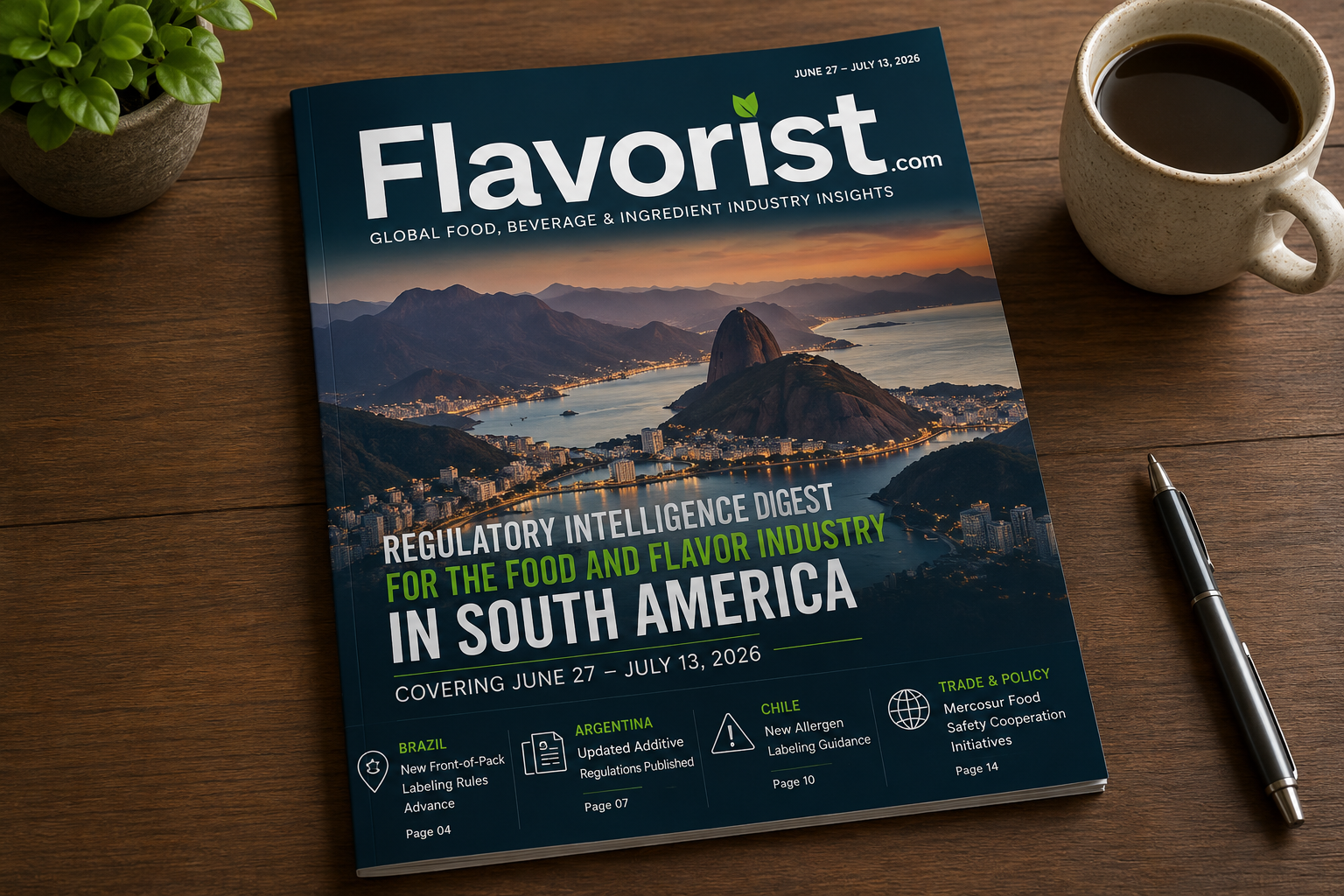
Here is a regulatory intelligence digest for the food and flavor industry in South America covering June 27 – July 13, 2026, based on searches of official government sources (ANVISA, MAPA, ANMAT, SENASA, boletines oficiales) and specialist regulatory reporting. Items are grouped by country, each with a summary and a link to the source.
Brazil
1. ANVISA board approves new rulemaking and 90-day public consultations on food labeling (RDC 727/2022) — July 8, 2026 At its 12th Ordinary Public Meeting of 2026, ANVISA's Collegiate Board (Dicol) approved the opening of regulatory processes and public consultations to amend RDC 727/2022 (general labeling of packaged foods), covering three topics: requirements for the quantitative declaration of ingredients (QUID), the use of technologies for transmitting information on food labels (e.g., digital/QR-type solutions), and revision of the rules on labeling of irradiated foods. The board authorized public consultations on all three topics with a 90-day comment period. This is a major development: QUID rules would force ingredient-percentage disclosure on labels, and digital-labeling rules could reshape how flavor/additive information is communicated to consumers. Sources: ANVISA official news release | Jornal de Brasília coverage | Dicol meeting agenda (PDF)
2. Close of ANVISA Public Consultation 1.394/2026 on food additives and processing aids — July 6, 2026 The comment window for CP 1.394/2026, which proposes a broad amendment of IN 211/2023 (the positive list of food additives and processing aids), ran from May 7 to July 6, 2026. The proposal includes revision of authorized technological functions for food additives, updates to maximum use limits, inclusion/exclusion/adjustment of permitted substances, and revision of conditions of use for processing aids, aiming at closer alignment with international references. The consultation closing inside this window means ANVISA will now consolidate contributions into a final normative instruction — a high-impact file for flavor houses and ingredient suppliers (IN 211 governs flavorings' carriers, antioxidants, emulsifiers, etc.). Source: Intertox summary of CP 1.394/2026
3. MAPA extends compliance deadline for the Mercosur strawberry identity-and-quality standard to February 2027 (Portaria nº 923/2026) — announced June 30, 2026 After strong pushback from producers and Congress against Portaria MAPA nº 886/2026 (which internalized the Mercosur strawberry RTIQ, Res. GMC 11/23, with millimetric caliber classification, defect tolerances and mandatory lot/origin/caliber labeling), the Ministry of Agriculture presented Portaria nº 923/2026, published in the Diário Oficial da União, extending the deadline for compliance with the strawberry rules until February 2027; the confirmation came in a June 30 meeting in Brasília with the Agriculture Minister, after the ministry had earlier suspended application of the norm for 60 days. Relevant to fruit suppliers, fruit-preparation and flavor ingredient chains sourcing Brazilian strawberries. Source: Report on Portaria 923/2026 deadline extension | Background: CompreRural on Portaria 886/2026
4. MAPA Portaria nº 925/2026 — annual update of agricultural-defense fines (published ~June 26, 2026, effective at window start) Portaria MAPA nº 925, of June 24, 2026, published in an extra edition of the DOU, provides for the annual inflation adjustment (based on the INPC index) of the fines set out in the Annex to Law nº 14.515/2022 — the law governing self-control programs and agricultural-defense enforcement. Food companies under MAPA inspection (meat, dairy, beverages, plant products) face proportionally higher penalty exposure from this window onward. Source: Fukuma Advogados regulatory bulletin
5. MAPA public consultations closing in the window (phytosanitary/veterinary, supply-chain relevance) Two MAPA consultations affecting food supply chains closed or approached closure in the period: the consultation on a proposed Portaria instituting the National Program for Prevention and Control of Bacterial Canker of Grapevine (Xanthomonas), open May 13 – July 13, 2026, and the consultation on the technical regulation for registration of generic and interchangeable similar veterinary medicines, running May 29 – July 15, 2026. The grapevine program affects grape, juice and wine-derivative raw-material availability; the veterinary-medicines rule affects residue management in animal-derived food ingredients. Source: MAPA public consultations page
6. ANVISA sector workshops on labeling of flavorings and colorants — late June/early July 2026 Directly relevant to the flavor industry: ANVISA circulated materials on the labeling of flavorings and colorants in packaged foods, describing the goal as improving the clarity and usefulness of consumer information for flavorings and colorants, with internal workshops during June and external workshops scheduled for late June and early July; the process includes technical contributions from ABIFRA (the Brazilian flavor and fragrance association), signaling active flavor-sector engagement in a rulemaking that may eventually change how flavorings, colorants and compound ingredients are declared on Brazilian labels. Source: Flavorist South America Regulatory Intelligence Report
Argentina
7. Joint Resolution 7/2026 — new Mercosur UHT milk technical regulation incorporated into the Argentine Food Code — published July 7, 2026 ANMAT announced that, through Joint Resolution 7/2026 (ANMAT and the Agriculture Secretariat), Argentina incorporated Mercosur GMC Resolution 13/23, the Mercosur Technical Regulation of identity and quality for UHT (UAT) milk, into national law, replacing Article 560 bis of the Código Alimentario Argentino. The update revises the definition, classification and sales denominations of UHT milk (whole, semi-skimmed, skimmed), sets harmonized compositional, physicochemical, microbiological, sensory, hygiene, packaging and labeling requirements, defines the authorized additives and reference analytical/sampling methods, and repeals GMC Resolutions 78/94 and 135/96. High relevance for dairy processors and suppliers of stabilizers/flavors used in UHT dairy across Mercosur. Sources: ANMAT news release (July 7, 2026) | Boletín Oficial – Resolución Conjunta 7/2026 | CIRA text summary
8. ANMAT updates the list of substances subject to special control — June 29, 2026 ANMAT published an update to its list of substances subject to special fiscalization (controlled substances). While primarily pharmaceutical, this list matters for dietary-supplement and botanical-ingredient companies, since substances on it cannot be used in foods/supplements and trigger enhanced import and handling controls. Source: ANMAT news release (June 29, 2026)
9. SENASA Resolution 592/2026 — modernization of inspection/fiscalization procedures — early July 2026 Regional regulatory monitoring reported that SENASA continued updating its rules to modernize its inspection processes through Resolution 592/2026, entering into force the day after publication. SENASA oversees agri-food establishments and primary products, so procedural changes affect audits and certifications for exporters and ingredient suppliers. Source: Latam Regulatory News (Budnik)
Mercosur / regional (context for the window)
10. Continued national incorporation of Mercosur food standards The Argentine UHT milk measure (item 7) is part of an accelerated wave of Mercosur harmonization visible just before and during the window: in June, Argentina had incorporated updated Mercosur inorganic-contaminant limits (arsenic in rice, Joint Resolution 4/2026) and the Mercosur rule permitting starches in very-high-moisture cheeses (Joint Resolution 5/2026), plus updated food-contact packaging rules for plastics and cellulosic materials (Joint Resolution 6/2026, incorporating GMC Res. 19/21, 20/21 and 21/21). Companies should expect parallel internalization steps in Brazil, Paraguay and Uruguay in coming months. Sources: ANMAT/La Nueva summary of RC 4 & 5/2026 | ANMAT release on food-contact packaging (RC 6/2026)
Colombia (active watch item during the window)
11. Front-of-pack "ULTRAPROCESADO" warning-label resolution still pending — decisive phase No final resolution was issued in the June 27–July 13 window, but this remains the region's most consequential open rulemaking. The MinSalud draft proposes to expressly repeal Resolution 810 of 2021 (as amended by Resolution 2492/2022 and corrected by Resolution 254/2023) and replace it with a unified technical regulation that keeps the octagonal warning seals for critical nutrients while adding a new "ultraprocessed" warning and microseals for small packages. During May–June, civil-society groups (Red PaPaz, FIAN, academics) urged the ministry to finalize the resolution and keep the implementation deadlines planned for August 2027, while industry (ANDI, ASOLECHE, CEJ) filed extensive objections. Any product with sweeteners, flavors or additives sold in Colombia could require full label redesign if adopted. Sources: ConsultorSalud analysis of the draft | El País – civil society support | Draft resolution text (PDF)
Chile
No new food regulation was published in the Diario Oficial in this specific window based on my searches. The dominant compliance story remains implementation of the February–March 2026 overhaul of the Reglamento Sanitario de los Alimentos (D.S. 977/96), which shifts enforcement from visual/structural checks toward documented risk-control systems — mandatory documented traceability, verifiable cleaning programs, recorded staff training, refrigerated-transport controls and systematic GMP/HACCP implementation. Companies selling into Chile were actively adapting during July. Sources: InfoSalmon analysis of the 2026 RSA update | Consolidated RSA text updated March 6, 2026 (PDF)
Notes on completeness
- The window was scanned across ANVISA, MAPA, ANMAT/Boletín Oficial, SENASA, Chile Minsal/Diario Oficial, Colombia MinSalud/INVIMA, Peru DIGESA/Congress, Ecuador ARCSA, and Mercosur normative databases, plus specialist trackers (Fukuma, Flavorist, Latam Regulatory News, Food Compliance International). The highest-impact confirmed releases inside June 27–July 13, 2026 are the ANVISA labeling rulemaking package (July 8), the close of Brazil's food-additive consultation CP 1.394/2026 (July 6), Argentina's UHT milk regulation (July 7), and Brazil's strawberry-standard deadline extension (June 30).
- Peru, Ecuador, Uruguay, Paraguay and Bolivia showed no major national food regulations published in this exact window in my searches; their most relevant activity (e.g., Ecuador's ARCSA processed-foods normative effective February 2026, Peru's octagon-labeling bill in Congress) predates or postdates the period.
###