Salting Out in Flavor Chemistry: What the SFC Requires Flavorists to Know
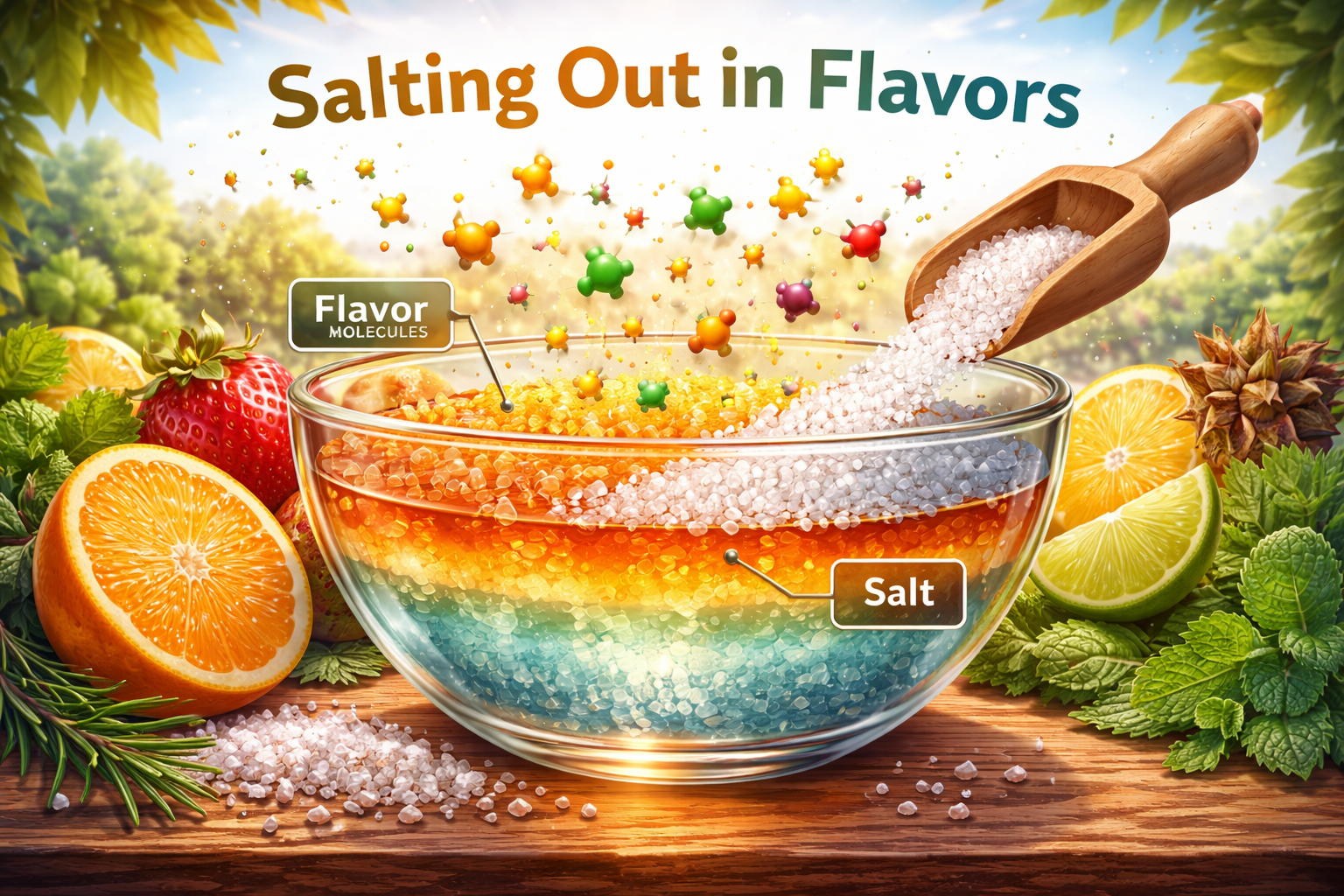
The Society of Flavor Chemists requires flavorists to fully understand approximately two dozen reactions and processes that can occur in flavor systems. Flavorists must be able to control these reactions or physical processes to enhance flavor or improve its stability and shelf life. "Salting out" is one of the physical processes included among these two dozen reactions and processes.
Below is a flavorist-level, SFC exam–aligned deep dive on “Salting Out”—structured exactly to match how candidates are evaluated (mechanism → control → application → shelf-life impact).
This presentation includes 1) the basics about "salting out", 2) a salting out decision tree, and 3) 40 industrial salting out cases.
Salting Out in Flavor Chemistry
(Physical–chemical phase behavior driven by ionic strength and water structuring)
1. Chemical Groups Involved & Conditions Required
Core Mechanism
Salting out is governed by Hofmeister Series effects:
- Salts compete with solutes for water molecules
- Reduce water availability for solvation of organics
- Result: decreased solubility of hydrophobic or semi-polar compounds
Key Chemical Groups Affected
A. Hydrophobic / Low-Polarity Compounds (Strongly Salted Out)
- Terpenes (limonene, pinene)
- Hydrocarbons
- Long-chain esters
- Lactones (γ-decalactone, δ-dodecalactone)
Reason: Minimal polarity → rely on weak hydration → easily displaced
B. Moderately Polar Aroma Compounds (Conditionally Salted Out)
- Esters (ethyl butyrate, isoamyl acetate)
- Aldehydes (hexanal, citral)
- Ketones (ionones)
Behavior depends on:
- Dipole moment
- Hydrogen bonding capability
C. Highly Polar / Hydrophilic Compounds (Weak or No Salting Out)
- Alcohols (ethanol, glycerol)
- Organic acids (acetic acid)
- Sugars
Reason: Strong hydration shells resist salt competition
D. Functional Groups Most Sensitive
- Nonpolar alkyl chains ↑ salting out
- Weakly polar carbonyls (esters, aldehydes)
- Aromatic rings (π systems)
Salts Commonly Involved
- NaCl (most common in food)
- KCl
- CaCl₂ (stronger salting-out effect)
- MgSO₄ (very strong dehydrating salt)
Order of salting-out strength (typical):
MgSO₄ > CaCl₂ > NaCl > KCl
Conditions Required
- High ionic strength (≥0.5–1.0 M salt typical)
- Aqueous system (continuous phase must be water)
- Presence of partially soluble organics
- Temperature-dependent:
- Lower temp → stronger salting-out effect
2. Factors Accelerating or Inhibiting the Process
Accelerating Factors
A. Salt Concentration
- Primary driver
- Nonlinear effect at high concentrations
B. Ion Type (Hofmeister Effects)
- “Kosmotropic” ions (structure makers) enhance salting out:
- SO₄²⁻, Mg²⁺
C. Temperature Decrease
- Lower temperature → reduced solubility → stronger effect
D. Hydrophobicity of Flavor Compounds
- Higher logP → stronger salting out
E. Low Ethanol Content
- Ethanol increases solubility → reduces salting out
Inhibiting Factors
A. Co-solvents
- Ethanol, propylene glycol
- Increase organic solubility → suppress salting out
B. Emulsifiers
- lecithin
- gum arabic
- modified starch
→ Stabilize dispersed oil phase
C. High Sugar Content
- Competes for water but does not reduce organic solubility as efficiently as salts
- Can sometimes counteract salting-out via viscosity increase
D. pH Effects
- Ionizable compounds (acids, phenols):
- Ionized form = more soluble → less salting out
Formulation Considerations
- Balance between:
- Ionic strength
- Emulsification system
- Co-solvent level
- Monitor:
- Cloud point
- Phase separation kinetics
- Flavor partition coefficient
3. Examples of Salting-Out in Flavor Systems
Example 1: Citrus Beverage (Classic Case)
- System: Orange drink with NaCl (sports drink or savory citrus)
- Effect:
- Limonene solubility decreases
- Oil droplets grow → cloud instability
Outcome:
- Flavor becomes:
- Less uniform
- More “top-note burst” (due to volatilization)
Example 2: Pickle Brine Flavor
- High NaCl (3–10%)
- Volatiles (dill oil, garlic sulfides):
- Partition into headspace more efficiently
Impact:
- Strong aroma release when opening jar
Example 3: Flavor Extraction (Analytical / Industrial)
- Adding salt to aqueous extract:
- Forces volatiles into organic solvent phase
Used in:
- GC sample prep
- Essential oil recovery
Example 4: Dairy Systems
- Salted butter / cheese:
- Alters partitioning of diacetyl and lactones
Result:
- Enhanced aroma perception despite same concentration
Example 5: Alcoholic Beverages
- In low-ethanol systems:
- Salt increases aroma volatility
- In high ethanol:
- Effect reduced
4. Impact on Flavor Aging & Shelf Life
A. Physical Stability
Negative Effects
- Phase separation (oil-out, ring formation)
- Cloud loss in beverages
- Sedimentation (if droplets aggregate)
B. Chemical Stability
Acceleration of Oxidation
- Salting out:
- Pushes hydrophobic compounds into oil phase
- Increases exposure to oxygen
→ Terpene oxidation ↑ (e.g., limonene → carvone, peroxides)
C. Volatility & Aroma Loss
- Reduced solubility → increased headspace partitioning
- Faster loss of:
- Top notes (esters, aldehydes)
D. Reaction Kinetics
Possible Acceleration
- Local concentration effects:
- Reactants forced into same phase
Examples:
- Lipid oxidation
- Aldehyde polymerization
E. Microstructure Changes Over Time
- Droplet coalescence
- Emulsion breakdown
- Crystal or haze formation
F. Sensory Evolution
| Stage | Effect |
|---|---|
| Early | Stronger aroma release |
| Mid | Imbalance (loss of top notes) |
| Late | Flat, oxidized, or separated flavor |
5. Key SFC Exam Insights (What Examiners Expect)
Conceptual Mastery
- Salting out = water structuring + reduced solvation of organics
- Driven by ionic strength + molecular polarity
Practical Understanding
- Predict:
- Which compounds will salt out
- At what salt level instability occurs
- Design:
- Emulsion systems to counteract
Critical Formulation Insight
- Salting out is:
- Useful in extraction
- Dangerous in finished beverages
Typical Exam Pitfalls
- Confusing salting out with precipitation
- Ignoring role of co-solvents
- Overlooking impact on volatility (not just solubility)
6. One-Line Industrial Takeaway
Salting out is a double-edged tool: it enhances aroma release and extraction efficiency, but can destabilize flavor systems and accelerate degradation if not carefully controlled.
Below is a flavorist-grade Salting-Out Decision Tree designed for real formulation work and SFC exam reasoning. It integrates chemistry → matrix → risk → corrective actions in a structured, decision-driven format.
Salting-Out Decision Tree for Flavorists
(From problem recognition → mechanism → formulation control)
STEP 1 — Identify the System
Q1: Is your system aqueous?
- ❌ No → Salting out not relevant
- ✅ Yes → Proceed
Q2: Is salt present or expected?
- ❌ No → Low risk (unless future processing adds salt)
- ✅ Yes → Proceed
Q3: Salt level?
- <0.2% → Minimal effect
- 0.2–1% → Moderate risk
1% → High salting-out risk zone
STEP 2 — Identify Flavor Composition Risk
Q4: Are hydrophobic compounds present?
- Terpenes (limonene, myrcene)
- Lactones
- Long-chain esters
- ❌ No → Low salting-out sensitivity
- ✅ Yes → Proceed
Q5: What is the polarity profile?
| Compound Type | Risk Level |
|---|---|
| Hydrocarbons / terpenes | 🔴 High |
| Esters / aldehydes | 🟠 Medium |
| Alcohols / acids | 🟢 Low |
STEP 3 — Evaluate Physical Form of Flavor
Q6: How is the flavor delivered?
- Oil phase (neat oil) → 🔴 High risk
- Emulsion → 🟠 Moderate risk
- Water-soluble flavor → 🟢 Lower risk
Q7: Emulsion quality (if applicable)?
- Poor droplet control → 🔴 instability likely
- Fine stable emulsion → 🟡 manageable
STEP 4 — Detect Early Warning Signs
Q8: Are you observing:
- Ring formation?
- Oil droplets?
- Haze increase?
- Aroma burst on opening?
- ❌ No → Monitor
- ✅ Yes → Salting-out likely occurring
STEP 5 — Mechanism Confirmation
Q9: Does adding salt increase aroma intensity?
- ✅ Yes → Classic salting-out (volatility increase)
Q10: Does dilution (adding water) restore clarity?
- ✅ Yes → Confirms reversible salting-out
STEP 6 — Matrix Interaction Check
Q11: Is ethanol present (>5%)?
- ✅ Yes → Salting-out suppressed
- ❌ No → Salting-out stronger
Q12: Sugar level?
- High sugar:
- Slight buffering effect
- But not a full solution
Q13: pH conditions?
- Ionized compounds → less salting out
- Neutral compounds → more salting out
STEP 7 — Risk Classification
| Condition | Risk Level |
|---|---|
| High salt + hydrophobic flavor + low ethanol | 🔴 Critical |
| Moderate salt + emulsion system | 🟠 Manageable |
| Low salt + water-soluble flavor | 🟢 Low |
STEP 8 — Corrective Action Pathways
PATH A — Reduce Salting-Out Driving Force
- Lower salt concentration (if possible)
- Replace with partial KCl (slightly weaker effect)
- Adjust ionic strength
PATH B — Increase Solubility
- Add co-solvents:
- Ethanol
- Propylene glycol
→ Improves organic solvation
PATH C — Stabilize Physical System
Use emulsifiers:
- gum arabic
- modified starch
- lecithin
Enhance:
- Smaller droplet size
- Better interfacial film strength
PATH D — Density & Cloud Engineering
- Add weighting agents (if beverage):
- Brominated vegetable oil (where allowed)
- Ester gums
→ Prevent oil rise caused by salting-out
PATH E — Reformulate Flavor Composition
Reduce:
- High logP compounds (terpenes)
Increase:
- Slightly more polar analogs
- Oxygenated terpenes
PATH F — Control Process Conditions
- Increase temperature (during mixing only)
- Optimize mixing shear
- Avoid localized salt spikes
STEP 9 — Shelf-Life Risk Assessment
Q14: Does salting-out increase oil-phase concentration?
- ✅ Yes → oxidation risk ↑
Q15: Is headspace aroma increasing over time?
- ✅ Yes → volatility loss → flavor fade
Shelf-Life Outcomes
| Effect | Result |
|---|---|
| Phase separation | Visual failure |
| Oxidation | Off-notes |
| Volatility increase | Loss of top notes |
STEP 10 — Final Decision Node
IF stability is acceptable
→ Lock formulation
IF instability persists
→ Iterate through:
- Emulsion redesign
- Solvent adjustment
- Flavor composition modification
Compact Visual Logic (Mental Model)
Salt ↑ → Water availability ↓ → Organic solubility ↓
→ Flavor pushed out of water → Oil phase / headspace ↑
→ Instability + aroma burst + oxidation risk
SFC-Level Insight (Critical Thinking)
- Salting out is not just a solubility issue
→ It is a partitioning + kinetics + stability problem - A strong answer must connect:
- Molecular polarity
- Matrix composition
- Physical structure (emulsion vs solution)
- Shelf-life consequences
One-Line Decision Rule
If your system has high salt + hydrophobic flavor + weak solubilization → assume salting-out and design against it immediately.
Below are 40 industrial-style salting-out troubleshooting cases with answers, written in the style of flavor-house training problems and aligned with the level of reasoning expected for SFC qualification pre
40 Real Industrial Salting-Out Troubleshooting Cases With Answers
1) Clear citrus beverage turns cloudy after salt is added
Case: A lemon-lime flavor is crystal clear in water. After adding 0.35% NaCl, haze appears within 30 minutes.
Answer:
Likely salting out of hydrophobic citrus oil components, especially terpene-rich fractions such as limonene. Salt reduces water’s ability to solvate the flavor materials, so the oil begins to separate or form visible microdroplets.
Corrective action:
Use a better water-soluble system, increase co-solvent or emulsifier support, reduce terpene load, or replace part of the oil with oxygenated citrus fractions.
2) Orange sports drink develops an oil ring at the neck
Case: A beverage flavored with orange oil looks acceptable at filling, but after 2 weeks a visible ring forms near the top.
Answer:
Classic salt-driven oiling out plus creaming. Electrolytes in the sports drink increased ionic strength, lowering the solubility of the oil phase. Once droplets grew, they migrated upward.
Corrective action:
Improve emulsification, reduce droplet size, add proper weighting support if permitted, reduce free oil, and test the flavor in the final electrolyte matrix rather than in plain water.
3) Savory tomato beverage smells stronger on opening but tastes weaker after storage
Case: A salted tomato beverage has a strong aroma burst when opened, but after 8 weeks the in-cup flavor seems flat.
Answer:
Salt is increasing headspace partitioning of key volatiles. Early on this boosts aroma release. Over time, that same effect accelerates loss of top notes, so the product tastes flatter later.
Corrective action:
Reduce the most volatile top notes, support with more persistent body notes, improve packaging barrier, and consider reducing free hydrophobes.
4) Pickle brine aroma is very intense at first but dill character fades during shelf life
Case: Dill pickle brine has excellent fresh aroma after processing, but dill top note drops sharply over time.
Answer:
Brine salt is salting out dill volatiles, causing stronger initial release but also faster depletion from the liquid phase and possible oxidation of oil-rich fractions.
Corrective action:
Use more oxidation-resistant dill fractions, protect against oxygen, add antioxidants where appropriate, and shift some character into more stable background notes.
5) Garlic note becomes uneven in salted sauce
Case: A creamy garlic sauce with added salt has inconsistent flavor from batch to batch, even though flavor addition is constant.
Answer:
Salt may be changing the partitioning of sulfur compounds and oil-soluble garlic fractions, especially if the dispersion quality varies slightly. Small process differences become magnified.
Corrective action:
Standardize order of addition, shear, salt addition rate, and temperature. Improve flavor dispersion before adding salt.
6) Beverage is stable in pilot but breaks in production
Case: A flavored electrolyte beverage is stable in the lab, but full-scale production shows cloud instability and slight oiling out.
Answer:
In production, local high-salt zones likely form before full mixing. Those local ionic spikes can salt out flavor oils immediately, damaging the emulsion irreversibly.
Corrective action:
Pre-dilute salts, change order of addition, add flavor after salt is fully dissolved, or improve agitation.
7) Strawberry flavor in a salted dairy drink loses freshness
Case: A pink dairy beverage with mild salt tastes less fruity after 6 weeks.
Answer:
Salt may not fully separate the flavor, but it can change partitioning of esters and suppress the balanced delivery of fruity top notes. In dairy, protein-fat interactions can add another layer of binding or redistribution.
Corrective action:
Rebuild with stronger middle notes, reduce highly volatile esters, test with full matrix including salt, proteins, and fat.
8) Pineapple ester note drops after brine addition
Case: A pineapple application is added to a sweet-salty marinade. Fruity note is lower than expected.
Answer:
Salt changes partitioning, sometimes pushing esters away from the aqueous phase or accelerating their loss into headspace. The result may be lower perceived fruitiness in use.
Corrective action:
Raise the level of more robust pineapple body notes, use esters with better persistence, and validate in the actual marinade system.
9) Cola flavor becomes harsher after electrolyte fortification
Case: A cola drink tastes more aggressive and less rounded after salts are added.
Answer:
Salt can alter volatility balance and change how certain top notes present. Hydrophobic top-note fractions may release more sharply, making the profile seem harsher or more angular.
Corrective action:
Rebalance top vs body, reduce sharp terpenic or aldehydic notes, and rebuild for the fortified matrix.
10) Clear beverage passes QC at day 1 but fails by day 14
Case: No visible instability immediately after manufacture, but haze develops over 2 weeks.
Answer:
Salting out can be progressive. Small droplets may initially remain below visibility threshold, then slowly aggregate into visible haze.
Corrective action:
Conduct accelerated shelf-life testing, droplet-size monitoring, centrifuge screening, and reformulate before scale-up.
11) Salted caramel flavor becomes more “top heavy”
Case: A salted caramel beverage has great impact initially but lacks depth after storage.
Answer:
Salt boosts release of some aroma components, especially more hydrophobic volatiles, giving strong initial impact. Over time, those notes dissipate faster, leaving a less balanced base.
Corrective action:
Strengthen nonvolatile or persistent body notes such as creamy, cooked sugar, and dairy background materials.
12) Butter flavor in popcorn seasoning is strong in the bag headspace but weak on product
Case: Salted popcorn seasoning smells buttery in the package, but the finished popcorn tastes less buttery than expected.
Answer:
Salt may be promoting release of volatile butter notes into package headspace rather than retaining them on product. This is a partitioning and retention problem.
Corrective action:
Use a more tenacious butter system, encapsulated notes, or more substrate-binding carriers.
13) Cheese powder aroma changes after anti-caking salt system is adjusted
Case: Reformulation of a cheese seasoning changed the mineral salt balance. Aroma now seems less cheesy and more sharp.
Answer:
Changed ionic environment can alter moisture distribution and volatile release. Some compounds salt out more strongly, disturbing overall balance.
Corrective action:
Re-optimize salt system and flavor balance together, not independently.
14) Dry soup mix gives different aroma depending on reconstitution salt level
Case: End users report different chicken aroma intensity depending on how much salt they add at home.
Answer:
The salt concentration after reconstitution changes aroma partitioning. Higher salt often increases headspace release of hydrophobic compounds.
Corrective action:
Design flavor to be robust across the realistic salt-use range. Include stable background notes.
15) Brined meat marinade gives strong aroma in plant but weak flavor in cooked product
Case: During mixing the flavor seems strong, but the final cooked meat has less impact.
Answer:
Salt may be salting out hydrophobic components during the marinade stage, causing early volatilization losses or uneven deposition.
Corrective action:
Delay flavor addition, use encapsulation, increase binding to protein or oil phase, and reduce exposed volatile top notes.
16) High-salt snack slurry separates after holding
Case: A seasoning slurry for extruded snacks separates during hold before application.
Answer:
High ionic strength reduces stability of dispersed flavor oils and can collapse weak emulsification systems.
Corrective action:
Shorten hold time, improve emulsion design, increase viscosity or stabilizer support, and add salt after proper flavor dispersion where possible.
17) Electrolyte gel beverage loses citrus top note
Case: A gel hydration product with sodium and potassium salts loses citrus brightness during storage.
Answer:
Salting out plus volatility loss. Citrus oils become less effectively held in the aqueous phase and are gradually lost or oxidized.
Corrective action:
Use more oxygenated citrus materials, lower terpene fraction, improve barrier packaging, include antioxidants if suitable.
18) Bloody Mary mix develops visible droplets after hot fill
Case: The mix is stable before heating but shows small oil droplets after hot fill.
Answer:
Heat plus salt can weaken some dispersions. Once destabilized, hydrophobic flavor fractions salted out by the brine can separate more easily.
Corrective action:
Validate flavor stability under thermal process conditions, not just cold bench tests. Improve heat-stable emulsion design.
19) Soy sauce flavor in noodle broth seems stronger when sodium is increased
Case: Developers increase sodium and suddenly aroma seems more savory and immediate.
Answer:
Salt can enhance release of some hydrophobic savory aroma materials from the broth, increasing immediate orthonasal perception.
Corrective action:
This may be desirable, but shelf-life and retention must be checked. Do not assume stronger initial aroma means better long-term flavor.
20) Reduced-sodium reformulation changes flavor release unexpectedly
Case: A reduced-sodium version tastes less aromatic even though flavor level is unchanged.
Answer:
Lower ionic strength reduces salting-out effect, so headspace release of some compounds may decrease. The old flavor was tuned to higher salt.
Corrective action:
Rebuild specifically for reduced-sodium conditions rather than simply transferring the same flavor.
21) Cola concentrate is fine, but RTD salted version is unstable
Case: The concentrate looks perfect. Once diluted into ready-to-drink salted base, instability appears.
Answer:
Concentrates often mask salting-out risk because the final aqueous electrolyte environment is different. The failure only appears in-use.
Corrective action:
Always test flavor in final-use dilution with actual salt composition.
22) Lemonade with sea salt has better aroma at first but oxidizes faster
Case: Product has good launch quality but develops terpene oxidation notes earlier than control.
Answer:
Salting out concentrates hydrophobic citrus oils into droplets or oil-rich microdomains where oxygen exposure and oxidation become more significant.
Corrective action:
Lower terpene load, use folded oils or oxygenated fractions, improve oxygen control and packaging.
23) Fermented brine product has excellent opening aroma but poor retained flavor in cooked applications
Case: A fermented savory liquid smells powerful in the bottle but disappears in cooking.
Answer:
Salted matrix promotes headspace release at opening, but key notes are not well retained during further processing.
Corrective action:
Add more thermally persistent notes and reduce overdependence on easily salted-out top notes.
24) Salted mango drink has haze only at refrigeration temperature
Case: Stable at room temperature, hazy in the cooler.
Answer:
Lower temperature reduces solubility further, so salting-out becomes more visible at cold storage.
Corrective action:
Cold-test all salted beverages. Increase solvent support or redesign the flavor system.
25) A flavor works in sweet beverage but fails in isotonic version
Case: Same orange flavor is excellent in a regular soft drink but breaks in an isotonic beverage.
Answer:
The isotonic product contains far more electrolytes. Greater ionic strength drives salting out much more strongly.
Corrective action:
Create a separate isotonic-grade flavor/emulsion.
26) Gin botanical note shifts after tonic salts are changed
Case: Reformulation changes mineral profile and the juniper/citrus balance is altered.
Answer:
Botanical terpenes are sensitive to ionic environment. Salt/mineral changes shift volatility and solubility, changing aroma presentation.
Corrective action:
Re-optimize the flavor profile in the new mineral matrix.
27) Protein beverage with sodium caseinate shows muted top notes
Case: Salted protein beverage has lower apparent fruit top note than expected.
Answer:
This may be mixed mechanism: salting-out of some hydrophobes, but also protein binding and emulsion redistribution. Salt alters the whole partition system.
Corrective action:
Use more protein-tolerant flavor systems and test against actual protein plus salt conditions.
28) Brined olive flavor becomes greasy in perception
Case: Olive profile starts clean but later tastes oily and less fresh.
Answer:
Salt may be driving oil-soluble fractions out of ideal dispersion, changing release balance and making the flavor seem fatter or oilier.
Corrective action:
Reduce heavy hydrophobic fractions and support with greener, more water-compatible notes.
29) Ready-to-drink soup smells stronger after sodium increase but scores lower overall
Case: Consumer panel detects more aroma but lower liking.
Answer:
Salting out has likely overemphasized sharp top notes while reducing smooth integrated flavor perception over time.
Corrective action:
Balance the flavor architecture, not just intensity. Add body and reduce spiky volatiles.
30) Cocktail mixer loses lime note in warehouse
Case: Salt-containing mixer has acceptable line quality but weak lime note after ambient storage.
Answer:
Salted-out citrus components are lost to headspace and oxidation over time.
Corrective action:
Improve packaging, oxygen control, and use more stable lime fractions.
31) Salted seasoning oil appears clear warm but hazy cool
Case: A seasoning system with some water content is clear at 35°C and hazy at 10°C.
Answer:
Temperature and salt together are reducing solubility of certain flavor constituents, causing reversible phase disturbance.
Corrective action:
Reformulate for the coldest expected condition, not just room temperature.
32) Beverage flavor differs depending on whether flavor is added before or after salts
Case: Same formula, different order of addition, different flavor stability.
Answer:
Adding flavor into a partially dissolved salt solution can create local salting-out shock. Adding it after full dissolution and dispersion may reduce damage.
Corrective action:
Fix order of addition in the process specification.
33) Hot sauce aroma weakens after sodium increase, despite more initial punch
Case: Product smells stronger at bottling but weaker after three months.
Answer:
Initial salting-out enhanced release, but long-term retention worsened. This is a common false-positive during development.
Corrective action:
Judge performance after aging, not only fresh aroma.
34) Brined cheese spread develops flavor pockets
Case: Some bites are much more flavorful than others.
Answer:
Salt may have destabilized flavor distribution, especially if oil-rich flavor domains formed or the emulsion partially broke.
Corrective action:
Improve homogenization, distribution, and salt incorporation.
35) Shrimp flavor in instant noodle seasoning smells too fishy at high salt
Case: A seafood seasoning becomes more aggressive as salt is increased.
Answer:
Salt is increasing release of potent hydrophobic seafood top notes, making the profile less controlled.
Corrective action:
Reduce aggressive top notes and support with warmer cooked-shellfish body notes.
36) Encapsulated flavor works better than liquid in high-salt base
Case: A liquid lemon flavor fails, but an encapsulated version survives.
Answer:
Encapsulation reduces immediate contact between salts and flavor oils, limiting direct salting-out effects and improving retention.
Corrective action:
For severe electrolyte systems, consider encapsulated or otherwise protected flavor delivery.
37) Low-pH salted beverage shows less problem than neutral salted beverage
Case: Same flavor is more stable in acidic product than near-neutral product.
Answer:
Acidic conditions may keep some compounds in a more water-compatible state and can also alter emulsion behavior. The exact result depends on flavor composition, but pH can influence apparent salting-out response.
Corrective action:
Study pH-salt interaction case by case.
38) Sodium replacement with calcium worsens instability
Case: Product was marginally stable with NaCl, but replacing part with calcium salt causes clear separation.
Answer:
Divalent ions often produce stronger salting-out and emulsion-disrupting effects than monovalent sodium. Calcium can be much harsher on flavor stability.
Corrective action:
Rebuild flavor system specifically for calcium-containing matrix; do not assume sodium and calcium behave similarly.
39) Product passes sensory fresh but fails after transport vibration
Case: A salted beverage looks acceptable initially, but after transport it shows visible instability.
Answer:
Salt may have already weakened the dispersion. Vibration then accelerates coalescence and reveals the instability.
Corrective action:
Use stress tests including vibration, centrifuge, thermal cycling, and cold storage.
40) Flavorist cannot reproduce customer complaint in plain water
Case: Complaint says flavor oils out in finished beverage, but in-house bench test in water is fine.
Answer:
The bench test is wrong. Salting-out behavior must be evaluated in the actual customer matrix containing salts, acids, sugars, proteins, and process conditions.
Corrective action:
Recreate the exact application matrix and process. Salting out is matrix-dependent and often invisible in simplified lab screening.
Master Lessons Behind the 40 Cases
1. Salting out is usually a matrix problem
A flavor that works in water may fail in:
- electrolyte drinks
- brines
- dairy
- protein beverages
- sauces
- soups
- marinades
2. Salting out often gives a false early benefit
Fresh product may show:
- stronger aroma
- more opening impact
- more immediate headspace
But later it may suffer:
- top-note loss
- oxidation
- oil ring
- haze
- phase separation
- sensory imbalance
3. The most common high-risk compounds are:
- terpene hydrocarbons
- hydrophobic aldehydes
- long-chain esters
- lactones
- oil-soluble savory notes
4. The most common control strategies are:
- improve emulsification
- reduce free oil
- increase co-solvent support where allowed
- use more polar analogs
- reduce terpene fraction
- fix order of addition
- validate in final matrix
- stress test over shelf life
Quick Answer Template for SFC-Style Case Questions
For a troubleshooting answer, a strong structure is:
1. Identify mechanism
“This is likely salting out caused by increased ionic strength reducing solubility of hydrophobic flavor compounds.”
2. Identify likely compounds affected
“Terpenes, oil-soluble esters, lactones, and other low-polarity components are most at risk.”
3. Explain visible/sensory effect
“This causes haze, oiling out, stronger initial aroma release, and later top-note depletion or oxidation.”
4. Give formulation/process fix
“Correct by improving emulsification, lowering free oil, adding solvent support, adjusting order of addition, and testing in the actual salted matrix.”
###