Sensates in Flavor Creation: A Certified Flavorist’s Guide to Chemesthesis, Formulation, Sensory Design, and Application
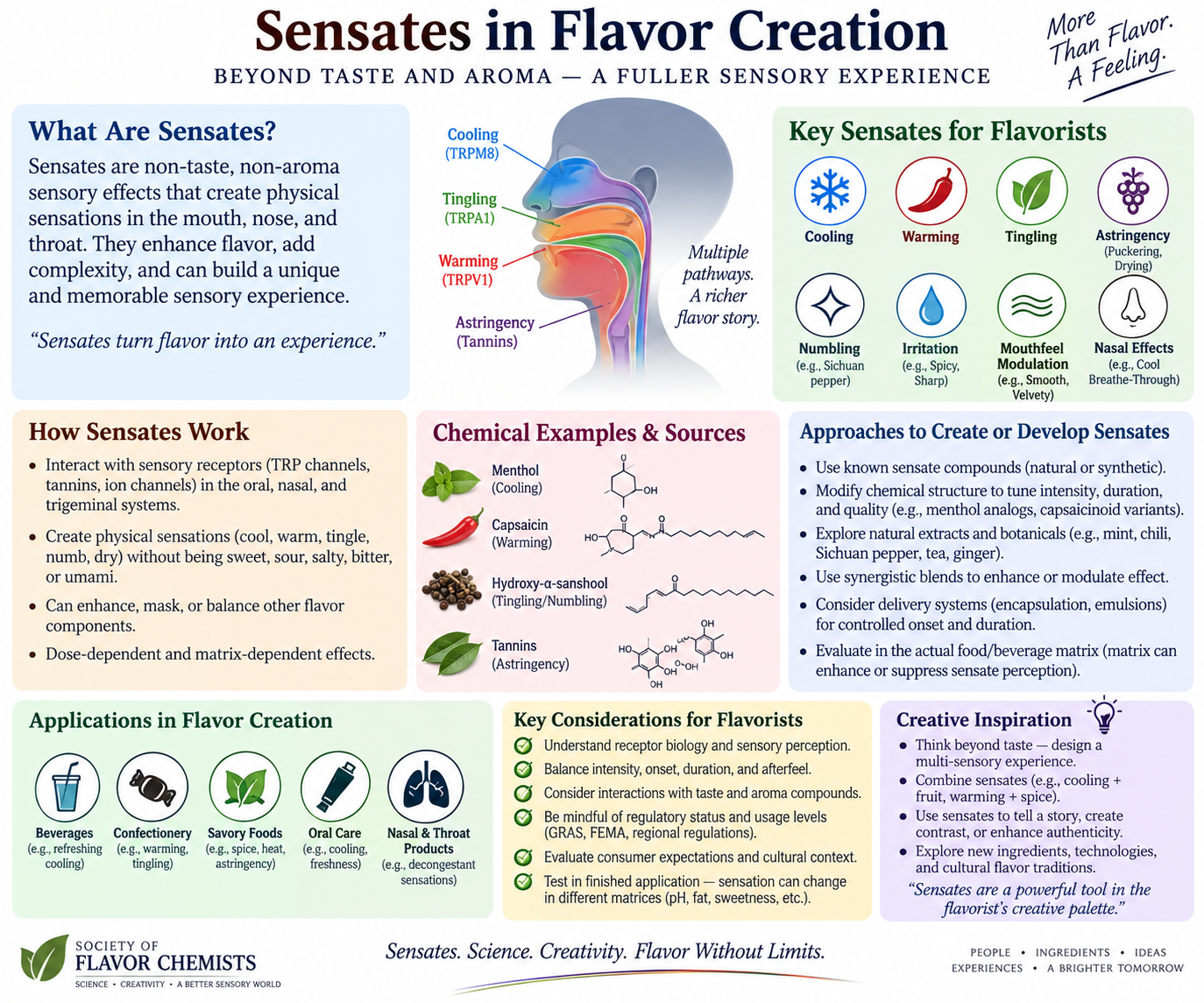
The Society of Flavor Chemists explicitly lists “Sensates” as one of the flavor types candidates should be prepared to explain creating and developing. For Certified membership, the SFC expects broad and deep working knowledge demonstrating successful independent and original flavor creation, including raw materials, laboratory practice, production, regulatory considerations, and economics. (Flavor Chemists)
For certification purposes, knowing that “menthol cools and capsaicin burns” is nowhere near enough. A Certified flavorist should be able to explain what a sensate is, how the major sensate systems work, how different sensate materials differ in onset and persistence, how they interact with flavor and matrix, how to formulate them, how to evaluate them sensorially, how to troubleshoot them, and how to use them safely and legally.
1. What is a sensate?
In flavor work, a sensate is a material or system that creates a physical oral or nasal sensation in addition to—or sometimes largely independent of—classical taste and aroma.
Sensates belong primarily to chemesthesis, the chemical stimulation of somatosensory nerves.
That sensory world includes:
| Sensation | Typical description |
|---|---|
| Cooling | Cold, fresh, icy, mint-like, refreshing |
| Heating | Warm, hot, burning |
| Pungency | Sharp, penetrating, irritating |
| Tingling | Buzzing, vibrating, sparkling |
| Numbing | Reduced oral tactile sensation |
| Stinging | Localized sharp irritation |
| Carbonation bite | Prickling, biting, acidic irritation |
| Nasal pungency | Wasabi/horseradish-type nasal impact |
| Mouthwatering | Salivary stimulation associated with some spices/sensates |
Flavor itself is multisensory. IOFI defines flavor as incorporating taste and smell as well as general pain and tactile receptors in the mouth, and describes flavor perception as involving gustatory, olfactory, and trigeminal systems. (IOFI)
This leads to the first Certified-level distinction:
Taste ≠ aroma ≠ chemesthesis.
Sweetness is taste.
Peppermint aroma is olfaction.
Menthol cooling is largely chemesthesis.
Capsaicin burn is chemesthesis.
A peppermint flavor can therefore smell minty without being strongly cooling, while a synthetic cooling system can provide significant cooling with very little mint aroma.
2. The trigeminal system
The major neurological player in oral sensates is the trigeminal nerve, cranial nerve V.
Trigeminal sensory neurons detect chemical irritation, temperature, pressure, touch, and pain throughout the oral and nasal cavities.
This system is different from the taste pathways carried primarily by cranial nerves VII, IX, and X.
A good oral-exam answer might therefore begin:
“I think of sensates primarily as chemesthetic stimuli mediated through trigeminal and related somatosensory pathways. I first define the desired sensation—cooling, heat, pungency, tingle, numbness, or carbonation bite—and then design its intensity, onset, localization, duration, and interaction with the flavor.”
That immediately demonstrates that you understand sensates as a designed sensory experience, not merely an ingredient category.
3. TRP channels: know these cold
A Certified flavorist does not need to be a neurobiologist, but several receptor/channel relationships should be second nature.
| Receptor/channel | Important stimuli | Typical sensation |
|---|---|---|
| TRPM8 | Cool temperature, menthol, many cooling agents | Cooling |
| TRPV1 | Capsaicin, heat, piperine, ginger pungents | Burning/heat |
| TRPA1 | Allyl isothiocyanate, cinnamaldehyde, allicin; many reactive pungents | Sharp pungency/irritation |
| TRPV3 | Warmth; compounds including eugenol, thymol and carvacrol | Warm sensation |
| KCNK-family mechanisms / mechanosensory pathways | Hydroxy-α-sanshool | Tingling/buzzing/numbing |
TRPM8 is activated by cooling and menthol, while TRPV1 is the classical capsaicin/heat-sensitive pathway. (PubMed Central (PMC)) TRPA1 responds to important flavor pungents including allyl isothiocyanate, cinnamaldehyde, and garlic-associated compounds such as allicin. (PubMed Central (PMC))
Do not reduce every material to one receptor, however. Many sensates act through multiple channels, receptor responses are concentration-dependent, and actual perception is generated by integrated neural activity rather than a single receptor assay.
That nuance is important at Certified level.
4. Cooling sensates
Cooling is probably the largest sensate category commercially.
The classic material is L-menthol.
Menthol is useful because it gives both:
a characteristic mint-associated aroma/flavor
and
a physiological cooling sensation.
But those two effects can become a disadvantage when the application needs cooling without tasting minty.
That need drove the development and use of so-called non-menthol or low-mint cooling agents.
Important cooling materials
| Material/class | What the Certified flavorist should understand |
|---|---|
| L-menthol | Strong cooling plus unmistakable mint character; relatively volatile; can become medicinal/toothpaste-like at excessive level. |
| Menthyl lactate | Softer, smoother, often longer cooling with less aggressive mint character than menthol. FEMA lists L-menthyl lactate as FEMA 3748 with a “Mint, Cool” profile. (FEMA) |
| WS-3 | N-ethyl-p-menthane-3-carboxamide, FEMA 3455; a widely recognized synthetic cooling agent with minimal mint aroma relative to menthol. FDA lists it as a flavoring agent/flavor enhancer and JECFA as a flavoring agent. (FAOHome) |
| WS-23 | 2-isopropyl-N,2,3-trimethylbutyramide, FEMA 3804; cooling agent often perceived somewhat differently in location/onset from WS-3. FEMA explicitly gives its flavor profile as “Cooling.” (FEMA) |
| Menthyl derivatives | Useful for modifying cooling onset, duration and aromatic character. |
| Dimethyl menthyl succinamide | FEMA 4230; FEMA describes it as imparting a cooling sensation. (FEMA) |
The reason a flavorist keeps multiple cooling materials is the same reason a perfumer keeps multiple musks:
“Cooling” is not a single sensory shape.
5. Cooling has a time curve
You should be able to describe cooling by:
latency → onset → build → peak → plateau → decay → residual cooling.
One coolant might hit the lips and front tongue immediately but disappear quickly.
Another might take longer to develop yet remain in the throat for several minutes.
Another might be clean at 3 ppm but become chemically bitter or irritating at 15 ppm.
Therefore a sophisticated cooling system may layer materials.
Conceptually:
fast coolant + middle coolant + persistent coolant
can produce a more complete temporal profile than one molecule alone.
This is sensate creation.
You are designing a time–intensity curve, not merely calculating ppm.
6. Menthol is not just cooling
Menthol illustrates why receptor knowledge must be paired with sensory experience.
At an appropriate concentration, menthol is cooling and fresh.
At higher concentrations it can also produce:
burning, irritation, tingling and numbing.
Human sensory work has demonstrated that menthol-induced irritation can desensitize during repeated exposure and that different perceptual qualities of menthol do not necessarily adapt identically. (PubMed)
So the statement:
“Menthol activates TRPM8, therefore it only creates cooling”
is too simplistic.
7. Heat: capsaicin
Capsaicin is the reference material for oral heat.
Capsaicin activates TRPV1, a channel involved in detecting noxious heat and chemical irritation.
FEMA lists capsaicin as FEMA 3404. (FEMA)
A Certified flavorist should understand the difference between using:
pure capsaicin,
capsaicinoid preparations,
capsicum oleoresin/extract,
and whole pepper materials.
These are not sensorially equivalent.
Pure capsaicin is primarily useful when controlled heat is desired without introducing the complete aromatic profile of a chili.
Capsicum extracts or oleoresins may contain heat plus varying degrees of characteristic chili aroma, color, resinous character and other components.
FEMA separately lists Capsicum extract from Capsicum frutescens / C. annuum as FEMA 2233. (FEMA)
8. Capsaicin heat has characteristic behavior
Capsaicin heat tends to: build rather than arrive instantaneously, remain after the food is swallowed, accumulate across repeated bites, show substantial individual variation, and undergo sensitization/desensitization effects with repeated exposure. This has major implications for sensory work. The heat in bite six of a spicy snack is not necessarily the same sensory event as bite one.
A Certified flavorist should therefore evaluate both: single-exposure heat
and cumulative consumption heat. That distinction is commercially important.
9. Capsaicin versus physical temperature
One of the beautiful things about chemesthesis is that the nervous system can interpret a chemical as though the tissue were physically hot or cold.
Capsaicin can produce a burning sensation even when the sample is at room temperature.
Menthol can produce cooling even when no significant physical temperature decrease occurs.
That is why these are sometimes described as thermal illusions.
But actual product temperature still matters because thermal and chemical signals interact.
An ice-cold beverage containing a cooling agent will not necessarily produce the same experience as the same concentration at room temperature.
10. Black-pepper heat: piperine
Black pepper is not simply a weaker chili pepper.
Its principal pungent alkaloid is piperine, FEMA 2909. (FEMA)
Piperine activates TRPV1 and can also act on TRPA1 pathways. (PubMed)
Sensory character is different from capsaicin.
A flavorist may describe piperine heat as comparatively:
peppery, dry, slower, spreading and less chili-like.
Therefore piperine can be valuable where the brief calls for warmth without making the product read as “chili.”
Applications might include:
pepper flavors, meat seasonings, savory sauces, ginger-style products, botanical beverages or complex warming systems.
11. Ginger heat
Ginger is another distinct heat architecture.
Important pungent families include:
gingerols, shogaols and zingerone.
These materials can activate TRPV1; ginger constituents also interact with TRPA1. (PubMed)
FEMA lists zingerone, FEMA 3124, with a flavor profile specifically described as “Heat.” (FEMA)
A flavorist should understand that fresh ginger and dried/heated ginger do not have identical pungency chemistry.
Processing changes the relative balance of gingerols, shogaols and related compounds.
So if a customer asks for: fresh ginger bite versus deep dried-ginger warmth
you should not approach them identically.
12. Cinnamon-type warmth
Cinnamaldehyde is one of the major active materials associated with cinnamon pungency.
It activates TRPA1 and contributes a characteristic warm, prickling, cinnamon-type oral effect. (PubMed Central (PMC))
FEMA lists cinnamaldehyde as FEMA 2286. (FEMA)
This material demonstrates another important principle: the aroma and sensate are integrated.
Cinnamaldehyde is simultaneously: a flavor/aroma material
and a chemesthetic stimulus.
Increasing it therefore changes both cinnamon character and oral warmth.
A flavorist must decide whether more cinnamon identity and more warmth are both desirable. If only warmth needs adjustment, another sensate may be preferable.
13. Mustard, horseradish and wasabi pungency
One of the most important pungent molecules is allyl isothiocyanate, FEMA 2034. FEMA describes it as garlic/pungent/sulfur. (FEMA)
It is closely associated with: mustard, horseradish and wasabi-type pungency.
Its mechanism involves TRPA1. (PubMed Central (PMC))
Its sensory behavior is markedly different from capsaicin.
Capsaicin tends toward lingering oral heat.
Allyl isothiocyanate is comparatively: sharp, rapidly penetrating, volatile and strongly nasal.
This is why horseradish can seem to shoot upward into the nose whereas chili tends to burn the mouth and lips.
This difference is central to sensate creation.
14. Volatility determines where a sensate is experienced
The physical chemistry matters enormously.
A volatile pungent such as allyl isothiocyanate reaches the nasal cavity readily.
A relatively nonvolatile lipophilic capsaicinoid behaves very differently.
So when creating sensates you should think not merely in terms of receptor activity but:
volatility + solubility + partitioning + delivery + receptor activation.
That determines whether the consumer experiences the sensation predominantly at the: lips, tip of tongue, whole mouth, back of throat, nose, or after-swallow.
15. Garlic and onion-type chemesthesis
Garlic chemistry supplies several potent sulfur compounds associated with pungency.
Allicin and related allyl sulfur compounds can stimulate TRPA1 pathways. (PubMed Central (PMC))
These materials can create: sharpness, raw-garlic bite and nasal irritation.
Again, they are not simply aroma ingredients.
At high levels they contribute a physical oral sensation that becomes part of the flavor architecture.
16. Clove, oregano and thyme warmth
Materials such as: eugenol, thymol and carvacrol can create warm or pungent sensations.
Experimental work shows strong activation of the warm-sensitive TRPV3 channel by eugenol, thymol and carvacrol, while carvacrol can also influence TRPA1. (PubMed)
This helps explain why clove and certain herbal/spice systems can feel warm without having the same character as chili heat.
A Certified candidate should therefore understand that there are many kinds of warmth.
17. Tingling and buzzing: Sichuan pepper
Sichuan pepper provides one of the most interesting sensates.
Its characteristic effect includes: tingling, buzzing, vibration-like sensation and partial numbness.
A key active substance is hydroxy-α-sanshool.
It does not simply reproduce capsaicin heat.
Research shows that sanshool activates mechanosensory populations and can act through inhibition of two-pore potassium channels including KCNK-family channels; other work also shows interactions with TRPV1/TRPA1. (PubMed)
Human perception is extraordinarily characteristic: a buzzing or electrically tingling oral sensation rather than conventional chili burn.
That makes sanshool-type systems valuable for modern creative flavor profiles such as:
electric citrus, buzzing berry, Sichuan, exotic botanical, sparkling candy and interactive beverage concepts.
18. Tingling is not heat
Do not describe sanshool simply as “spicy.”
Sensory research distinguishes its tingling/numbing qualities from classical nociceptive capsaicin-type burning. (PubMed Central (PMC))
A skilled flavorist may combine small amounts of: tingle + cooling to produce an effervescent perception, or tingle + heat to create a complex chili/Sichuan experience.
But each must be controlled independently.
19. Carbonation is a sensate
Carbonated beverages provide another useful Certified-level example.
The bite of carbonation is not merely bubbles physically hitting the tongue.
CO₂ is converted into carbonic acid through carbonic-anhydrase-mediated processes, generating chemosensory signals and trigeminal irritation; taste pathways also contribute to carbonation perception. (PubMed)
Experiments have even shown that carbonation “bite” can persist when bubble formation is prevented, demonstrating the importance of the chemical component. (PubMed)
Therefore carbonation interacts profoundly with sensate flavor design.
A citrus cooling system that works in still water may feel substantially more aggressive in a carbonated beverage.
20. Ethanol is also chemesthetic
Alcohol does more than carry aroma.
At sufficient concentrations ethanol contributes:
warmth, burn, irritation and trigeminal stimulation.
So creating a cinnamon flavor for a 0% beverage is different from creating one for a 20% alcohol product.
The alcohol is already contributing part of the sensate architecture.
A competent flavorist compensates accordingly.
21. A sensate has at least six dimensions
This is one of the most useful frameworks for an SFC interview.
When designing a sensate, define:
| Dimension | Question |
|---|---|
| Quality | Cool, burn, warm, tingle, numb, sting, sharp? |
| Intensity | How strong? |
| Onset | How quickly does it appear? |
| Location | Lips, tongue, palate, throat, nose? |
| Duration | How long does it remain? |
| Temporal evolution | Does it rise quickly, build slowly, plateau or accumulate? |
I would also add a seventh: interaction with the characterizing flavor.
A cooling agent can transform watermelon into “icy watermelon.”
The same concentration might make vanilla taste toothpaste-like or unnatural.
Sensate design cannot be separated from flavor identity.
22. The creative workflow for sensates
When asked in an SFC interview, “How would you develop a sensate?” do not immediately answer with an ingredient.
Start with the desired sensory experience.
For example:
“I want a lime beverage that feels cold immediately on the lips, develops a clean cooling sensation across the tongue, persists for about 20–30 seconds after swallowing, but does not become minty or medicinal.”
Now you have an actual creative brief.
Then select and combine materials whose temporal, spatial and aromatic properties create that experience.
That is flavor creation.
23. Layering cooling materials
Suppose one coolant gives an immediate front-mouth impact but disappears too quickly, while another is slow but long lasting.
A flavorist can blend them.
The result can resemble musical orchestration:
attack → body → finish.
This is one of the best analogies for explaining sensate creation.
Just as esters, aldehydes and lactones build different phases of fruit flavor, sensates can be layered for temporal architecture.
24. Layering heat
The same principle works for heat.
Imagine a savory seasoning requiring:
immediate sharp impact + medium pepper warmth + long chili finish.
A theoretical architecture could involve: a volatile mustard-type note for attack, a pepper/ginger component for mid-palate warmth, and a capsaicinoid component for persistent heat.
That produces a much more sophisticated result than increasing chili extract alone.
25. The relationship between sensate and aroma
Sensates can change perceived flavor even when aroma composition is unchanged.
Cooling may make a flavor seem:
fresher, cleaner, lighter, brighter or more refreshing.
Warmth may make it seem:
richer, darker, spicier or more indulgent.
Tingling can make something seem:
sparkling, energetic or electric.
So the sensate itself can become part of the flavor's semantic identity.
This is why sensates are creative tools rather than simply functional additives.
26. Congruency matters
Certain flavor/sensate combinations are naturally congruent.
Cooling often works well with: mint, citrus, tropical fruit, berry, melon and some beverages.
Heat often works naturally with: chili, ginger, cinnamon, savory, barbecue and certain tropical concepts.
Tingling can complement: citrus, botanicals, Sichuan, exotic fruits and modern confectionery.
But incongruent combinations can also be creative when intentional.
A cooling chocolate or warming cherry can be successful if the concept is coherent.
The flavorist must determine whether the sensate reinforces the product story or feels like a defect.
27. Matrix effects are enormous
A sensate concentration is meaningless without knowing the application.
| Matrix factor | Possible consequence |
|---|---|
| Fat | Alters partitioning/release of lipophilic sensates such as capsaicinoids |
| Protein | May bind materials and alter delivery |
| Sugar | Can suppress or soften perceived irritation |
| Acid | May increase overall sharpness/irritation |
| Alcohol | Adds its own burn and changes solubility |
| Carbonation | Adds chemesthetic bite |
| Viscosity | Changes oral coating and release |
| Temperature | Interacts strongly with thermal sensates |
| Emulsion structure | Changes release and localization |
| Serving size | Controls accumulated dose |
| Consumption rate | Strongly affects cumulative heat |
The exact same sensate concentration can therefore feel very different in: water, soda, chewing gum, hard candy, chocolate, ice cream, oil-based sauce, or protein beverage.
28. Fat and capsaicin
Capsaicin is lipophilic.
This has practical consequences.
In a fatty product, distribution and oral release may be different from a water-based system.
Fat can also influence how capsaicin is cleared from oral tissues.
This is one reason dairy or fatty foods can help reduce chili burn better than plain water.
From a formulation perspective, it means a capsaicin concentration developed in aqueous solution should never be blindly transferred into an oil-rich application.
29. Solubility is a formulation problem
Many powerful sensate compounds are not conveniently water soluble.
A flavorist therefore needs to consider: appropriate food-grade solvents, emulsions, carrier systems, pre-dilutions, encapsulation, plating, spray drying, and delivery systems.
For example, JECFA describes WS-3 as insoluble in water but soluble in ethanol. (FAOHome)
That physical property has immediate formulation implications.
If you dump an improperly dissolved coolant directly into a beverage system, you can encounter: precipitation, uneven dosing, localized sensory hot spots, or inconsistent batch performance.
30. Very potent ingredients require controlled dilution
Sensates are often used at relatively low levels.
Never formulate a highly potent sensate by attempting to weigh an impractically tiny amount directly into a production flavor.
Use controlled predilutions where appropriate.
For example:
If you need 5 ppm of a sensate in a finished beverage and your flavor is used at 0.1%, the sensate concentration required in the flavor is:
5 ppm ÷ 0.001 = 5,000 ppm
which is:
0.50% in the flavor.
A Certified flavorist should be comfortable doing this calculation immediately.
31. Know ppm and use-level calculations
Example:
A flavor contains 0.25% cooling agent.
The flavor is dosed at 0.20% in the finished beverage.
0.0025 × 0.0020 = 0.000005
Therefore the finished product contains:
5 ppm cooling agent.
These calculations matter for: sensory optimization, regulatory assessment, cost-in-use, batch consistency, and safety documentation.
32. Sensate location matters
Ask testers where they feel the effect.
A sensate can localize to:
lips, tongue tip, tongue sides, palate, throat or nasal cavity.
This can be commercially decisive.
A throat-cooling effect might be desirable in: mint confectionery or beverages.
The same effect might seem medicinal in: strawberry yogurt.
A sharp nasal sensation may be essential in horseradish but unacceptable in barbecue sauce.
33. Sensate onset matters
Two formulations can produce identical maximum intensity but still feel completely different.
Example:
Sample A reaches maximum cooling after 3 seconds and disappears after 15 seconds.
Sample B begins slowly, peaks after 20 seconds and lasts for two minutes.
An overall “cooling intensity = 7” score fails to capture the difference.
Dynamic sensory evaluation is therefore extremely valuable.
34. Time–Intensity
For sensate work, Time–Intensity can be more informative than a single static rating.
Useful measurements include: time to onset, time to maximum intensity, maximum intensity, duration, area under the curve, decay rate, and time to complete clearing.
For spicy products you may also want: cumulative intensity over successive bites.
35. Adaptation, sensitization and desensitization
This is one of the most important practical topics.
Repeated chemesthetic exposure alters perception.
Capsaicin can produce complex sensitization and desensitization effects.
Menthol-induced irritation can also desensitize with repeated exposure, and interactions between menthol and capsaicin have been demonstrated. (PubMed)
Therefore you cannot responsibly taste: coolant A, coolant B, capsaicin, WS-23, mustard, ginger, and another capsaicin system in rapid succession and assume your sensory judgments are independent.
36. Sensory panel procedure
For sensates, control:
sample order,
temperature,
sample volume,
contact time,
swallow/spit protocol,
time between samples,
palate-cleansing procedure,
and maximum number of samples.
Randomization and replication are important.
But rest periods are particularly important because trigeminal adaptation and cumulative effects can be substantial.
37. Water is useful—but insufficient
Screening sensates in water is useful for understanding:
intrinsic quality,
threshold,
onset,
duration,
off-taste,
and approximate potency.
But final judgment has to occur in the actual application.
A coolant that tastes clean in water can behave differently in:
acidic cola,
high-fat dairy,
protein shake,
gum,
or candy.
Certified flavorists should instinctively move from mechanistic screen → application validation.
38. Sensory thresholds
You should understand the distinction between:
detection threshold – something is present,
recognition threshold – the quality can be identified,
and
useful application level – the level producing the intended commercial effect.
These are not identical.
A sensate may be detectable at a concentration too low to contribute useful product impact.
Likewise, the optimum commercial level can be far below the concentration where the material's undesirable side effects become apparent.
39. Dose–response curves
Never assume:
twice the concentration = twice the sensation.
Sensate dose-response relationships can be nonlinear.
At increasing concentration you might see:
no effect → detectable effect → desirable effect → plateau → irritation/off-character.
This is particularly important for potent coolants and pungent compounds.
Always establish a sensory dose-response range.
40. Overdosing cooling agents
Excessive cooling can produce unwanted descriptors such as:
chemical, medicinal, anesthetic, throat-catching, bitter, metallic, mint-like or unnaturally persistent.
A common development mistake is chasing greater intensity rather than improving temporal balance.
If a cooling flavor is not refreshing enough, the correct answer may be to change the cooling profile, not simply increase total coolant concentration.
41. Overdosing heat systems
Too much heat can mask the flavor you are trying to deliver.
When capsaicin dominates perception, subtle: meat, fruit, brown, fermented, smoke, or spice nuances may disappear.
The best hot flavor is not necessarily the hottest flavor.
Heat must support the flavor identity.
42. Heat can suppress discrimination
As chemesthetic intensity rises, a consumer may become increasingly focused on irritation and increasingly poor at resolving other flavor details.
This is why developing a high-heat sauce requires judging:
character before heat becomes dominant,
character during heat,
and character after heat.
You may need stronger aromatic top notes or more persistent flavor components so the intended character survives the sensate load.
43. “Hot” itself should be broken into descriptors
A Certified flavorist should avoid treating heat as one attribute.
Useful terms include:
sharp, penetrating, prickling, stinging, warming, burning, dry, peppery, chili-like, nasal, throat heat, lip burn, spreading heat, lingering heat.
This descriptive vocabulary is essential for creative work.
44. Cooling should also be broken down
Likewise distinguish:
icy, mint-cool, fresh, wet-cool, throat-cool, mouth-cool, immediate, delayed, smooth, sharp, persistent, medicinal or anesthetic.
A flavorist who only says “more cooling” has not adequately diagnosed the brief.
45. Astringency is related but different
Astringency is an oral somatosensory experience characterized by:
drying, puckering, roughness and loss of lubrication.
It is not a basic taste and is not equivalent to bitterness.
It is often caused by interactions involving polyphenols and salivary proteins.
Whether a company organizationally includes astringency under “sensates” varies, but a Certified flavorist should certainly understand the distinction because consumers routinely confuse: bitterness, astringency, and irritation.
Misdiagnosis leads to poor formulation.
46. Numbing
Numbing may accompany materials such as: sanshool-containing extracts, high levels of certain mint/cooling materials, and some spice systems.
Do not confuse: true reduction of tactile perception with strong cooling that consumers describe as numb.
The sensory descriptors may overlap, but the mechanisms can differ.
47. Natural sensate sources
A flavorist should be comfortable discussing natural sources such as: peppermint and mint oils, capsicum, black pepper, ginger, cinnamon, clove, mustard, horseradish, wasabi, garlic, Sichuan/Zanthoxylum materials, and other botanicals.
But “natural” is a regulatory designation, not merely a sensory impression.
You must know the source and manufacturing method.
48. Synthetic sensates
Synthetic cooling agents are valuable because they can provide a desired chemesthetic effect without bringing all of the aroma associated with a natural botanical.
WS-3 is a good example.
The FAO/JECFA specification identifies N-ethyl-p-menthane-3-carboxamide as FEMA 3455, while FDA's current food-substance inventory describes it as a flavoring agent or adjuvant/flavor enhancer. (FAOHome)
This does not mean every cooling agent can automatically be used in every food worldwide.
49. Regulatory status is ingredient- and jurisdiction-specific
“Sensate” is primarily a sensory/industry concept, not a universal legal category.
Regulatory treatment depends on: the exact chemical or extract, source, technical function, concentration, food category, country, and applicable flavor legislation.
In the U.S., 21 CFR 101.22 defines natural versus artificial flavor based in large part on source and flavoring function. (Legal Information Institute)
In the EU, Regulation (EC) 1334/2008 controls flavorings and defines flavorings as products added to impart or modify odor and/or taste, with an authorized Union-list framework for flavoring substances. (EUR-Lex)
So:
“It has a FEMA number, therefore it is legal everywhere”
is not an acceptable Certified-level regulatory answer.
50. FEMA GRAS: know what it means
The FEMA Flavor Ingredient Library contains flavor substances whose safety has been determined to be generally recognized as safe under conditions of intended use as flavor ingredients. (FEMA)
The important words are: conditions of intended use.
Always confirm appropriate: food categories, levels, jurisdiction, identity/purity, and labeling.
51. Processing stability
A sensate has to survive manufacturing.
Consider: heat, acid, alkali, oxygen, light, water activity, storage, packaging, and interaction with other flavor constituents.
For volatile materials, evaporation during processing can change impact.
For reactive materials such as certain isothiocyanates or sulfur compounds, chemical stability can be especially important.
For encapsulated systems, release characteristics may matter as much as chemical stability.
52. Encapsulation as a creative tool
Encapsulation is not only about shelf life.
It can alter when the consumer experiences the sensate.
A protected sensate can potentially deliver: delayed release, reduced processing loss, reduced interaction with other ingredients, or more controlled oral release.
In chewing gum, confectionery and powdered systems, this can be particularly useful.
Thus formulation technology can become part of sensate design.
53. Delivery systems matter
Suppose the brief calls for a candy with: initial fruit, then cooling, then a final warming center.
You might accomplish that not only with chemistry but with physical placement.
Outer coating, shell, center fill, encapsulation, layering, particle size, and dissolution rate can create sequential sensations.
This is a very strong example of original flavor creation because the flavorist is designing the consumption experience, not just the formula.
54. Application: chewing gum
Gum is a classic sensate application because mastication provides prolonged release.
A coolant that lasts 30 seconds in a beverage may behave very differently when continuously released from gum.
Important considerations include: partitioning into gum base, release from sweetener/polyol phases, encapsulation, saliva, duration of chewing, and interaction with mint aroma.
You often need multiple cooling materials to sustain freshness.
55. Application: hard candy
In hard candy consider: high-temperature processing, distribution, release during dissolution, surface versus center placement, and cumulative oral exposure.
A sensate must survive the process and remain sensorially coherent as the candy dissolves.
56. Application: beverages
For beverages consider: water solubility, emulsion clarity, acid, carbonation, sweetener system, alcohol, serving temperature, and sip accumulation.
Cooling often appears stronger in a cold carbonated beverage because several sensory systems reinforce the “cold/fresh” perception even though the chemistry has not changed.
57. Application: dairy
Fat and protein can substantially affect sensate delivery.
A coolant that is bright and clean in water can feel muted in ice cream.
Capsaicin can partition differently and may release slowly.
Creaminess also changes interpretation: a small amount of warming may seem rich and indulgent rather than sharply irritating.
58. Application: savory seasonings and sauces
Here the flavorist should distinguish: capsaicin heat, black-pepper heat, mustard pungency, ginger warmth, garlic/onion bite, Sichuan tingle, and smoke/roasted aroma.
All can coexist.
The creative challenge is arranging them so they produce the intended cuisine and sequence.
59. Application: fruit flavors
Sensates can radically change fruit identity.
Cooling can make fruit read:
fresh, frozen, icy or beverage-like.
Heat can turn mango into:
chili mango.
Tingling can turn citrus into:
electric citrus.
But excessive cooling can erase ripeness and make creamy fruits feel thin.
Sensate intensity must be calibrated to the fruit profile.
60. A model creation exercise: cooling lime beverage
Suppose the customer wants:
a sugar-free lime beverage that feels extremely refreshing but must not taste minty.
A weak approach is: “Add menthol.”
A Certified approach is: First define the target against a benchmark.
Then score: lime aroma, acid sharpness, sweetness onset, bitterness, carbonation bite, initial cooling, mid-mouth cooling, throat cooling, duration, and any medicinal character.
Because mint aroma is undesirable, I would screen low-aroma cooling materials rather than relying primarily on menthol.
I would create dose-response curves for each candidate and then blend materials to shape onset and persistence.
I would test the system in the actual carbonated acid matrix because CO₂ and acidity contribute their own irritation.
Then I would rebalance the lime top notes and sweetness, because stronger cooling may make the product seem less sweet or more acidic.
Finally I would verify stability, regulatory status, manufacturability and cost.
That is the answer style SFC is looking for.
61. Model exercise: hot chicken seasoning
Brief:
“We need medium-high heat, but we don't want it to taste like chili powder.”
I would not begin by increasing capsicum oleoresin.
I would first define whether the desired heat is: front, mid-palate, throat, lingering, peppery, or sharp.
I might build a layered heat using a controlled capsaicinoid source for persistence plus pepper/ginger-type warmth for complexity while minimizing chili aroma.
Then I would make sure the chicken, browned-fat, sulfur, roasted and savory notes remain identifiable under the heat load.
That demonstrates original sensate creation.
62. Model exercise: Sichuan citrus
Desired experience:
bright citrus → electric tingle → mild warmth → clean finish.
Here the sensate is part of the flavor identity.
A Zanthoxylum/sanshool-type material may supply tingle.
A small cooling component can accentuate the sparkling sensation.
A modest ginger/chili component can supply warmth.
But timing matters.
If the heat arrives too early, it suppresses the delicate citrus.
If tingle becomes too high, it may appear anesthetic.
If cooling lingers too long, the experience may drift toward oral-care territory.
This is sensory orchestration.
63. Analytics
Analytical techniques supporting sensate work depend on the chemistry.
GC or GC-MS can be useful for volatile compounds such as menthol and volatile pungent/aroma constituents.
HPLC/LC methods are often more appropriate for less volatile compounds such as capsaicinoids and piperine.
Analytical work can quantify what is present.
It does not tell you the complete sensory experience.
A beverage containing a measured 3 ppm coolant does not necessarily have a “3 ppm sensory intensity.”
Human sensory evaluation remains essential.
64. Scoville and heat measurement
The Scoville scale is culturally important and you should know what it describes: chili pungency.
Historically it is based on sensory dilution methodology; contemporary capsaicinoid analysis can be performed instrumentally and related to pungency values.
But Scoville units should not become your universal language for sensates.
They are not appropriate for comparing: menthol cooling, mustard pungency, Sichuan tingling, or carbonation bite.
Different chemesthetic qualities require different descriptive frameworks.
65. Safety during flavor creation
This subject matters enormously.
Never casually taste concentrated sensate raw materials.
Potent pungents and cooling agents should be handled according to: SDS information, company SOPs, appropriate PPE,controlled dilution practices, and approved sensory procedures.
Capsaicinoids and potent spice extracts can be especially problematic because contamination of: eyes, nose, skin, benches, pipettes, door handles, or gloves can cause significant irritation.
Sensory tasting should occur only at appropriate food-use concentrations.
66. Cross-contamination in the lab
Sensates create unusual laboratory problems.
A tiny amount of capsaicin contamination may affect later samples.
Menthol can contaminate aroma space.
Volatile mustard materials can affect nearby evaluations.
Therefore maintain appropriate:
dedicated tools when necessary,
hood/ventilation practices,
clean containers,
pipette discipline,
and bench sanitation.
Do not taste a subtle vanilla flavor immediately after opening a powerful mint or mustard system.
67. Production considerations
The flavorist should understand what happens after the lab formula leaves the bench.
Questions include:
Can production weigh the material accurately?
Does it require a predilution?
Does it crystallize?
Is it soluble in the selected carrier?
Will it precipitate during winter storage?
Will volatile sensate material be lost during mixing?
Will the powder segregate?
Can the flavor be cleaned out of production equipment?
Will residual capsaicin contaminate the next batch?
These are Certified-flavorist questions.
68. Economics
Sensates can appear expensive on a dollar-per-kilogram basis yet inexpensive on a finished-product basis because use levels may be low.
The correct metric is usually:
cost-in-use.
A $300/kg cooling agent used at 5 ppm contributes:
$300 × 0.000005 = $0.0015/kg finished product
or 0.15 cents/kg.
The flavorist therefore needs to consider potency, use level, processing loss and manufacturing complexity—not raw-material price alone.
69. Sensates can modify taste indirectly
Even though SFC lists Sensates separately from FMPs/Taste Modulation, the sensory systems interact.
Pungency can influence perceived:
sweetness,
saltiness,
bitterness,
sourness,
and overall flavor intensity.
TRPV1/TRPA1 pathways interact with taste perception, and chemesthetic stimulation can modify ratings of basic tastes. (PubMed Central (PMC))
Therefore do not evaluate a sensate in isolation from taste balance.
70. Cooling and sweetness
Cooling can alter the way sweetness is interpreted.
A beverage may feel less heavy or more refreshing without a measurable reduction in sweetener.
Conversely, excessive cooling may make sweetness seem disconnected from the fruit.
So after changing the coolant system, re-evaluate: sweetness intensity and temporal profile.
Do not assume the sweetener formula can remain untouched.
71. Heat and sweetness
Sweetness can soften or balance pungency.
This is why chili often works so effectively with: mango, pineapple, honey, chocolate, or sweet sauces.
But this is not just cultural.
Taste and trigeminal stimuli interact perceptually.
Therefore reducing sugar in a spicy product may unexpectedly increase apparent harshness even when capsaicin concentration is unchanged.
72. Acid and sensates
Acidic beverages already generate substantial oral stimulation.
Combine:
acid + carbonation + alcohol + cooling + ginger
and the total trigeminal load may become much stronger than any one component predicts.
A flavorist needs to assess total sensory load, not individual ingredient intensity.
73. Sensory fatigue
Chemesthetic evaluation is unusually vulnerable to fatigue.
A panel tasting 20 orange flavors might remain relatively functional.
A panel tasting 20 capsaicin variants almost certainly will not.
Design experiments realistically.
Sometimes the scientifically correct choice is:
fewer samples per session and more replication across sessions.
74. Individual variation
People differ substantially in sensitivity and response to oral irritants.
Repeated-exposure studies with capsaicin and menthol have shown considerable individual differences in sensitization and desensitization. (PubMed)
Therefore a single flavorist's palate is useful for creation but is not sufficient for all validation.
Use multiple trained assessors when making consequential sensate decisions.
75. Consumer segmentation
One consumer's “exciting” is another consumer's “painful.”
This is particularly relevant for: chili heat, tingling, intense cooling, and unusual numbing systems.
Commercial development should account for target consumer experience and cultural expectations.
A medium-heat product in one market may be perceived as mild or extremely hot in another.
76. Do not confuse irritation with flavor quality
Some inexperienced developers chase high sensate intensity because the effect is dramatic.
But intensity can destroy flavor integration.
The objective is not:
maximum cooling
or
maximum heat.
The objective is:
the right sensory experience for the product concept.
77. Know representative raw materials
For the SFC interview, flavorists would know at least these examples comfortably:
| Sensory type | Representative materials |
|---|---|
| Cooling | Menthol, menthyl lactate, WS-3, WS-23, menthyl derivatives |
| Chili heat | Capsaicin/capsaicinoids, capsicum extracts |
| Pepper heat | Piperine, pepper extracts/oleoresins |
| Ginger warmth | Gingerols, shogaols, zingerone |
| Cinnamon warmth | Cinnamaldehyde |
| Mustard/wasabi pungency | Allyl isothiocyanate |
| Garlic pungency | Allicin and allyl sulfur systems |
| Clove/herbal warmth | Eugenol, thymol, carvacrol |
| Tingle/numb | Sanshools/Zanthoxylum systems |
| Carbonation bite | CO₂/carbonic-acid-mediated chemesthesis |
You do not need to claim that every one of these belongs to a single regulatory “sensate” category. They are sensory tools with different regulatory identities.
78. Common oral-exam traps
| Weak answer | Certified-level answer |
|---|---|
| “Sensates are hot and cold flavors.” | Sensates are chemesthetic/somatosensory stimuli including cooling, warming, burning, pungency, tingling, numbness and related sensations. |
| “Menthol makes things cold.” | Menthol activates cooling pathways, principally TRPM8, without requiring actual product cooling; it also contributes mint character and can become irritating at high levels. |
| “Capsaicin is spice.” | Capsaicin is a principal chili pungent activating TRPV1; its temporal profile, persistence, matrix partitioning and cumulative behavior must be considered. |
| “All heat is capsaicin.” | Piperine, gingerols/shogaols, cinnamaldehyde, AITC and other materials produce different heat/pungency profiles. |
| “Wasabi is like chili.” | Wasabi/mustard pungency is strongly associated with volatile isothiocyanates/TRPA1 and is comparatively rapid and nasal; capsaicin heat is more oral and persistent. |
| “Sichuan pepper is just spicy.” | Sanshools create distinctive tingling/buzzing/numbing through mechanosensory and ion-channel mechanisms. |
| “More coolant means better cooling.” | Cooling agents differ in onset, localization, duration and side effects; layering often works better than simply increasing dose. |
| “FEMA GRAS means unlimited use.” | FEMA status applies under conditions of intended flavor use; jurisdiction, food category and use level matter. |
| “I test all my hot samples together.” | Chemesthetic adaptation, sensitization, desensitization and carryover demand controlled sensory design. |
| “It works in water, so I'm done.” | Matrix, processing, temperature, carbonation, fat, protein and serving conditions can transform sensate performance. |
79. A model SFC verbal answer
If the interviewer asks:
“How do you approach creating a sensate?”
A strong response would be:
“I start by defining the desired sensory quality and temporal experience rather than choosing an ingredient first. I determine whether the target is cooling, warming, burning, sharp pungency, tingling or numbness, and I define the desired onset, maximum intensity, location and duration. Then I select candidate materials based on their chemesthetic profile, aroma contribution, solubility and regulatory suitability. I screen them over a dose range and evaluate their time–intensity behavior. If necessary I combine materials—for example, a fast and persistent coolant or multiple heat sources—to build the desired sensory curve. I then move into the real application because fat, protein, acid, alcohol, carbonation, temperature and processing can dramatically change sensate perception. I optimize the sensate together with the characterizing flavor and taste system, assess cumulative exposure and sensory adaptation, then confirm stability, manufacturing feasibility, regulatory status, labeling and cost-in-use.”
That answer communicates independent creation ability.
80. A model answer for “Create a cooling flavor”
“I would first determine what the customer means by cooling. Do they want minty freshness, physical icy perception, front-mouth cooling, throat cooling, or long residual cooling? If mint character is acceptable, menthol may be part of the system. If not, I would screen low-aroma cooling agents such as menthane carboxamides or other permitted cooling materials. I would create dose-response and time-intensity profiles individually, then layer agents if necessary to obtain the desired onset and duration. I would evaluate bitterness, irritation and medicinal character at overdose. Finally I would optimize the cooling system in the finished application at its actual pH, temperature and processing conditions.”
Excellent SFC material.
81. A model answer for “Create heat”
“I would determine what kind of heat is appropriate rather than automatically using capsaicin. Capsaicin gives persistent chili burn, piperine contributes a different peppery warmth, ginger constituents provide ginger-type pungency, cinnamaldehyde provides cinnamon warmth and allyl isothiocyanate gives rapid nasal pungency. I would choose or layer those effects according to onset, location, duration and flavor identity, then validate them through repeated consumption because heat can accumulate. I would also ensure the sensate does not suppress the characterizing flavor and would confirm regulatory status, processing stability and cost.”
82. How sensates demonstrate creativity
This is ultimately why SFC includes the topic under Flavor Creation.
The creative flavorist is not asking:
“What chemical causes cold?”
The creative flavorist asks:
“What should the consumer physically experience during the first second, the chew or sip, the swallow, and the finish—and how do I construct that experience?”
That might mean:
fresh mint → immediate cooling → long clean throat freshness,
or
mango → sweetness → chili warmth → lingering lip heat,
or
lemon → sparkling acidity → electric tingle → fast clean finish,
or
ginger → nasal lift → warming throat impact → slow fade.
Those are sensory narratives.
That is flavor creation.
83. What I would memorize for the Certified interview
These are the core facts flavorists would be able to answer instantly:
- Sensates are primarily chemesthetic/somatosensory effects, generally involving trigeminal pathways, rather than basic tastes.
- TRPM8 = cooling/menthol; TRPV1 = capsaicin/heat; TRPA1 = mustard/wasabi/cinnamaldehyde/other pungents.
- Menthol provides cooling plus mint aroma; synthetic cooling agents can provide cooling with much less mint character.
- WS-3 = N-ethyl-p-menthane-3-carboxamide, FEMA 3455.
- WS-23 = 2-isopropyl-N,2,3-trimethylbutyramide, FEMA 3804.
- Menthyl lactate = FEMA 3748, a useful mint/cooling material.
- Capsaicin = persistent chili heat; TRPV1; FEMA 3404.
- Piperine = black-pepper pungency; TRPV1/TRPA1 activity; FEMA 2909.
- Allyl isothiocyanate = mustard/horseradish/wasabi-type rapid nasal pungency; TRPA1; FEMA 2034.
- Cinnamaldehyde contributes cinnamon aroma plus warmth/pungency and activates TRPA1.
- Gingerols, shogaols and zingerone contribute ginger heat; TRPV1 is important.
- Hydroxy-α-sanshool creates Sichuan-type tingling/buzzing/numbing and involves mechanosensory/KCNK pathways rather than simply reproducing chili burn.
- Carbonation bite is substantially chemogenic; CO₂/carbonic acid stimulates oral sensory pathways, not merely mechanical bubble sensation.
- Every sensate should be described by quality, intensity, onset, location and duration.
- Repeated exposure changes perception through sensitization/desensitization/carryover, so sensory design is critical.
- Matrix matters: fat, protein, acid, sugar, alcohol, carbonation, viscosity and temperature all change sensate performance.
- Sensates can be layered to design attack, body and finish.
- Solubility and delivery matter as much as receptor potency.
- Never casually taste concentrated sensate raw materials; controlled dilutions and appropriate safety procedures are essential.
- Regulatory status must be confirmed for the exact material, source, level, food category and jurisdiction.
The central Certified-flavorist concept
For SFC purposes, the most important idea is this:
A sensate is not merely an ingredient that makes food hot or cold. It is a controllable sensory dimension that a flavorist designs in space and time.
A Certified flavorist should be capable of moving fluently from:
sensory objective → trigeminal mechanism → raw-material selection → dose-response → temporal profile → flavor integration → application matrix → delivery system → sensory validation → manufacturing → stability → regulation → economics.
That is the level at which flavorists would prepare to discuss Sensates in an SFC Certified interview. (Flavor Chemists)
###