Separation in Flavor Systems: What the SFC Requires Every Certified Flavorist to Know
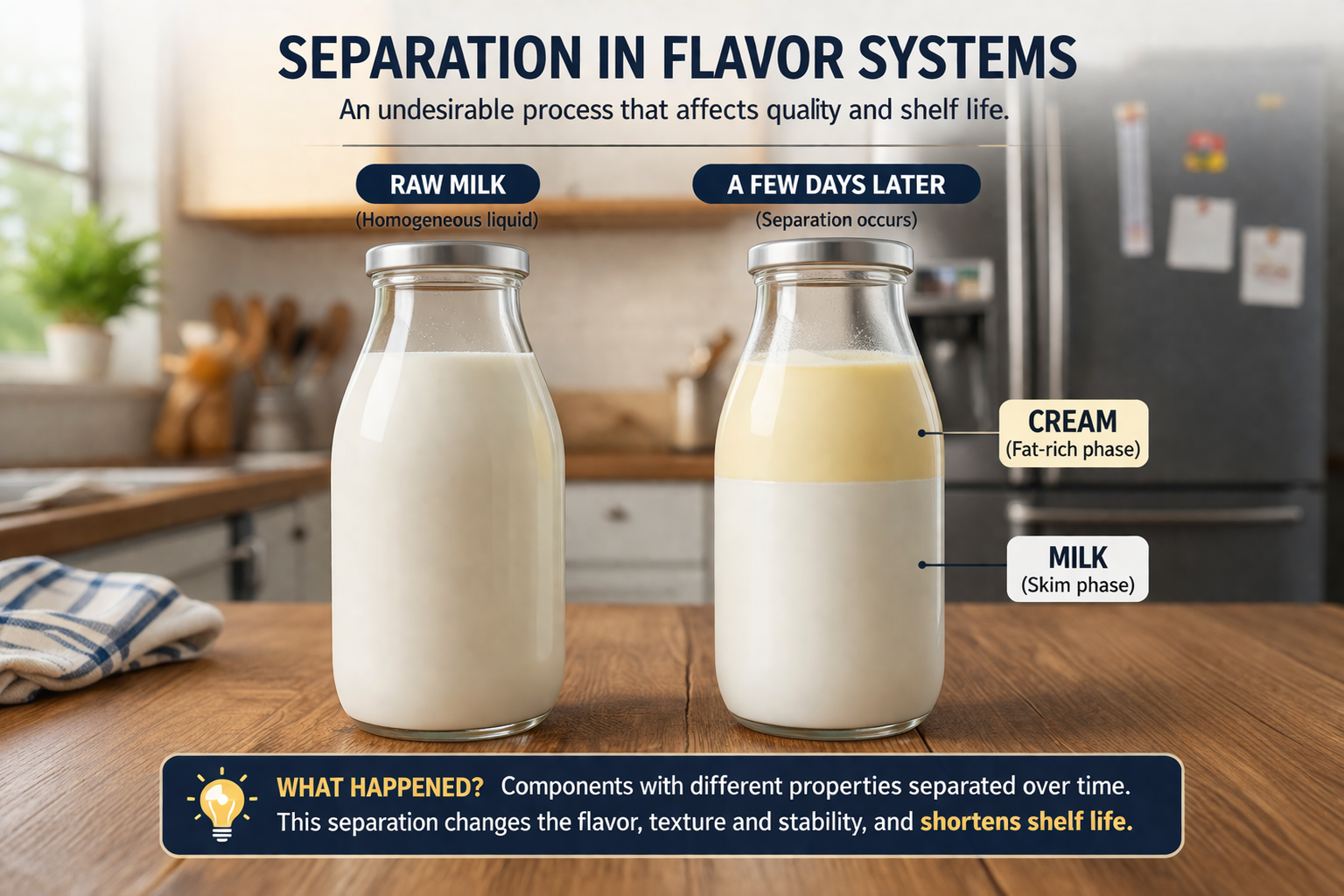
This is a technical overview of separation as it applies to flavor chemistry, structured to address the specific syllabus points for the Society of Flavor Chemists (SFC) qualification exam. The information presented should be more than enough for flavorist trainees to know for the exam.
The Society of Flavor Chemists requires flavorists to fully understand approximately two dozen reactions and processes that can occur in flavor systems. Flavorists must be able to control these reactions or physical processes to enhance flavor or improve its stability and shelf life. Separation is one of the physical processes included among these two dozen reactions and processes.
1. Chemical Groups Involved & Conditions Required
Separation in flavor systems refers to the physical or physicochemical partitioning of components into distinct phases (e.g., oil/water, solid/liquid, gas/liquid).
Chemical Groups Most Susceptible
- Nonpolar volatiles (terpenes, sesquiterpenes, alkanes) → tend to separate into an oil phase.
- Polar aroma compounds (alcohols, aldehydes, short-chain esters, acids) → partition into water or migrate across phases.
- Hydrocolloids & emulsifiers → can separate via creaming or sedimentation.
- Lipid-soluble colors & flavors (oleoresins, paprika, capsicum) → separate with oil droplets.
Conditions Required for Separation to Occur
- Low viscosity (water-thin systems) → allows droplet coalescence.
- High interfacial tension (poor emulsification) → accelerates phase separation.
- Temperature extremes → freezing (destabilizes emulsions), heating (reduces viscosity, accelerates coalescence).
- pH shifts → near pKa of emulsifiers or flavor acids (e.g., citric acid) reduces electrostatic stabilization.
- High centrifugal or gravitational force (storage, transport vibrations).
2. Factors Accelerating or Inhibiting the Process
Accelerating Factors
| Factor | Mechanism |
|---|---|
| High temperature | Lowers viscosity, increases Brownian motion → coalescence |
| Low emulsifier concentration | Incomplete interfacial coverage |
| High electrolyte content | Screens electrostatic repulsion (e.g., Ca²⁺, NaCl) |
| Repeated freeze-thaw | Ice crystal formation punctures emulsion droplets |
| Large droplet size (>1 µm) | Faster Stokes’ law creaming/sedimentation |
Inhibiting Factors
| Factor | Mechanism |
|---|---|
| High viscosity (e.g., gums, starches) | Slows particle movement |
| Proper HLB matching | Ensures stable emulsion |
| Small droplet size (nanoscale) | Brownian motion dominates over gravity |
| Steric stabilizers (e.g., modified cellulose) | Prevents coalescence |
| Uniform density match (oil/water) | Eliminates buoyancy difference |
3. Considerations During Formulation
To prevent or control separation in flavored products:
- Emulsifier selection – Match HLB to oil phase (e.g., polysorbate 80 for citrus oils).
- Density adjustment – Add weighting agents (brominated vegetable oil, sucrose acetate isobutyrate, ester gum) to match aqueous phase density.
- Viscosity modification – Use xanthan gum, CMC, or propylene glycol alginate to immobilize droplets.
- Particle size control – High-pressure homogenization (<1 µm droplets).
- pH management – Keep away from isoelectric points of proteins if used as emulsifiers.
- Antioxidants – Prevent oxidation-induced polar byproducts that alter partitioning.
- Cryoprotectants (sucrose, sorbitol) in frozen products to limit freeze-thaw separation.
4. Examples of the Process
Example 1: Citrus-flavored soft drink
- Separation observed: Cloudy ring at neck or sediment at bottom (terpenes/cloud emulsion breaking).
- Mechanism: Poor density matching + inadequate homogenization.
Example 2: Salad dressing (oil + vinegar + herbs)
- Separation observed: Clear oil layer on top, aqueous layer below.
- Mechanism: No emulsifier or insufficient shear → gravitational separation.
Example 3: Flavored milk beverage
- Separation observed: Creaming (fat globules rise) + flavor loss in fat-depleted phase.
- Mechanism: Incomplete homogenization or protein destabilization.
Example 4: Flavor emulsion for hard candy
- Separation observed: Oil droplets coalesce → burn-on in cooking kettle.
- Mechanism: High temperature + low emulsifier stability.
5. Understanding How the Process Impacts Aging of a Flavor and Shelf Life
Flavor Aging Due to Separation
| Consequence | Explanation |
|---|---|
| Non-uniform flavor distribution | First sip/piece may have different flavor profile than last. |
| Loss of volatile top notes | Separated oil phase can float and increase surface exposure → evaporation. |
| Oxidative degradation | Separated oil layer has higher O₂ contact → accelerated rancidity (aldehydes, ketones, off-notes). |
| Hydrolysis | Water-soluble acids and enzymes at interface can hydrolyze esters (e.g., ethyl butyrate → butyric acid). |
| Phase trapping | Lipophilic flavors trapped in separated oil phase → perceived flavor weakening in aqueous phase. |
Shelf Life Impact
- Physical shelf life ends when separation exceeds consumer acceptance (e.g., >1 mm oil layer).
- Chemical shelf life shortened because separated phases accelerate reaction kinetics (oxidation, hydrolysis, Maillard intermediates partitioning).
- Re-emulsification not feasible by consumer → product rejection.
Mitigation during aging
- Use of microencapsulation (spray-dried flavors) prevents separation entirely.
- Thickening agents delay separation beyond stated shelf life (kinetic stability, not thermodynamic).
- Rheological design – yield stress fluids (e.g., gels, pastes) arrest droplet movement completely.
Exam tip for SFC: When answering a question on separation, always link the physical phenomenon (Stokes’ law, interfacial tension) to a practical flavor outcome (loss of citrus top notes, rancidity, consumer rejection). Mention both thermodynamic (density, HLB) and kinetic (viscosity, droplet size) stability.
Separation in Flavor Systems: Practical Control Factors for Flavorists
What Is Separation in Flavor Terms?
Separation is the physical splitting of a flavored product into distinct phases—oil layer on top, sediment at bottom, or a "ring" at the neck of a bottle. This makes the product look defective and delivers uneven flavor (first sip weak, last sip overpowering).
Chemical Groups Most Prone to Separation
| Chemical Group | Examples | Why They Separate |
|---|---|---|
| Terpenes | d-limonene, myrcene, pinene | Very low density (0.84 g/mL) → float rapidly |
| Sesquiterpenes | caryophyllene, valencene | Poor water solubility, coalesce easily |
| Heavy flavor bases | vanillin, ethyl vanillin, coumarin | Can crystallize or sediment |
| Oleoresins | paprika, capsicum, black pepper | Lipophilic, dense, tend to sediment |
| Short-chain esters | ethyl butyrate, isoamyl acetate | Moderate polarity → partition unpredictably |
Factors Every Flavorist Must Know to Control Separation
1. Droplet Size (The #1 Factor)
| Control | Effect on Separation |
|---|---|
| Small droplets (<0.5 µm) | Stable for months to years—Brownian motion overcomes gravity |
| Large droplets (>2 µm) | Cream or sediment within days |
| How to achieve small droplets | High-pressure homogenization (500–1000 bar), microfluidization, or proper high-shear mixing |
Practical rule: If you can see individual droplets under a standard microscope (40×), your emulsion will separate.
2. Density Matching
| Situation | Result |
|---|---|
| Oil density ≈ water density (0.98–1.02 g/mL) | No buoyancy → no creaming or sedimentation |
| Oil too light (e.g., citrus oil 0.84) | Rapid creaming → ring at top |
| Oil too heavy (e.g., some oleoresins) | Sediment at bottom |
How flavorists fix density:
| Weighting Agent | Density | Typical Use |
|---|---|---|
| SAIB (sucrose acetate isobutyrate) | ~1.14 g/mL | Beverage emulsions |
| Ester gum | ~1.08 g/mL | Citrus cloud emulsions |
| BVO (brominated vegetable oil) | ~1.00–1.30 g/mL | Heavy oils (restricted in many countries) |
| Dammar gum | ~1.07 g/mL | Traditional applications |
Target: Blend weighting agent into oil phase so combined density = 0.99–1.01 g/mL.
3. Viscosity of the Continuous Phase
| Viscosity | Effect |
|---|---|
| Low (water-thin) | Droplets move freely → rapid separation |
| Moderate (50–200 cP) | Slowed creaming → weeks of stability |
| High (gel-like) | Droplets immobilized → no separation |
Practical thickeners for flavor systems:
| Thickener | Typical Use Level | Notes |
|---|---|---|
| Xanthan gum | 0.1–0.3% | Pseudoplastic, works in wide pH |
| Propylene glycol alginate (PGA) | 0.2–0.5% | Excellent emulsion stabilizer |
| CMC (carboxymethyl cellulose) | 0.2–0.5% | Clear solutions, pH sensitive |
| Gum arabic | 5–15% | Oldest beverage emulsion stabilizer |
| Modified starches | 5–10% | Capsule former, also thickens |
4. Emulsifier Selection (HLB Matching)
HLB (Hydrophilic-Lipophilic Balance) Rule:
| HLB Range | Application |
|---|---|
| 3–6 | Water-in-oil emulsions (butter, margarine) |
| 8–10 | Wetting agents |
| 10–14 | Oil-in-water emulsions (most flavors) |
| 13–18 | Detergents, solubilizers |
Common emulsifiers for flavorists:
| Emulsifier | HLB | Best For |
|---|---|---|
| Polysorbate 80 (Tween 80) | 15.0 | Citrus oils, general O/W |
| Polysorbate 20 (Tween 20) | 16.7 | More polar oils, terpeneless oils |
| Mono- and diglycerides | 3–6 | W/O systems |
| DATEM | 8–10 | Bakery emulsions |
| Sucrose esters | 5–16 | Natural label, adjustable |
| Lecithin (modified) | 8–12 | Clean label, less efficient |
Practical HLB calculation:
For a mixed oil phase, the required HLB is the weighted average of individual oil HLB requirements:
| Oil | Required HLB |
|---|---|
| Lemon oil | 10–12 |
| Orange oil | 9–11 |
| Vegetable oil | 7–8 |
| Mineral oil | 10–11 |
If emulsifier HLB is too low → Oil separation (creaming/sediment)
If emulsifier HLB is too high → Excessive foaming, possible flavor loss
5. Emulsifier Concentration
| Concentration | Result |
|---|---|
| Too low | Incomplete coverage → coalescence → separation |
| Optimum (usually 1–5× critical micelle concentration) | Stable interface, small droplets |
| Too high | No additional benefit, possible off-taste (soapy), cost waste |
Rule of thumb: For beverage emulsions, use emulsifier at 10–20% of oil weight.
6. pH and Ionic Strength
| Factor | Effect | Control Strategy |
|---|---|---|
| Low pH (2–4) | May hydrolyze some emulsifiers (e.g., polysorbates) | Use acid-stable emulsifiers (PGA, modified starch) |
| High ionic strength (salt) | Screens electrostatic repulsion → coalescence | Increase emulsifier level or use steric stabilizers |
| Isoelectric point of proteins | Protein emulsifiers precipitate | Keep pH away from pI |
7. Temperature (Processing and Storage)
| Temperature Condition | Problem | Prevention |
|---|---|---|
| High processing heat | Lowers viscosity, promotes coalescence | Cool quickly after homogenization |
| Freeze-thaw | Ice crystals puncture emulsion droplets | Add cryoprotectants (sucrose, sorbitol, propylene glycol) |
| Temperature cycling | Repeated expansion/contraction accelerates creaming | Insulate storage, avoid warehouse temperature swings |
Practical Signs of Separation and What They Mean
| Visible Sign | What Is Happening | Flavor Consequence |
|---|---|---|
| Creamy ring at bottle neck | Oil droplets have floated to top | Top notes lost to evaporation; remaining flavor is heavy, dull |
| Sediment at bottom | Dense particles (crystals, weighting agents, some oleoresins) | Gritty mouthfeel; uneven flavor distribution |
| Clear layer at top, cloudy bottom | Complete phase separation | Product is ruined; shaking may re-emulsify temporarily |
| "Oiling off" (small oil droplets on surface) | Partial coalescence | Flavor will taste weak; accelerated oxidation (rancidity) |
| Cloudy ring + clear liquid | Partial creaming of cloud emulsion | Citrus beverages lose "fresh" character |
Quick Checklist for Formulating Against Separation
Before launching a flavored product, verify:
- [ ] Droplet size < 1 µm (ideally <0.5 µm) via proper homogenization
- [ ] Density difference < 0.02 g/mL (adjust with SAIB, ester gum, or other weighting agent)
- [ ] Viscosity ≥ 50 cP (add xanthan, CMC, PGA, or gum arabic if needed)
- [ ] Emulsifier HLB matches oil phase (calculate weighted average)
- [ ] Emulsifier concentration sufficient (typically 10–20% of oil weight)
- [ ] pH compatible with emulsifier (avoid hydrolysis or protein precipitation)
- [ ] Salt level not excessive (if >1% NaCl, increase emulsifier or use non-ionic)
- [ ] Freeze-thaw stability tested (add cryoprotectants if product will be frozen)
Summary: What Flavorists Actually Control
| Factor | How Flavorist Controls It | Practical Target |
|---|---|---|
| Droplet size | Homogenization method & pressure | <0.5 µm |
| Density | Add weighting agents to oil | Δρ < 0.02 g/mL |
| Viscosity | Add hydrocolloids | >50 cP |
| Interfacial tension | Choose correct HLB emulsifier | HLB match within ±1 |
| Coalescence | Sufficient emulsifier concentration | 10–20% of oil |
| Crystallization | Use terpeneless oils or solvents | Prevent sediment |
| Freeze-thaw | Add cryoprotectants | 5–10% sucrose or sorbitol |
Final Exam Takeaway for SFC
The Society of Flavor Chemists expects you to know how to prevent separation through practical formulation choices—not to derive Stokes' law. Focus on: droplet size (homogenization), density matching (weighting agents), viscosity (hydrocolloids), and emulsifier HLB & concentration. These are the levers every flavorist pulls daily.
The following equations are presented for those seeking a detailed understanding of separation in flavor systems from the perspectives of thermodynamics and kinetics. These equations quantify the relationships among all factors involved in the physical process of separation, thereby offering readers a deeper insight into how separation occurs.
🧪 Separation in Flavor Systems
Stokes' Law & Interfacial Tension: Loss of Top Notes, Rancidity, and Consumer Rejection
Society of Flavor Chemists — Qualification Exam Syllabus
📐 Stokes' Law: The Physics of Droplet Movement
Where: \( v \) = separation velocity, \( r \) = droplet radius, \( \rho_d \) = density of dispersed phase, \( \rho_c \) = density of continuous phase, \( g \) = gravitational acceleration, \( \eta \) = viscosity of continuous phase.
🔬 Interfacial Tension: The Energy Barrier to Stability
Interfacial tension (\( \gamma \)) is the free energy per unit area at the oil-water interface. High \( \gamma \) means:
- Droplets resist deformation → remain large
- Emulsifiers adsorb poorly → insufficient steric/electrostatic repulsion
- Droplets coalesce when they collide → rapid increase in \( r \)
🍊 Loss of Top Notes: Mechanism
Stokes’ Law Role
- Low-density flavor oils (e.g., d-limonene, \( \rho \approx 0.84 \) g/mL) vs. water (\( \rho \approx 1.00 \)) → positive buoyancy → droplets cream upward
- Creamed oil layer forms a thin film at the product surface → top notes evaporate directly from this exposed oil layer
- Larger droplets (poor emulsion) cream faster → top notes lost within days instead of months
Interfacial Tension Role
- High \( \gamma \) → coalescence → fewer but larger droplets → faster creaming per Stokes’ law
- High \( \gamma \) also means oil-water interface is less populated by emulsifiers → no barrier to volatile diffusion from oil to air
Quantitative Example
| Droplet size | Creaming time (1 cm height) | Top note retention after 2 weeks |
|---|---|---|
| 0.5 µm | ~6 months | >95% |
| 5 µm | ~2 weeks | ~60% |
| 50 µm | ~8 hours | <20% (flat, cooked citrus note) |
Consumer perception: Beverage smells "weak" or "flat" immediately upon opening.
🧈 Rancidity: Mechanism
Stokes’ Law Role
- Creamed oil layer sits at air-liquid interface → direct exposure to atmospheric oxygen
- Oxygen diffusion rate in oil is ~100× higher than in water → thick oil layer accelerates oxidative cascade
Interfacial Tension Role
- High \( \gamma \) → incomplete emulsifier coverage → bare oil-water interfaces
- Bare interfaces allow pro-oxidant metal ions (Fe²⁺, Cu²⁺ from water) to contact unsaturated lipids directly → Fenton reaction acceleration
- High \( \gamma \) promotes droplet-droplet contact → hydroperoxides transfer, propagating oxidation
Ethyl esters hydrolyze at interface → free fatty acids → further oxidation to ketones, alkanals.
Consumer perception: "Cardboard," "paint thinner," "turpentine," or "rancid oil" notes.
🚫 Consumer Rejection: Direct and Indirect Pathways
Direct visual rejection (Stokes’ law)
- Rings or layers (creaming) → perceived as "old," "defective"
- Sediment (terpene crystals, weighting agents) → gritty mouthfeel
- Stokes’ law predicts time to visible separation: \( t_{\text{cream}} = h / v \)
Indirect sensory rejection
| Defect | Causal chain |
|---|---|
| Flavor imbalance | Top notes lost → heavy base notes dominate → dull, sweet, or burnt character |
| Rancid off-notes | Oxidation products as above |
| Metallic/soapy | Hydrolysis of emulsifiers at high \( \gamma \) interfaces |
| Phase-separated appearance | Consumer shakes bottle → temporary emulsion breaks rapidly → perceived as "watery then oily" |
📊 Summary: Stokes’ Law vs. Interfacial Tension
| Outcome | Primary Stokes’ law contribution | Primary interfacial tension contribution |
|---|---|---|
| Loss of top notes | Accelerated creaming → surface oil film → evaporation | Poor emulsifier coverage → no diffusion barrier |
| Rancidity | Oil layer exposed to O₂ → oxidation | Bare interfaces → metal ion contact + hydroperoxide transfer |
| Consumer rejection | Visible ring/sediment in predictable time | Flavor imbalance + off-notes + poor re-emulsification |
🔗 The Complete Causal Chain
⚛️ Thermodynamic & Kinetic Physics of Separation
Mathematical quantification for flavor emulsion stability | SFC Qualification Exam
1. Thermodynamics of Separation
Gibbs Free Energy of Emulsion
For a finely divided emulsion, \( \Delta A \) is huge and entropic term is negligible:
Thermodynamic Driving Force for Separation
Separation is spontaneous (\( \Delta G < 0 \)) whenever \( \gamma > 0 \). Larger \( \gamma \) → stronger driving force.
Ostwald Ripening: LSW Theory
Accelerators: high \( \gamma \), high solubility, small initial \( r_0 \).
Inhibitors: very low \( \gamma \), addition of highly insoluble ripening retarder.
2. Kinetics of Separation
2.1 Creaming/Sedimentation (Stokes' Law with Hindered Settling)
Factors Accelerating Separation (decrease \( t_{\text{cream}} \))
Large droplet radius \( r \)
\( t_{\text{cream}} \propto 1/r^2 \)10 µm vs 0.5 µm → 400× faster
Large density difference \( \Delta\rho \)
\( t_{\text{cream}} \propto 1/\Delta\rho \)Limonene (0.84) vs water (1.00) → fast creaming
Low viscosity \( \eta_c \)
\( t_{\text{cream}} \propto \eta_c \)Water-thin beverage → creaming in hours
Factors Inhibiting Separation (increase stability)
Small \( r \)
Microfluidizer → 0.2 µm → creaming time >1 yearDensity matching
\( \Delta\rho \to 0 \) → \( t_{\text{cream}} \to \infty \)Add SAIB or BVO to oil phase
High \( \eta_c \)
Xanthan gum 0.1% → 10× viscosity2.2 Coalescence Kinetics: Film Drainage
More accurate with compressive force \( F \):
Factors Affecting Coalescence
| Factor | Effect on \( t_{\text{drain}} \) | Impact on separation |
|---|---|---|
| High \( \gamma \) | \( t_{\text{drain}} \propto 1/\gamma \) | Accelerates |
| Low \( \eta_c \) | \( t_{\text{drain}} \propto \eta_c \) | Accelerates |
| Large \( r \) | \( t_{\text{drain}} \propto r^2 \) | Accelerates |
| Emulsifier (low \( \gamma \)) | \( t_{\text{drain}} \propto 1/\gamma \) → increases | Inhibits |
| Electrostatic repulsion | Adds \( \Pi_{\text{elec}} \) disjoining pressure | Inhibits |
| Steric repulsion | Prevents thinning below polymer layer | Inhibits |
2.3 Combined Separation Rate Constant
• Small \( r \) (<0.1 µm): Ostwald ripening dominates (\( \propto 1/r^4 \))
• Intermediate \( r \) (0.1–1 µm): Creaming dominates (\( \propto r^2 \))
• Large \( r \) (>1 µm): Coalescence dominates (\( \propto r^2 \))
3. Thermodynamic vs. Kinetic Stability Regions
| System | Thermodynamic status | Kinetic stability | Example |
|---|---|---|---|
| True solution | \( \Delta G_{\text{mix}} < 0 \) | N/A | Ethanol + water + flavor |
| Microemulsion | \( \Delta G \approx 0 \) (\( \gamma \sim 0.001 \) mN/m) | Years | Detergent-based systems |
| Nanoemulsion | \( \Delta G > 0 \) | >1 year | Modern beverage clouds |
| Macroemulsion | \( \Delta G \gg 0 \) | Days to weeks | Salad dressing |
| Separated phases | \( \Delta G = 0 \) (minimized) | No barrier | Oil layer + water layer |
4. Complete Factor Summary Table
| Factor | Thermodynamic effect | Kinetic effect | Net impact |
|---|---|---|---|
| High interfacial tension \( \gamma \) | Stronger driving force | Faster film drainage | Accelerates |
| Small droplet radius \( r \) | Higher Laplace pressure → faster Ostwald | Slower creaming & coalescence | Inhibits (except Ostwald <100 nm) |
| Density matching | No effect | \( v \to 0 \) | Inhibits |
| High viscosity \( \eta \) | No effect | Slower creaming & drainage | Inhibits |
| High temperature | Minor reduction in \( \Delta G \) | Lowers \( \eta \), increases \( D \), \( c_\infty \) | Accelerates |
| Emulsifier addition | Reduces \( \gamma \) | Slows coalescence, adds barriers | Inhibits |
| Polydispersity | Favors growth of large droplets | Faster Ostwald | Accelerates |
5. Practical Thresholds for Shelf Life
\( r < 0.5 \) µm → beverage shelf life >6 months
\( \gamma < 5 \) mN/m → coalescence inhibition
\( \Delta\rho < 0.02 \) g/mL → no visible creaming
1. Thermodynamic: \( \Delta G_{\text{formation}} = \gamma \Delta A - T\Delta S \) — emulsions are unstable because \( \gamma \Delta A \gg T\Delta S \).
2. Kinetic: Stokes' law (\( v \propto r^2 \Delta\rho / \eta \)), film drainage (\( t_{\text{drain}} \propto \eta r^2 / \gamma \)), Ostwald (\( r^3 \propto \gamma D t \)).
3. Accelerating factors: large \( r \), high \( \gamma \), low \( \eta \), high \( \Delta\rho \), high \( T \), no emulsifier.
4. Inhibiting factors: small \( r \), low \( \gamma \), high \( \eta \), density matching, steric/electrostatic barriers.