Smoke concentrates: What flavorists need to know, according to the Society of Flavor Chemists
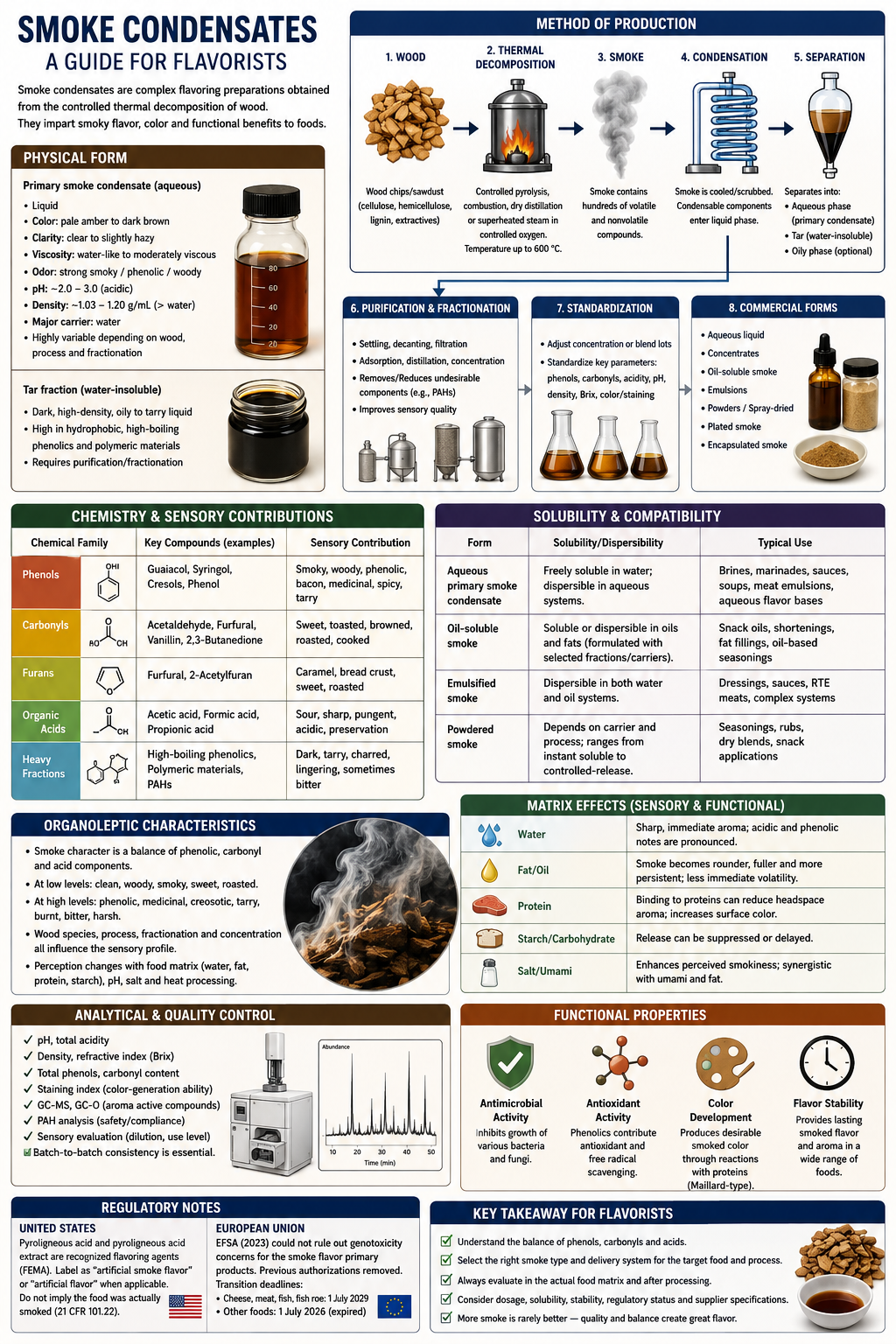
According to the Society of Flavor Chemists (SFC) syllabus, a flavorist/candidate is expected to be able to explain the physical form, method of production, organoleptic characteristics, and solubility of smoke condensates. The syllabus places smoke condensates among the major categories of flavoring materials that a professional flavorist should understand. It does not, however, prescribe one universal composition or sensory profile; commercial smoke condensates vary greatly with wood, pyrolysis conditions, fractionation, and standardization. (Flavor Chemists)
1. What exactly is a smoke condensate?
At the simplest level:
wood → controlled thermal decomposition → smoke → condensation → separation/purification → smoke condensate
It is important for a flavorist not to treat liquid smoke, smoke condensate, primary smoke condensate, tar fraction, and smoke flavor as perfectly interchangeable terms.
Under the technical terminology used in EU smoke-flavor legislation, a primary smoke condensate is specifically the purified water-based portion of condensed smoke. A primary tar fraction is a purified fraction obtained from the water-insoluble high-density tar phase. Further processing of those materials produces derived smoke flavorings. (Eur-Lex)
So, for SFC purposes, think of the category broadly as food-grade condensates and fractions generated from controlled wood smoke, while remembering that the strict regulatory meaning may be narrower.
2. Physical form
Primary aqueous smoke condensate
The classic material is a liquid.
It is normally:
| Property | Typical character |
|---|---|
| State | Liquid |
| Appearance | Pale amber → reddish amber → dark brown |
| Clarity | Clear to slightly hazy depending on fraction/refinement |
| Viscosity | Water-like to moderately viscous |
| Odor | Strong smoky/phenolic/woody odor |
| pH | Usually strongly acidic |
| Density | Usually somewhat greater than water |
| Major carrier | Water |
| Nonvolatile material | Variable |
| Color-producing capability | Highly variable |
Commercial primary products demonstrate just how broad the range can be. For example, one EFSA-characterized product was an aqueous amber-brown liquid with pH 2.0–2.5, density about 1.07 kg/L, 28–33 °Brix, and a substantial staining index. Other evaluated commercial smokes show different density, phenol, carbonyl, acid, water, and staining specifications. These numbers are therefore illustrative, not universal specifications. (EFSA)
Tar fractions
The crude condensed smoke can also form a darker, high-density, water-insoluble tar phase.
This material tends to contain more:
high-boiling phenolics + hydrophobic material + polymeric/condensed material + undesirable PAHs.
Crude tar should not be confused with ordinary food-grade aqueous liquid smoke. Food-grade tar fractions require further purification/fractionation. EU legislation specifically distinguishes the water-insoluble high-density tar phase from the aqueous primary smoke condensate. (Eur-Lex)
Derived commercial forms
Once the primary material has been processed and formulated, a flavorist may encounter smoke as:
| Commercial form | Practical use |
|---|---|
| Aqueous liquid | Brines, sauces, marinades, meat systems |
| Concentrated aqueous smoke | High-impact compounding |
| Oil-compatible smoke | Snack oils, fats, oil-based seasonings |
| Emulsion | Mixed oil/water systems |
| Powder | Seasonings, rubs, dry blends |
| Plated smoke | Dry flavor systems |
| Spray-dried smoke | Dry mixes, encapsulated systems |
| Smoke fraction | Selective phenolic, carbonyl, color, or other character |
An important exam distinction is that a powdered smoke flavor is not literally a primary smoke condensate. It normally begins with a condensate/fraction that has subsequently been placed on or encapsulated in a carrier.
3. How smoke condensates are produced
Wood chemistry is the starting point
Wood consists principally of:
cellulose + hemicellulose + lignin, with smaller amounts of extractives, minerals, resins, etc.
Each contributes differently when heated.
Hemicellulose
It decomposes relatively readily and contributes strongly to:
acetic acid and other organic acids, aldehydes, ketones, furans and related compounds.
These contribute acidity, pungency, sweet/browned nuances and antimicrobial activity.
Cellulose
Thermal decomposition gives many:
carbonyls, furans, hydroxycarbonyl compounds and carbohydrate-degradation products.
These are particularly important for sweetness, toasted/browned character and smoke-induced surface coloration.
Lignin
Lignin is enormously important to smoke aroma.
Its thermal degradation produces phenolic compounds such as:
guaiacol derivatives, syringol derivatives, phenol, cresols and related substituted phenols.
These compounds supply much of what the flavorist identifies as:
smoky, woody, phenolic, charred, spicy and bacon-like character.
A useful memory aid is:
Lignin → phenolic smoke character
Carbohydrates → carbonyl/furan/browning character
Hemicellulose → much of the acid fraction
That is simplified, but extremely useful in practical flavor work.
4. Generation of smoke
Wood chips, sawdust or other specified wood material are thermally decomposed under controlled conditions.
Depending on the process this may involve:
pyrolysis, controlled burning, dry distillation or treatment with superheated steam under controlled oxygen conditions.
The point is not simply to "burn wood." The manufacturer is controlling:
temperature, oxygen availability, residence time, wood moisture, particle size and smoke residence time.
These parameters radically change the chemistry.
European production provisions, for example, describe controlled burning, dry distillation or superheated-steam treatment in controlled oxygen conditions and set a maximum processing temperature of 600 °C for production of the regulated primary products. (Eur-Lex)
Why temperature matters
Too little thermal severity can give weak, acidic, raw-wood character.
Appropriate pyrolysis gives desirable:
phenolics + carbonyls + furans + acids.
Excessive thermal severity or uncontrolled combustion increases:
burnt, soot, bitter/tarry character and potentially undesirable PAHs.
So a professional flavorist should understand that wood species alone does not determine smoke profile. The production process can be just as important, and sometimes more important, than whether the label says hickory, oak, apple, beech, etc.
5. Condensation
The generated smoke is cooled or scrubbed so that condensable constituents enter a liquid phase.
At this point you have a complex mixture containing hundreds of substances.
Water may be used to capture the relatively polar smoke components.
The condensed mixture can separate into:
| Fraction | Main character |
|---|---|
| Aqueous phase | Acids, carbonyls, phenolics; primary smoke condensate |
| Heavy tar phase | Hydrophobic/high-boiling material, heavy phenolics, tar |
| Oily phase | Water-insoluble hydrophobic materials |
EU terminology specifically describes the aqueous primary condensate as containing mainly carboxylic acids, carbonyl compounds and phenolic compounds. (Eur-Lex)
6. Purification and fractionation
This is one of the most important concepts for flavorists.
Crude smoke condensate is not simply bottled and sold as food flavor.
Processing can include:
settling, phase separation, decanting, filtration, adsorption, concentration, distillation/fractionation and other physical purification processes.
The goals include both:
sensory improvement and removal/reduction of undesirable material.
Particularly important are polycyclic aromatic hydrocarbons (PAHs), which tend to associate with the heavier hydrophobic/tar portions of smoke.
EU production rules historically specified maximum levels in primary products of:
benzo[a]pyrene: 10 µg/kg
benz[a]anthracene: 20 µg/kg
and analytical requirements cover a broader PAH set. (Eur-Lex)
This is why a flavorist should never think that "natural wood smoke" automatically means chemically benign. Purification, specifications, regulatory status and supplier documentation matter.
7. Standardization
After purification, manufacturers can adjust the product by:
concentrating, diluting, blending fractions or combining lots.
The objective is batch-to-batch consistency.
A smoke supplier may therefore standardize parameters such as:
phenol content, carbonyl content, total acidity, density, pH, refractive index/Brix, color or staining index.
EFSA's technical guidance specifically identifies physicochemical properties such as solubility, specific gravity, staining index and pH, as well as chemical composition, as relevant characterization information for primary smoke products. (PMC)
8. Organoleptic characteristics
Smoke condensate is best understood sensorially by separating it into several chemical "axes."
| Chemical family | Typical sensory contribution |
|---|---|
| Phenols | Smoky, woody, phenolic, bacon, medicinal, spicy, tarry |
| Guaiacol derivatives | Classic smoke, charred wood, BBQ |
| Syringol derivatives | Woody, smoky, sweet-spicy smoke |
| Cresols/phenol | Sharp, phenolic, medicinal, tarry |
| Carbonyls | Sweet, browned, toasted, cooked |
| Furans | Caramel, bread crust, sweet, roasted |
| Organic acids | Sour, sharp, pungent, acidic |
| Heavy fractions | Dark, tarry, charred, lingering, sometimes bitter |
A review of liquid smoke chemistry similarly identifies phenols, carbonyl compounds and organic acids as the principal chemical groups responsible for its flavor, color and antimicrobial properties. (PubMed)
Phenolic character
Phenolics are the easiest part of smoke to recognize.
At appropriate levels they give:
pleasant BBQ, hardwood, bacon, fireplace, toasted wood and smoked-meat character.
As concentration increases, the same family can move through:
smoky → phenolic → medicinal → creosote → tar → burnt/bitter.
That dose-response relationship is extremely important in flavor creation.
More smoke is very rarely equivalent to better smoke.
9. Carbonyl character
Carbonyl-rich smoke fractions can be considerably less "campfire-like" than phenol-rich fractions.
They tend to support:
sweet smoke, browned meat, toasted, roasted, caramelized and cooked surface notes.
They are also important in development of the characteristic brown surface appearance associated with smoked foods.
In meat applications, carbonyl chemistry interacting with proteins/amino groups contributes to this surface coloration.
This is why manufacturers sometimes talk about a smoke's staining ability or staining index.
Staining index is essentially an indication of the ability of smoke constituents to produce smoked-food browning/color through reactions with amino-containing materials; it is not merely the optical darkness of the liquid itself. (Google Patents)
10. Acid character
Acetic acid and related acids contribute:
sharpness, pungency, tang, sourness and preservation effects.
At low levels, acidity can make smoke seem:
cleaner, sharper and more authentic.
At excessive levels the flavor becomes:
vinegary, biting, harsh or chemically acidic.
Acidity is one reason many aqueous liquid smokes have pH values around roughly 2–3, although individual products vary and the supplier specification—not a textbook range—should control formulation decisions. Several commercial products assessed by EFSA fall within this acidic region. (EFSA)
11. Wood-associated sensory profiles
Flavorists commonly talk about hickory smoke, mesquite smoke, apple smoke, oak smoke, cherry smoke and so forth.
Broadly:
| Style | Typical association |
|---|---|
| Hickory | Strong, classic BBQ, bacon-like |
| Mesquite | Robust, earthy, sharp, dark |
| Oak | Balanced, woody, versatile |
| Beech | Clean, moderate, traditional European smoke |
| Apple/cherry | Softer, sweeter, somewhat fruity |
| Maple | Mild, sweet-woody |
| Alder | Light, delicate, fish-compatible |
But don't memorize those as absolute chemical laws.
The pyrolysis process, fractionation and concentration can override wood-species differences. Two hickory smokes from different processes may smell less alike than two smokes made from different woods.
That is a very flavorist-like way to think about the material.
12. Solubility
This is another area where terminology matters.
Aqueous primary smoke condensate
By definition, the principal condensate is the water-based fraction.
It contains appreciable quantities of:
organic acids, low-molecular-weight carbonyls, furans and sufficiently water-compatible phenolics.
Consequently it normally disperses very readily in aqueous systems.
Good applications include:
brines, marinades, sauces, soups, meat emulsions and aqueous flavor bases.
Why phenols stay in water at all
Many smoke phenols are neither completely hydrophilic nor completely lipophilic.
They possess:
an aromatic hydrophobic ring plus one or more polar hydroxyl/methoxy groups.
Consequently they partition between water, alcohol, oil, protein and other phases.
That partitioning is one of the main reasons smoke character changes so dramatically between food matrices.
Oil-soluble smoke
A commercial "oil-soluble smoke" generally involves further processing, selected fractions, carriers or formulation technology.
It is valuable in:
snack oils, shortening, fat fillings, oil-based seasoning systems and spray oils.
It should not automatically be called a primary aqueous smoke condensate in the strict technical sense.
Powder smoke
Powder solubility depends primarily on the carrier and manufacturing method.
A spray-dried smoke on maltodextrin may dissolve readily in water.
A plated smoke on salt, silica or another substrate may behave more as a dispersion.
An encapsulated smoke may be deliberately designed not to release immediately.
Thus, for powders, the question is not simply "Is smoke soluble?"
It is:
What is the smoke fraction? What is the carrier? What is the encapsulation system? What triggers release?
13. pH and solubility
pH can change smoke behavior.
Many phenolic compounds are weak acids. Their partitioning and apparent solubility change as pH changes.
More importantly in actual food systems, pH affects:
protein interactions, emulsion stability, volatility, taste perception, browning reactions and microbial behavior.
Because liquid smoke itself can be highly acidic, adding a concentrated smoke directly to a sensitive dairy or protein system can sometimes produce localized destabilization.
The practical solution is often to:
pre-dilute, add slowly under good agitation, or adjust the order of addition.
14. Matrix effects every flavorist should understand
This is where textbook knowledge becomes flavor creation.
In water
Smoke tends to present relatively sharply.
Acid and volatile phenolic notes are immediately apparent.
In fat
Hydrophobic smoke components partition into the lipid phase.
Smoke may become:
rounder, fuller and more persistent but less immediately volatile.
This means a smoke that is impressive in water may behave completely differently in a cheese sauce, snack oil or fatty meat system.
In protein
Smoke constituents can interact with proteins.
The result may be:
lower free headspace aroma, increased surface coloration and modification of perceived harshness.
A smoke dosage developed in plain water therefore should never be assumed to transfer directly to meat, dairy or plant protein.
In starch/carbohydrate matrices
Release can be suppressed or delayed.
A dry snack seasoning that smells powerfully smoky in the seasoning jar can produce surprisingly modest smoke after application.
Salt
High ionic strength can alter perception and partitioning.
Smoke also has a strong perceptual relationship with:
salt + umami + fat + Maillard notes.
This is why smoke often appears stronger in a properly salted savory food than in a simple water evaluation.
15. Heat stability
Smoke flavors contain both volatile and relatively nonvolatile components.
Processing can therefore reshape the profile.
High heat tends to reduce some:
volatile, sharp and aromatic top notes.
The remaining profile may become relatively more:
phenolic, woody, roasted and lingering.
Consequently the smoke used for a cold dip or dressing may not be the right smoke for:
baking, frying, retorting, extrusion or high-temperature meat processing.
A flavorist should evaluate smoke after the complete manufacturing process, not merely in the flavor laboratory.
16. Surface application versus internal application
The same smoke can give quite different results depending on application.
Surface spray/dip: strong aroma impact, authentic smoked surface, more coloration.
Injection/brine: uniform internal smoke, generally softer headspace impression.
Direct blend into meat: homogeneous flavor, but protein/fat binding changes release.
Seasoning application: strong initial top note, highly dependent on oil and carrier.
Casing application: useful for smoked-meat appearance and surface aroma.
Smoke flavor therefore has an unusually strong relationship between delivery method and sensory result.
17. Smoke is more than a flavor
Historically, smoking also contributes:
antimicrobial activity, antioxidant effects and color.
Phenolics can contribute antioxidant activity, while acids, phenolics and carbonyl compounds can contribute antimicrobial effects. Scientific literature has demonstrated antimicrobial activity of various liquid smokes against several foodborne microorganisms. (PubMed)
But a flavorist should not assume that adding smoke flavor automatically gives a legally or microbiologically adequate preservation hurdle.
Preservation claims require product-specific validation.
Flavor dosage and antimicrobial dosage are not necessarily the same.
18. Analytical knowledge useful to a flavorist
The SFC syllabus expects flavorists to understand analytical tools including GC, GC-O, MS, density, pH, refractive index/Brix and other measurements relevant to flavor materials. (Flavor Chemists)
For smoke, particularly useful measurements are:
| Measurement | What it tells the flavorist |
|---|---|
| pH | Acidity/system compatibility |
| Total acidity | Strength of acid fraction |
| Density | Identity/lot QC |
| Refractive index/Brix | Concentration/identity |
| Total phenols | Approximate smoke/phenolic intensity |
| Carbonyl content | Browning/sweet-smoke potential |
| Staining index | Color-generation capability |
| GC-FID/GC-MS | Composition and lot consistency |
| GC-O | Which compounds actually drive aroma |
| PAH analysis | Safety/compliance |
| Sensory dilution evaluation | Actual flavor quality |
GC-MS alone is insufficient because a compound present at a very low concentration can dominate odor if its sensory threshold is extremely low.
This is why GC-Olfactometry is especially powerful for smoke. The SFC itself recently hosted work describing use of GC-MS-O and aroma-extract dilution analysis to identify important aroma compounds in condensed hardwood smoke. (Society of Flavor Chemists)
19. How a flavorist should evaluate smoke condensate
The most useful practical discipline is not to judge it only neat.
A concentrated smoke smelled directly from the bottle can be:
overwhelmingly phenolic, acidic and misleading.
Instead, professional evaluation should examine:
odor after controlled dilution → taste at intended use level → behavior in a simple model → behavior in the actual food → behavior after processing → behavior through shelf life.
A useful flavorist vocabulary includes:
clean smoke, sweet smoke, dry smoke, woody, ashy, charred, grilled, roasted, fireplace, bacon, phenolic, medicinal, creosotic, tarry, acidic, pungent, caramelized, browned, spicy, lingering, harsh, smooth and dirty smoke.
"Dirty" versus "clean" is especially useful commercially.
A clean smoke usually has a controlled phenolic character without excessive:
tar, soot, bitterness, creosote or medicinal harshness.
20. How to construct smoke character in a flavor
A flavorist rarely needs "maximum smoke."
You generally want a specific type of smoke.
For example:
BBQ smoke may need smoke phenolics + sweet brown notes + meat/Maillard notes + spice + molasses/caramel nuance.
Bacon smoke may need moderate phenolic smoke + fatty meat character + cured notes + sweet brown character.
Grilled beef may need less obvious "liquid smoke" and more charred, roasted, sulfur/Maillard, fatty and seared notes.
Smoked cheese needs smoke that integrates into dairy fat rather than sitting on top as a medicinal phenolic note.
Applewood-style smoke usually calls for softer, sweet, clean smoke rather than a very creosotic high-phenol impression.
A common beginner's mistake is:
needing "grilled" and adding more liquid smoke.
Grilled, roasted, charred and smoked are related but not identical sensory concepts.
21. Quality-control considerations
For every commercial smoke raw material, the flavorist should obtain and understand:
supplier specification, certificate of analysis, SDS, regulatory declaration, source wood, carrier/solvent, recommended use range, pH, physical form, storage requirements and market-specific regulatory status.
Lot-to-lot sensory checks are important because smoke is a complex natural reaction mixture.
EFSA assessments, for example, examine not only composition but batch-to-batch variability of volatile constituents and physicochemical parameters. (EFSA)
22. Storage and stability
Smoke condensates should generally be protected from:
excessive heat, evaporation, oxidation, contamination and inappropriate container materials.
Potential changes during storage include:
precipitation, darkening, polymerization/reaction of carbonyls, loss of volatile top notes and formation of sediment.
If a smoke develops sediment, do not automatically assume the flavor has spoiled—but investigate against the supplier's specification.
The same applies to haze.
A previously clear material turning hazy may indicate:
temperature effects, chemical aging, pH changes or precipitation of less soluble components.
23. Regulatory knowledge is essential
This category is a particularly good example of why flavor chemistry and regulatory affairs cannot be separated.
United States
FDA's current ingredient inventory identifies pyroligneous acid and pyroligneous acid extract as flavoring agents/adjuvants and links them to FEMA numbers. U.S. labeling rules also specifically address pyroligneous acid/artificial smoke flavor. (FDA HFP App External)
Under 21 CFR 101.22, pyroligneous acid or other artificial smoke flavor may be declared as artificial flavor or artificial smoke flavor, and the regulation limits representations implying that such a product was actually smoked. (Legal Information Institute)
Exact labeling depends on the identity of the smoke product, manufacturing process, food, claims and jurisdiction, so the flavorist should not personally infer a "natural" declaration simply because wood was the starting material.
European Union — particularly important now
The regulatory situation changed substantially.
EFSA reported in November 2023 that it could not rule out genotoxicity concerns for any of the eight smoke flavor primary products being reassessed. (European Food Safety Authority)
The European Commission subsequently refused renewal and removed the ten former entries from the authorized Union list. Under the transition adopted in Regulation (EU) 2024/2067:
cheese, meat, processed fish/fishery products and fish roe have a transition extending to 1 July 2029 for the relevant products.
For other food categories, the transition date was 1 July 2026, which has already passed as of August 2026. (Food Safety)
That is a major commercial-development consideration for any flavorist formulating products for Europe.
24. The most useful SFC-style answer to remember
If you were asked the subject orally in an SFC examination, a strong concise answer would essentially be:
Smoke condensates are complex flavoring preparations generated by controlled pyrolysis or combustion of wood, followed by condensation, phase separation, purification and often further fractionation or standardization. The primary smoke condensate is the purified aqueous fraction and is generally an amber-to-dark-brown, acidic liquid. Its important chemical families are phenolics, carbonyls/furans and organic acids. Phenolics provide the principal smoky, woody and phenolic character; carbonyl and furan components contribute sweet, toasted and browning characteristics; acids contribute sharpness and acidity. Heavy tar fractions contain more hydrophobic high-boiling material and require purification, particularly with respect to PAHs. The primary condensate is predominantly water-compatible, while further processing can produce oil-compatible, emulsified and dry smoke preparations. Selection requires consideration of wood/process, phenol-carbonyl-acid balance, staining potential, solubility, target matrix, heat processing, dosage, regulatory status and sensory performance in the finished food.
That covers the SFC's four explicit expectations while demonstrating the broader working knowledge expected of a professional flavorist. (Flavor Chemists)
The most important practical principle is: never select a smoke solely by how smoky it smells in the bottle. Select it according to its phenolic/carbonyl/acid balance, delivery system, food matrix, processing conditions, target sensory concept and regulatory market.
###