Smoking-Specific Flavor Compounds in Smoked Foods
Smoking-Specific Flavor Compounds in Smoked Foods
Smoking generates unique flavor compounds primarily through thermal decomposition of wood (pyrolysis) and deposition of smoke constituents onto food surfaces. Key chemical pathways include condensation of smoke volatiles, absorption into food matrices, interaction with food components, and secondary reactions during smoking and storage. Smoking-specific compounds are dominated by phenolic compounds, carbonyls, organic acids, and polycyclic aromatic hydrocarbons (PAHs) derived from lignin, cellulose, and hemicellulose pyrolysis.
Key Chemical Pathways in Smoking vs. Other Cooking Methods:
- Wood pyrolysis (200-600°C) → primary smoke compounds from lignin, cellulose, hemicellulose
- Smoke deposition: Particle adhesion, condensation, absorption onto food surfaces
- Smoke-food interactions: Reactions between smoke phenols and food proteins/fats
- Combined heat/smoke effects: Simultaneous cooking and flavoring
- Antimicrobial/antioxidant effects: From phenolic acids and carbonyls
- Multiple smoke generation methods: Hot smoking (cooks + flavors), cold smoking (flavors only), liquid smoke (controlled application)
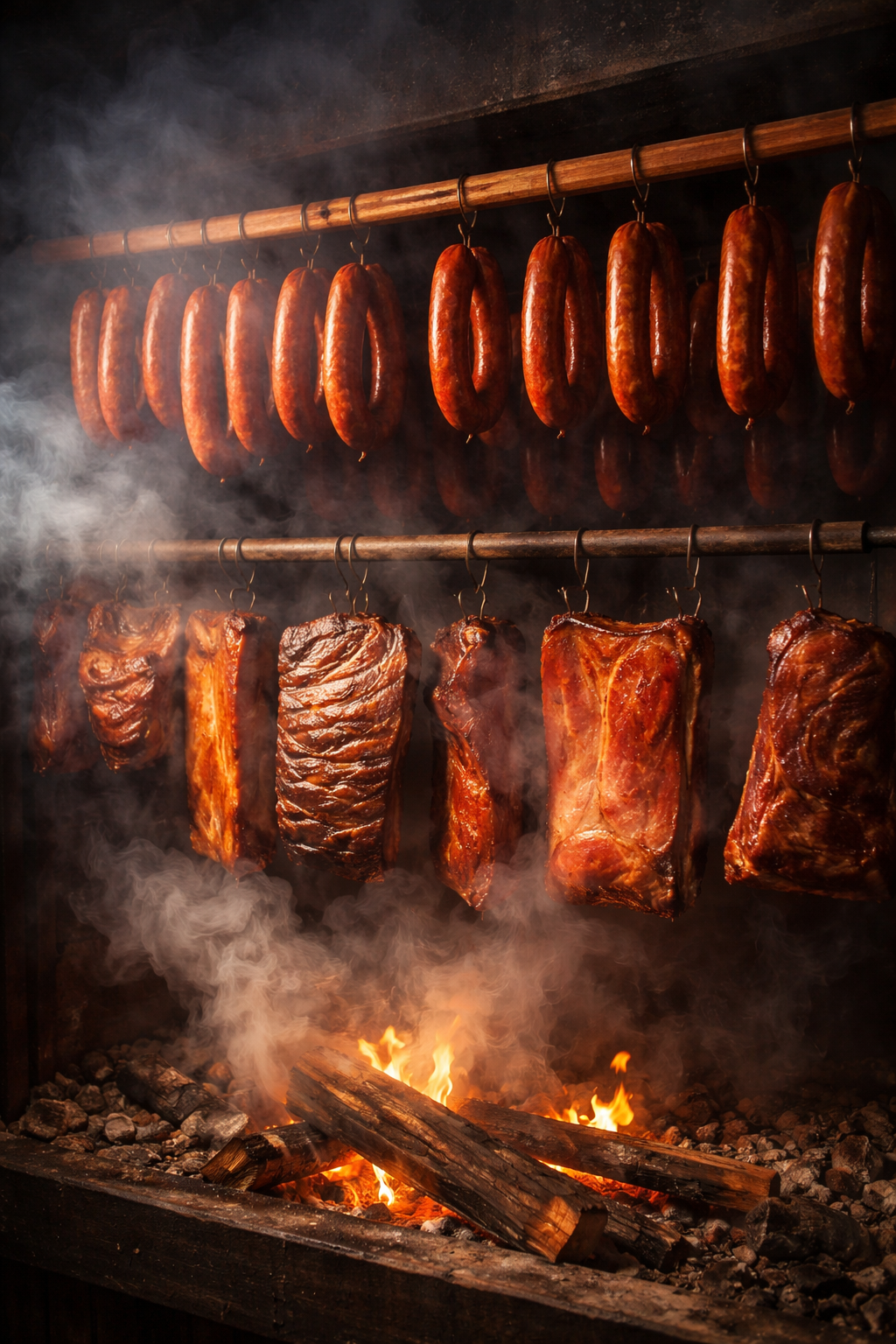
1. SMOKED MEATS (Ham, Bacon, Sausages, Pastrami)
Smoking-specific compounds:
- Phenolic compounds (from lignin pyrolysis):
- Guaiacol (2-methoxyphenol) – smoky, medicinal
- 4-Methylguaiacol – smoky, spicy
- Syringol (2,6-dimethoxyphenol) – smoky, sweet
- Eugenol (4-allyl-2-methoxyphenol) – clove-like (from hardwood smoke)
- Creosol (4-methyl-2-methoxyphenol) – smoky
- Phenol – medicinal, tarry
- Carbonyl compounds (from cellulose/hemicellulose pyrolysis):
- Furfural – sweet, bready
- 5-Methylfurfural – caramel-like
- Hydroxyacetone (acetol) – sweet, caramel
- Cyclotene (2-hydroxy-3-methyl-2-cyclopenten-1-one) – maple-like
- Organic acids (antimicrobial):
- Acetic acid – sharp, vinegar
- Formic acid – pungent
- Propionic acid – rancid, sweet
- Polycyclic aromatic hydrocarbons (PAHs) (undesirable, but smoking-specific):
- Benzo[a]pyrene – carcinogenic marker compound
- Benzo[a]anthracene, chrysene
- Smoke-derived heterocycles:
- 2,6-Dimethoxyphenol derivatives
- Maltol (3-hydroxy-2-methyl-4H-pyran-4-one) – sweet, caramel
Key References:
- Maga, J. A. (1988). Smoke in Food Processing. CRC Press.
→ Definitive text on smoke chemistry, generation, and application to foods. - Guillén, M. D., & Ibargoitia, M. L. (1999). Influence of the moisture content on the composition of the liquid smoke produced in the pyrolysis process of Fagus sylvatica L. wood. Journal of Agricultural and Food Chemistry, 47(10), 4126-4136.
→ Detailed analysis of wood pyrolysis products. - Tóth, L., & Potthast, K. (1984). Chemical aspects of the smoking of meat and meat products. Advances in Food Research, 29, 87-158.
→ Comprehensive review of meat smoking chemistry.
2. SMOKED FISH (Salmon, Trout, Mackerel, Haddock)
Smoking-specific compounds (beyond meat phenolics):
- Fish-smoke interactions:
- Trimethylamine oxide (TMAO) + smoke phenols → unique reaction products
- Fish lipid oxidation enhanced by smoke phenols → different aldehyde profiles
- Specific phenolic ratios: Higher syringol/guaiacol ratio preferred for fish vs. meats
- Nitrogen-containing smoke compounds (from protein in wood): Pyridines, pyrroles that interact with fish amines
- Formaldehyde from smoke: Reacts with fish proteins → texture changes
- Phenol-protein interactions: Modify texture and water-holding capacity
Key References:
- Cardinal, M., Knockaert, C., Torrissen, O., Sigurgisladottir, S., Mørkøre, T., & Thomassen, M. (2001). Relation of smoking parameters to the yield, colour and sensory quality of smoked Atlantic salmon (Salmo salar). Food Research International, 34(6), 537-550.
→ Links smoking parameters to fish quality. - García-Arias, M. T., Álvarez Pontes, E., García-Fernández, M. C., & Sánchez-Muniz, F. J. (2003). Cooking-freezing-reheating (CFR) of sardine (Sardina pilchardus) fillets. Effect of different cooking and reheating procedures on the proximate and fatty acid composition. Food Chemistry, 83(3), 349-356.
→ Includes smoked fish analysis.
3. SMOKED CHEESES (Smoked Gouda, Scamorza, Applewood Cheddar)
Smoking-specific compounds:
- Surface-adsorbed phenols: Different penetration than in meats due to fat content
- Phenol-lipid interactions: Phenols partition into cheese fat, modifying release kinetics
- Lactone enhancement: Smoke heat can increase γ-lactone formation from hydroxy fatty acids
- Methyl ketone reduction: Some smoke compounds may reduce blue cheese character
- Casein-phenol complexes: Affect texture and melt properties
- Wood-specific characters: Applewood vs. hickory vs. mesquite give different profiles
Key References:
- Banks, J. M., & Muir, D. D. (1988). Stability of lipids in smoked cheese. International Journal of Dairy Technology, 41(1), 25-28.
→ Examines smoke effects on cheese lipids.
4. SMOKED VEGETABLES/NUTS (Smoked Paprika, Almonds, Salt)
Smoking-specific compounds:
- Surface deposition without penetration: Most smoke compounds remain on surface
- Vegetable oil absorption: In nuts, smoke compounds dissolve in surface oils
- Carotenoid-smoke interactions: In paprika, smoke affects color stability
- Moisture content effects: Dry vegetables absorb smoke differently than moist ones
- Cellulose-derived compounds dominate: More furfurals, hydroxyacetone relative to phenols
Key References:
- Guillén, M. D., & Manzanos, M. J. (2002). Study of the volatile composition of an aqueous oak smoke preparation. Food Chemistry, 79(3), 283-292.
→ Analysis of smoke for vegetable applications.
5. LIQUID SMOKE vs. TRADITIONAL SMOKING
Liquid smoke-specific characteristics:
- PAH removal: Fractionation removes heavy PAHs
- Controlled composition: Consistent phenol/carbonyl/acid ratios
- Different application: Spraying, dipping, injection vs. atmospheric exposure
- Concentrated fractions: Specific fractions for color, flavor, preservation
- pH adjustment: Often adjusted for specific applications
Traditional smoke advantages:
- Complexity: Hundreds of minor compounds not in liquid smoke
- Simultaneous drying: With smoke deposition
- Surface effects: Pellicle formation on meats/fish
Key References:
- Underwood, G., & Graham, R. (1989). Liquid smoke: a natural antimicrobial and antioxidant. Journal of Food Safety, 10(2), 91-103.
→ Details liquid smoke composition and effects. - Hattula, T., Elfving, K., Mroueh, U. M., & Luoma, T. (2001). Use of liquid smoke flavouring as an alternative to traditional flue gas smoking of rainbow trout fillets (Oncorhynchus mykiss). LWT-Food Science and Technology, 34(8), 521-525.
→ Direct comparison of methods.
WOOD TYPE EFFECTS ON SMOKE COMPOSITION:
| Wood Type | Dominant Compounds | Flavor Profile | Common Uses |
|---|---|---|---|
| Hickory | High guaiacol, syringol | Strong, bacon-like | Pork, ham |
| Apple/Cherry | More syringol, eugenol | Sweet, fruity | Poultry, cheese |
| Mesquite | High phenol, creosol | Earthy, intense | Beef, strong meats |
| Alder | Balanced phenols, furfurals | Mild, sweet | Fish, poultry |
| Oak | Guaiacol, vanillin precursors | Wine-like, balanced | General purpose |
| Beech | Similar to oak, less intense | Mild, clean | European meats, fish |
SMOKING-SPECIFIC CHEMICAL SIGNATURES:
- Phenol-to-carbonyl ratio: Indicates lignin vs. cellulose pyrolysis balance
- Guaiacol/syringol ratio: Indicates wood type and pyrolysis conditions
- PAH profile: Benzo[a]pyrene as marker for heavy PAHs
- Furfural/hydroxyacetone ratio: Indicates cellulose pyrolysis temperature
- Acetic acid content: Related to antimicrobial effect
SMOKE GENERATION CHEMISTRY:
Primary pyrolysis products (from wood at 200-400°C):
- Lignin → phenols (guaiacol, syringol, phenol)
- Cellulose → levoglucosan, hydroxyacetone, furfural
- Hemicellulose → acetic acid, furfural
Secondary reactions (in smoke phase, 400-600°C):
- Phenol polymerization → polyphenols
- Aldol condensations → larger carbonyls
- PAH formation → benzopyrenes
Deposition mechanisms:
- Condensation: On cooler food surfaces
- Adsorption: To food surfaces
- Absorption: Into food matrices (especially fats)
- Chemical binding: To proteins, amines
COMPARISON WITH OTHER COOKING METHODS:
| Compound/Characteristic | Smoking | Grilling | Roasting | Frying |
|---|---|---|---|---|
| Guaiacol | Very High | Medium | Low* | None |
| Syringol | High | Low | None | None |
| Phenol | High | Low | None | None |
| Furfural | High | Medium | High | Medium |
| PAHs | High** | Medium | Low | Low |
| Acetic acid | High | None | None | None |
| *Unless wood/roasted | ||||
| **Depends on method |
KEY CHEMICAL MECHANISMS IN SMOKING:
- Pyrolysis selectivity:
- Low temperature (<350°C): More acids, fewer phenols
- Medium temperature (350-450°C): Optimal flavor balance
- High temperature (>450°C): More PAHs, harsher flavors
- Smoke aging:
- Fresh smoke: More reactive compounds
- Aged smoke: More condensation products, milder flavor
- Food-smoke interactions:
- pH effects: Acidic foods absorb more phenols
- Fat content: Lipophilic smoke compounds partition into fat
- Moisture: Water layer affects absorption
- Protein binding: Phenols bind to amino groups
- Preservation mechanisms:
- Antimicrobial: Phenols, acids, carbonyls
- Antioxidant: Phenols prevent lipid oxidation
- Surface drying: Reduces water activity
PRACTICAL FLAVOR CREATION FOR SMOKED NOTES:
Key target compounds:
- Guaiacol – primary smoky note
- 4-Methylguaiacol – spicy smoky
- Syringol – sweet smoky
- Furfural – sweet, bready background
- Acetic acid – sharp, preservative note
Smoke flavor formulations typically include:
- Phenolic fraction: Guaiacol, creosol, phenol
- Carbonyl fraction: Furfural, hydroxyacetone, cyclotene
- Acid fraction: Acetic, formic acids
- Support notes: Vanillin, maltol for sweetness
References for flavor creation:
- Bratzler, L. J., Spooner, M. E., & Weatherspoon, J. B. (1969). Smoke flavoring of food products. Journal of Agricultural and Food Chemistry, 17(1), 36-39.
→ Early work on synthetic smoke flavors. - Fiddler, W., Doerr, R. C., & Wasserman, A. E. (1970). Composition of hickory sawdust smoke. Furans and phenols. Journal of Agricultural and Food Chemistry, 18(2), 310-312.
→ Analysis of specific wood smoke.
SAFETY CONSIDERATIONS IN SMOKING:
- PAH control:
- Temperature control: <400°C reduces PAH formation
- Distance from heat: Longer smoke path allows PAH condensation
- Filtration: Remove particulates that carry PAHs
- Liquid smoke: PAH removal during production
- Nitrosamine formation:
- Smoke + nitrite-cured meats → potential nitrosamines
- Controlled by ascorbate addition, proper smoking conditions
- Formaldehyde:
- From wood pyrolysis, especially softwoods
- Reacts with proteins, affects texture
MODERN SMOKING TECHNOLOGIES:
- Electrostatic smoking: Charged smoke particles increase deposition efficiency
- Smoke condensate fractionation: Separate flavor, color, preservative fractions
- Controlled pyrolysis: Precise temperature control for consistent smoke
- Smoke flavor encapsulation: Microencapsulation for controlled release
- Combined processes: Smoking + drying, smoking + cooking optimization
Reference:
- Šimko, P. (2005). Factors affecting elimination of polycyclic aromatic hydrocarbons from smoked meat foods and liquid smoke flavorings. Molecular Nutrition & Food Research, 49(7), 637-647.
→ Modern approaches to smoke safety.
CRITICAL FACTORS IN SMOKING CHEMISTRY:
- Wood composition:
- Hardwoods (oak, hickory, fruitwoods): Better flavor, fewer resins
- Softwoods (pine, fir): More resins, harsher flavor, more formaldehyde
- Moisture content:
- Dry wood (<15%): Burns hotter, less smoke
- Moderate moisture (20-30%): Optimal smoke production
- Wet wood (>40%): Steam, less pyrolysis
- Oxygen availability:
- Limited oxygen: More pyrolysis, less combustion
- Excess oxygen: More combustion, less smoke
- Smoke application method:
- Cold smoking (<30°C): Flavor only, no cooking
- Hot smoking (60-80°C): Cooking + flavoring
- Liquid smoke application: Dipping, spraying, injection
- Food characteristics:
- Surface moisture: Dry surfaces absorb more smoke
- Fat content: Fat absorbs lipophilic smoke compounds
- pH: Affects smoke compound absorption
- Surface area: Finely ground foods absorb more smoke
ANALYTICAL METHODS FOR SMOKE CHARACTERIZATION:
- GC-MS for volatiles: Phenols, carbonyls, acids
- HPLC for PAHs: Benzo[a]pyrene as marker
- Sensory analysis: Correlate chemical composition with flavor perception
- Smoke density measurement: Optical methods for smoke concentration
- Particle size analysis: Affects deposition efficiency
The unique combination of thermal decomposition products from wood, their deposition onto food, and subsequent interactions with food components creates the characteristic smoked flavor profile. Unlike other cooking methods where flavors are generated from the food itself, smoking introduces exogenous flavor compounds that define the final product character. The preservative effects (antimicrobial, antioxidant) are additional functional benefits not provided by other cooking methods.