Spectrophotometer vs. Colorimeter: A Complete Guide for the Flavor Industry
Introduction
In the flavor industry, visual perception shapes taste expectations. Before a consumer ever tastes a product, they evaluate its color. This makes precise color measurement essential for quality control, shelf-life testing, and formulation development.
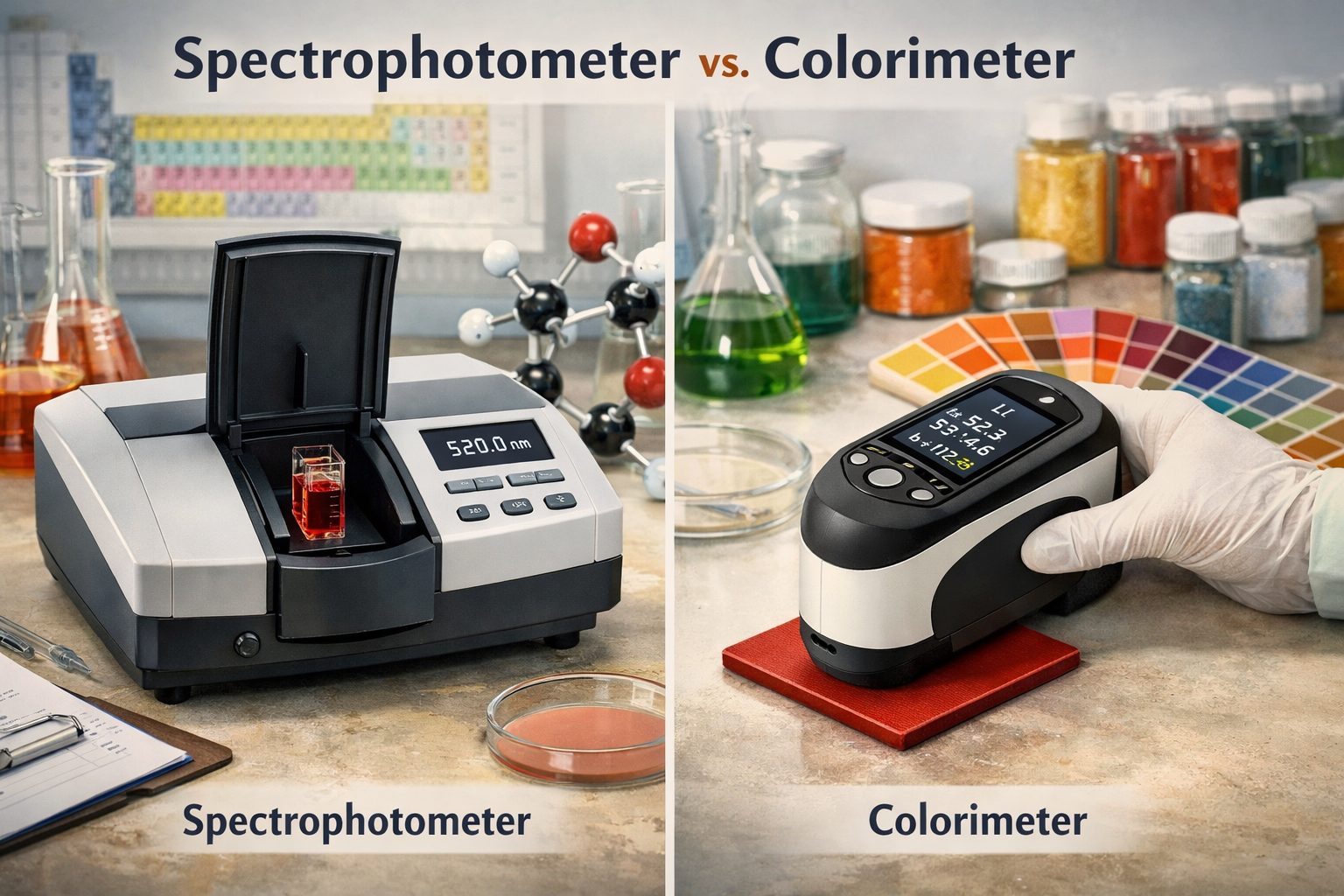
Two instruments dominate this field: the colorimeter and the spectrophotometer. While both measure light interaction with samples, they serve distinct purposes. Understanding their differences helps flavor laboratories and production facilities choose the right tool for consistent, market-ready products.
1. Theory of Operation
How a Colorimeter Works
A colorimeter operates on the principle of filter photometry. It uses a fixed light source—typically tungsten or LED—and passes the light through a physical filter. This filter isolates a specific wavelength band, usually 40 to 100 nanometers wide.
The instrument measures:
- Incident light ($I_0$): light before passing through the sample
- Transmitted light ($I$): light after passing through the sample
It calculates absorbance using the relationship $A = \log_{10}(I_0/I)$. According to the Beer-Lambert principle, absorbance correlates directly with the concentration of the light-absorbing substance in the sample.
Because colorimeters rely on fixed filters, they can only measure at preset wavelengths. Common options include 420 nm, 540 nm, and 620 nm.
How a Spectrophotometer Works
A spectrophotometer uses molecular absorption spectroscopy with full spectral dispersion. Instead of fixed filters, it employs a monochromator—typically a diffraction grating or prism—that separates light into individual wavelengths.
Key components include:
- Light sources: deuterium for ultraviolet ranges, tungsten for visible ranges
- Monochromator: isolates narrow bandwidths as small as 0.5 to 2 nm
- Detector: measures light intensity before and after sample interaction
This design allows the instrument to scan across a continuous spectrum. The resulting absorption pattern serves as a molecular fingerprint, enabling both qualitative identification and precise quantitative analysis.
2. Functions and Reporting Capabilities
Core Functions
| Function | Colorimeter | Spectrophotometer |
|---|---|---|
| Primary use | Routine quantification of known compounds | Qualitative identification and full-spectrum analysis |
| Wavelength range | Fixed, filter-dependent | Continuous scanning (typically 380–780 nm for visible) |
| Sample types | Clear liquids, routine QC | Liquids, emulsions, powders, opaque samples |
| Data collection | Single or limited data points | Full spectral curves |
Reporting Formats
Colorimeter outputs typically include:
- Absorbance values at specific wavelengths
- Percent transmittance (%T)
- Calculated concentration based on calibration curves
- Basic tristimulus values
Spectrophotometer outputs provide significantly more detail:
- Full spectral curves (absorbance vs. wavelength)
- CIE Lab* color space values (L* for lightness, a* for red-green balance, b* for yellow-blue balance)
- LCH values (luminance, chroma, hue)
- ΔE (total color difference) for batch comparison
- Color matching under multiple illuminants (daylight, incandescent, fluorescent)
- Whiteness and yellowness indices
3. Relevance to the Flavor Industry
Color directly influences flavor perception. A clear lemon-flavored beverage that appears amber may be perceived as oxidized or stale before tasting. For this reason, color measurement is integrated throughout the flavor development and production process.
Quality Control and Batch Consistency
Flavor manufacturers produce thousands of batches annually. Raw material variations—such as differences in caramel color, vanilla extract oxidation, or natural extract batches—can cause visible shifts.
Using a spectrophotometer, quality control teams measure ΔE between production batches and the approved standard. When ΔE exceeds 1.0, the batch may be rejected despite meeting chemical specifications. This ensures consistent shelf appearance across retail channels.
Shelf-Life Stability Studies
Citrus, vanilla, and berry flavors are susceptible to oxidation and photodegradation. Over time, these flavors develop yellow or brown discoloration.
Spectrophotometers track the browning index over accelerated stability studies. By measuring spectral changes at regular intervals, research teams can:
- Predict true shelf life
- Determine appropriate packaging materials
- Select light-blocking additives
- Establish expiration dating
Natural Versus Artificial Flavor Matching
Reformulating to natural flavors presents unique challenges. Natural flavors often contain color bodies from carrier oils, oleoresins, or botanical extracts that artificial versions lack.
Spectrophotometers quantify these inherent color contributions. Flavorists use this data to adjust formulations—adding color correction or selecting alternative carriers—to match legacy product appearance without altering taste profiles.
Beverage Haze and Clarity Measurement
In beverages, clarity or haze is a critical quality attribute. Cloudy lemonades require consistent turbidity, while clear spirits and flavored waters demand near-zero haze.
Spectrophotometers measure percent haze by detecting scattered light at 90-degree angles. This allows manufacturers to:
- Verify filtration effectiveness
- Detect microbial contamination early
- Maintain consistent product appearance
4. Advantages and Limitations
Colorimeter
Advantages
- Lower cost: typically one-fifth the price of a spectrophotometer
- Portability: rugged design suitable for production floors
- Ease of use: minimal training required
- High throughput: rapid testing for routine parameters
Limitations
- Fixed wavelengths: cannot adapt to new analytes without physical filter changes
- Metamerism blind: cannot verify color matching under different lighting conditions
- Limited diagnostics: provides pass/fail data without explaining root causes
- Turbidity interference: may misinterpret suspended particles as color changes
Spectrophotometer
Advantages
- Full spectral data: enables compound identification and degradation tracking
- Metamerism analysis: calculates color appearance under multiple illuminants
- Versatility: supports both color measurement and concentration analysis
- High sensitivity: detects subtle shifts before visible changes occur
- Multiple sample types: handles liquids, emulsions, powders, and solids
Limitations
- Higher investment: increased capital and maintenance costs
- Technical complexity: requires trained personnel for method development
- Environmental sensitivity: diffraction gratings are susceptible to vibration and humidity
- Sample preparation: may require dilution or filtration for optimal results
Comparison Table: Flavor Industry Applications
| Parameter | Colorimeter | Spectrophotometer |
|---|---|---|
| Best application | Production floor QC, clear liquids | R&D formulation, shelf-life studies, complex matrices |
| Typical output | Single-wavelength absorbance | Full spectrum + CIE Lab* + ΔE |
| Flavor example | Caramel color in soda syrup | Natural lemon emulsion color matching |
| Environment | Factory floor, field use | Laboratory, controlled environment |
| Data depth | Quantitative only | Quantitative + qualitative |
Choosing the Right Instrument
The choice between a colorimeter and a spectrophotometer depends on the specific application:
Select a colorimeter when:
- Testing high volumes of clear, consistent samples
- Operating on a production floor with varied staff
- Budget is a primary constraint
- Only pass/fail color data is required
Select a spectrophotometer when:
- Developing new flavor formulations
- Conducting shelf-life stability studies
- Matching colors across different lighting conditions
- Troubleshooting unexpected color variations
- Working with opaque, turbid, or complex samples
Conclusion
Both colorimeters and spectrophotometers serve essential roles in the flavor industry. The colorimeter acts as a reliable, efficient gatekeeper for routine production quality control. The spectrophotometer functions as a comprehensive analytical tool for research, development, and complex troubleshooting.
For companies seeking to maintain brand consistency, extend product shelf life, and successfully execute natural flavor transitions, understanding the capabilities and limitations of each instrument is essential. Selecting the appropriate technology ensures that the first impression—color—aligns with the taste experience consumers expect.
Keywords: spectrophotometer vs colorimeter, flavor industry color measurement, beverage color analysis, CIE Lab flavor applications, shelf-life stability testing, natural flavor matching, color difference ΔE, quality control flavor manufacturing, browning index measurement, beverage haze analysis*
###