The Brown Note System™: A Complete Flavorist’s Guide to Maillard Chemistry, Compound Libraries, Reaction Flavor Design, and Multi-Phase Formulation Across All Applications
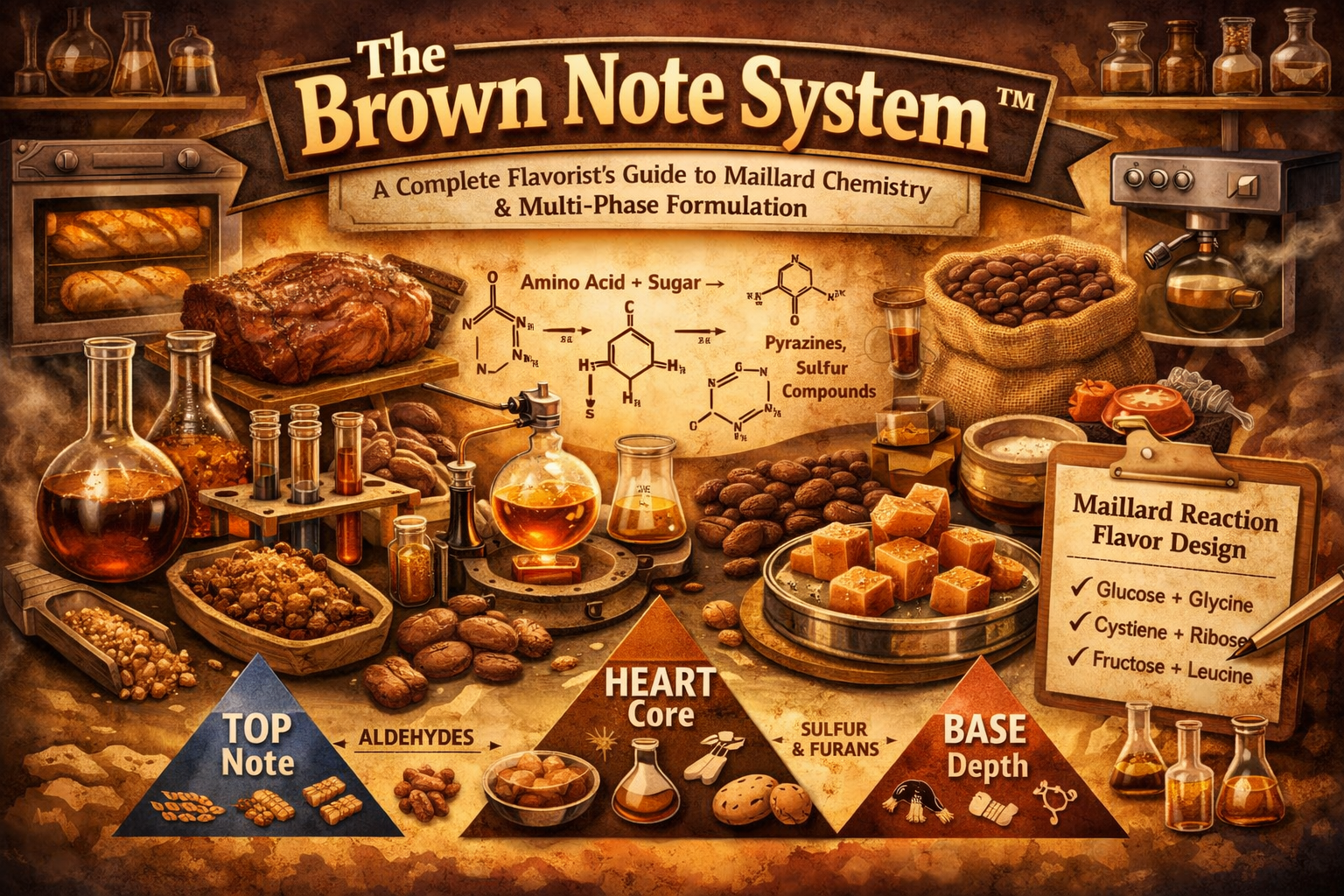
The Society of Flavor Chemists requires flavorists to fully understand roughly 20 essential flavor notes and to skillfully manipulate each note for every application. The brown note is one of them.
The following are the common questions about the brown note.
- What chemical compounds are responsible for creating the "brown note" in a flavor?
- Is the brown note considered part of the top note, heart note, or base note?
How can a flavorist increase or reduce the intensity of the brown note in a formulation? - Which specific flavor compounds help boost or dampen this note?
- What are the main challenges in maintaining the brown note throughout a product's shelf life?
- Which food matrices (such as high-fat, high-protein, or dry systems) are most favorable for preserving the brown note?
Here is a thorough training course on the "brown note" designed for beginner flavorist trainees. The course is structured into modules, directly answering these questions and adding essential knowledge for formulation work.
Course Title: Mastering the Brown Note in Flavor Creation
Target Audience: Trainee Flavorists
Prerequisites: Basic knowledge of flavor terminology (top/middle/base notes, volatile organic compounds)
Module 1: What Is the "Brown Note"?
Definition:
The "brown note" is not a single chemical but a sensory profile associated with cooked, roasted, caramelized, baked, or toasted flavors. It evokes warmth, depth, richness, and often sweetness or savoriness. Think of:
- Crust on bread
- Coffee roast
- Chocolate
- Gravy or roasted meat
- Caramel or toffee
Key point for trainees: The brown note sits between sweet and savory. It often signals Maillard reaction products and caramelization compounds.
Module 2: What Chemical Compounds Define the Brown Note?
Here are the major classes and examples:
| Compound Class | Examples | Sensory Descriptor |
|---|---|---|
| Pyrazines | 2,3,5-Trimethylpyrazine, 2-Ethyl-3-methylpyrazine | Nutty, roasted, earthy |
| Furans & Furanones | Furaneol (strawberry furanone), Sotolon | Caramel, sweet, maple, curry (at high levels) |
| Thiazoles | 4-Methyl-5-vinylthiazole | Roasted, nutty, popcorn |
| Pyrroles | 2-Acetylpyrrole | Bready, nutty, slightly sweet |
| Thiophenes | 2-Methylthiophene | Meat-like, roasted |
| Aldehydes (low volatility) | Phenylacetaldehyde (honey-like), Furfural | Bready, almond, caramel |
Beginner tip: Start with pyrazines and furaneol for most brown notes. Use thiazoles for savory/meaty profiles.
Module 3: Is the Brown Note Part of the Top, Heart, or Base Note?
Answer: Primarily a Heart Note, but with Base Note persistence.
- Top note (seconds to minutes): Rarely brown. Highly volatile (e.g., citrus, green). Brown notes are too heavy.
- Heart note (minutes to hours): Main location of brown note. Emerges after top notes fade. Examples: roasted pyrazines, furaneol.
- Base note (hours to days): Some brown compounds (e.g., vanillin, sotolon, certain pyrazines) linger as base notes.
Key for formulation: Build brown note in the heart, but reinforce with base note materials for longevity.
Module 4: How to Increase the Brown Note in a Flavor
Increase via:
- Add higher levels of pyrazines (e.g., 2,3,5-trimethylpyrazine at 0.05–0.5% of flavor concentrate).
- Use furaneol (0.1–1%) for caramelized sweetness.
- Include Maillard reaction precursors (sugars + amino acids) if heat-treated in final product.
- Add natural extracts: roasted barley, coffee extract, cocoa distillate.
- Use sulfur-containing compounds (e.g., 2-methyl-3-furanthiol) at very low ppb levels for meaty brown notes.
Dosage caution:
- Pyrazines above 1% can become bitter, earthy, or dirty.
- Thiazoles above 100 ppm can dominate as popcorn or rubbery.
Module 5: How to Reduce or Dampen the Brown Note
Reduce via:
- Dilution – simply lower the dosage of brown compounds.
- Add green or fresh notes (e.g., hexenal, cis-3-hexenol) to mask.
- Use high-impact citrus or mint top notes to shift perception away from brown.
- Add acidic compounds (citric, malic acid) – acidity suppresses roasted notes.
- Use vanillin or lactones to shift toward creamy/vanillic and away from roasted/brown.
Avoid:
- High heat during processing (brown note intensifies with heat).
- Reducing sugars + amines in the matrix unless you want more brown.
Module 6: What Compounds Boost or Dampen the Brown Note?
Boosters (synergists):
- Vanillin – adds sweet woody that enhances caramel/brown.
- Maltol – sweet, cotton-candy-like, boosts brown sweetness.
- Ethyl maltol – stronger, fruitier-sweet booster.
- Diacetyl (low dose) – buttery, enhances roasted.
- Cyclotene – maple, caramel booster.
Dampeners (maskers or suppressors):
- Citral – sharp citrus cuts through brown.
- Menthol – cooling masks heavy notes.
- High-impact esters (ethyl butyrate, isoamyl acetate) – fruity shifts attention.
- Sotolon in high dose – actually becomes curry/spicy, not brown (paradoxical damping of clean brown).
Training exercise: Take a 0.1% trimethylpyrazine solution. Add 0.01% vanillin – brown increases. Add 0.01% citral – brown decreases.
Module 7: Challenges for Keeping the Brown Note in a Flavor
| Challenge | Explanation | Solution |
|---|---|---|
| Volatility loss | Some pyrazines evaporate during storage or cooking. | Use less volatile forms or encapsulate. |
| Matrix binding | Proteins or starches trap brown compounds. | Increase dosage or use emulsifiers. |
| pH sensitivity | High pH (alkaline) can destroy thiazoles and furaneol. | Keep pH 4–7. Avoid >8. |
| Light oxidation | Furans and sulfur compounds degrade in light. | Use opaque packaging + antioxidants (tocopherols). |
| Flavor fatigue | Brown notes adapt quickly on palate. | Add a top note contrast (e.g., tiny fruit or mint) to reset perception. |
| Off-note generation | Overuse creates burnt, ashy, or bitter. | Keep total pyrazines <0.5% of concentrate. |
Module 8: What Food Matrix Is Favorable for Maintaining the Brown Note?
Most favorable matrices (high stability for brown note):
- High-fat systems (oil, cream, chocolate, butter) – fat traps and slowly releases pyrazines and furaneol.
Examples: chocolate ganache, creamy sauces, fried coatings. - Low-moisture solids (baked goods, crackers, dry seasoning blends) – minimal water means less evaporation and hydrolysis.
Examples: BBQ rub, cocoa powder, coffee grounds. - Emulsions with high viscosity (mayonnaise, peanut butter) – slows volatile release.
Less favorable matrices:
- High-water, low-fat (broths, clear beverages) – brown notes dissipate quickly.
- High-alcohol ( >20% ABV) – can extract but also accelerate evaporation.
- High-acid (pH <3) – some brown compounds degrade or taste sour-metallic.
Best practice: For beverages, use encapsulated brown flavors (spray-dried or gum arabic coated).
Module 9: Formulation Tips & Common Mistakes for Beginners
Tips:
- Start small. Brown notes are potent. Use 0.01–0.1% pyrazine solutions as 1% dilutions.
- Build in layers: Base (vanillin/maltol) + heart (pyrazine/furaneol) + top (tiny touch of nutty or diacetyl).
- Test in final matrix – brown note changes drastically in fat vs. water vs. dry.
- Use sensory triangles – compare with/without brown booster.
Common mistakes:
- Adding too much 2,3,5-trimethylpyrazine → tastes like burnt peanuts.
- Using furaneol in high-acid drink → disappears in 2 weeks.
- Ignoring base notes → brown note fades after 1 day.
- Thinking "brown note is one chemical" – it’s always a blend.
Module 10: Self-Assessment for Trainees
Answer these to test understanding:
- Name three chemical families that create brown notes.
- Is brown note top, heart, or base? Explain.
- How would you increase brown note in a vanilla milkshake?
- How would you reduce brown note in an over-roasted coffee flavor?
- What food matrix is worst for brown note stability?
- Why is furaneol unstable at high pH?
- Give two boosters and two dampeners of brown note.
Final Exercise for the Trainee
Brief: Create a “brown note base” for a caramel cookie flavor.
Constraints: Must last 30 days in a high-fat shortbread cookie at room temperature.
Allowed compounds: Vanillin, ethyl maltol, 2,3,5-trimethylpyrazine, furaneol, sotolon (trace).
Task: Write a starting formula (in parts per 1000 of flavor concentrate).
Expected answer example:
- Vanillin 300
- Ethyl maltol 100
- Furaneol 200
- Trimethylpyrazine (1% soln) 50
- Sotolon (0.1% soln) 5
- Propylene glycol to 1000
Then defend your choices.