The Complete Flavor Brief: What Buyers Must Provide for Successful Custom Flavor Development
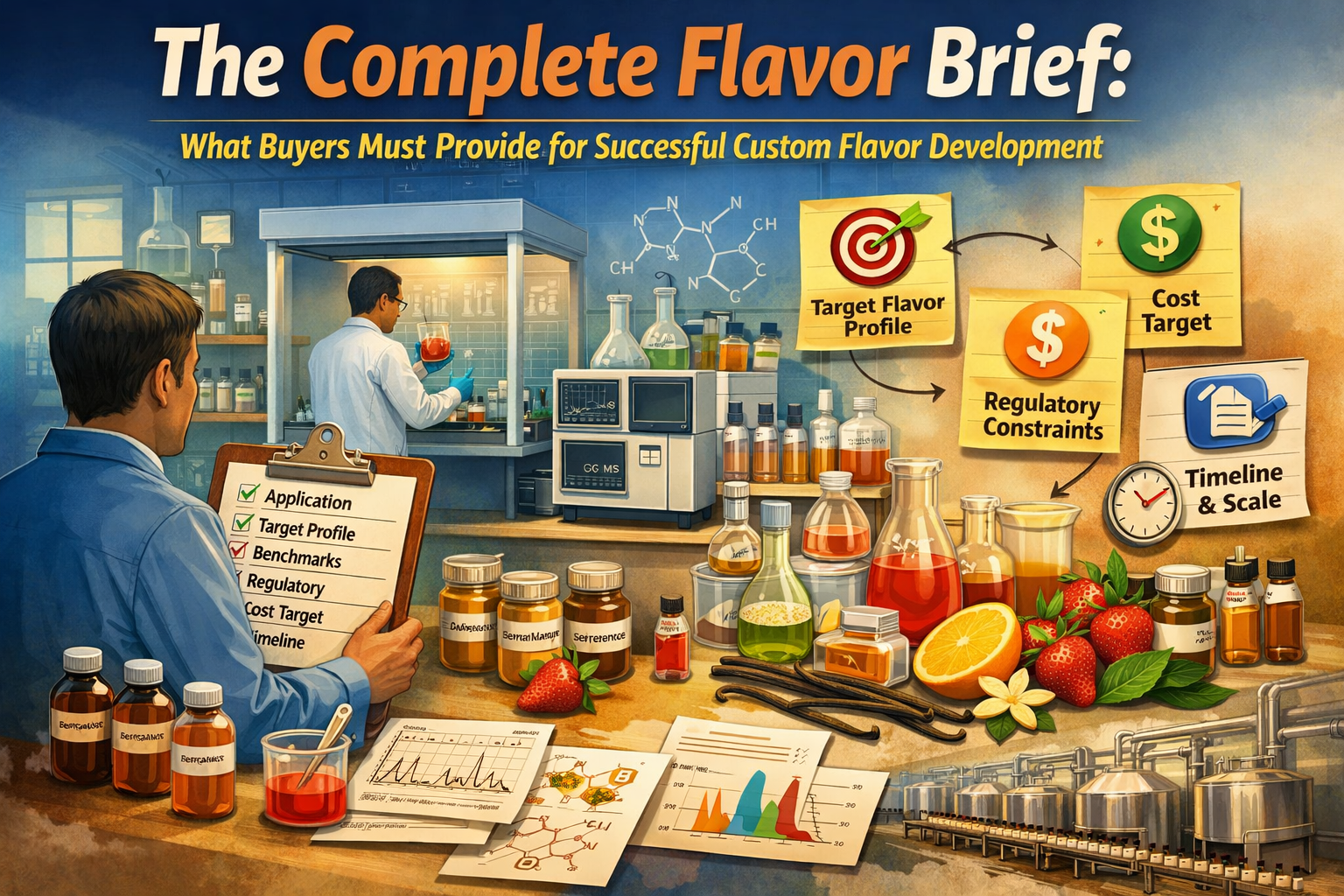
When a flavor buyer approaches a flavor house with the intention of purchasing a flavor, it is common that not all the necessary information is communicated. As a result, the flavor house may lack critical details required to develop a flavor that performs successfully in the buyer’s final product.
Flavor formulation is not simply a matter of blending ingredients to match a desired flavor profile. It requires a deep understanding of the application, processing conditions, regulatory constraints, and sensory expectations. Therefore, obtaining a comprehensive and well-structured client brief is essential for the flavor house.
From the buyer’s perspective, an unsuccessful first attempt can often be revisited—either by refining the brief or by approaching another flavor house. However, for the flavor house, a missed opportunity is rarely recoverable. Once the project is lost, it is typically lost for good.
For this reason, sales managers at flavor houses invest significant effort in uncovering the buyer’s true needs—both stated and unstated. Their goal is to ensure that flavorists are equipped with the right information to design a flavor solution that is not only appealing but also technically and commercially viable for the buyer’s application.
Here are some general buyer brief guidelines for flavor buyers and sellers
To get a precisely tailored, commercially successful flavor, the buyer’s brief must go far beyond “make it taste like X.” The best flavor houses operate like problem-solvers—so the more structured and technical your input, the higher the success rate and the fewer reformulation cycles.
Here’s a professional, industry-grade flavor brief framework used by top flavor houses:
1) PRODUCT CONTEXT (WHERE THE FLAVOR LIVES)
This is the most critical starting point.
- Application (beverage, dairy, bakery, confectionery, savory, pharma, etc.)
- Product format (RTD drink, powder, concentrate, syrup, baked matrix)
- Processing conditions
- Heat (pasteurization, UHT, baking temp/time)
- Shear / homogenization
- Fermentation (if any)
- pH range
- Water activity (aw)
- Fat content / type of fat system
- Alcohol content (if applicable)
👉 Why it matters: A strawberry flavor in yogurt behaves very differently from one in a carbonated beverage.
2) TARGET FLAVOR PROFILE (SENSORY VISION)
Define the flavor like a flavorist would think:
A. Core Identity
- What is the flavor?
- e.g., “ripe jammy strawberry” vs “fresh green strawberry”
B. Sensory Attributes
- Top notes (fresh, citrusy, aldehydic, green)
- Body (fruity, jammy, creamy)
- Base (caramelized, cooked, sulfury, woody)
C. Descriptive Language
Use precise descriptors, not vague terms:
- ❌ “nice fruity”
- ✅ “ripe, cooked, slightly caramelized berry with light floral lift”
D. Intensity & Balance
- Target strength (weak / moderate / strong)
- Sweetness perception
- Acidity perception
- Mouthfeel contribution
3) BENCHMARKS & REFERENCES (CRITICAL)
Provide anchors:
- Existing product(s) to match or outperform
- Competitor samples
- Internal gold standard
- Natural references (e.g., “like cooked strawberry jam at 70° Brix”)
👉 Without benchmarks, interpretation varies wildly between flavorists.
4) FUNCTIONAL & PERFORMANCE REQUIREMENTS
- Dosage range (target ppm or %)
- Stability requirements
- Shelf life (e.g., 12 months at 25°C)
- Light stability
- Oxidation resistance
- Flavor release behavior
- Immediate impact vs lingering
- Masking needs
- e.g., protein bitterness, stevia aftertaste
5) FORMULATION CONSTRAINTS
A. Regulatory
- Target markets (US, EU, China, etc.)
- Labeling requirements:
- Natural / artificial / WONF / organic
B. Ingredient Restrictions
- No allergens?
- No solvents (e.g., PG-free)
- No certain chemicals (e.g., diacetyl, certain aldehydes)
C. Certification Needs
- Halal / Kosher
- Non-GMO
- Clean label
6) PHYSICAL FORM REQUIREMENTS
- Liquid vs powder vs emulsion
- Oil-soluble vs water-soluble
- Encapsulation needed?
- Clarity requirement (clear beverage vs cloudy)
7) COST TARGET (VERY IMPORTANT)
- Target cost per kg
- Target use level cost in finished product
👉 This directly controls:
- Choice of raw materials
- Natural vs synthetic balance
- Complexity of formulation
8) SUPPLY CHAIN & SCALE
- Expected annual volume
- Launch timeline
- Need for dual sourcing?
- Regional production constraints
9) BRAND & CONSUMER POSITIONING
- Target consumer (kids, premium adults, functional health)
- Brand story (natural, indulgent, nostalgic, exotic)
- Market positioning (mass vs premium)
10) SUCCESS CRITERIA (HOW WIN IS DEFINED)
- Must match benchmark within X %
- Must pass sensory panel
- Must survive processing
- Must meet cost
11) OPTIONAL BUT HIGHLY VALUABLE
A. Base Formula / Prototype
- Your actual product base (huge advantage)
B. Analytical Data
- GC-MS profile (if available)
- Key compounds to include or avoid
C. Previous Attempts
- What failed and why
🔥 INDUSTRY INSIGHT (WHAT MAKES A GREAT BRIEF)
A strong brief does 3 things:
- Reduces ambiguity
- Defines constraints clearly
- Provides sensory anchors
🚫 COMMON MISTAKES BUYERS MAKE
- “Make it taste like natural strawberry” (too vague)
- No processing info (flavor fails after heating)
- No cost target (results unusable)
- No benchmark (endless iteration)
- Ignoring matrix effects (fat, sugar, protein)
🧠 PRO TIP (USED BY TOP FLAVOR COMPANIES)
The best buyers provide a “flavor architecture statement”:
“We want a medium-high intensity strawberry with bright ethyl butyrate top notes, jammy furaneol body, and a slight cooked caramelized base, optimized for low pH (3.2) RTD beverage with stevia masking.”
That level of clarity dramatically accelerates success.
✅ QUICK CHECKLIST (BUYER SIDE)
Before sending a brief, confirm you have:
- Application + processing conditions
- Detailed sensory description
- Benchmark samples
- Regulatory constraints
- Cost target
- Stability requirements
- Physical format
- Timeline
Here is an example to translate the brief into a real flavor house project, from client brief → interpretation → formulation → production.
🧾 1) SIMULATED CLIENT BRIEF (BUYER → FLAVOR HOUSE)
📌 Project Title
Strawberry Flavor for RTD Beverage (Low Sugar, Stevia-Sweetened)
🧪 Application
- RTD beverage (still, non-carbonated)
- pH: 3.1–3.4
- Sugar: 2–3% (low sugar)
- Sweetener: Stevia (Reb A 97%)
- Processing:
- Pasteurization: 90°C / 30 sec
- Shelf life: 12 months (ambient)
🎯 Target Flavor Profile
- Top notes: Fresh, bright, slightly green strawberry
- Body: Jammy, ripe, slightly cooked
- Base: Light caramelized / candy-like
Descriptors:
“Like strawberry jam diluted into a refreshing drink, but still with a fresh top note”
⚖️ Functional Requirements
- Strong masking of stevia bitterness
- Good flavor persistence
- No “thin” taste due to low sugar
🚫 Constraints
- Natural flavor (WONF acceptable)
- No artificial solvents (PG-free preferred)
- Allergen-free
- Clean label leaning
💰 Cost Target
- Flavor cost in beverage: ≤ $0.08/kg finished product
- Use level target: 0.08–0.12%
🧾 Benchmark
- Competitor: “Premium strawberry water” (provided)
- Internal note: needs more jammy depth + better sweetness masking
🧠 2) FLAVORIST INTERPRETATION
Key Technical Challenges:
- Low sugar → weak body
- Stevia → bitterness + lingering aftertaste
- Acidic system → ester hydrolysis risk
- Heat → loss of top notes
Strategy:
- Build layered architecture:
- Volatile esters → top
- Furanones/lactones → body
- Caramelized notes → base
- Add mouthfeel enhancers
- Include bitterness blockers
- Stabilize with emulsion system
🧪 3) INDUSTRIAL STRAWBERRY FLAVOR FORMULA (WONF STYLE)
📦 Flavor Concentrate (100%)
🔝 TOP NOTES (Fresh / Green / Lift)
| Compound | % | Function |
|---|---|---|
| Ethyl butyrate | 6.5 | Bright fruity impact |
| Ethyl 2-methylbutyrate | 2.0 | Juicy realism |
| Cis-3-hexenol | 0.5 | Green freshness |
| Hexanal | 0.2 | Fresh cut note |
| Ethyl acetate | 4.0 | Volatility boost |
❤️ BODY (Jammy / Ripe)
| Compound | % | Function |
|---|---|---|
| Furaneol | 8.0 | Signature strawberry |
| Ethyl maltol | 5.0 | Sweetness enhancer |
| Gamma-decalactone | 2.5 | Creamy fruit body |
| Benzyl acetate | 1.2 | Floral nuance |
| Methyl cinnamate | 0.8 | Strawberry identity |
🔻 BASE (Cooked / Depth)
| Compound | % | Function |
|---|---|---|
| Maltol | 2.5 | Caramel body |
| Vanillin (natural) | 1.0 | Roundness |
| Cyclotene | 0.6 | Cooked sugar note |
⚙️ MODULATORS / MASKING
| Ingredient | % | Function |
|---|---|---|
| Neohesperidin DC | 0.3 | Bitterness blocker |
| Glycyrrhizin | 0.2 | Sweetness modifier |
| Citric acid (trace) | 0.5 | Brightness |
💧 CARRIER SYSTEM
| Ingredient | % |
|---|---|
| Ethanol (natural source) | 20.0 |
| Triacetin | 10.0 |
| Water | q.s. |
🧴 4) EMULSION SYSTEM (FOR BEVERAGE STABILITY)
Emulsion (separate phase)
| Ingredient | % |
|---|---|
| Orange oil (cloud) | 8.0 |
| Gum acacia | 12.0 |
| OSA starch | 6.0 |
| Glycerol ester of wood rosin | 3.0 |
| Water | q.s. |
Function:
- Improve flavor retention
- Enhance mouthfeel
- Provide visual body
🏭 5) MANUFACTURING PROCESS
Step 1 – Blend Aroma Phase
- Mix all aroma chemicals
- Add ethanol + triacetin
- Stir under low shear
Step 2 – Prepare Emulsion
- Hydrate gum acacia + OSA starch
- Add oil phase slowly
- Homogenize (150–250 bar)
Step 3 – Combine
- Add flavor concentrate into emulsion
- Gentle mixing
Step 4 – Polish
- Filter (if needed)
- QC check (GC + sensory)
🧪 6) APPLICATION IN BEVERAGE
Suggested Use Level:
- 0.10%
Beverage Base Example:
| Ingredient | % |
|---|---|
| Water | q.s. |
| Sugar | 2.5 |
| Citric acid | 0.15 |
| Stevia | 0.02 |
| Flavor | 0.10 |
🔬 7) EXPECTED PERFORMANCE
✔ Strengths
- Strong strawberry identity
- Balanced fresh + jammy
- Masks stevia bitterness
- Good shelf stability
⚠️ Risks
- Ester loss over long storage → may need slight overdose
- Furaneol degradation → monitor heat exposure
🔄 8) HOW TO TUNE THE FORMULA
More Fresh:
- ↑ Ethyl butyrate
- ↑ Cis-3-hexenol
More Jammy:
- ↑ Furaneol
- ↑ Ethyl maltol
Less Candy:
- ↓ Ethyl maltol
- ↓ Vanillin
Better Stevia Masking:
- ↑ Glycyrrhizin (careful!)
- Add thaumatin (optional)
🧠 9) WHAT A FLAVOR HOUSE WOULD DELIVER
- 2–3 variants (fresh / jammy / balanced)
- Stability data
- Regulatory docs
- SDS + specs
- Sensory panel results
###