The Flavorist's Mint Compendium
Pre-order a digital copy of the book now to save 30%
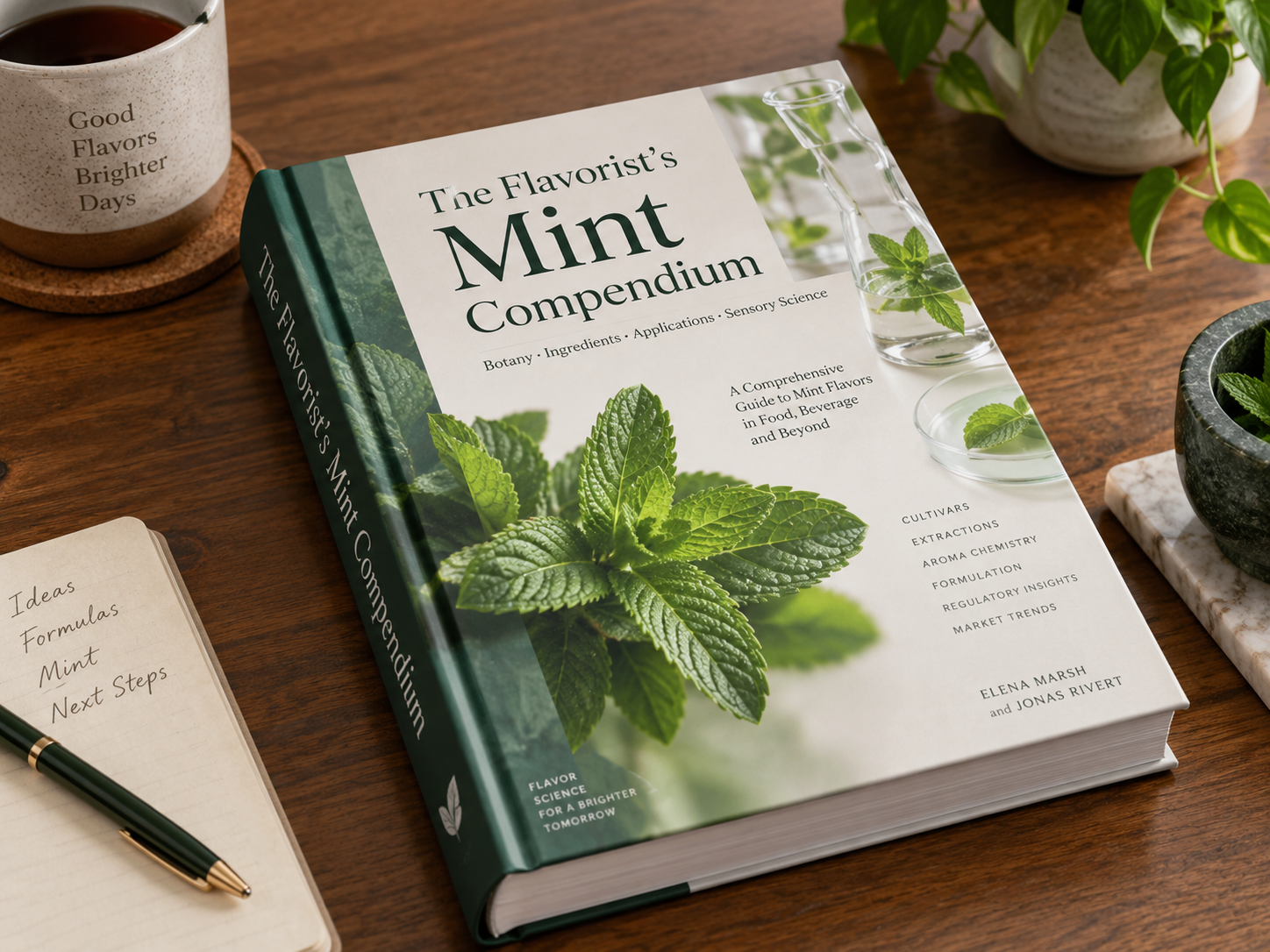
The Flavorist's Mint Compendium, a rare content-rich source book featuring 29 chapters, seven appendices, and approximately 700 pages, prepared by flavorist.com, will be available here at flavorist.com. This highly informative reference book is essential for anyone whose work involves mints, covering all things about mints including but not limited to sources, mint varieties, mint formulation, and flavor applications across about ten major categories.
Contact us at support @flavorist.com if you want to be informed when it arrives.
About the book
Mint is one of the largest and most technically demanding flavor categories in the industry. It dominates chewing gum and oral care, anchors breath-freshening confectionery, carries pharmaceutical and nicotine products, and appears in beverages, dairy, chocolate, and savory cuisine worldwide. Few categories require a flavorist to integrate so many disciplines at once: plant taxonomy, terpene biosynthesis, stereochemistry, distillation technology, trigeminal physiology, matrix release behavior, regulatory arithmetic, and authentication science.
This compendium is written for working flavorists, trainee flavorists preparing for Society of Flavor Chemists (SFC) certification, application scientists, sensory specialists, QC chemists, and raw-material buyers. It is organized so that each chapter can be read independently, but the chapters build on one another: botany explains chemistry, chemistry explains sensory character, sensory character explains creative choices, and application and regulation constrain those choices.
Why a Book About Mint?
Few flavors are as familiar, or as deceptively complex, as mint. It is the taste of clean teeth and fresh breath, of chewing gum and candy canes, of Moroccan tea and Cuban mojitos, of cough drops and after-dinner chocolates. Mint is one of the largest flavor categories in the world, and in many markets it is effectively the default flavor of oral care. Behind that familiarity lies an extraordinary depth of science and craft.
A single mint flavor can draw on plant genetics and terpene biosynthesis, the stereochemistry of menthol and carvone, steam distillation and rectification, the physiology of cold receptors and trigeminal nerves, the physics of flavor release from gum base, the chemistry of oxidation and packaging interactions, the arithmetic of regulatory limits, isotope-based authentication, and the economics of agricultural commodities whose prices can swing with a monsoon. Mint also sits at the intersection of food, cosmetic, pharmaceutical, and tobacco regulation, making it one of the most regulatorily diverse flavor families a flavorist will encounter.
Much of this knowledge has traditionally been passed from mentor to apprentice, scattered across technical books, journal articles, pharmacopoeial monographs, regulatory texts, supplier literature, and years of bench experience. This book brings those threads together into a single, structured reference focused entirely on mint and minty flavors.
What This Book Is
The Flavorist’s Mint Compendium is a comprehensive technical reference and study guide covering the science, creation, application, quality, regulation, and commerce of mint flavors. It is written from the perspective of the working flavorist: someone who must not only understand mint, but also create with it, apply it, defend it, and deliver it reliably to customers and consumers.
The book is organized into five parts and seven appendices:
| Part | Title | What it covers |
|---|---|---|
| I | Foundations | Botany and taxonomy of Mentha and related plants; biosynthesis of mint volatiles; cultivation, distillation, and rectification; the sensory science of smell, taste, cooling, and time |
| II | Raw Materials | Complete monographs on peppermint, spearmint, cornmint, dementholized mint oil, and menthol; minor mints and chemotypes; mint-family and non-mint “minty” plants; the aroma chemical palette; cooling agents; warming, tingling, and other trigeminal modifiers |
| III | Creation | The creative process from brief to launch; reconstruction of natural oils; cooling curve design; mint combination profiles; natural flavors and label claims; cost engineering and supply-risk substitution |
| IV | Applications | Chewing gum; confectionery; oral care; beverages, dairy, frozen desserts, bakery, and savory foods; pharmaceuticals, supplements, nicotine and tobacco products, and animal products |
| V | Quality, Stability, Regulation, and Commerce | Stability and packaging; analytical methods and authentication; regulatory affairs and safety; the global mint market, sustainability, and trends |
| Appendices | A–G | Sensory lexicon and reference standards; data tables; formula skeletons and teaching formulas; worked calculations; glossary; key literature and standards; examination preparation with model oral-exam answers |
Each chapter is designed to stand on its own, with summaries of key points and review questions, while cross-references connect related topics throughout the book.
What Makes This Book Distinctive
- Mint-focused depth. Rather than treating mint as one entry among hundreds of flavors, the book devotes its entire length to mint and minty systems.
- Integration across disciplines. Botany, chemistry, sensory science, application technology, analytical science, regulation, and commerce are connected rather than treated in isolation.
- Practical orientation. Tables, worked examples, formula frameworks, troubleshooting guides, checklists, and case studies are included throughout.
- Emphasis on reasoning. The book repeatedly explains why materials, processes, and decisions matter, reflecting how flavorists are evaluated in professional practice and certification.
- Responsible practice. Safety, regulatory compliance, authenticity, sustainability, and ethical considerations are woven into every part of the book rather than confined to a single chapter.
Who This Book Is For
The book is written primarily for flavor professionals, but its structure allows many readers to use it selectively.
Primary Readers
| Reader | How the book helps |
|---|---|
| Flavorists and senior flavorists | A consolidated reference for materials, creative strategies, reconstruction, cooling design, applications, troubleshooting, and regulatory constraints |
| Trainee and junior flavorists | A structured learning path from botany and chemistry through creation and application, with exercises and review questions |
| Candidates preparing for flavorist certification | Model answers, answer frameworks, rapid-fire drills, sensory identification lists, and troubleshooting scenarios supporting oral examination preparation |
| Application scientists and technologists | Detailed guidance on gum, confectionery, oral care, beverage, dairy, bakery, savory, pharmaceutical, and nicotine product matrices |
Additional Readers Who Can Benefit
| Reader | Relevant sections |
|---|---|
| Sensory scientists and panel leaders | Sensory science (Chapter 4), cooling curve evaluation (Chapter 17), lexicon and reference standards (Appendix A) |
| Analytical and quality control chemists | Raw material monographs (Chapters 5–8), analytical methods and authentication (Chapter 27), data tables (Appendix B), calculations (Appendix D) |
| Regulatory affairs specialists | Natural claims (Chapter 19), regulatory affairs and safety (Chapter 28), application-specific regulatory notes (Chapters 21–25) |
| Product developers at consumer goods companies | Creation principles (Chapter 15), combinations (Chapter 18), applications (Part IV), stability (Chapter 26) |
| Oral care and pharmaceutical formulators | Oral care (Chapter 23), pharmaceuticals and supplements (Chapter 25), coolants and trigeminal agents (Chapters 13–14) |
| Procurement, sourcing, and supply chain professionals | Cultivation and processing (Chapter 3), raw materials (Part II), cost engineering (Chapter 20), market and sustainability (Chapter 29) |
| Researchers, educators, and students in food science, flavor chemistry, sensory science, and plant science | Foundations (Part I), primary literature (Appendix F), glossary (Appendix E) |
| Growers, distillers, and processors | How field and still decisions affect oil quality, authenticity, and market value (Chapters 1–3, 5–7, 29) |
| Consultants and technical sales professionals | A broad, cross-functional reference for customer problem-solving |
Readers do not need to be experts in every discipline to benefit. Technical concepts are introduced progressively, and the glossary (Appendix E) supports readers from adjacent fields.
Pre-order a digital copy of this book to save 30%.
###