The Ultimate Guide to Becoming a Flavorist: Answers to Every Question You've Ever Asked
The Ultimate Guide to Becoming a Flavorist: Answers to Every Question You've Ever Asked
What Does a Flavorist Do?
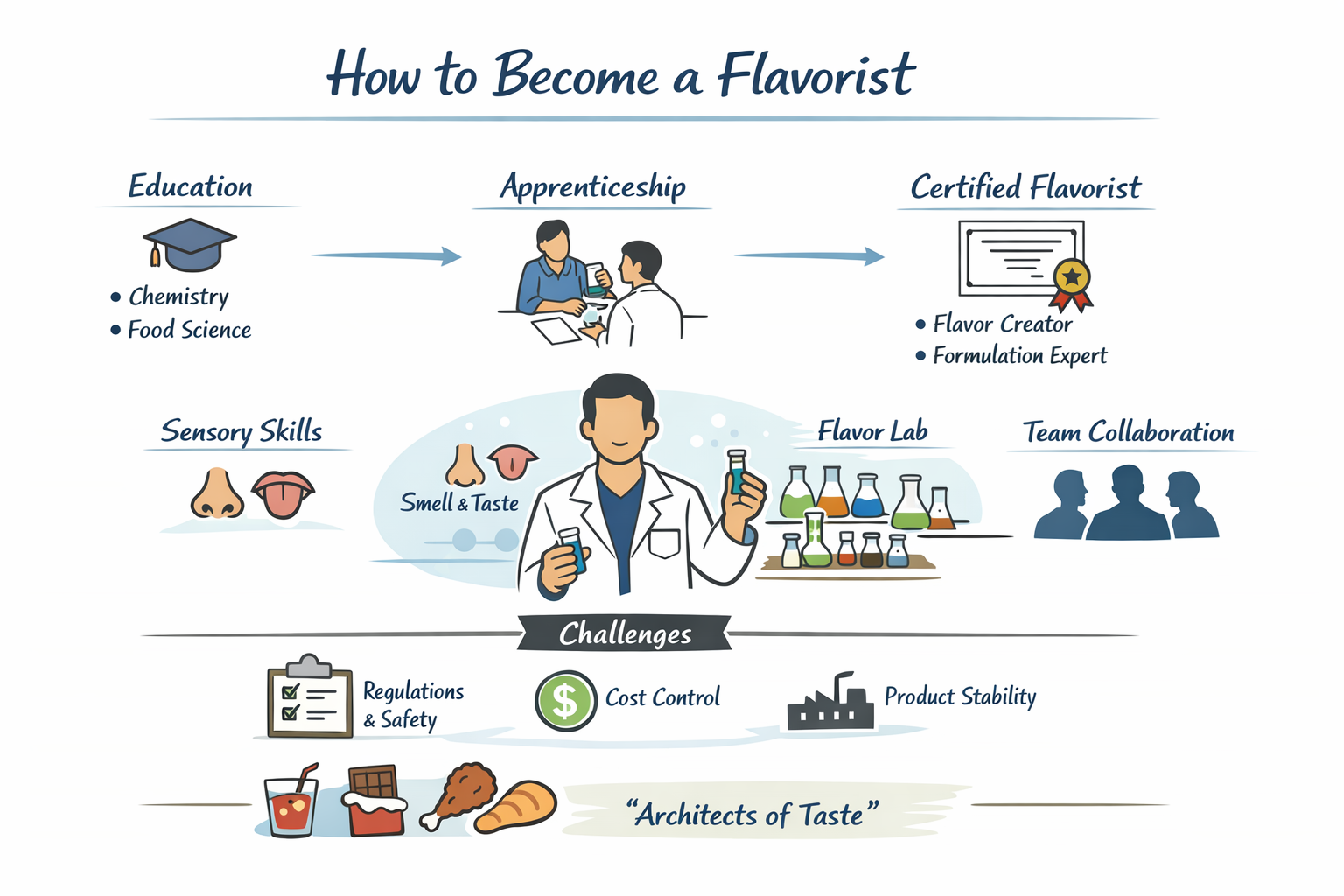
A flavorist is a specialized scientist who creates, develops, and improves flavors for the food, beverage, and pharmaceutical industries. Think of them as the architects of taste—the professionals responsible for making sure your favorite strawberry yogurt actually tastes like strawberries, or that your sugar-free gum has a refreshing mint flavor that lasts.
The day-to-day work of a flavorist is far more complex than simply mixing ingredients together. These professionals work in laboratories equipped with thousands of raw materials, ranging from natural extracts derived from fruits, herbs, and spices to synthetic aroma chemicals created through organic synthesis. Their work involves understanding the chemical composition of these materials and how they interact with each other and with food matrices.
When a flavorist receives a project brief—for example, "create a natural watermelon flavor for a children's vitamin gummy that can withstand high heat processing"—they must consider multiple factors simultaneously. They need to select the right combination of volatile and non-volatile compounds that will create the characteristic watermelon profile. They must ensure these compounds remain stable during manufacturing and throughout the product's shelf life. They need to consider regulatory compliance, cost constraints, and the specific application requirements.
Flavorists spend significant time conducting bench-top work, carefully weighing and mixing small batches of experimental flavors. They then apply these flavors to the target product—perhaps a simple sugar solution for beverage testing or a cream base for dairy applications. Sensory evaluation is critical; flavorists taste and smell their creations repeatedly, making subtle adjustments until the profile matches the desired outcome.
Beyond creation, flavorists are problem-solvers. When a client reports that a flavor tastes different than expected in their final product, the flavorist investigates whether the flavor interacted with other ingredients, whether processing conditions altered the volatile compounds, or whether storage conditions caused degradation. They might need to modify the formulation to improve heat stability, increase shelf life, or mask undesirable off-notes from other ingredients like vitamins, proteins, or high-intensity sweeteners.
Collaboration is essential to the role. Flavorists work closely with food scientists who understand how the finished product will be manufactured. They consult with regulatory experts to ensure compliance with food safety laws in different countries. They meet with marketing teams to understand consumer trends and with clients to understand their specific needs. Senior flavorists may also mentor junior colleagues, passing down the knowledge and techniques accumulated over years of experience.
What Does "Flavorist" Mean?
The term "flavorist" refers to a trained professional who possesses the specialized knowledge and skill to formulate flavors for commercial use. This designation is not simply a job title anyone can claim; it represents years of training, a deep understanding of chemistry, and a highly developed sense of taste and smell.
The word itself combines "flavor" with the suffix "-ist," indicating someone who practices or is concerned with something, similar to "chemist" or "artist." This linguistic construction is fitting because flavorists truly operate at the intersection of science and art. They must understand the scientific principles of organic chemistry, analytical chemistry, and sensory science while simultaneously exercising creative judgment to craft pleasing and authentic taste experiences.
In professional contexts, the term carries specific weight. When someone is introduced as a flavorist within the industry, it implies they have undergone rigorous training, often through a formal apprenticeship program, and have developed the ability to work with hundreds or even thousands of raw materials. They understand the safety and regulatory status of these materials, their stability characteristics, and their sensory profiles.
It's worth noting the spelling variation between American and British English. In the United States, it's typically spelled "flavorist," while in the United Kingdom and Commonwealth countries, the spelling "flavourist" is common. Both refer to exactly the same profession, and both are recognized internationally within the industry.
The term also distinguishes these professionals from related roles. A perfumer, for example, works with fragrances for cosmetics and household products, while a flavorist specifically works with ingestible products. A food technologist might develop the overall food product, while the flavorist provides the specific taste component. A chef creates flavors through cooking techniques and whole ingredients, while a flavorist creates flavors at the molecular level using isolated compounds.
What Is a Flavourist?
This is simply the British English spelling of the same profession. A flavourist in the United Kingdom, Australia, New Zealand, or other Commonwealth countries performs exactly the same work as a flavorist in the United States. The spelling difference reflects regional language conventions rather than any distinction in the role, responsibilities, or professional standing.
The term "flavourist" is widely used in professional organizations based in the UK, such as the British Society of Flavourists, one of the most respected professional bodies in the field. When you see job postings in London for a "flavourist," or training courses offered at the University of Reading described as "flavourist courses," they are referring to the identical profession.
For international readers, it's helpful to know both spellings because they appear frequently in industry literature, job descriptions, and educational programs. Search engines will recognize both, and professional networking platforms like LinkedIn contain profiles using both spellings depending on the user's location.
The profession itself transcends these spelling differences. Whether you call yourself a flavorist or a flavourist, you are part of a global community of sensory scientists who share common training methods, professional standards, and scientific knowledge. International organizations like the International Organization of the Flavor Industry (IOFI) bring together professionals from both spelling traditions under one umbrella.
How Long Does It Take to Become a Flavorist?
Becoming a fully qualified flavorist is a lengthy process that typically requires seven to ten years of combined education and supervised training. This extended timeline reflects the complexity of the field and the depth of knowledge required to work independently with ingredients that affect human taste and safety.
The journey begins with undergraduate education, which takes four years for a bachelor's degree in the United States or three years in many other countries. This foundational period provides essential knowledge in organic chemistry, analytical chemistry, biochemistry, and often food science. Some aspiring flavorists pursue master's degrees, adding an additional one to two years of specialized study.
After completing formal education, the real hands-on training begins. Most flavorists enter the industry through structured apprenticeship programs at major flavor companies. These programs typically last five to seven years, during which the trainee works under the direct supervision of experienced senior flavorists. This apprenticeship period is not merely a formality; it's essential for developing the sensory memory, practical skills, and problem-solving abilities that cannot be taught from textbooks.
During these training years, apprentices progress through increasing levels of responsibility. They might start by mixing simple flavors according to established formulas, gradually learning to identify hundreds of raw materials by smell and taste. They study the chemical structures of aroma compounds and learn how different molecules contribute to overall flavor profiles. They work on increasingly complex projects, first under close supervision and eventually with greater independence.
The timeline can vary depending on individual aptitude, the intensity of the training program, and opportunities for hands-on experience. Some exceptionally dedicated individuals might progress more quickly, while others might take longer to develop the refined sensory skills required. The key benchmark in many countries is certification by a professional body, which typically requires documented evidence of several years of practical experience and successful completion of rigorous examinations.
Even after achieving full qualification, flavorists continue learning throughout their careers. New raw materials become available, consumer preferences evolve, regulatory requirements change, and processing technologies advance. The most successful flavorists embrace lifelong learning as an integral part of their professional identity.
What Degree Do You Need to Be a Flavorist?
The educational foundation for becoming a flavorist is typically a bachelor's degree in a science-related field, with chemistry being the most common and most preferred qualification. However, several degree paths can lead to this career, each offering different advantages.
Chemistry is considered the gold standard for aspiring flavorists. A degree in chemistry, particularly with emphasis on organic chemistry, provides deep understanding of molecular structures, chemical reactions, and analytical techniques. Organic chemistry is especially relevant because flavor compounds are organic molecules, and understanding their behavior, stability, and interactions is fundamental to flavor creation. Analytical chemistry courses teach the techniques used to identify and quantify flavor compounds, skills that become essential when reverse-engineering competitor products or troubleshooting stability issues.
Food Science is another excellent pathway and perhaps the most directly applicable to the industry. Food science programs typically include coursework in food chemistry, which covers the chemical composition of foods and how ingredients interact. Students learn about food processing, preservation, and product development, all of which provide context for how flavors will perform in real-world applications. Many food science programs also include sensory evaluation courses, teaching the principles of taste testing and consumer perception that are central to a flavorist's work.
Biochemistry offers valuable perspective on how flavor compounds interact with biological systems. Understanding receptor mechanisms, metabolic pathways, and the physiological basis of taste and smell can provide insights into why certain molecules taste the way they do. This knowledge becomes increasingly relevant as the industry moves toward more sophisticated understanding of flavor perception.
Chemical Engineering can be a less common but still viable path. Chemical engineers bring strong process understanding, which is valuable when scaling up flavor production from laboratory batches to industrial manufacturing. They understand heat transfer, mixing dynamics, and process optimization, all of which affect how flavors are produced and how they behave in finished products.
While a bachelor's degree is the minimum requirement, many successful flavorists hold advanced degrees. A master's degree or Ph.D. can provide deeper specialization and may accelerate career progression. Programs specifically in flavor chemistry are rare but exist at institutions like the University of Reading in the UK and ISIPCA in France. These specialized programs combine advanced chemistry with practical flavor training and are highly regarded in the industry.
The specific degree matters less than the foundational knowledge it provides. Employers look for candidates with strong chemistry background, analytical thinking skills, attention to detail, and genuine passion for the sensory aspects of the work. A candidate with a chemistry degree who has sought out sensory training and demonstrated interest in food applications may be equally competitive as a food science graduate with strong chemistry coursework.
What Is the Highest Paid Chemist Job?
In the context of the flavor and fragrance industry, the highest paid chemist position is typically that of a Senior or Master Flavorist with extensive experience and a proven track record of successful creations. These top professionals command impressive salaries because they possess a rare combination of scientific knowledge, artistic talent, and practical experience that takes decades to develop.
The earning potential for flavorists increases significantly with experience and reputation. Entry-level flavor trainees might start around $60,000 to $70,000 annually. As they progress to junior flavorist positions with several years of experience, salaries typically rise to the $80,000 to $100,000 range. Fully qualified flavorists with certification and a decade of experience often earn between $100,000 and $130,000.
At the highest levels, Master Flavorists with twenty-five or more years of experience, international reputations, and portfolios of commercially successful flavors can earn substantially more. These individuals are often responsible for creating signature flavors that define product categories or generate millions in revenue for their companies. Their compensation may include base salaries exceeding $150,000, plus bonuses tied to commercial success, profit sharing, and other incentives that can push total compensation well beyond $200,000 annually.
Beyond base salary, the most valuable compensation for top flavorists often comes in the form of recognition and creative freedom. Master flavorists may have input on company strategy, opportunities to mentor the next generation, and the resources to explore creative projects that interest them. They become thought leaders in the industry, presenting at conferences, publishing papers, and serving on professional organization boards.
Comparing across the broader chemical industry, some specialized roles can exceed even top flavorist compensation. Petroleum chemists working in oil exploration, pharmaceutical research directors, and chemical engineering executives in major industrial corporations can earn salaries in the range of $200,000 to $300,000 or more. However, within the food and consumer products sector, senior flavorists consistently rank among the highest-paid technical professionals.
The key insight is that compensation in this field correlates strongly with expertise that cannot be quickly acquired. A newly graduated chemist with a Ph.D. cannot step into a senior flavorist role, regardless of their academic credentials. The years of practical training, the development of sensory memory, and the积累 of formulation experience create a barrier to entry that protects the earning potential of those who have completed the journey.
Flavorist Salary
Flavorist salaries vary significantly based on experience level, geographic location, employer size, and individual expertise. Understanding these variations helps aspiring flavorists set realistic expectations and negotiate effectively throughout their careers.
In the United States, comprehensive salary data shows that the average annual salary for a flavorist is approximately $100,000, with hourly rates averaging around $48. However, this average masks considerable variation across experience levels and regions.
Entry-level positions, often titled Flavor Trainee or Junior Flavorist, typically start around $60,000 to $70,000 for candidates with bachelor's degrees and minimal industry experience. Those entering with master's degrees or relevant internship experience may command starting salaries at the higher end of this range or slightly above.
As flavorists gain experience and progress through training programs, salaries increase steadily. With two to four years of experience, salaries often reach the $80,000 to $95,000 range. At this stage, flavorists are taking on more independent projects and demonstrating their developing capabilities.
Fully qualified flavorists with eight to twelve years of experience typically earn between $100,000 and $120,000. These professionals have completed their formal training, achieved certification if they pursued it, and can work independently on complex projects. They may supervise junior staff and contribute to business development through client interactions.
Senior flavorists with fifteen or more years of experience often earn $120,000 to $140,000 or more. These individuals have extensive portfolios of successful commercial flavors, deep expertise in specific application areas, and significant mentoring responsibilities. They are valued for their ability to solve difficult technical problems and guide strategic flavor development.
Geographic location significantly impacts salary levels. Major flavor industry hubs in the United States include the New York/New Jersey area, Chicago, and California. Salaries in these regions tend to be higher to offset cost of living and compete for talent. For example, flavorists in New York City might earn 10-15% above national averages.
In the United Kingdom, salary structures follow similar patterns with different absolute numbers. The average flavorist salary in the UK is approximately £49,000 annually. Entry-level positions start around £45,000, while senior flavorists with extensive experience can earn £54,000 or more. London-based positions typically pay a premium, with averages reaching £53,600 to reflect higher living costs.
Beyond base salary, total compensation packages often include bonuses based on individual and company performance, profit sharing, retirement contributions, and comprehensive benefits. Some companies offer relocation assistance, continuing education support, and professional development funding. These additional elements can significantly increase total compensation value.
Flavorist Jobs
Flavorist jobs exist primarily within three types of organizations: dedicated flavor and fragrance companies, large food and beverage manufacturers, and specialized ingredient suppliers. Each setting offers different opportunities and work environments.
Flavor and Fragrance Houses are the largest employers of flavorists globally. Companies like Kerry, McCormick, Givaudan, Firmenich, International Flavors & Fragrances (IFF), Symrise, and Takasago employ hundreds of flavorists across multiple locations worldwide. These organizations focus exclusively on creating and manufacturing flavors and fragrances for clients in the food, beverage, and consumer products industries. Working at a flavor house exposes flavorists to diverse projects across many product categories, from beverages and dairy to savory snacks and confectionery. The pace is fast, the variety is high, and collaboration with colleagues across different application areas is common.
Food and Beverage Manufacturers employ flavorists internally to develop proprietary flavors for their own products. Companies like PepsiCo, Nestlé, Unilever, Mars, and Kraft Heinz have in-house flavor teams that work on their specific brand portfolios. These positions offer the opportunity to deeply understand one company's products and consumers, potentially working on flavors for years before they reach market. The work is often more focused, with flavorists specializing in categories relevant to their employer, such as beverages, frozen foods, or confectionery.
Ingredient Suppliers that provide raw materials to the food industry sometimes employ flavorists for technical support and product development. These companies might specialize in essential oils, natural extracts, or synthetic aroma chemicals. Flavorists in these roles help customers understand how to use the company's ingredients effectively, develop application ideas, and troubleshoot problems. This position offers deep ingredient knowledge but less direct flavor creation than flavor house roles.
Entry-level positions are typically advertised as Flavor Trainee, Junior Flavorist, Associate Flavorist, or Flavor Development Technician. These roles emphasize learning and development under supervision rather than independent creation. Candidates for these positions should highlight their scientific education, any relevant laboratory experience, and genuine interest in sensory science.
Mid-level positions for qualified flavorists are advertised simply as Flavorist, sometimes with specification of application area such as Beverage Flavorist, Savory Flavorist, or Sweet Flavorist. These roles require several years of experience and demonstrated ability to work independently. Employers look for portfolios of successful projects and often prefer candidates with professional certification.
Senior positions include Senior Flavorist, Principal Flavorist, and Master Flavorist. These roles require extensive experience, deep expertise, and often management responsibilities. Candidates at this level are expected to mentor junior staff, contribute to business strategy, and represent the company to important clients.
Job seekers can find openings through specialized industry job boards, professional organization websites like the Society of Flavor Chemists or British Society of Flavourists, and general platforms like LinkedIn. Networking is particularly valuable in this specialized field, with many positions filled through professional connections before public advertising.
Flavorist Job Description
A comprehensive flavorist job description outlines the responsibilities, qualifications, and personal attributes required for success in this unique role. Understanding these elements helps candidates prepare applications and evaluate whether they would thrive in the position.
Core Responsibilities:
The primary responsibility is creating new flavors that meet specific customer requirements. This involves interpreting briefs from clients or internal marketing teams, selecting appropriate raw materials from thousands of available options, and formulating blends that achieve the desired taste profile. Flavorists must consider the target application—whether a beverage, baked good, confectionery item, or savory product—and ensure the flavor performs appropriately during processing and throughout shelf life.
Modifying and improving existing flavors is equally important. Clients may request cost reductions, natural alternatives, or versions with improved stability. Flavorists analyze current formulations, identify opportunities for improvement, and develop modified versions that maintain the original taste character while meeting new requirements.
Troubleshooting is a constant responsibility. When flavors perform unexpectedly in finished products, flavorists investigate root causes. This might involve analyzing how processing conditions affect volatile compounds, studying interactions with other ingredients, or evaluating stability under different storage conditions. Solutions might require reformulation, processing recommendations, or client guidance on application modifications.
Sensory evaluation is woven throughout daily work. Flavorists continuously taste and smell their creations, comparing them to reference standards and desired profiles. They participate in formal sensory panels, document their observations, and make adjustments based on findings. Developing and maintaining sensory memory for hundreds or thousands of raw materials is an ongoing process.
Documentation and regulatory compliance are essential but often underappreciated responsibilities. Flavorists must maintain accurate records of formulations, ensure all ingredients comply with food safety regulations in target markets, and provide necessary documentation for clients and regulatory authorities.
Qualifications and Requirements:
Educational requirements typically include a bachelor's degree in chemistry, food science, biochemistry, or a related field. Advanced degrees are preferred for many positions. Strong academic performance in organic chemistry is particularly valued.
Experience requirements vary by level. Entry-level positions may require no industry experience but seek evidence of relevant laboratory skills and genuine interest. Mid-level positions typically require three to seven years of flavor industry experience. Senior roles require ten or more years with demonstrated successful project outcomes.
Certification from professional bodies like the Society of Flavor Chemists is highly desirable for senior positions and often required for the highest-level roles. This certification demonstrates that the flavorist has met rigorous professional standards and passed comprehensive examinations.
Personal Attributes:
Successful flavorists possess exceptional sensory acuity—the ability to detect subtle differences in taste and smell that others might miss. This is partly innate but can be developed through training and practice. They have excellent memory for sensory experiences, allowing them to recall and recognize thousands of distinct aroma and taste profiles.
Curiosity drives continuous learning about new ingredients, emerging trends, and evolving technologies. Patience is essential because flavor development often requires dozens or hundreds of iterations before achieving the desired result. Attention to detail prevents costly errors in formulation and documentation.
Communication skills are increasingly important. Flavorists must explain technical concepts to non-technical colleagues, present recommendations to clients, and document their work clearly. Collaboration with food scientists, marketers, and regulatory specialists requires the ability to work effectively in cross-functional teams.
How to Become a Flavorist
Becoming a flavorist requires a strategic approach spanning education, experience, and professional development. Following a structured pathway increases the likelihood of success in this competitive field.
Step 1: Build the Right Educational Foundation
Begin by earning a bachelor's degree in chemistry, food science, or biochemistry. Focus on courses that build understanding of organic chemistry, analytical chemistry, and sensory science. Seek opportunities for undergraduate research that develop laboratory skills and scientific thinking. Maintain strong grades, as competition for entry-level positions is intense.
Consider pursuing advanced education if your undergraduate record is strong and you can afford additional time. A master's degree in food science with flavor emphasis or a related field can provide specialized knowledge and make you more competitive. Programs at institutions like the University of Reading or ISIPCA offer direct pathways into the industry.
Step 2: Gain Relevant Experience
While still in school, seek internships at flavor companies, food manufacturers, or ingredient suppliers. Even positions not directly in flavor creation can provide valuable industry exposure and connections. Laboratory assistant roles, quality control positions, or research assistant opportunities build transferable skills.
After graduation, target entry-level positions at major flavor houses. Look for titles like Flavor Trainee, Junior Flavorist, or Flavor Development Technician. These roles are designed to train newcomers and provide structured learning opportunities. Be prepared to relocate to flavor industry hubs where these positions are concentrated.
Step 3: Commit to the Apprenticeship
Once hired, embrace the apprentice mindset. Your early years will involve significant learning under supervision. Study the raw material library, learning to identify hundreds of ingredients by smell and taste. Master laboratory techniques for accurate weighing, mixing, and documentation. Observe senior flavorists closely, asking questions about their decision-making processes.
Take advantage of every training opportunity your employer offers. Many companies have formal training programs covering flavor chemistry, sensory evaluation, regulatory affairs, and application technology. Participate enthusiastically in sensory panels and seek feedback on your developing abilities.
Step 4: Pursue Professional Development
Beyond company training, seek external educational opportunities. Consider attending the University of Reading Flavourist Course or similar intensive programs. These provide structured learning and networking opportunities with professionals from other companies.
Join professional organizations like the Society of Flavor Chemists (US), British Society of Flavourists (UK), or your country's equivalent. Attend meetings, participate in events, and begin building your professional network. These connections become increasingly valuable throughout your career.
Step 5: Work Toward Certification
After gaining several years of experience, pursue professional certification. In the United States, the Society of Flavor Chemists offers a rigorous certification process requiring documented experience, letters of recommendation, and successful completion of written and practical examinations. Certification demonstrates your competence to employers and clients and can accelerate career advancement.
Step 6: Continue Learning Throughout Your Career
Even after achieving certification, maintain your commitment to learning. Stay current with new raw materials, emerging analytical techniques, and evolving consumer preferences. Attend industry conferences, read technical literature, and seek mentorship from senior colleagues. The most successful flavorists never stop learning.
Flavorist Certification
Flavorist certification represents formal recognition that a professional has achieved a specified level of knowledge, skill, and experience in flavor creation. In the United States, the Society of Flavor Chemists (SFC) administers the most widely recognized certification program.
The Society of Flavor Chemists Certification Process:
The SFC certification program is designed to ensure that certified flavorists possess comprehensive knowledge of flavor chemistry, raw materials, regulatory requirements, and practical formulation skills. The process typically requires several years to complete and involves multiple stages.
Eligibility Requirements:
Candidates must have at least five years of full-time experience in the flavor industry, with at least three of those years working under the direct supervision of a certified flavorist. They must be members of the SFC in good standing and must have demonstrated commitment to the profession through participation in society activities.
The Examination Process:
Certification examinations are administered twice annually and consist of multiple components designed to test different aspects of flavorist competence.
The written examination covers theoretical knowledge including flavor chemistry, raw material identification and properties, regulatory affairs, safety assessment, and application technology. Candidates must demonstrate deep understanding of how flavor compounds behave in different food matrices and under various processing conditions.
The practical examination is particularly demanding. Candidates receive a blind sample of a commercial product and must analytically identify its flavor components, then recreate the flavor in their own laboratory. They submit their formulated version along with documentation of their analytical approach and formulation decisions. This examination tests the core skills that define a flavorist's competence.
The oral examination before a panel of senior certified flavorists probes the candidate's experience, problem-solving abilities, and professional judgment. Panel members ask questions about specific projects, challenging situations the candidate has handled, and their approach to difficult formulation problems.
Benefits of Certification:
Certification provides formal recognition of competence that is respected throughout the industry. Certified flavorists often command higher salaries and are considered for senior positions more quickly than non-certified colleagues. Certification also demonstrates commitment to the profession and adherence to ethical standards.
For employers, hiring certified flavorists reduces risk because certification provides independent verification of competence. Many companies preferentially hire certified flavorists for senior roles and may require certification for advancement to certain positions.
International Certification:
Other countries have their own certification programs. The British Society of Flavourists has a similar but distinct certification process. Some flavorists pursue certification in multiple jurisdictions, particularly those working internationally or for global companies.
Certified Flavorist Salary
Certified flavorists typically earn significantly more than their non-certified colleagues, reflecting the advanced knowledge and demonstrated competence that certification represents. The salary premium for certification varies by experience level, employer, and geographic location but generally ranges from 10% to 25% above non-certified salaries.
United States Certified Flavorist Salaries:
Certified flavorists in the United States with moderate experience (five to ten years) typically earn between $110,000 and $130,000 annually. This compares to non-certified flavorists at similar experience levels who might earn $95,000 to $115,000. The certification premium at this level is approximately $15,000 to $20,000 per year.
Senior certified flavorists with fifteen or more years of experience and established reputations can earn $130,000 to $160,000 or more. Those in leadership positions, such as directing flavor departments or managing major client accounts, may earn $170,000 to $200,000 including bonuses and incentives.
The certification premium tends to increase with experience. Early-career flavorists pursuing certification may see modest immediate increases, but the long-term career trajectory for certified professionals is significantly higher. Certification opens doors to senior positions that would otherwise be inaccessible.
Factors Affecting Certified Flavorist Compensation:
Several factors influence exactly what a certified flavorist earns beyond the baseline certification premium.
Specialization matters. Flavorists with deep expertise in high-demand categories like natural flavors, beverage applications, or savory profiles may command higher salaries. Those who have developed commercially successful flavors with significant sales volumes are particularly valuable.
Employer type affects compensation. Major multinational flavor houses typically offer the highest base salaries, while smaller companies or food manufacturers might offer lower bases but better work-life balance or other advantages. Freelance and consulting flavorists can earn premium rates but must manage their own benefits and business development.
Geographic location continues to influence salaries even for certified professionals. Major flavor industry hubs like the New York/New Jersey area, Chicago, and California offer higher salaries to offset cost of living. International assignments often include additional compensation for relocation and hardship.
Return on Investment:
Pursuing certification requires significant time investment and effort over several years. The financial return in terms of increased earnings and career advancement typically justifies this investment for serious flavorists. Beyond financial considerations, certification provides professional recognition, access to advanced opportunities, and the satisfaction of achieving a significant professional milestone.
For those committed to a career in flavor creation, certification represents not just a credential but a statement of professional identity. Certified flavorists join an elite group of professionals who have demonstrated mastery of their craft and commitment to the highest standards of the profession. The salary premium reflects the market's recognition of this achievement.