Unicorn Frappuccino Flavor Returns: Starbucks Revives Its Viral Sweet-and-Tart Mango Drink for One Weekend
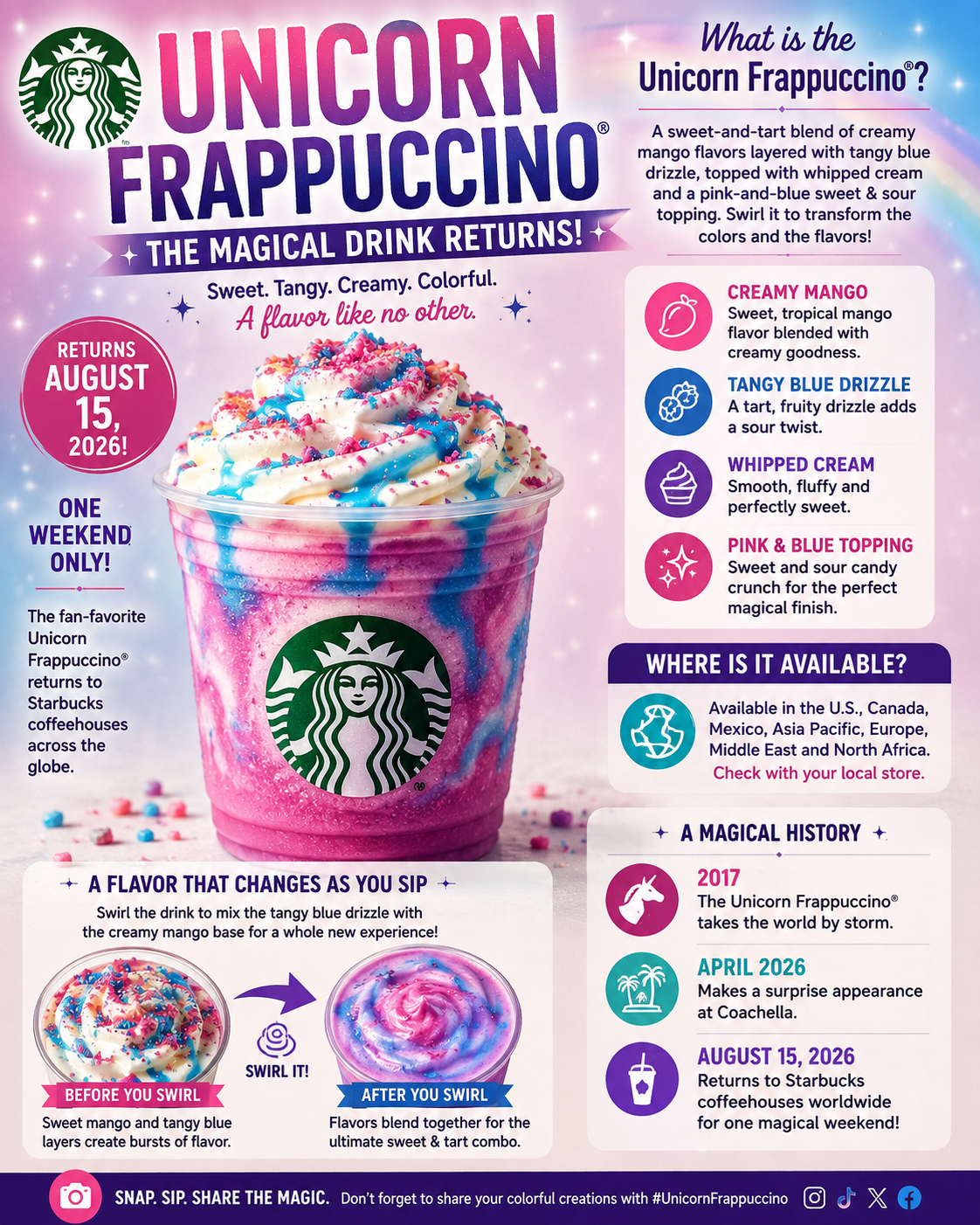
Searches for “Unicorn Frappuccino flavor” are surging as Starbucks prepares to revive one of the most famous—and visually distinctive—drinks in its history. The Starbucks Unicorn Frappuccino returns beginning August 15, 2026, for one weekend only, bringing its colorful combination of creamy tropical fruit, tangy blue drizzle, whipped cream and sweet-and-sour toppings back to coffeehouses around the world. (About Starbucks)
The timing explains the renewed search activity. The drink returns tomorrow after disappearing from regular Starbucks menus for nearly a decade. It first became a viral sensation in 2017 and made a limited comeback at the Coachella music festival earlier in 2026. Now, consumers who missed both releases have another opportunity to experience the beverage.
For consumers, the Unicorn Frappuccino is an exercise in nostalgia and visual spectacle. For flavorists and beverage developers, however, its return offers an interesting case study in dynamic flavor design—using sweetness, acidity, fruit character, color and physical mixing to create a beverage whose sensory profile changes while it is consumed.
What Is the Unicorn Frappuccino Flavor?
Despite its fantastical name, the Unicorn Frappuccino isn't actually an undefined “candy” flavor.
Starbucks describes the returning beverage as a sweet-and-tart blend of creamy mango flavors layered with tangy blue drizzle, finished with whipped cream and a colorful pink-and-blue topping. Swirling the beverage changes both its appearance and the balance of flavors. (About Starbucks)
In broad sensory terms, consumers should expect:
- Creamy mango and tropical fruit
- Sweet confectionery notes
- Tart or sour fruit character
- Vanilla-like whipped cream
- A sweet-and-sour candy impression
- A creamy frozen mouthfeel
People’s early tasting of the 2026 return similarly describes the drink as having a creamy mango character contrasted by the tangier blue component. (People.com)
The result is less like a conventional coffee Frappuccino and more like a frozen tropical fruit confection.
Starbucks — Unicorn Frappuccino 2026 announcement
When Does the Unicorn Frappuccino Return?
The Unicorn Frappuccino begins its extremely limited return on August 15, 2026.
Starbucks says the drink is returning to coffeehouses across multiple international markets for one weekend as a special end-of-summer event. The rollout includes the United States, Canada, Mexico, Asia Pacific, Europe, the Middle East and North Africa. (About Starbucks)
The international expansion is significant. Starbucks announced today that the drink will make its debut in several Asia-Pacific markets, including Australia, New Zealand, Singapore and Vietnam. (About Starbucks)
That makes the 2026 revival substantially more than a nostalgic U.S. promotion—it is a global limited-edition beverage event.
Why Is “Unicorn Frappuccino Flavor” Trending?
The immediate reason for the search spike is simple: the drink returns tomorrow.
People published an advance tasting yesterday, bringing renewed attention to what the beverage actually tastes like rather than simply how it looks. (People.com)
But nostalgia is equally important.
The original Unicorn Frappuccino debuted in 2017 during the peak of the internet’s “unicorn” aesthetic. Pastel colors, rainbow foods and highly photogenic desserts were dominating social platforms, and Starbucks created a drink practically engineered to be photographed.
The beverage quickly became an internet phenomenon.
Its dramatic pink, purple and blue appearance encouraged customers to post photos and videos, while its extremely limited availability created urgency.
In 2026, Starbucks is tapping into that memory.
The company first previewed the comeback at Coachella in April, where the Unicorn Frappuccino appeared as an exclusive festival offering. That appearance effectively reintroduced the product before the wider global return. (Good Housekeeping)
What Flavor Professionals Can Learn From the Unicorn Frappuccino
The beverage is particularly interesting from a flavor-development perspective because its sensory architecture is based on contrast rather than harmony alone.
Most beverages attempt to deliver a consistent flavor from the first sip through the finish.
The Unicorn Frappuccino deliberately changes.
Creamy Mango Forms the Foundation
The core is tropical and creamy.
Mango is particularly effective in frozen beverages because its naturally associated sensory characteristics—ripe fruit, tropical sweetness, juiciness and almost creamy flesh—work well with a blended base.
A mango flavor system can potentially contain sensory impressions ranging from fresh green fruit through ripe peach-like and tropical notes.
Here, Starbucks pushes the mango toward the sweeter, creamier side.
Tangy Blue Drizzle Creates Contrast
The blue component introduces acidity.
Starbucks describes it specifically as a tangy blue drizzle, providing the sour counterpoint to the creamy mango foundation. (About Starbucks)
This creates an important sensory mechanism:
sweet mango → sour fruit → creamy sweetness → tart finish.
Because the drizzle isn't initially distributed uniformly throughout the drink, individual sips can deliver different ratios.
The Flavor Changes When You Swirl It
This may be the most innovative element of the original concept.
Starbucks says swirling the cup changes the colors and transforms the flavors. (About Starbucks)
That means physical interaction becomes part of flavor delivery.
Before swirling, consumers may encounter more distinct zones of creamy mango and acidic blue drizzle.
After swirling, those components increasingly combine, producing a more integrated sweet-tart tropical profile.
For beverage developers, this demonstrates a valuable concept: flavor doesn't necessarily need to be homogeneous.
Layered beverages can intentionally produce sensory variation.
Modern examples include cold foam drinks, dirty sodas, layered refreshers, boba beverages and cocktails in which the experience changes as ingredients mix.
Why Sweet and Sour Works
Sweetness and acidity are fundamental partners in fruit flavor.
Without enough acidity, mango can become heavy, syrupy or overly ripe.
Without sufficient sweetness, sour flavor can become harsh.
Combining the two creates contrast and increases perceived refreshment.
The Unicorn Frappuccino exaggerates this principle by physically separating some of those sensations.
The sweet pink-and-sour blue topping further reinforces the candy-like sweet-acid architecture described by Starbucks. (About Starbucks)
For flavorists, the concept could be represented as:
Top: bright tropical fruit + tart candy
Heart: ripe creamy mango
Contrast: sour fruit drizzle
Base: vanilla/cream sweetness
Finish: alternating sweet and tart fruit
2026 Unicorn Frappuccino vs. the 2017 Original
The returning beverage preserves the central sensory idea that made the original famous.
The 2017 version used mango flavor, colorful sweet-and-sour components, whipped cream and dramatic pink-and-blue presentation. Good Housekeeping notes that the original included mango syrup, pink powder and sour blue swirls. (Good Housekeeping)
The 2026 version continues the essential combination of creamy mango + tangy blue drizzle + whipped cream + colorful sweet/tart topping. (About Starbucks)
That consistency is important.
Starbucks isn't simply borrowing the Unicorn name for an unrelated beverage. The company is bringing back the sensory characteristics consumers associate with the original phenomenon.
A Different Formula in Some International Markets
Flavor professionals should note that descriptions can vary by market.
Recent UK coverage describes that market’s 2026 version as combining a crème-style base with peach and mango plus blue raspberry character. (The Sun)
That suggests Starbucks may adapt the exact flavor execution depending on region, ingredient supply or local product specifications.
Therefore, it is more accurate to think of the global Unicorn profile as a tropical creamy sweet-and-sour concept rather than assume every market uses an identical formula.
The Role of Color in Flavor Perception
The Unicorn Frappuccino also demonstrates something flavor professionals know well: consumers don't taste with their tongues alone.
Color creates expectations before the first sip.
Bright pink suggests sweetness, berries or candy.
Electric blue frequently suggests blue raspberry, sour candy or artificial fruit.
Purple created by mixing pink and blue can suggest grape, berry or fantasy confectionery.
Even when those colors do not correspond directly to the underlying flavor chemistry, they influence what consumers expect to taste.
That makes the Unicorn Frappuccino an unusually clear example of multisensory product design.
Its appearance isn't packaging around the flavor.
Its appearance is part of the flavor experience.
Nostalgia Becomes a Beverage Innovation Strategy
Starbucks has increasingly revisited recognizable beverages from its past.
The Unicorn Frappuccino follows another major 2026 comeback: the S’mores Frappuccino, which returned in July after a six-year absence. (Delish)
These revivals demonstrate how established brands can use nostalgia almost like a flavor ingredient.
A returning beverage already has:
- Consumer recognition
- Emotional associations
- Social-media history
- Existing curiosity
- A story that can be retold
For younger consumers who never experienced the original launch, the same product functions as something entirely new.
That gives nostalgia-based launches an unusual ability to address two audiences simultaneously.
Why the Unicorn Frappuccino Still Matters to Flavorists
The drink may appear gimmicky, but its product-development lessons are surprisingly relevant.
It demonstrates that a successful flavor experience can combine tropical fruit, creamy texture, controlled acidity, confectionery cues, visual contrast and consumer interaction.
More importantly, the product isn't defined solely by mango.
The complete experience comes from the relationship between mango and sourness, creaminess and acidity, pink and blue, uniformity and layering.
That distinction matters when developing modern beverages.
Consumers increasingly experience products not simply as “a flavor,” but as combinations of flavor + texture + appearance + ritual + storytelling.
The Unicorn Frappuccino was built around that principle years before experiential beverages became as widespread as they are today.
Final Thoughts
The current search surge for “Unicorn Frappuccino flavor” is being driven by a genuinely timely event: Starbucks’ famous pink-and-blue beverage returns beginning August 15, 2026, for one weekend only. (About Starbucks)
Consumers can expect the familiar combination of creamy mango flavor, tangy blue drizzle, whipped cream and sweet-and-tart colorful topping, with swirling changing both the appearance and flavor balance.
For consumers who remember 2017, the return is pure nostalgia. For people who missed the original phenomenon, it is an opportunity to finally understand why a brightly colored frozen drink became an international social-media event.
For flavor professionals, however, the Unicorn Frappuccino offers a deeper lesson. Its success demonstrates the power of dynamic flavor architecture: contrasting sweetness and acidity, building multiple sensory layers and allowing consumers to physically transform the beverage while drinking it.
Nearly a decade after its original debut, the Unicorn Frappuccino is therefore returning as more than an old Starbucks novelty. It is a reminder that memorable flavor innovation often happens when taste, color, texture, interaction and cultural timing all work together.
Read Starbucks’ official Unicorn Frappuccino return announcement
###