Unlocking Authenticity: Mastering 2-Butylfuran in Savory, Brown, and Fruit Flavors
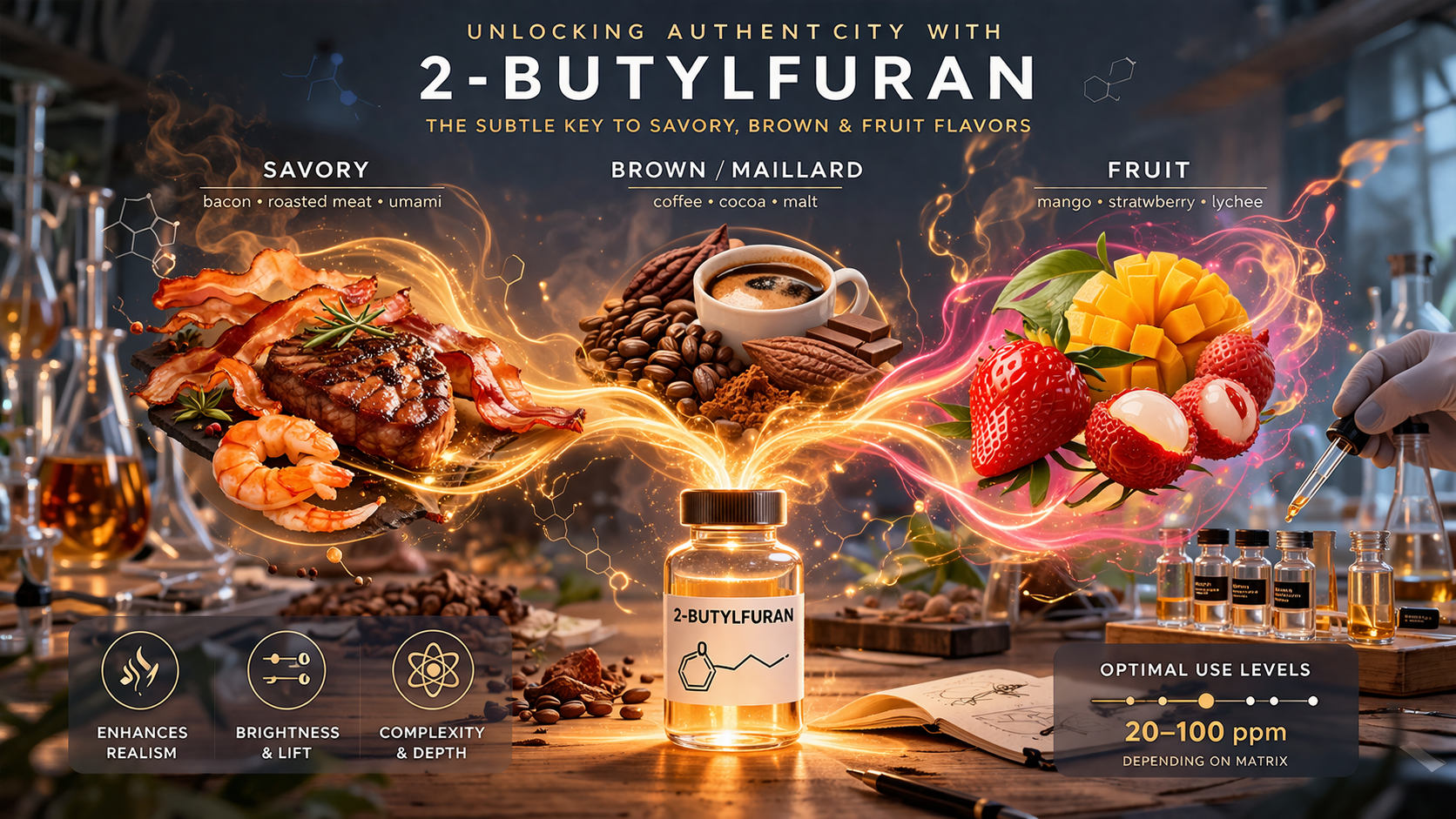
Unlocking Authenticity: Mastering 2-Butylfuran in Savory, Brown, and Fruit Flavors
For Flavorist Trainees: The Unsung Hero of Background Notes
In the world of flavor creation, not every ingredient wants to be the star. Some of the most powerful tools in a flavorist’s kit are the subtle enhancers—the molecules that don’t scream their presence but make a profile feel real, complete, and authentic.
One such molecule is 2-Butylfuran (often found in databases under identifiers like FEMA# 4081 or CAS# 4466-24-4). This compound is not a heavy, dominating character. Instead, it is a master of the “soft touch,” adding a unique blend of bright, ethereal lift with a fruity, pineapple-like warmth to the background of countless flavor systems.
This guide is written specifically for trainee flavorists. We will explore how to use 2-Butylfuran across different food categories, the sensory problems it solves, and the dosage ranges that work best.
Important Note for Trainees: The dosages mentioned below assume your finished flavor concentrate will be used at 0.05% in a ready-to-drink beverage or a simple bouillon. Always adjust based on your specific application matrix and regulatory limits.
Why 2-Butylfuran? The Sensory Profile
Before diving into formulas, understand what this ingredient brings:
- Odor Description: A luminous, volatile top note (ethereal) paired with a ripe, tropical fruit nuance (pineapple-like).
- Function: It is a complexity booster and authenticator. It fills in the "flat spots" in a flavor, smoothing harsh edges and adding a natural, just-cooked freshness.
- Regulatory Status: Widely accepted globally (check local regulations like DG SANTE in the EU). Always verify your use level against current standards.
Category 1: Savory Flavors (Meat, Seafood, and Vegetables)
In savory applications, 2-Butylfuran acts as a bridge, connecting fatty, sulfurous, and roasted notes into a cohesive whole.
- Bacon & Pork (50-100 ppm): Bacon flavors often rely too heavily on a single smoky or sulfur compound, making them feel artificial. Adding 2-Butylfuran (aim for 50 ppm) fills out the mid-note and reduces that "one-note" dominance. For general pork profiles, a range of 50-100 ppm works beautifully.
- Roast Beef & Chicken (100 ppm): These profiles are more complex than bacon, but still benefit from the added lift and juiciness that 2-Butylfuran provides. It prevents the flavor from tasting "muted" or "stewed."
- Seafood (Shrimp, Lobster, Crab: 40-100 ppm; White Fish: 30 ppm): Seafood flavors can lose their delicate top notes during processing. 2-Butylfuran restores freshness and sweetness. For crab, start low (40 ppm). For robust shrimp and lobster profiles, go higher (80-100 ppm).
- Lamb (50-100 ppm): Lamb has a characteristic fatty note. This ingredient lifts and clarifies that fatty profile, preventing it from becoming greasy or mutton-like.
- Egg, Boiled (20 ppm): A very subtle application. Use just a touch to add a fresh, airy quality without making it taste fruity.
- Tomato (30 ppm): Works in both fresh and cooked tomato flavors. It enhances the natural green-fruity notes and adds a just-picked brightness.
- Miso & Rice (10 ppm): In delicate, fermented, or starchy bases, use a minimalist hand. 2-Butylfuran brightens the top notes without disturbing the umami core.
- French Fries (50-100 ppm): Fried potato flavors can be harsh or burnt. This compound softens the acrylamide-like harshness while preserving the fatty, fried impact.
Category 2: Brown Flavors (Coffee, Cocoa, Tea, Vanilla)
Brown flavors are often heavy, roasted, and can lack "lift." 2-Butylfuran is surprisingly effective here.
- Vanilla Bean (400 ppm): This is the highest typical use level. Real vanilla has natural fruity and ethereal nuances (like pineapple). 2-Butylfuran enhances these top notes beautifully.
- Cocoa (80 ppm): Cocoa can be dusty or bitter. 80 ppm adds brightness and a fruity complexity that makes the cocoa taste richer.
- Black Tea & Darjeeling (100 ppm) vs. Green Tea (20 ppm): The more fermented the tea, the more it benefits. Black tea gets a lively, astringent edge from this molecule, while green tea only needs a whisper.
- Coffee (50 ppm): The main challenge in coffee flavors is the instability of sulfur notes (which provide freshness). 2-Butylfuran helps simulate that fresh-brewed top note at 50 ppm.
- Malt (20 ppm): Malt flavors often feature methional (cooked potato-like). 2-Butylfuran softens methional’s harshness and adds complexity.
Category 3: Nut and Dairy Flavors
- Nuts (Almond/Pistachio: 40 ppm; Hazelnut/Peanut: 50-100 ppm; Walnut: 60 ppm): The "roast level" dictates the dosage. Lightly roasted nuts (almond) need less; deeply roasted nuts (peanut, hazelnut) can handle more. It accentuates the sweet, caramelized notes.
- Cooked Butter & Toasted Cheese (up to 100 ppm): Raw dairy flavors don't benefit much. But heated dairy (ghee, toasted cheese) gains a nutty, browned-butter brightness.
- Condensed Milk (50-100 ppm): Adds a rustic, caramelized dairy note, especially in sweeter profiles.
Category 4: Fruit and Other Flavors
- Tropical Fruits (Passionfruit: 80 ppm; Guava, Lychee, Mango: 20 ppm): Passionfruit’s natural profile includes sulfurous and fruity notes that align perfectly with 2-Butylfuran. For other tropicals, a low dose adds an ethereal "fresh-picked" aura.
- Berries & Melons (Strawberry, Cranberry, Watermelon: 20 ppm): Not an obvious match, but brilliant as a texturizer—adding a sparkling, juicy quality to the top note.
- Mint (Peppermint & Spearmint: 20 ppm): Mint flavors can feel flat or one-dimensional. 2-Butylfuran adds a green, luminous lift that makes the mint feel fresher.
- Honey (10 ppm): Honey can be cloyingly heavy. A tiny amount introduces a delicate, floral brightness without destroying the honey character.
Practical Tips for the Trainee Flavorist
- Start Low, Go Slow: Because 2-Butylfuran works in the background, it is easy to over-dose. Begin at 50% of the suggested range and taste in your final application.
- Combine with Sulfurs: This molecule is a fantastic partner for sulfur compounds (like thiazoles or mercaptans) in savory flavors. It "polishes" the rough edges of sulfur.
- Think "Context": 400 ppm is great in vanilla but would ruin a white fish. Always consider the application matrix (fat content, sugar level, pH).
- Check Synonyms: When ordering, look for 2-Butylfuran, FEMA 4081, or CAS 4466-24-4.
Conclusion: The Art of Subtlety
As you progress from trainee to expert flavorist, you will learn that authenticity rarely comes from loud, character-impact molecules alone. It comes from the harmony of supporting players. 2-Butylfuran is a perfect example of that principle. It is a universal enhancer—adding a touch of ethereal light to savory, a fruity warmth to brown, and a juicy lift to fruit flavors.
Master this molecule, and you master the subtle art of making flavors taste real.
Keywords: 2-Butylfuran, FEMA 4081, flavorist training, savory flavor enhancement, authentic flavor creation, brown flavors, fruit flavor lift, beverage flavoring, CAS 4466-24-4, background flavor notes.
###