Vegetable and Animal-Derived Fats & Oils: Sources, Forms and Flavor Applications
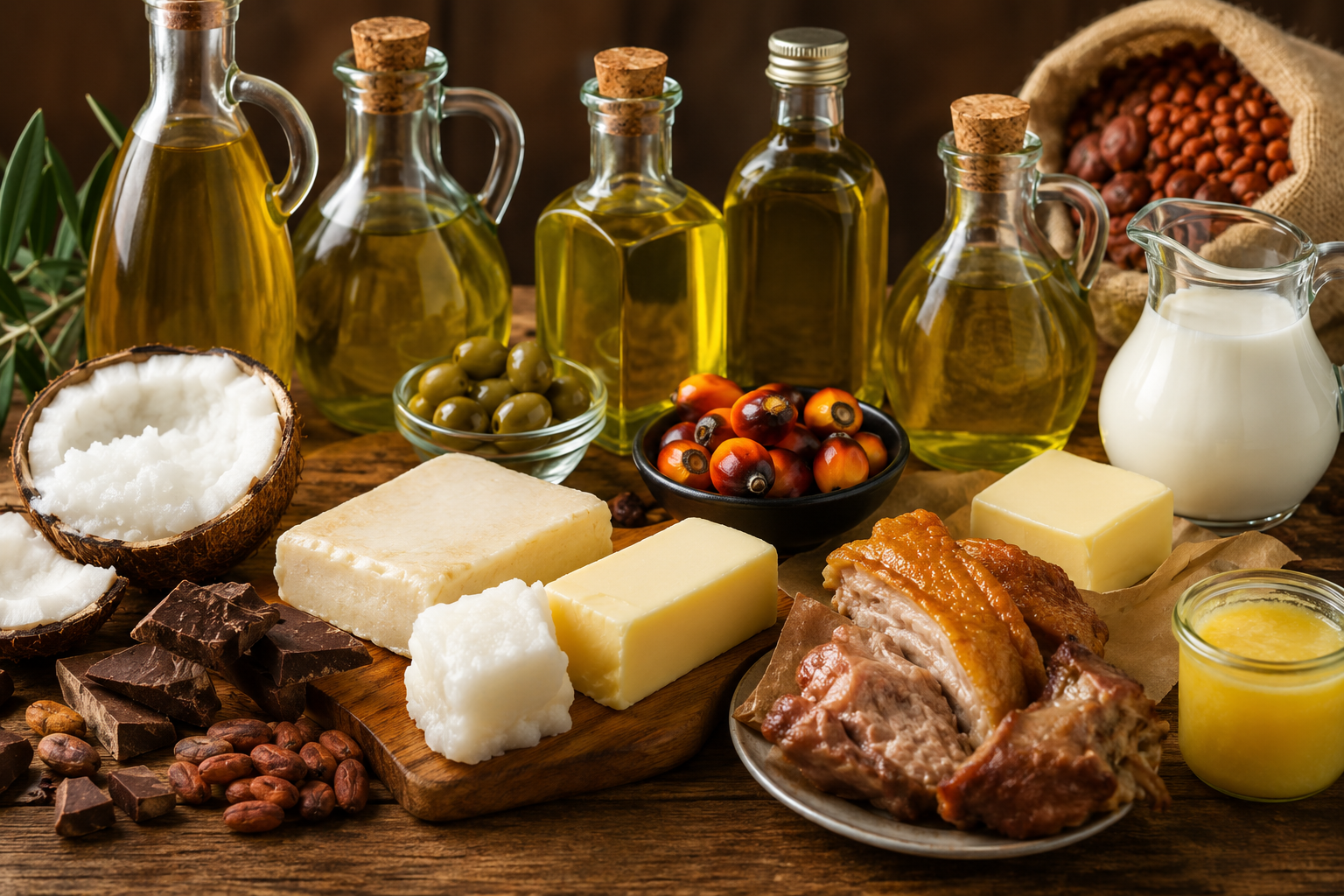
For the Society of Flavor Chemists, fats and oils are not just “carriers.” A trainee is expected to understand them simultaneously as chemical systems, processed raw materials, sensory contributors, flavor solvents, texture modifiers, and sources of reaction products. The current SFC syllabus specifically lists “Vegetable and Animal derived fats/oils” among the materials candidates should be able to discuss in terms of physical form, method of production, organoleptic properties, and solubility. (Flavor Chemists)
A strong way to prepare is to organize the subject around those four questions, while always connecting the answer back to flavor creation and shelf life.
1. Physical form: why some lipids are oils and others are fats
Edible fats and oils are chemically much more alike than their everyday names suggest. They consist predominantly of triacylglycerols, also called triglycerides or TAGs: glycerol esterified with three fatty acids. They may also contain smaller amounts of free fatty acids, mono- and diglycerides, phospholipids, sterols, tocopherols or tocotrienols, waxes, pigments, oxidation products, and naturally occurring flavor-active compounds. Codex recognizes edible fats and oils of vegetable, animal, and marine origin and describes them primarily as glycerides of fatty acids. (FAOHome)
The words “fat” and “oil” mainly refer to physical state. An oil is predominantly liquid at the temperature being considered, while a fat is predominantly solid or semi-solid. That is not a botanical versus animal distinction.
This is why several common assumptions fail:
- Coconut oil, palm oil, and cocoa butter are vegetable-derived but can be solid or semi-solid around room temperature.
- Fish oil is animal-derived but is liquid.
- Lard is normally softer than beef tallow even though both are animal fats.
The physical state comes largely from fatty-acid composition and triglyceride structure.
More saturated fatty acids generally allow tighter molecular packing and therefore higher melting behavior. Tallow, cocoa butter, and coconut oil illustrate this tendency. Cis-unsaturated fatty acids contain bends in their chains that interfere with packing, lowering the melting tendency; therefore soybean, sunflower, canola, and fish oils are generally liquid.
Chain length also matters. Longer hydrocarbon chains usually increase intermolecular attraction and raise melting tendency. The exact triglycerides present matter as well: two fats can have similar overall fatty-acid compositions but behave differently if the fatty acids are distributed differently among the triglyceride molecules.
Crystallization is another important part of the physical behavior. Fats can form different crystal polymorphs, commonly discussed as α, β′, and β forms. Their relative stability and crystal size influence whether a material feels smooth, creamy, waxy, grainy, brittle, or plastic. This is especially important in cocoa butter, confectionery fats, shortenings, margarines, and dairy fat.
A flavorist should therefore connect physical form directly to sensory delivery. Melting range, solid-fat content, viscosity, and crystal form influence lubrication, creaminess, waxiness, melt-away, and the rate at which aroma chemicals become available during eating.
2. How vegetable fats and oils are produced
Vegetable oils come broadly from seeds, kernels, nuts, or oily fruits.
Common seed, kernel, and nut sources include soybean, sunflower, canola or rapeseed, corn germ, cottonseed, peanut, sesame, rice bran, coconut, and palm kernel. Oily fruits include olive, oil-palm fruit, and avocado.
The production route depends on the raw material.
Mechanical pressing
A plant material may first be cleaned, dehulled or cracked, ground or flaked, and sometimes conditioned with heat. It is then mechanically pressed, often using a screw-type expeller. Oil is forced from the plant tissue while a solid press cake remains.
Cold-pressed oils are obtained mechanically without deliberate application of heat. Codex permits limited physical purification such as washing, settling, filtration, and centrifugation. (FAOHome)
Because cold-pressed and virgin oils are treated relatively gently, they retain much more of their original source character: pigments, seed or fruit volatiles, minor lipids, and other naturally occurring flavor-active materials.
That distinction matters greatly in sensory work. A cold-pressed oil is often intended to taste like its source. A fully refined commodity oil is often intended to taste like almost nothing.
Solvent extraction
Mechanical pressing does not always recover enough oil. Many commercial seed oils are therefore extracted using a lipophilic solvent, traditionally a light hydrocarbon solvent such as hexane. The oil dissolves into the solvent, the liquid phase is separated from the solid meal, and the solvent is subsequently removed and recovered.
Soybean, rice-bran, and corn-germ oils are examples for which solvent extraction can be industrially important. FAO distinguishes this route from mechanical pressing of oily fruits and rendering of animal tissues. (FAOHome)
The material obtained at this point is crude oil. It normally requires further purification before it has the bland, stable character expected of a refined edible oil.
Fruit oils
Oily fruits are treated differently from many dry seeds. Olives or oil-palm fruit, for example, are cleaned and crushed or digested, and the oil-containing phase is separated mechanically by pressing and/or centrifugation.
An important examination distinction is:
Palm oil comes mainly from the fruit mesocarp, whereas palm-kernel oil comes from the seed or kernel.
They are not interchangeable. Their fatty-acid compositions, melting behavior, and flavor characteristics differ substantially.
3. Refining vegetable oils
Crude vegetable oil may contain phospholipids, free fatty acids, pigments, trace metals, waxes, oxidation products, and volatile materials. Commercial refining removes or reduces these materials.
The usual sequence includes some combination of:
Degumming → neutralization or deacidification → bleaching → deodorization → optional winterization or fractionation.
AOCS identifies these as the central operations in edible-oil refining. (AOCS)
Degumming
Degumming primarily removes phospholipids, commonly called gums. Water and/or acid treatment converts them into a form that can be separated from the oil.
Neutralization
In chemical refining, free fatty acids are reacted with alkali, typically sodium hydroxide, forming soaps that are subsequently separated.
In simplified form:
FFA + NaOH → soap
Physical refining handles the free fatty acids differently. Instead of neutralizing them with alkali, they are removed predominantly by distillation during deodorization. (AOCS)
Bleaching
“Bleaching” should not be understood simply as whitening the oil. Bleaching earth or clay adsorbs undesirable materials including pigments, chlorophyll, residual soaps, trace metals, phospholipids, and some oxidation products. (AOCS)
Deodorization
For a flavorist, deodorization is one of the most important refining concepts.
The oil is heated under strong vacuum and contacted with steam. Volatile compounds are stripped away, including many aldehydes, ketones, free fatty acids, and odor-active impurities. The objective for many refined commodity oils is a light-colored, stable, bland product with little intrinsic aroma. (AOCS)
That gives a useful sensory contrast:
Virgin or cold-pressed oil preserves source identity. Refined and deodorized oil deliberately minimizes it.
The abbreviation RBD therefore deserves to be memorized:
Refined, Bleached, Deodorized.
4. Processes that modify physical behavior
Several downstream operations are often confused in interviews, so they should be kept conceptually separate.
Winterization or dewaxing
The oil is cooled so waxes and higher-melting triglycerides crystallize. Those crystals are then removed by filtration.
The purpose is often to prevent cloudiness or crystallization during refrigeration.
For flavor applications, this may matter when an oil carrier is expected to remain visually clear at low temperature.
Fractionation
A fat is partially crystallized and separated into portions with different melting behavior.
With palm oil, the classic result is:
- palm olein: lower-melting, more liquid fraction
- palm stearin: higher-melting, harder fraction
Fractionation is a physical separation. It is not hydrogenation.
Hydrogenation
Hydrogen is added across carbon-carbon double bonds.
The resulting fat becomes more saturated, generally harder, and more oxidatively stable. Partial hydrogenation historically could also generate substantial trans fatty acids.
From the flavorist's perspective, hydrogenation changes more than texture. It can alter mouthfeel, oxidative stability, and release of lipophilic flavor materials.
Interesterification
Interesterification redistributes fatty acids among glycerol backbones.
The overall fatty-acid composition may remain nearly the same even though the triglyceride population changes considerably. As a result, melting behavior and crystallization can change dramatically.
A useful examination summary is:
| Process | What changes? |
|---|---|
| Hydrogenation | Degree of unsaturation |
| Interesterification | Distribution of fatty acids among triglycerides |
| Fractionation | Physical separation of higher- and lower-melting triglycerides |
5. Sensory profiles of important vegetable oils
These are general room-temperature descriptions. Exact behavior varies with cultivar, processing, fractionation, and temperature.
| Material | Typical physical form | Organoleptic character |
|---|---|---|
| Soybean oil | Liquid | Refined material is very bland. Crude or unrefined oil can be beany, green, and seed-like. Oxidation or flavor reversion may become grassy, stale, or painty. |
| Canola oil | Liquid | Refined oil is mild and neutral. Less-refined material may show seed-like, green, cabbage-like, or mustard-like nuances. |
| Sunflower oil | Liquid | Mild, fatty, sometimes lightly seedy or nutty when less refined; fully refined grades are nearly neutral. |
| Corn oil | Liquid | Slight corn, grain, or nutty character; refined grades are comparatively mild. |
| Peanut oil | Liquid | Refined oil can be mild; less-refined or roasted forms can be strongly peanutty, nutty, and roasted. |
| Sesame oil | Liquid | Unroasted oil has light seed and nut character. Toasted sesame oil has intense roasted, nutty, toasted, sulfurous, and brown notes. |
| Olive oil | Liquid | Extra virgin oil can be fruity, green, grassy, leafy, bitter, and peppery. Refined olive oil is much less aromatic. |
| Avocado oil | Liquid | Virgin material can be green, buttery, avocado-like, and vegetal; refined material is much milder. |
| Coconut oil | Solid or semi-solid below roughly warm room temperature; melts readily | Virgin oil is sweet, coconut-like, creamy, lactonic, and nutty. RBD coconut oil is comparatively bland. |
| Palm oil | Semi-solid | Crude or red palm oil has characteristic earthy, fruity, carotenoid-associated character. RBD palm is much milder. |
| Palm-kernel oil | Solid or semi-solid | Mild, clean, lauric-fat character after refining. |
| Cocoa butter | Firm solid at room temperature; melts near mouth temperature | Mild cocoa/chocolate background, fatty, creamy; valued for its sharp melt and clean mouthfeel. |
Coconut oil and palm-kernel oil are particularly worth remembering because both are commonly grouped as lauric fats. They contain large amounts of medium-chain saturated fatty acids, especially lauric acid.
That composition contributes to relatively high oxidative stability, firmness below their melting range, and comparatively sharp melting. If significant hydrolysis liberates free fatty acids, these fats can develop soapy or rancid characteristics.
6. Why refined oils taste so different from virgin oils
A likely oral question is: why can extra-virgin olive oil smell intensely fruity and green while refined soybean oil is almost neutral?
The important answer is processing.
Virgin and cold-pressed oils retain volatile and nonvolatile compounds from the raw material because refining is limited. Fully refined oils undergo purification operations designed to remove pigments, free fatty acids, oxidation products, and—especially during deodorization—volatile odorants. AOCS describes deodorization as a vacuum steam-stripping process whose purpose includes removal of off-flavor compounds and production of a bland oil. (AOCS)
So “stronger flavor” is not simply a property of the source plant. It also reflects how much processing has been deliberately used to remove source character.
Animal-derived fats and oils
The major examples a flavorist should recognize include lard, pork fat, beef tallow, mutton tallow, chicken fat, duck fat, goose fat, milk fat or butterfat, butter, anhydrous milk fat or butter oil, and fish oils.
Unlike commodity seed oils, many mammalian and poultry fats are produced by rendering.
7. Rendering
Rendering separates lipid from animal tissue, connective material, protein, and water through heat and physical separation.
Codex defines lard as rendered fat from suitable swine fatty tissues and edible tallow as fat obtained by rendering suitable bovine or sheep tissues. (FAOHome)
A simplified process is:
Size reduction → heating/rendering → separation of solids and water → clarification or centrifugation → optional refining or deodorization.
The amount of heat used affects sensory quality. Thermal treatment can contribute desirable cooked, fatty, meaty, roasted, sulfurous, or browned notes, but excessive treatment may also produce oxidized, burnt, stale, or animalic defects.
Dry rendering
In dry rendering, the animal tissue is heated without addition of large quantities of water. Naturally present moisture is evaporated, and the molten fat separates from proteinaceous solids. The fat is then drained, pressed and/or centrifuged, filtered, and sometimes refined.
Wet rendering
Wet rendering uses water or steam during heating. The process ultimately separates a fat phase, aqueous phase, and proteinaceous solid fraction.
FAO distinguishes wet and dry rendering as major routes for animal tissues. (FAOHome)
8. Lard
Lard is rendered pork fat.
It is generally soft or semi-solid at room temperature and is often softer than beef tallow.
Its consistency is not fixed. Pig diet can substantially alter fatty-acid composition; greater unsaturation in the diet can result in softer lard. (FAOHome)
Fresh edible lard may be:
- mild
- slightly sweet
- fatty
- pork-like
Highly refined grades can be relatively neutral.
Rendered or heated pork fat can also produce pork-skin, roasted-meat, savory, fatty, and mildly animalic notes.
Leaf lard, from internal fat deposits especially around the kidneys, is typically more delicate, softer, and less strongly pork-flavored than many other rendered pork fats.
9. Beef tallow
Tallow is produced by rendering bovine fatty tissues.
It is generally firmer and waxier than lard because of its higher proportion of saturated and higher-melting triglycerides.
Typical sensory descriptors include:
- beef fat
- suet
- meaty
- fatty
- waxy
- cooked beef
- sometimes animalic
Heated beef fat can contribute strongly to authentic beef character because oxidation of the lipid generates flavor-active volatiles that interact with sulfur and Maillard-derived materials.
That leads to an important savory-flavor principle:
Meat flavor is not produced by Maillard chemistry alone. Lipid-derived volatiles contribute substantially to characteristic meat identity.
10. Poultry fats
Chicken fat is normally softer than beef tallow and may be semi-solid or fluid depending on temperature. It is generally more unsaturated.
Typical descriptors include:
- chicken skin
- poultry fat
- savory
- brothy
- roasted
When associated with cooked meat components, sulfurous nuances may also be present.
In savory flavor creation, chicken fat can provide both authentic fatty character and a lipid phase capable of carrying lipophilic cooked-meat compounds.
Duck and goose fats are likewise relatively soft compared with beef tallow. Their sensory character can be described as rich, fatty, savory, roasted-skin-like, poultry-like, and sometimes slightly gamey depending on source and processing.
11. Milk fat, butter, and butter oil
Milk fat should not simply be grouped with rendered carcass fats because its production route is different.
Butter is made by churning cream. The churning process destabilizes the milk-fat globules, causing fat to separate from the aqueous buttermilk phase and form a semi-solid continuous fat structure. USDA describes butter manufacture in this way. (AMS)
This is also a useful emulsion-chemistry question.
Cream is an:
oil-in-water emulsion
Butter is predominantly a:
water-in-oil emulsion
That phase inversion is a good point to mention in an interview because it shows understanding of both processing and physical chemistry.
Sweet-cream butter is typically perceived as creamy, milky, sweet, fatty, lactonic, and dairy-like.
Cultured butter may additionally show:
- diacetyl-like buttery notes
- fermented character
- tanginess
- lactic character
- cultured-dairy complexity
USDA butter grading explicitly considers flavor and recognizes defects such as acid, aged, old-cream, bitter, scorched, cooked, storage, and feed characteristics. (AMS)
Butter oil or anhydrous milk fat is a concentrated milk-fat material from which nearly all water and nonfat milk solids have been removed. It can be solid or semi-solid at room temperature and liquid when warmed, with rich buttery, creamy, dairy-fat, and lactonic character.
The distinction between butter and butter oil matters when heat is involved. Brown-butter character depends substantially on reactions involving the nonfat milk solids; it is not generated by the triglyceride fraction alone.
12. Fish and marine oils
Fish oil is the clearest demonstration that an animal-derived lipid need not be solid.
Fish oils are generally liquid because they contain substantial quantities of long-chain unsaturated and highly polyunsaturated fatty acids.
Industrial production commonly involves:
- cooking the fish or fish material,
- pressing,
- removing solids,
- centrifuging the resulting liquid,
- collecting the oil,
- refining or purifying it as necessary.
FAO describes cooking, pressing, and centrifugation as principal operations in fish-oil manufacture. (FAOHome)
Fresh, well-refined fish oil should be relatively mild.
When oxidation develops, sensory notes can include:
- fishy
- metallic
- painty
- oily
- seaweed-like
- cardboard-like
- rancid
Because fish oils are highly polyunsaturated, they are especially sensitive to oxidation.
That gives another useful interview point:
Strong fishiness in a fish oil often reflects oxidation chemistry rather than the odor of intact triglycerides themselves.
13. Solubility: the answer a flavorist should give
Triglyceride fats and oils are essentially insoluble in water because the long hydrocarbon portions of their fatty acids dominate their behavior.
They are readily soluble or miscible in nonpolar or lipophilic media, including other fats and oils and many nonpolar organic solvents.
They are generally soluble in materials such as:
- oils and fats
- hydrocarbon solvents
- hexane
- petroleum ether
- ether-type solvents
- many other nonpolar organic solvents
They are generally poorly soluble or insoluble in:
- water
- aqueous sugar solutions
- aqueous salt solutions
- aqueous acid solutions
With ethanol, the appropriate general answer is that triglyceride fats and oils have limited to poor solubility, particularly in dilute aqueous ethanol. Their behavior depends strongly on alcohol concentration, temperature, and lipid composition.
A candidate should avoid casually describing triglyceride oils as “alcohol soluble.”
14. Emulsion does not mean solution
This distinction is essential in flavor formulation.
When oil is distributed throughout water using an emulsifier, the oil has not become molecularly dissolved. It remains present as dispersed droplets.
So:
Oil + water + emulsifier → emulsion
not a true molecular solution.
Materials such as modified starches, gums, proteins, mono- and diglycerides, and appropriate surfactants can help stabilize those droplets.
This is why an oil-soluble flavor cannot simply be poured into a soft drink and expected to remain uniformly distributed. Depending on the system, one may need an emulsion, a cloud system, a suitable carrier, or a reformulation using more water-compatible flavor materials.
15. Fat as a flavor solvent and release medium
For flavorists, the solubility discussion should go beyond saying “insoluble in water.”
Many aroma chemicals are lipophilic and preferentially partition into the fat phase. Examples include many terpenes, lactones, long-chain aldehydes, ketones, sulfur compounds, aromatic hydrocarbons, and esters.
That partitioning changes perception.
A lipophilic aroma molecule dissolved in fat may produce a lower immediate headspace concentration than the same molecule in a more aqueous system. In sensory terms, this can make the first aroma impact appear weaker.
At the same time, retention in the fat phase can prolong release. During chewing and warming, the food matrix changes, saliva dilutes the system, solid fat melts, and volatile compounds redistribute.
This can alter flavor balance as well. Increasing fat content can change the relative headspace concentrations of different aroma chemicals.
Therefore the same dosage of a flavor does not necessarily produce the same sensory profile in a low-fat beverage and a high-fat dairy food.
16. Temperature and flavor release
Temperature affects the fat matrix and therefore the way flavor is delivered.
As fat warms:
- crystals melt,
- viscosity falls,
- diffusion increases,
- retained aroma molecules become more mobile.
Chocolate is a useful example: when cold it may release comparatively little aroma, but as cocoa butter melts in the mouth, flavor perception becomes much more intense.
Cocoa butter's melting behavior is therefore both a physical property and a sensory property.
17. Not all lipid components behave alike
Free fatty acids and phospholipids should be separated conceptually from intact triglycerides.
Long-chain free fatty acids remain poorly water soluble. Shorter-chain fatty acids are increasingly water soluble and volatile.
This is especially important in dairy chemistry. Fatty acids such as:
- butyric
- caproic
- caprylic
- capric
can contribute intense buttery, cheesy, goaty, sweaty, or rancid character when released.
This explains why hydrolyzed milk fat can smell extremely strong even though intact triglycerides themselves have very little odor.
Phospholipids behave differently because they contain both hydrophilic and lipophilic portions. They are amphiphilic, which is why materials such as lecithin can function as emulsifiers.
18. Why intact fat is not strongly odorous
High-molecular-weight triglycerides have extremely low volatility.
Consequently, much of what people perceive as “fat aroma” actually comes from other materials:
- naturally occurring minor volatiles
- free fatty acids formed by hydrolysis
- lipid-oxidation products
- thermal-degradation compounds
- compounds produced through interaction with Maillard chemistry
- source-associated minor constituents
It is useful to think of the fat phase as both a precursor reservoir and a solvent for aroma molecules.
19. Lipid oxidation and flavor deterioration
A flavorist should understand oxidation because it connects raw-material chemistry directly to shelf life.
A simplified sequence is:
Unsaturated lipid → lipid radical → hydroperoxide → secondary oxidation products
Hydroperoxides themselves are not necessarily the strongest odorants. Their breakdown generates aldehydes, ketones, alcohols, hydrocarbons, acids, and other volatile compounds.
Depending on the lipid and reaction conditions, the resulting sensory character can be:
- green
- fatty
- fried
- cardboard-like
- painty
- metallic
- fishy
- rancid
The general resistance to oxidation follows the trend:
Saturated > monounsaturated > polyunsaturated
Thus coconut oil is comparatively oxidation-stable, high-oleic oils are relatively stable, conventional soybean and sunflower oils are less stable, and omega-3-rich fish oils are especially oxidation-sensitive.
Fatty-acid composition therefore controls not only physical form but also flavor stability.
20. Hydrolytic rancidity versus oxidative rancidity
These should be explained separately.
Hydrolytic rancidity
Triglycerides are hydrolyzed:
TAG + water → glycerol + free fatty acids
Lipases, moisture, and processing conditions can promote the reaction.
In butter and milk fat, liberation of short-chain fatty acids can produce rancid, cheesy, sweaty, and goaty notes.
In lauric fats such as coconut oil, appreciable free-fatty-acid formation may give soapy, pungent, or fatty off-character.
Oxidative rancidity
Unsaturated fatty acids undergo radical oxidation and eventually generate odor-active decomposition products.
Typical descriptors include:
- cardboard
- paint
- metallic
- stale
- grassy
- fishy
- oily
- oxidized
That difference is a very plausible oral-interview question.
21. Factors that promote or suppress oxidation
A trainee should be able to name the main accelerators quickly.
Oxidation is promoted by:
- oxygen
- heat
- light
- iron and copper
- high degree of unsaturation
- large surface area
- existing hydroperoxides
- loss of natural antioxidants
- inappropriate packaging
- long storage
It can be inhibited by:
- antioxidants
- tocopherols
- oxygen exclusion
- nitrogen flushing
- protection from light
- low-temperature storage
- chelating agents
- avoidance of iron and copper contamination
This relates directly to SFC's broader expectation that candidates understand factors affecting reaction rates, formulation stability, aging, and shelf life. (Flavor Chemists)
22. A practical way to answer any fat or oil question
If the examiner names a material—say lard, sesame oil, cocoa butter, or fish oil—run through the same four-part mental sequence.
| SFC topic | Questions to ask yourself |
|---|---|
| Physical form | Is it liquid, semi-solid, or solid? At what temperature? Is it crystalline, plastic, waxy, or sharply melting? Is it relatively saturated or unsaturated? |
| Production | Is it pressed, cold pressed, expeller pressed, solvent extracted, rendered, centrifuged, refined, bleached, deodorized, winterized, fractionated, hydrogenated, or interesterified? |
| Organoleptic | Does it retain source identity or is it bland? Is it nutty, seedy, green, dairy, meaty, poultry-like, marine, creamy, waxy, oxidized, or rancid? |
| Solubility | Is it water insoluble? Oil soluble? Poorly soluble in aqueous ethanol? Would a water-based system require an emulsion or other formulation approach? |
That framework makes it much easier to improvise an answer even when the examiner names a fat you have not specifically memorized.
23. Comparisons worth memorizing
| Comparison | Examination distinction |
|---|---|
| Fat vs. oil | Same basic chemistry; the terminology mainly reflects physical state. |
| Vegetable vs. animal | Source does not reliably predict whether the lipid is solid or liquid. |
| Virgin vs. refined oil | Virgin oil retains source character; refining and deodorization remove much of it. |
| Palm vs. palm kernel | Palm comes from fruit mesocarp; palm kernel comes from the seed and has a very different fatty-acid profile. |
| Cold pressing vs. solvent extraction | Mechanical extraction without deliberate heating versus extraction into a lipophilic solvent. |
| Rendering vs. pressing | Rendering uses heat to separate animal fat from tissue; pressing mechanically removes oil from suitable plant material. |
| Hydrogenation vs. fractionation | Hydrogenation changes unsaturation; fractionation physically separates higher- and lower-melting triglycerides. |
| Interesterification vs. hydrogenation | Interesterification redistributes fatty acids among glycerides; hydrogenation reduces carbon-carbon double bonds. |
| Solubilization vs. emulsification | Molecular solution versus dispersed droplets. |
| Hydrolytic vs. oxidative rancidity | Release of free fatty acids versus oxidation of unsaturated lipids. |
| Butter vs. butter oil | Butter contains water and nonfat milk solids; butter oil or AMF is concentrated milk fat. |
| Cream vs. butter | Cream is oil-in-water; butter is predominantly water-in-oil. |
| Lard vs. tallow | Pork fat is usually softer; beef tallow is generally firmer and waxier. |
| Animal fat vs. fish oil | Fish oil shows that an animal-derived lipid can be highly unsaturated and liquid. |
24. What a compact oral answer could sound like
If asked simply, “Explain vegetable and animal fats and oils,” an effective answer would cover the entire subject without becoming a catalog:
Fats and oils are composed predominantly of triglycerides, and the distinction between the terms mainly reflects whether the material is solid or liquid at a particular temperature. Their physical behavior depends on fatty-acid chain length, degree of unsaturation, triglyceride structure, and crystallization.
Vegetable oils may be obtained by mechanical pressing or solvent extraction and are often refined through degumming, neutralization or physical deacidification, bleaching, and deodorization; they may also be winterized, fractionated, hydrogenated, or interesterified.
Animal fats such as lard, tallow, and poultry fat are commonly produced by rendering, whereas butter is made by churning cream, and fish oil may be obtained by cooking, pressing, and centrifugation.
Virgin or minimally processed oils retain source-specific flavors such as fruity or green olive character, toasted sesame, or coconut, while fully refined oils are usually intentionally bland. Animal fats can contribute characteristic dairy, pork, beef, poultry, or marine notes depending on source and processing.
Triglycerides are essentially insoluble in water, readily soluble in fats and other nonpolar media, and generally poorly soluble in aqueous alcohol; water-based applications therefore often require emulsification.
Fat also influences flavor perception because lipophilic aroma compounds partition into the lipid phase. Finally, highly unsaturated oils are particularly vulnerable to oxidation, which can generate aldehydes, ketones, acids, and related volatile compounds responsible for both desirable cooked-fat character and undesirable rancidity.
That type of answer demonstrates much more than memorized definitions. It shows that you understand the material as a chemical phase, a manufactured ingredient, a sensory contributor, and a formulation variable.
For SFC preparation, that is the most useful mindset: whenever you study a fat or oil, ask not only “what is it?” but also “why is it in that physical form, how was it produced, what should fresh material smell and taste like, what defects can develop, where will it dissolve or disperse, and how will it alter release of the flavor I put into it?”
###