American Spice Trade Association (ASTA): What Flavorists Need to Know
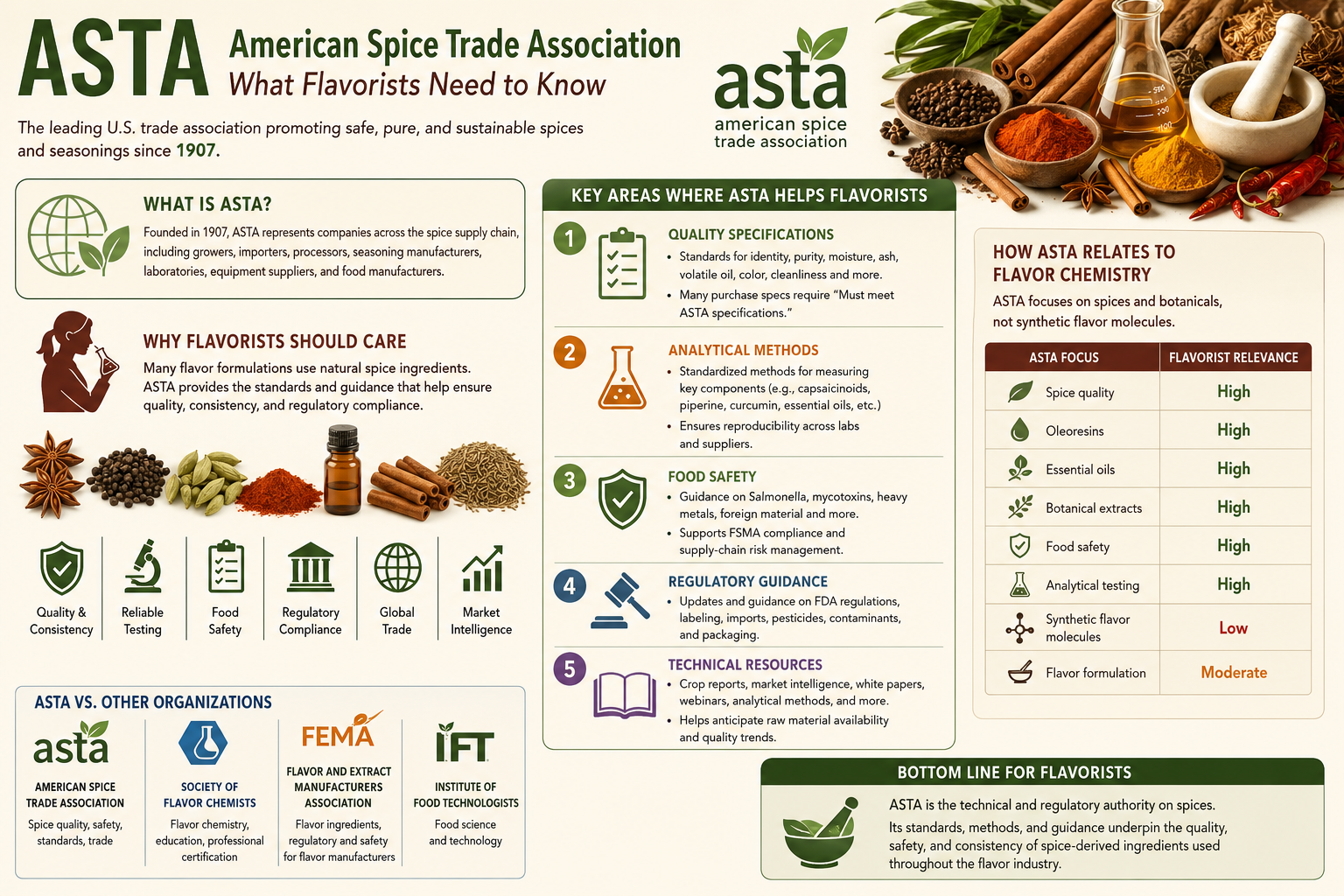
For flavorists, the American Spice Trade Association (ASTA) is not primarily a flavor creation organization—it's the leading U.S. trade association for the spice and seasoning industry. However, it has significant influence on how flavorists develop, source, specify, and validate spice-based flavors and seasonings. (ASTA)
What is ASTA?
The American Spice Trade Association was founded in 1907 and represents companies across the spice supply chain, including:
- Spice growers
- Importers
- Processors
- Seasoning manufacturers
- Ingredient suppliers
- Analytical laboratories
- Food manufacturers
- Equipment and service providers
Its mission is to promote safe, pure, and sustainable spices while representing industry interests before regulators such as the U.S. FDA. (ASTA)
Why should a flavorist care?
Although flavorists often work with aroma chemicals and compounded flavors, many formulations contain:
- Natural spice extracts
- Essential oils
- Oleoresins
- Ground spices
- Botanical ingredients
ASTA provides the technical framework that helps ensure these ingredients meet industry expectations.
1. Quality specifications
ASTA publishes widely recognized standards for:
- Identity of spices
- Purity
- Moisture
- Ash
- Volatile oil content
- Color
- Cleanliness
Many purchasing specifications simply state:
"Must meet ASTA specifications."
For flavorists developing spice profiles, understanding these specifications helps ensure consistency between suppliers.
2. Analytical methods
ASTA develops standardized laboratory methods for measuring:
- Capsaicinoid content (heat)
- Piperine
- Curcumin
- Essential oil levels
- Color values
- Particle size
- Moisture
- Microbiological quality
These methods improve reproducibility across suppliers and laboratories. (ASTA)
3. Food safety
One of ASTA's biggest roles today is promoting spice safety.
Topics include:
- Salmonella control
- Pathogen reduction
- Foreign material prevention
- Mycotoxins
- Heavy metals
- Supply-chain risk
- Food Safety Modernization Act (FSMA) compliance
Flavorists working with natural spice ingredients should understand these issues because ingredient selection affects both flavor quality and regulatory compliance. (ASTA)
4. Regulatory guidance
ASTA provides guidance on:
- FDA regulations
- Labeling
- Import requirements
- International trade
- Pesticide residues
- Contaminants
- Packaging regulations
This information is especially useful for flavor companies selling into the U.S. market. (ASTA)
5. Technical resources
Members gain access to resources such as:
- Crop reports
- Market intelligence
- Technical white papers
- Guidance documents
- Analytical methods
- Regulatory updates
- Educational webinars
These resources can help flavorists anticipate changes in raw material availability and quality. (ASTA)
How does ASTA relate to flavor chemistry?
ASTA focuses on spices, not flavor compounds.
| ASTA focus | Flavorist relevance |
|---|---|
| Spice quality | High |
| Oleoresins | High |
| Essential oils | High |
| Botanical extracts | High |
| Food safety | High |
| Analytical testing | High |
| Synthetic flavor molecules | Low |
| Flavor formulation | Moderate |
Flavorists creating spice flavors (e.g., black pepper, cinnamon, cumin, paprika) benefit from understanding ASTA standards, while those working mainly with synthetic aroma molecules may rely more on other organizations.
ASTA vs. other organizations
| Organization | Primary focus |
|---|---|
| American Spice Trade Association | Spice quality, safety, standards, trade |
| Society of Flavor Chemists | Flavor chemistry, education, professional certification |
| Institute of Food Technologists | Food science and technology |
| Flavor and Extract Manufacturers Association | Flavor ingredients, regulatory and safety matters for flavor manufacturers |
In practice:
- ASTA = spices and seasonings
- Society of Flavor Chemists = flavorist profession
- Flavor and Extract Manufacturers Association = flavor manufacturing and regulatory issues
- Institute of Food Technologists = broader food science
Is ASTA membership worthwhile for a flavorist?
Membership is most valuable if you work with:
- Natural flavors
- Spice extracts
- Seasonings
- Savory flavors
- Botanical ingredients
- Ingredient sourcing
- Quality assurance
- Regulatory affairs
If your work centers on beverage flavors, fragrance chemistry, or synthetic aroma molecules, organizations such as the Society of Flavor Chemists or Flavor and Extract Manufacturers Association may be more directly relevant, though ASTA standards remain important when spice-derived ingredients are involved. Community discussions also note that even professionals who do not attend ASTA events frequently rely on its published specifications in day-to-day work.
Bottom line
For flavorists, ASTA is best viewed as the technical and regulatory authority on spices rather than a flavor formulation organization. Its standards, analytical methods, and guidance underpin the quality, safety, and consistency of spice-derived ingredients used throughout the flavor industry.
###