GMO vs Bioengineered Foods: What is the Difference?
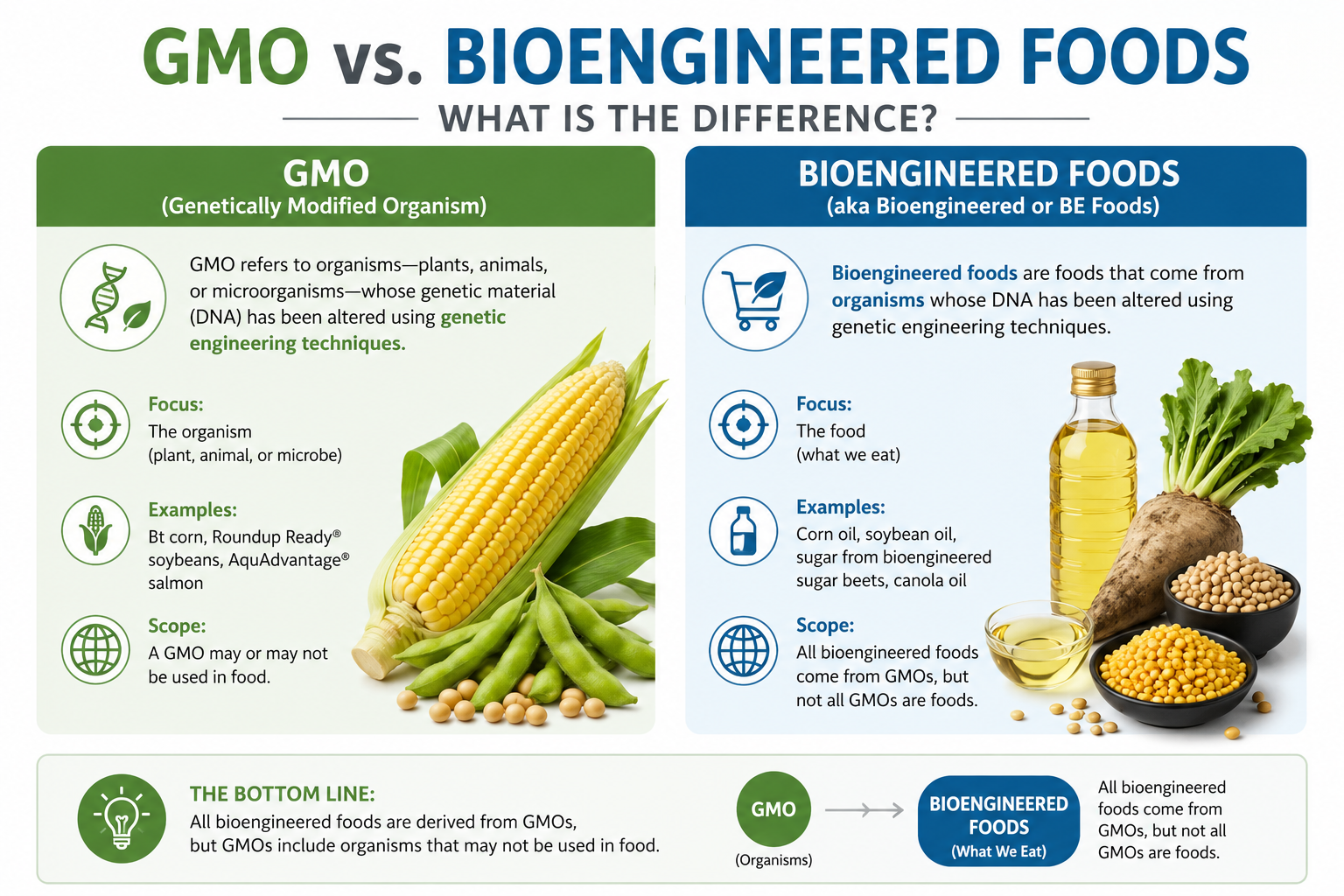
The terms GMO and bioengineered (BE) are closely related, but they are not exactly the same in how they're used.
The short answer
- GMO (Genetically Modified Organism) is the broader scientific term.
- Bioengineered (BE) is the legal labeling term used in the United States for certain GMO foods.
What is a GMO?
A GMO is any organism whose DNA has been altered using genetic engineering techniques rather than traditional breeding.
Scientists may:
- Add a gene from another organism (transgenic)
- Modify an existing gene
- Delete or turn off a gene
- Make precise edits using newer tools like CRISPR
Examples include:
- Corn resistant to insects
- Soybeans tolerant of herbicides
- Virus-resistant papaya
- Non-browning apples
What does "bioengineered" mean?
In the U.S., the United States Department of Agriculture defines a bioengineered food as one that:
Contains detectable genetic material that has been modified through certain laboratory techniques and could not have been achieved through conventional breeding or found in nature.
Because of this legal definition:
- Many foods people call "GMOs" are labeled "Bioengineered" instead.
- Some genetically engineered foods don't require a BE label if the modified DNA isn't detectable in the final product (for example, some refined oils or sugars).
GMO vs. Bioengineered
| Term | What it means |
|---|---|
| GMO (Genetically Modified Organism) | A broad term for any organism whose DNA has been altered using biotechnology. This includes older and newer genetic engineering methods. |
| Bioengineered (BE) | A legal labeling term used in the United States for foods that contain detectable genetic material modified through certain laboratory techniques that couldn't be achieved through conventional breeding or found in nature. |
The U.S. adopted the term "bioengineered" under the National Bioengineered Food Disclosure Standard, so food packages now typically say "Bioengineered food" instead of "Contains GMOs."
Why did the U.S. switch to "bioengineered"?
The term "bioengineered" was adopted as part of the U.S. National Bioengineered Food Disclosure Standard to create a single nationwide labeling system.
Reasons included:
- Standardizing labels across all states.
- Using a term regulators viewed as more scientifically precise.
- Replacing a patchwork of different state GMO-labeling laws.
Critics argue "bioengineered" is less familiar to consumers than "GMO," while supporters say it reflects the underlying technology more accurately.
Why create bioengineered foods?
Scientists engineer crops for several reasons:
| Goal | Example |
|---|---|
| Reduce insect damage | Bt corn produces a protein that targets certain insect pests. |
| Reduce plant diseases | Virus-resistant papaya saved Hawaii's papaya industry from ringspot virus. |
| Simplify weed control | Herbicide-tolerant soybeans allow farmers to manage weeds more effectively. |
| Improve nutrition | Golden Rice produces beta-carotene, a precursor to vitamin A. |
| Reduce food waste | Arctic Apple resists browning after being sliced. |
| Increase resilience | Researchers are developing crops that better tolerate drought, heat, and other environmental stresses. |
Are bioengineered foods safe?
Major scientific organizations—including the World Health Organization, the National Academy of Sciences, and the American Medical Association—have concluded that currently approved bioengineered foods are no more risky to eat than comparable conventional foods. Each new genetically engineered crop is evaluated individually before approval.
That said, scientists continue to assess:
- Environmental impacts (such as effects on biodiversity and insect resistance)
- Herbicide use patterns
- Economic impacts on farmers
- Long-term sustainability
These are generally considered separate issues from the safety of eating the foods themselves.
Why do some people oppose them?
Concerns generally focus on issues beyond the food itself, such as:
- Potential environmental effects (e.g., herbicide-resistant weeds)
- Increased herbicide use in some farming systems
- Corporate control of patented seeds
- Economic impacts on farmers
- Consumer preference for natural or organic foods
These are separate questions from whether approved bioengineered foods are safe to eat.
List of bioengineered foods
https://www.ams.usda.gov/rules-regulations/be/bioengineered-foods-list
The Agricultural Marketing Service (AMS) developed the List of Bioengineered Foods to identify the crops or foods that are available in a bioengineered form throughout the world and for which regulated entities must maintain records. These records will inform regulated entities about whether they must make a bioengineered food disclosure.
New BE products continue to be developed. Even if a food is not included on the List, regulated entities whose records show that a food they are selling is bioengineered must make appropriate disclosure of that food.
AMS continually reviews the List and, if necessary, updates it through the federal rulemaking process.
- Alfalfa (pdf)
- Apple (ArcticTM varieties) (pdf)
- Canola (pdf)
- Corn (pdf)
- Cotton (pdf)
- Eggplant (BARI Bt Begun varieties) (pdf)
- Papaya (ringspot virus-resistant varieties) (pdf)
- Pineapple (pink flesh varieties) (pdf)
- Potato (pdf)
- Salmon (AquAdvantage®) (pdf)
- Soybean (pdf)
- Squash (summer, coat protein-mediated virus-resistant varieties) (pdf)
- Sugarbeet (pdf)
- Sugarcane (Bt insect-resistant varieties) (pdf)
###