Analytical Instruments/Measurements the SFC Wants Flavorists to Understand
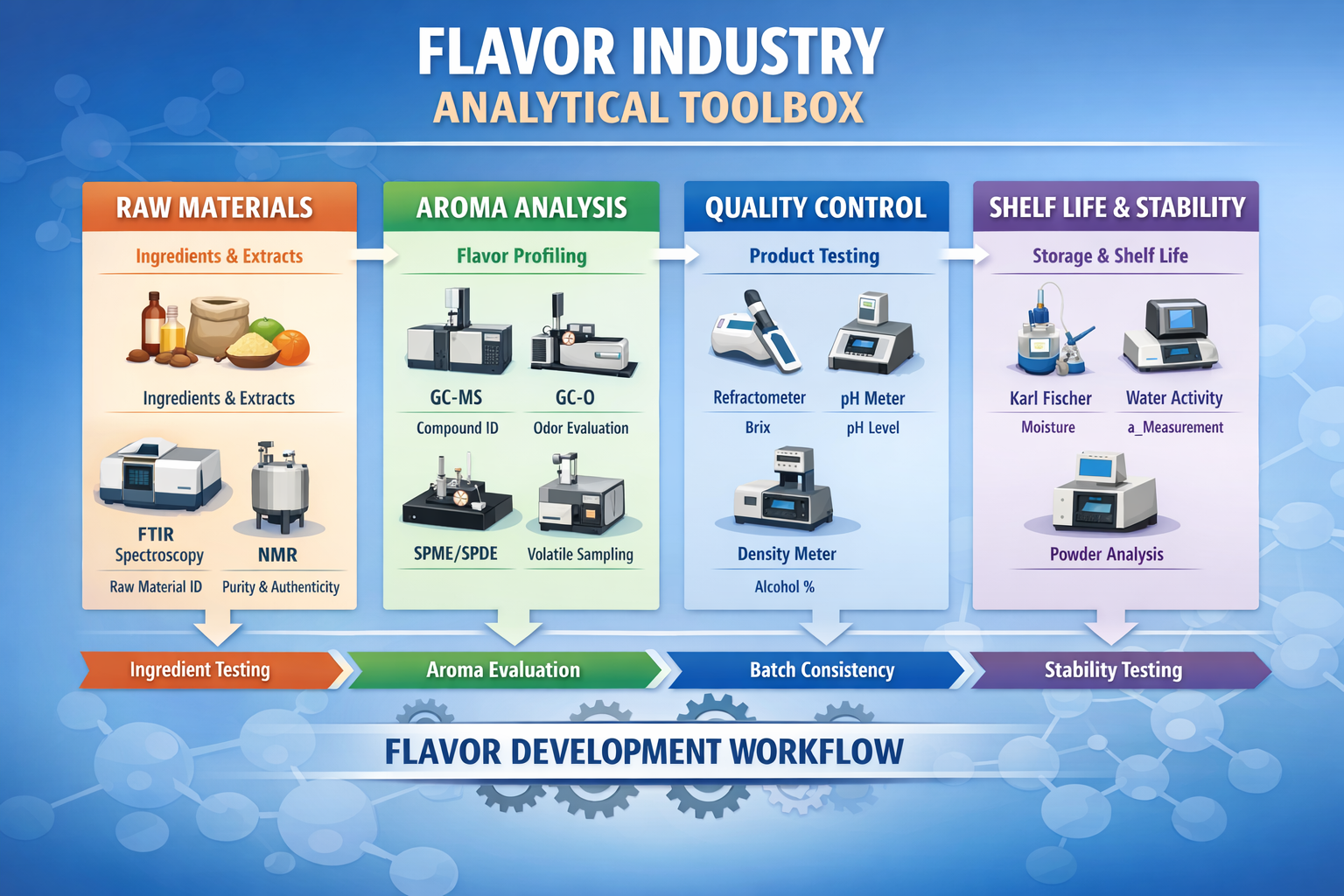
The Society of Flavor Chemists requires flavorists to understand 19 instruments and measurements, including their underlying theories, functions, reporting methods, relevance to the flavor industry, as well as their advantages and disadvantages. In practice, not all flavor labs are equipped with every one of these instruments. Nevertheless, flavorists must still be familiar with all of them—not only to pass the Society’s qualification exam but also because they may need to employ advanced analytical tools when investigating complex issues related to a flavor or a food product.
The following overview provides the essential basics for trainee flavorists. This material should be sufficient for trainees to successfully pass the instrumentation and measurements portion of the Society’s qualification exam, as commonly used in the flavor industry.
Refractometer (Refractive Index/Brix)
Theory, Function, and Reporting: A refractometer measures the extent to which light bends as it passes through a liquid sample. The degree of refraction, or Refractive Index (RI), correlates directly to the concentration of dissolved solids, primarily sugars. It reports measurements in degrees Brix (°Bx), which represents the percentage of sugar by weight, or as a direct refractive index value.
Relevance to the Flavor Industry: This is a fundamental tool for quality control of raw materials. It is used to measure the sugar content (Brix) in fruits, juices, and syrups, ensuring they meet specifications for ripeness and sweetness. This consistency is the first step in creating a reproducible flavor profile in the final product.
Advantages and Limitations: Its primary advantages are that it is fast, easy to use, requires a very small sample, and portable handheld models are widely available. However, it measures total soluble solids, not just specific sugars, and readings can be interfered with by other dissolved compounds like alcohol or acids. It is also temperature-sensitive, though many modern units have automatic temperature compensation.
Density Meter / Densitometer
Theory, Function, and Reporting: This instrument measures the mass per unit volume of a liquid or gas. Modern density meters often use the oscillating U-tube principle, where a hollow glass tube is vibrated at its natural frequency. The frequency changes based on the density of the fluid filling the tube, allowing for a precise calculation. Results are reported in specific gravity, grams per cubic centimeter (g/cm³), or degrees Plato, Brix, or Baumé after conversion.
Relevance to the Flavor Industry: Density measurement is key for monitoring the concentration of liquid foods like fruit juices and syrups. In the production of alcoholic beverages, it is the standard method for determining alcohol content by measuring the density of the distillate.
Advantages and Limitations: It offers highly precise results, is very fast, and often includes automated temperature control for accuracy. In-line models can provide real-time data for process control. On the downside, the instruments are relatively expensive, and their accuracy is highly dependent on strict temperature control and the absence of bubbles in the sample.
pH Meter
Theory, Function, and Reporting: A pH meter measures the activity of hydrogen ions in a solution, indicating its acidity or alkalinity on a logarithmic scale of 0 to 14. It uses a glass electrode that generates a small voltage proportional to the pH of the solution. The result is reported simply as a pH value.
Relevance to the Flavor Industry: pH is a critical control point for both product quality and safety. It directly influences the perception of sourness, affects the texture and stability of products like yogurt and sauces, and determines the growth environment for microbes, making it essential for ensuring the safety and consistency of fermented foods and beverages.
Advantages and Limitations: pH meters are essential tools that are easy to use, affordable, and provide real-time results. Their main limitations are the fragility of the glass electrode, which requires careful handling, regular calibration with buffer solutions, and proper storage to keep it hydrated. Measurements are also temperature-dependent.
Flash Point Tester
Theory, Function, and Reporting: This tester determines the lowest temperature at which a substance's vapors will ignite when exposed to an ignition source, such as a flame or electric arc. There are two main types: open-cup and closed-cup, with closed-cup methods generally providing lower, more safety-relevant values. The result is reported as a temperature, typically in degrees Celsius or Fahrenheit.
Relevance to the Flavor Industry: This test is fundamentally about safety and regulatory compliance. It is crucial for classifying flavor extracts, essential oils, and aroma chemicals for safe transportation, handling, and storage. A higher flash point indicates lower flammability and therefore lower risk during manufacturing and shipping.
Advantages and Limitations: The test is essential for meeting legal safety requirements. Modern testers offer the significant advantage of requiring very small sample volumes, often only 1-2 mL, which is critical when working with expensive flavor materials. However, the samples themselves are often flammable, and traditional methods can be hazardous and require larger volumes.
Karl Fischer Titration / Moisture Analyzer
Theory, Function, and Reporting: This is a precise chemical titration method specifically for measuring water content. It is based on a reaction between water and a specialized reagent containing iodine and sulfur dioxide. The amount of reagent consumed is directly proportional to the amount of water in the sample. It reports moisture content as a percentage.
Relevance to the Flavor Industry: Precise moisture control is vital for the stability and shelf life of many flavor products. This method is critical for measuring the low water content in hygroscopic materials like spray-dried flavor powders (to prevent caking) and for ensuring the consistency of pastes and liquid extracts where water activity affects stability.
Advantages and Limitations: Its key advantage is its high specificity and accuracy for water, as it is unaffected by other volatile compounds like alcohols or aroma molecules that can interfere with simpler loss-on-drying methods. However, it is more complex and expensive than other moisture tests, requires the use of specialized chemical reagents, and often needs method development to ensure complete water extraction from different sample types.
Spectrophotometer / Colorimeter
Theory, Function, and Reporting: These instruments measure how much light a sample absorbs or transmits at specific wavelengths. A colorimeter uses filters to mimic the human eye's response, while a more advanced spectrophotometer measures reflectance or transmittance across the full visible spectrum and beyond. Results are often reported in color space values, most commonly the CIE Lab* system, where L* represents lightness, a* represents red/green, and b* represents yellow/blue.
Relevance to the Flavor Industry: Color is a primary sensory attribute and a key indicator of quality. This instrument provides objective, quantifiable data to ensure the color of finished products like beverages and sauces, as well as raw materials like spices and caramel, is consistent from batch to batch. It can also indicate the degree of roasting or processing.
Advantages and Limitations: It replaces subjective visual assessment with objective, reproducible data that can be used to set strict quality specifications. The main limitations are the cost of a good spectrophotometer and the need for highly controlled sample preparation, as factors like particle size and sample thickness can significantly affect the reading.
Water Activity Meter
Theory, Function, and Reporting: This meter measures the vapor pressure of water in a sealed sample relative to the vapor pressure of pure water at the same temperature. This indicates the amount of "free" water available in a product, as opposed to water that is chemically or physically bound. The result is reported as water activity (Aw), a value on a scale from 0 (bone dry) to 1.0 (pure water).
Relevance to the Flavor Industry: Aw is the most critical factor for predicting the shelf life and microbial safety of flavor-containing products. It directly correlates with the potential for the growth of bacteria, yeast, and mold, as well as the rate of enzymatic and chemical reactions that can degrade flavor over time.
Advantages and Limitations: Its major advantage is that it is a much better predictor of product stability and spoilage than simple moisture content. The main limitations are that measurement can be relatively slow (taking 15-30 minutes for equilibrium) and requires a stable temperature, making the instruments more expensive than basic moisture analyzers.
Gas Chromatography (GC), GC-O, Flame Ionization Detector (FID)
Theory, Function, and Reporting: Gas chromatography is a separation technique for volatile compounds. A sample is vaporized and carried by an inert gas through a long, narrow column coated with a specific material. Compounds separate based on how they interact with this coating, eluting (coming off) at different times. An FID is a universal detector that burns organic compounds to produce a signal, creating a chromatogram with peaks representing each compound. GC-O, or olfactometry, replaces the detector with a human "sniffer port," allowing a trained analyst to smell each compound as it elutes and describe its odor.
Relevance to the Flavor Industry: GC is the absolute workhorse of flavor analysis. It is used to profile the complex mixtures of volatile organic compounds that constitute the aroma of a food or ingredient. GC-O is uniquely powerful because it identifies which of the hundreds of peaks in a chromatogram are actually sensorially relevant to human perception.
Advantages and Limitations: GC provides unparalleled separation power for volatile mixtures and is highly sensitive and reproducible. GC-O directly links chemistry to sensory experience. However, the technique requires complex sample preparation, expert operation, and data analysis is time-consuming. GC-O itself is a slow process that requires trained panelists.
Mass Spectrometry (MS)
Theory, Function, and Reporting: Mass spectrometry is a detection method that ionizes chemical molecules and sorts the resulting ions based on their mass-to-charge ratio (m/z). This produces a unique mass spectrum that acts as a molecular "fingerprint" for each compound. It is almost always coupled with a separation technique like GC (GC-MS) or LC (LC-MS). The result is a chromatogram where the identity of each peak is confirmed by its corresponding mass spectrum.
Relevance to the Flavor Industry: MS is the gold standard for definitively identifying and confirming the structure of both volatile and non-volatile flavor compounds. It is essential for discovering new flavor molecules, for detecting adulteration or off-notes in raw materials, and for quantifying known compounds at very low levels.
Advantages and Limitations: Its power lies in its ability to provide definitive identification of unknown compounds with extremely high sensitivity. However, it is a very expensive technology to purchase and maintain, and it requires highly skilled personnel for operation, method development, and complex data interpretation.
Liquid Chromatography (LC or HPLC)
Theory, Function, and Reporting: High-Performance Liquid Chromatography (HPLC) is a technique for separating non-volatile or heat-sensitive compounds in a liquid solution. The sample is pumped at high pressure through a column packed with a solid adsorbent material. Compounds separate based on their different chemical interactions with the column. As they elute, they pass through a detector, such as a UV-Vis or fluorescence detector, producing a chromatogram.
Relevance to the Flavor Industry: This technique is essential for analyzing the non-volatile components that contribute to flavor, such as sugars (sweetness), organic acids (sourness), bitter compounds from hops or citrus, and pungent compounds like capsaicin in chili. It is also used to analyze color compounds and preservatives.
Advantages and Limitations: It is the primary method for analyzing a huge range of non-volatile and thermally labile compounds. It is highly versatile and can be adapted for many applications. The main drawbacks are its complexity, higher cost compared to GC, and its consumption and disposal of significant volumes of organic solvents.
Particle Size Analysis
Theory, Function, and Reporting: This analysis determines the distribution of particle sizes within a powder or suspension. Common techniques include laser diffraction, where the angle of scattered light is related to particle size, or mechanical sieving. Results are reported as a particle size distribution, often summarized by key values like D10, D50, and D90, which indicate the diameter below which 10%, 50%, and 90% of the sample's particles fall.
Relevance to the Flavor Industry: Particle size is a critical physical property for powdered flavors, such as those that are spray-dried or dry-blended. It directly affects how the powder flows out of a container, its dissolution rate when added to a beverage, its tendency to cake, and the final mouthfeel of the rehydrated product.
Advantages and Limitations: Controlling particle size ensures consistent physical performance and shelf life of flavor powders. The instruments, however, can be expensive, and results from different measurement techniques (e.g., sieving vs. laser diffraction) can vary, so a consistent methodology is crucial for quality control.
SPME / SPDE (Solid-Phase Microextraction / Solid-Phase Dynamic Extraction)
Theory, Function, and Reporting: These are solvent-free sample preparation techniques used to isolate volatile compounds for analysis, typically by GC. A sample is placed in a sealed vial. A fiber (SPME) or a coated needle (SPDE) is exposed to the headspace above the sample, where it adsorbs the volatile organic compounds. The fiber/needle is then inserted directly into a hot GC injector, where the heat desorbs the trapped compounds onto the column for separation and analysis.
Relevance to the Flavor Industry: These are the preferred methods for capturing a realistic "snapshot" of what a person would smell from a food or beverage. They are simple, fast, and concentrate trace aroma compounds without the use of solvents that might mask or dilute the sample.
Advantages and Limitations: The major advantages are simplicity, speed, and the elimination of solvent use, along with high sensitivity for volatile compounds. The process can also be automated. The limitations are that the fiber coating is selective—it will adsorb some types of compounds better than others. Fibers are also fragile and have a limited lifespan. The technique is primarily used for qualitative or semi-quantitative analysis.
Turbidity Meter
Theory, Function, and Reporting: A turbidity meter measures the cloudiness or haziness of a fluid caused by the presence of suspended particles. It works by shining a light through the sample and measuring the amount of light that is scattered at a 90-degree angle by the particles. The result is reported in Nephelometric Turbidity Units (NTU).
Relevance to the Flavor Industry: This is a key test for any beverage where visual clarity is a quality attribute, such as beers, wines, clear juices, and soft drinks. It is used to monitor the efficiency of filtration processes and to ensure that products meet their visual specifications, whether that means crystal clarity or a consistent, deliberate haze.
Advantages and Limitations: It is a quick, easy, and non-destructive test that is essential for meeting visual quality standards. Its limitation is that it only quantifies the level of turbidity; it does not identify the specific particles causing it.
Polarimeter
Theory, Function, and Reporting: A polarimeter measures the angle of rotation of plane-polarized light as it passes through an optically active substance. Many organic molecules, especially sugars and many components of essential oils, have chiral centers that will rotate light to the left (levorotatory) or right (dextrorotatory). The result, known as specific rotation [α]D, is a physical constant for a given compound.
Relevance to the Flavor Industry: It is a valuable tool for assessing the purity and concentration of specific optically active compounds. It is commonly used to determine the authenticity of natural versus synthetic menthol (which have different optical rotations) and to characterize and quantify sugars and terpenes in essential oils.
Advantages and Limitations: It provides a quick and specific measurement for certain classes of compounds. However, it is only applicable to optically active substances, and the measurement is highly dependent on temperature and wavelength, which must be strictly controlled.
FTIR Spectroscopy (Fourier-Transform Infrared Spectroscopy)
Theory, Function, and Reporting: FTIR measures how a sample absorbs infrared light across a range of wavelengths. Different molecular bonds (e.g., C-H, O-H, C=O) absorb infrared light at specific frequencies, creating a unique spectral "fingerprint" for the sample. The result is an absorbance or transmittance spectrum.
Relevance to the Flavor Industry: FTIR is a powerful tool for the rapid identification and qualification of incoming raw materials, such as vegetable oils, fats, and liquid flavoring substances. By comparing a sample's spectral fingerprint to a reference library, it can quickly detect adulteration, contamination, or batch-to-batch variation.
Advantages and Limitations: Its greatest strengths are its speed (results in seconds), minimal to no sample preparation, and non-destructive nature. It is ideal for high-throughput screening in QA/QC labs. However, it is less sensitive and specific than chromatography-mass spectrometry methods, and the spectra can be complex, often requiring advanced statistical modeling (chemometrics) for interpretation.
Viscometer
Theory, Function, and Reporting: A viscometer measures a fluid's resistance to flow, or its viscosity. Different types exist; rotational viscometers measure the torque required to rotate a spindle in the fluid, while capillary viscometers measure the time it takes for the fluid to flow through a narrow tube. The result is reported in units of centipoise (cP) or Pascal-seconds (Pa·s).
Relevance to the Flavor Industry: Viscosity is a direct measure of a product's texture and mouthfeel, making it essential for characterizing liquid and semi-liquid flavor systems like syrups, emulsions, sauces, and pastes. It is also a critical parameter for predicting how a product will behave during processing, such as in pumping, mixing, and filling operations.
Advantages and Limitations: It directly measures a key sensory and processing attribute and is relatively simple to perform. The major limitation is that viscosity is highly dependent on temperature, requiring strict control for accurate and comparable results. Many food products are also non-Newtonian, meaning their viscosity changes with the rate of flow, which can make measurements complex.
Titratable Acidity
Theory, Function, and Reporting: Unlike a pH meter which measures the intensity of acidity, titratable acidity measures the total amount of acid in a solution. This is done by neutralizing the sample with a standard base solution (like sodium hydroxide) until it reaches a specific pH endpoint (often pH 8.2). The result is reported as a percentage of the predominant acid in the sample, such as "% lactic acid" or "% citric acid."
Relevance to the Flavor Industry: This measurement correlates much better with the perceived sourness of a product than pH alone. It is a critical test for balancing flavor in fermented products like yogurt, wine, and pickles, as well as in fruit juices, ensuring the sour notes are consistent and harmonious.
Advantages and Limitations: It provides a more flavor-relevant measure of acidity than pH. The test is relatively simple but more time-consuming and requires chemical reagents. It is not a substitute for pH, which is still needed for safety and stability assessments.
Salt Analysis
Theory, Function, and Reporting: This analysis determines the concentration of sodium chloride (salt) in a product. Common methods include titration with silver nitrate (the Mohr method), using a chloride ion-selective electrode, or a salt analyzer based on electrical conductivity. The result is typically reported as a percentage of salt (% NaCl).
Relevance to the Flavor Industry: Precise salt levels are fundamental to the flavor profile of savory products. It is a key flavor enhancer and also plays a critical role in preservation. This analysis is essential for quality control of savory flavors, seasoning blends, brines, and finished products like snacks, soups, and processed meats.
Advantages and Limitations: Several methods are available to suit different sample types, accuracy needs, and budgets. The main limitations are that manual titration methods are chemical and labor-intensive, and faster conductivity methods can be inaccurate if other ionic salts are present in the sample.
NMR (Nuclear Magnetic Resonance)
Theory, Function, and Reporting: NMR is a sophisticated analytical technique that exploits the magnetic properties of certain atomic nuclei, most commonly hydrogen (1H) and carbon (13C). When placed in a strong magnetic field and pulsed with radio waves, these nuclei absorb and re-emit energy at frequencies characteristic of their chemical environment. This provides exquisitely detailed information about molecular structure, dynamics, and interactions. The output is a complex spectrum of peaks.
Relevance to the Flavor Industry: NMR is the ultimate tool for determining the structure of an unknown flavor compound, whether it's a newly discovered molecule from a natural source or a synthesized aroma chemical. In more applied settings, it is used for high-throughput food profiling to verify the origin, authenticity, and overall quality of products like wine, honey, and fruit juices by looking at their complete metabolic "fingerprint."
Advantages and Limitations: It provides unparalleled structural information, is non-destructive, and requires minimal sample preparation for many applications. The overwhelming limitations are its extremely high cost to purchase and maintain, and the requirement for highly specialized expertise to operate the instrument and interpret the complex data it produces.
Below is a practical, flavor-industry oriented overview of the analytical tools that the Society of Flavor Chemists requires flavorists to understand. This summary is targeted at individuals who already have some background in the analysis of foods or flavors.
Analytical Instruments Used in Flavor Chemistry
1. Refractometer (Refractive Index / Brix)
Theory
Measures refractive index (RI)—how much light bends when passing through a liquid.
Higher dissolved solids → greater light refraction.
Brix scale = % sucrose equivalent solids.
Function
Determines:
- Sugar concentration
- Total soluble solids
Reporting
- °Brix
- Refractive Index (nD20)
Relevance to Flavor Industry
Used for:
- Beverage syrups
- Fruit juice concentrates
- Flavor extracts
- Standardizing sweetness level
Advantages
✔ Fast
✔ Very small sample
✔ Non-destructive
Limitations
✖ Not specific to sugar (other solutes affect reading)
✖ Temperature sensitive
2. Density Meter / Densitometer
Theory
Measures mass per unit volume using oscillating U-tube or hydrometer principle.
Function
Determines:
- Density
- Specific gravity
Reporting
- g/mL
- Specific gravity
Relevance
Used for:
- Alcohol content in extracts
- Flavor syrup concentration
- Quality control of liquid flavors
Advantages
✔ High precision
✔ Automated
Limitations
✖ Temperature effects
✖ Requires clean sample
3. pH Meter
Theory
Uses electrochemical potential difference between reference and glass electrode proportional to hydrogen ion concentration.
Function
Measures acidity/alkalinity.
Reporting
pH scale 0–14
Relevance
Important for:
- Beverage flavor stability
- Acidulant adjustment
- Microbial stability
Advantages
✔ Rapid
✔ Highly accurate
Limitations
✖ Requires calibration
✖ Electrodes drift
4. Flash Point Tester
Theory
Measures lowest temperature at which vapor ignites in air.
Function
Determines flammability risk.
Reporting
Flash point in °C
Relevance
Important for:
- Flavor oils
- Solvent-based extracts
- Transportation classification
Advantages
✔ Safety classification
✔ Regulatory compliance
Limitations
✖ Does not measure combustion energy
✖ Sample volatility affects result
5. Karl Fischer Titration (Moisture Analysis)
Theory
Water reacts with iodine + sulfur dioxide in methanol.
Reaction:
Water + I₂ + SO₂ → quantified reaction
Function
Measures trace moisture.
Reporting
- % water
- ppm moisture
Relevance
Critical for:
- Dry flavor powders
- Encapsulated flavors
- Shelf-life stability
Advantages
✔ Extremely accurate
✔ Detects very low water levels
Limitations
✖ Some compounds interfere
✖ Requires reagent maintenance
6. Spectrophotometer / Colorimeter
Theory
Based on Beer-Lambert Law:
Absorbance ∝ concentration
Function
Measures:
- Color
- Concentration of chromophores
Reporting
- Absorbance units
- Lab* color coordinates
Relevance
Used for:
- Beverage color stability
- Caramel color
- Extract standardization
Advantages
✔ Rapid
✔ Quantitative
Limitations
✖ Requires calibration curve
✖ Interference from turbidity
7. Water Activity Meter
Theory
Measures vapor pressure of water in a sample relative to pure water.
aw = vapor pressure ratio.
Function
Determines microbial growth potential.
Reporting
aw scale 0–1.0
Relevance
Critical for:
- Flavor powders
- Seasonings
- Shelf-life prediction
Advantages
✔ Predicts microbial stability
✔ Rapid measurement
Limitations
✖ Temperature sensitive
✖ Equilibration required
8. Gas Chromatography (GC)
Theory
Separates volatile compounds using gas mobile phase and stationary phase column.
Function
Separates aroma compounds.
Reporting
- Retention time
- Peak area %
Relevance
Primary tool in flavor analysis.
Applications:
- Flavor fingerprinting
- Quality control
- Off-flavor detection
GC-O (Gas Chromatography-Olfactometry)
Theory
Human nose detects odor at column outlet.
Function
Identifies odor-active compounds.
Reporting
- Odor intensity
- Aroma descriptors
Relevance
Critical for key aroma compound identification.
Flame Ionization Detector (FID)
Theory
Organic compounds burn in hydrogen flame producing ions.
Signal proportional to carbon content.
Advantages
✔ Extremely sensitive
✔ Linear response
Limitations
✖ Cannot identify compounds
✖ Needs standards
9. Mass Spectrometry (MS)
Theory
Molecules ionized → fragments separated by mass/charge ratio.
Function
Compound identification.
Reporting
- Mass spectra
- Molecular weight
- Library match %
Relevance
Essential for:
- Unknown aroma compounds
- Flavor authenticity
Advantages
✔ Highly specific
✔ Structural information
Limitations
✖ Expensive
✖ Requires skilled interpretation
10. Liquid Chromatography (HPLC)
Theory
Separation based on interaction between liquid mobile phase and stationary phase.
Function
Separates non-volatile compounds.
Reporting
- Retention time
- Peak area
Relevance
Used for:
- Sweeteners
- Organic acids
- Flavor precursors
Advantages
✔ Good for thermally unstable compounds
Limitations
✖ Slower than GC
✖ Solvent consumption
11. Particle Size Analysis
Theory
Often laser diffraction measuring scattering pattern of particles.
Function
Determines particle size distribution.
Reporting
- D10, D50, D90 values
- Mean particle size
Relevance
Important for:
- Spray-dried flavors
- Powder solubility
- Mouthfeel
Advantages
✔ Rapid distribution analysis
Limitations
✖ Assumes spherical particles
12. SPME (Solid Phase Microextraction)
Theory
Fiber coated with sorbent absorbs volatile compounds from headspace.
Function
Pre-concentrates aroma compounds before GC.
Reporting
- GC peak area
Relevance
Used for:
- Aroma profiling
- Trace volatile detection
Advantages
✔ Solvent-free
✔ Highly sensitive
Limitations
✖ Fiber saturation
✖ Limited reproducibility
13. SPDE (Solid Phase Dynamic Extraction)
Theory
Dynamic sampling using coated needle repeatedly exposed to headspace.
Function
More efficient volatile extraction than SPME.
Relevance
Used in detailed flavor research.
Advantages
✔ Higher extraction capacity
Limitations
✖ More complex instrumentation
SECONDARY ANALYTICAL METHODS
Turbidity Meter
Theory
Measures light scattering by suspended particles.
Reporting
NTU (Nephelometric Turbidity Units)
Relevance
Important for:
- Beverage clarity
- Emulsion stability
Limitations
Sensitive to particle type.
Polarimeter
Theory
Measures optical rotation of polarized light by chiral molecules.
Reporting
Specific rotation.
Relevance
Used for:
- Sugar analysis
- Authenticity testing
- Essential oils
Limitations
Requires optically active compounds.
FTIR Spectroscopy
Theory
Measures infrared absorption by molecular bonds.
Function
Identifies functional groups.
Relevance
Used for:
- Raw material identification
- Adulteration detection
Advantages
✔ Fast fingerprinting
Limitations
✖ Less sensitive than MS
Viscometer
Theory
Measures resistance to flow.
Reporting
- Centipoise (cP)
Relevance
Important for:
- Syrups
- Flavor emulsions
Titratable Acidity
Theory
Acid neutralized with base titration.
Reporting
% acid equivalent.
Relevance
Determines perceived sourness in beverages.
Salt Analysis
Methods
- Titration
- Ion chromatography
Reporting
% NaCl
Relevance
Savory flavor formulation.
Nuclear Magnetic Resonance (NMR)
Theory
Atomic nuclei absorb radiofrequency in magnetic field.
Function
Determines molecular structure.
Reporting
Chemical shifts (ppm)
Relevance
Used for:
- Structure elucidation
- Authenticity
- Purity verification
Advantages
✔ Highly detailed structural information
Limitations
✖ Very expensive
✖ Requires expertise
Quick Summary: Most Important Methods for Flavor Houses
| Category | Core Tools |
|---|---|
| Aroma analysis | GC-MS, GC-O |
| Moisture stability | Karl Fischer |
| Beverage QC | pH, Brix, density |
| Powder properties | Water activity, particle size |
| Authenticity | FTIR, NMR |
Detailed breakdown of each instrument and its relevance to the flavor industry
###