Asia Food & Flavor Regulatory Intelligence Report Significant Laws, Regulations, and Official Consultations Issued June 27–July 12, 2026
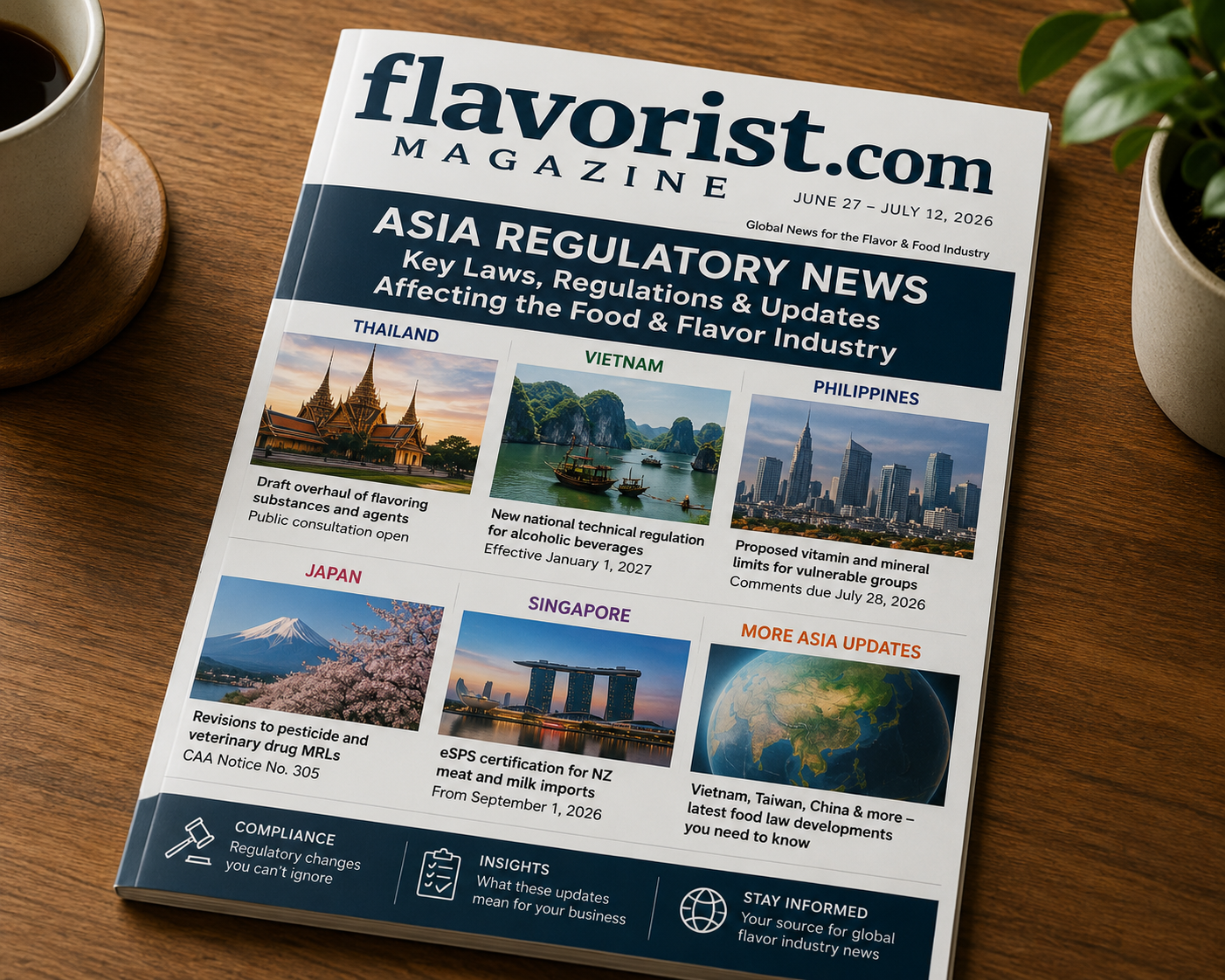
Asian food and flavor regulatory developments
Review period: June 27–July 12, 2026
Sources reviewed for this report include government notices, public consultations, regulatory databases, trade circulars, and specialist food-law reporting. The list below prioritizes measures with a meaningful effect on formulations, flavors, additives, labeling, product registration, manufacturing, food-contact materials, contaminants, e-commerce, or cross-border trade.
“Released” refers to the date on which the law, regulation, draft, circular, implementation guidance, or official notice became publicly available. Draft measures are clearly identified and are not yet binding.
1. Thailand — Proposed overhaul of flavoring substances and flavoring agents
Release: July 9, 2026
Status: Draft Ministry of Public Health notification; consultation closes September 15, 2026
Impact: Very high for flavor houses, ingredient suppliers and flavored-food manufacturers
Thailand’s Food and Drug Administration released a proposed Ministry of Public Health notification intended to replace Notification No. 223 B.E. 2544, Thailand’s principal flavoring rule dating from 2001. The proposal would modernize the classification of flavorings by consolidating the current system into natural and synthetic categories and eliminating the separate “imitation” category. It would also introduce a more structured positive-list approach, drawing on internationally recognized lists of permitted flavoring substances.
The draft is commercially significant because it may change how flavor formulations are classified, documented, imported, sold to food manufacturers and declared on labels. Flavor suppliers should expect to reassess whether every substance, solvent, carrier, processing aid and other component in a compounded flavor is covered by an accepted list and permitted under its conditions of use. Products currently described as “imitation,” “nature-identical,” or under legacy terminology may require new regulatory classifications and customer documentation.
The proposed labeling changes may also affect business-to-business flavor containers and finished foods. Companies should compare existing Thai-language ingredient statements, flavor descriptions, specifications and certificates against the draft. The unusually long consultation window provides an opportunity for suppliers to submit technical evidence concerning internationally accepted materials that may not appear on the proposed lists. (ChemLinked)
2. Thailand — Proposed expansion of permitted food-production enzymes
Release: July 1, 2026
Status: Draft notification; consultation closes July 31, 2026
Impact: High for enzyme suppliers, flavor manufacturers and fermentation-based processors
The Thai FDA opened consultation on a second revision to the list of enzymes permitted for food production under Ministry of Public Health Notification No. 443 B.E. 2566 (2023). The proposal would amend Annex 1, which functions as Thailand’s principal positive list for enzymes intentionally used during food manufacturing.
Although the individual proposed enzyme additions and conditions must be checked against the Thai-language annex, the measure is important for flavor and food manufacturers because enzymes are increasingly used to create reaction flavors, hydrolyzed proteins, dairy flavors, fruit and vegetable extracts, fermented ingredients, sweeteners and process-derived flavor precursors. An expanded list can create new formulation opportunities, while revised specifications or source-organism restrictions can affect existing products.
Suppliers should verify the enzyme’s systematic name, activity, producing organism, genetic-modification status, intended technological purpose and residual activity in the final product. A commercial preparation may also contain carriers, preservatives, stabilizers or processing aids that require separate compliance review.
Manufacturers relying on enzymes not expressly listed should consider submitting safety evaluations, international approvals and evidence of technological need before consultation closes. Companies should not assume that an enzyme permitted by JECFA, the EU, Japan or another ASEAN country is automatically acceptable in Thailand. (Foodmate)
3. Vietnam — New national technical regulation for alcoholic beverages
Release: July 4, 2026, according to the regulatory report; regulatory database records the underlying circular as issued June 30
Status: Final regulation; effective January 1, 2027
Instrument: Circular No. 39/2026/TT-BCT and QCVN 30:2026/BCT
Impact: Very high for alcoholic beverages, compounded flavors and exporters
Vietnam’s Ministry of Industry and Trade issued a new national technical regulation for alcoholic beverages, replacing the older health-ministry framework in QCVN 6-3:2010/BYT. The new regime broadens the scope beyond basic food-safety parameters and places product quality, safety, management and exporter obligations under the Ministry of Industry and Trade.
The regulation adds or refines classifications for products including fortified wine, aromatized wine and white spirits. This is particularly relevant to flavor companies supplying botanical extracts, fruit preparations, distillates, essences and compounded flavors for spirits, flavored wines, liqueurs and ready-to-drink alcoholic products. Product classification will determine applicable compositional and technical limits.
The measure also updates methanol limits and references concerning contaminants, additives, sampling and analytical methods. Manufacturers should therefore review raw-material specifications, alcohol-source controls, flavor-carrier systems and laboratory methods. Labeling and traceability requirements may require revisions to Vietnamese labels, batch records and supplier declarations.
Because the regulation takes effect January 1, 2027, companies have approximately six months to determine whether existing registrations, conformity documentation or labels need updating. Exporters should also clarify how transition provisions apply to goods manufactured or imported before the effective date but sold afterward. (ChemLinked)
4. Vietnam — Medium-risk classification for foods and food-contact materials
Release and effective date: July 1, 2026
Status: Final and in force
Instrument: Circular No. 27/2026/TT-BYT
Impact: High for nutrition products, water, ice, packaging and importers
Vietnam’s Ministry of Health issued a formal list classifying designated foods, food containers and direct-contact packaging materials as “medium risk.” The listed categories include specified nutritional products, bottled or packaged drinking water, edible ice and food-contact materials under the ministry’s responsibility.
The significance lies not only in the classification itself but in the regulatory pathway it triggers. Depending on the product category, businesses may be required to complete product-declaration registration or follow a prescribed self-declaration process. Importers and domestic producers will therefore need to determine the precise classification of each stock-keeping unit and establish which dossier, testing, conformity and record-retention requirements apply.
Flavor manufacturers are indirectly affected where products are supplied for nutritional formulas, fortified drinks or bottled beverages. Customers may request more extensive ingredient specifications, certificates of analysis, contaminant data, packaging-migration information and declarations concerning additives or processing aids. Packaging used for concentrated flavors or beverage bases may also fall within the circular if it is intended for direct food contact.
Businesses should map products against the official list rather than rely on broad commercial descriptions. Particular attention should be given to borderline products, such as electrolyte drinks, meal replacements, dietary products and concentrates sold through industrial rather than retail channels. (ChemLinked)
5. Vietnam — New product and goods quality-management rules
Release: June 30, 2026
Effective: July 1, 2026
Status: Final and in force
Instrument: Circular No. 34/2026/TT-BCT
Impact: High for manufacturers and importers in sectors supervised by the Ministry of Industry and Trade
Circular No. 34/2026/TT-BCT establishes rules for managing the quality of products and goods falling under the Ministry of Industry and Trade’s authority. Although broader than food alone, it is important to food and beverage businesses because the ministry supervises several relevant product groups, including alcoholic beverages and other processed commodities.
The circular should be read as part of Vietnam’s shift toward a more structured, risk-based product-quality regime. Businesses may face clearer responsibilities concerning conformity with technical regulations, quality documentation, market surveillance, sampling, testing, corrective action and handling of non-compliant goods. Imported products may require documentary alignment between customs records, product declarations, technical specifications and test results.
Flavor suppliers should anticipate increased customer scrutiny of certificates of analysis, manufacturing-site information, shelf-life support, contaminant controls and traceability. Where an ingredient is used in a regulated finished product, discrepancies between a supplier’s commercial specification and the applicable Vietnamese technical regulation could delay registration or import clearance.
The one-day interval between issuance and implementation leaves little formal transition time. Companies selling Ministry-supervised foods in Vietnam should therefore confirm immediately whether previous conformity files remain valid, whether local testing is required and which party—the producer, importer, brand owner or distributor—holds the primary compliance obligation. (ChemLinked)
6. Philippines — Proposed maximum vitamin and mineral levels for vulnerable groups
Release: July 6, 2026
Status: Draft Philippine FDA circular
Impact: High for supplements, fortified products and flavor systems used in pediatric or maternal nutrition
The Philippine FDA released a draft circular proposing amendments to the rules governing vitamin and mineral supplements intended for children, pregnant women and lactating women. The proposal would establish maximum nutrient levels for these vulnerable groups and clarify the registration pathway for products used in government or institutional micronutrient-supplementation programs.
The measure may require reformulation of supplements that exceed the proposed maximum daily intake or deliver nutrients through multiple recommended servings. Companies will need to assess both the amount per unit and the total intake generated by label directions. Particular difficulties may arise with products marketed across several age groups or simultaneously positioned for pregnant and lactating consumers.
The flavor industry is affected because nutrient reductions, changes in mineral salts and reformulation of iron-, calcium-, zinc- or vitamin-containing products can substantially alter taste, odor, stability and color. Masking flavors, sweeteners, acids and encapsulation systems may consequently need adjustment. Any flavor-system change must also remain compatible with Philippine additive and labeling requirements.
Companies should review nutrient overages used to compensate for shelf-life losses, because a maximum level may apply to the formulated or analytically measured amount rather than only the label declaration. Regulatory teams should also monitor whether the final circular provides transitional arrangements for products with existing certificates of product registration. (ChemLinked)
7. Japan — Revision of pesticide and veterinary-drug maximum residue limits
Release: July 3, 2026
Status: Final regulatory revision
Instrument: Consumer Affairs Agency Food Standards Division Notice No. 305
Impact: High for agricultural ingredients, extracts, botanicals and imported foods
Japan’s Consumer Affairs Agency revised the Specifications and Standards for Foods, Food Additives, etc. by changing maximum residue limits for a group of pesticides and veterinary drugs. Reported substances include afidopyropen and glufosinate, among others.
MRL amendments affect more than growers and exporters of whole agricultural commodities. Flavor and ingredient businesses using herbs, spices, citrus oils, fruit concentrates, tea, coffee, botanical extracts and other plant-derived inputs may also be exposed. Residues can become concentrated during drying, extraction, distillation or production of oleoresins, meaning a raw material that appears compliant at farm level may present a different analytical profile after processing.
Companies should obtain the complete commodity-by-substance table and identify whether an MRL was newly established, increased, reduced or replaced by Japan’s default limit. Export testing plans should use analytical methods with limits of quantification below the applicable Japanese tolerance. Suppliers should also confirm how Japan classifies processed products and whether processing factors or raw-commodity MRLs are used.
Existing purchase specifications, pesticide-control programs and certificates of analysis may need revision. Businesses should additionally check the notice’s individual enforcement dates because Japan often provides delayed application for certain reduced MRLs while other changes apply upon publication. (Foodmate)
8. Japan — Proposed amendments for foods with nutrient-function claims
Release: July 1, 2026
Status: Draft Cabinet Office order; comments due July 30, 2026
Impact: High for fortified foods, beverages and supplements
Japan’s Consumer Affairs Agency proposed amendments to Appendices 4 and 11 of the Food Labeling Standards. The changes concern foods with nutrient-function claims, including the upper and lower permitted levels for fortified nutrients and the authorized wording of nutrient-function claims.
Foods with nutrient-function claims occupy a defined regulatory category in Japan. A product can generally use specified standardized claims without individualized premarket approval only when it complies with the prescribed nutrient range, claim language, warnings and other labeling conditions. Changes to either the lower or upper limits can therefore determine whether a current product remains eligible for the category.
Manufacturers should model nutrient content at the end of shelf life as well as at manufacture. Vitamin degradation and formulation overages may create a situation in which the product falls below the minimum later in shelf life or exceeds the maximum when freshly manufactured. Reformulating nutrients can also change taste and odor, especially in beverages, gummies, powders and chewable products, creating follow-on work for flavor masking and stability.
Label reviews should cover Japanese claim wording, daily intake instructions, cautionary statements and the relationship between nutrient amounts per serving and per recommended daily intake. Stakeholders may submit comments through July 30, 2026. (LinkedIn)
9. Taiwan — Mandatory traceability and labeling for washed and graded fresh eggs
Release: June 30, 2026
Effective: July 1, 2026
Status: Final official notice
Instrument: Ministry of Agriculture Notice No. 1150042894
Impact: High for egg packers, processors, retailers and food-service supply chains
Taiwan’s Ministry of Agriculture revised the mandatory traceability-registration and labeling requirements for washed and graded fresh eggs. The measure classifies these eggs as agricultural products subject to compulsory traceability under the Agricultural Products Production and Certification Act.
Covered businesses will need to register prescribed traceability information and display it using the required labeling method. Operationally, this may require changes to egg coding, carton artwork, data interfaces, production records and links between farms, washing and grading facilities, packing operations and distributors. Businesses should confirm which party is responsible for each data element and how repacking or mixed-source lots must be handled.
The rule may also affect industrial food manufacturers purchasing shell eggs. Although the principal obligation falls on the fresh-egg chain, buyers may need to amend approved-supplier programs and receiving procedures to verify traceability codes and retain source information. Bakeries, sauce manufacturers, prepared-food companies and flavor producers using egg-derived materials should distinguish between covered fresh eggs and processed egg products governed under other rules.
Because the notice took effect one day after issuance, enforcement expectations and any accompanying implementation guidance should be monitored closely. Companies should also verify whether existing packaging stocks can be exhausted or whether immediate relabeling is required. (Foodmate)
10. Taiwan — Proposed cadmium limits for selected aquatic products
Release: June 29, 2026
Status: Draft amendment to the Standards for Contaminants and Toxins in Food
Impact: High for seafood suppliers, seasonings and marine-derived flavor ingredients
Taiwan’s Ministry of Health and Welfare proposed amending Article 6 and Appendix 1 to Article 3 of the Standards for Contaminants and Toxins in Food. The proposal would introduce or strengthen cadmium limits for selected aquatic products, reportedly including Japanese hairtail, anchovies, Pacific saury and sea urchins.
The proposed limits were developed using background-concentration surveys and dietary-risk assessments. For industry, the principal concern is that cadmium occurs naturally and may vary substantially by species, harvest location, age and organ tissue. Compliance therefore cannot always be ensured solely through good manufacturing practice.
The rule is relevant beyond whole seafood. Anchovy powders, fish extracts, seafood seasoning bases, fermented fish sauces and concentrated marine flavors may inherit or concentrate metal residues from raw materials. Suppliers should evaluate whether Taiwan applies the limit to the original commodity, the processed product or both, and whether any processing factors are recognized.
Importers should update species-identification controls because common or commercial names can conceal different scientific species with different regulatory limits. Companies may also need more frequent accredited-laboratory testing and geographically diversified sourcing. Since the measure remains a draft, stakeholders should examine whether proposed limits are achievable across normal commercial lots and submit supporting occurrence data during consultation. (Foodmate)
11. China — Implementation guidance for entrusted or contract food production
Release: July 1, 2026
Status: Official implementation Q&A; underlying Measures take effect December 1, 2026
Underlying instrument: SAMR Order No. 113
Impact: Very high for private-label, co-branded and contract-manufactured foods
China’s State Administration for Market Regulation released an implementation Q&A for the Measures for the Supervision and Administration of Entrusted Food Production. The guidance clarifies application of rules governing situations in which a brand owner or commissioning party engages another enterprise to manufacture food.
The regime is especially important for private-label foods, co-branded products, imported brand concepts manufactured locally and flavor or ingredient companies that outsource blending, filling or packing. The commissioning party cannot treat the manufacturer as bearing all food-safety responsibility. Contracts, supplier qualification, formula control, production supervision, label approval, traceability and incident response will need to reflect the allocation of statutory duties.
Businesses should identify which entity owns the formula, purchases raw materials, approves suppliers, releases finished batches and holds the production licence. Labels and advertising must not obscure the identities or roles of relevant parties. Brand owners may also need access to manufacturing records and the right to audit the contractor.
Flavor confidentiality can become an issue when regulators or commissioning parties require full formula and supplier information. Companies should create mechanisms that preserve legitimate trade secrets while ensuring authorities can verify additive compliance. Existing manufacturing agreements should be revised before the Measures become effective on December 1, 2026. (Foodmate)
12. China — Draft amendment to the E-commerce Law
Release: July 4, 2026
Status: Draft amendment; comments due August 4, 2026
Impact: Broad but significant for online food, imported ingredients and marketplace sellers
China’s State Administration for Market Regulation and Ministry of Commerce jointly published a 20-article draft amendment to the E-commerce Law. Although the proposal applies across consumer-product sectors, it is significant for foods, beverages, flavors, supplements and imported products sold through online marketplaces, social-commerce channels and cross-border e-commerce.
Food products present elevated platform risk because unlawful claims, unapproved ingredients, missing Chinese labels and food-safety incidents can trigger both sector-specific food law and platform obligations. The amendment may strengthen platform governance, merchant-verification, information-disclosure, consumer-protection and enforcement responsibilities. Food sellers should expect closer scrutiny of business licences, food-operation permissions, product registrations and advertising substantiation.
Marketplaces may respond by demanding more documentation from suppliers and using automated controls to identify prohibited health claims or potentially non-compliant ingredients. Overseas sellers should not assume that cross-border status exempts them from all Chinese consumer-information or product-safety requirements.
Flavor companies selling samples, extracts, concentrates or consumer-facing flavor drops online should determine whether products are legally treated as food ingredients, additives, compound seasonings or another category. Businesses should review marketplace contracts and establish procedures for rapid removal, recall and preservation of transaction records. The consultation closes August 4, 2026. (Foodmate)
13. Singapore — Electronic sanitary certification for New Zealand meat and milk
Release: June 29, 2026
Status: Final trade circular / administrative implementation measure
Impact: Moderate to high for importers, dairy processors and meat-product manufacturers
The Singapore Food Agency announced a transition to electronic sanitary and phytosanitary certification, or eSPS, for meat and milk from food-producing animals imported from New Zealand. The measure replaces or reduces reliance on paper health certificates by enabling certification data to move electronically between the competent authorities.
For importers, the change can shorten document-processing time and reduce risks associated with missing, damaged or inconsistent paper certificates. It also increases the importance of accurate data matching. Establishment numbers, product descriptions, species, quantities, lot information and permit details entered in Singapore’s import system must correspond with the electronic certificate.
Dairy and meat manufacturers should update customs-broker instructions and receiving procedures. Problems that previously could be resolved by examining or correcting a paper original may now require authority-to-authority amendments in the electronic system. Companies should establish escalation procedures for shipments placed on hold because of data discrepancies.
The measure can also affect ingredients such as milk powders, dairy bases, meat extracts and animal-derived flavoring materials where health certification is required. Importers should verify the precise commodity scope rather than assume that all processed dairy or meat-derived ingredients are included or excluded. (Default)
14. Singapore — HPAI-related restrictions affecting poultry imports
Release: July 2, 2026
Status: Trade circular / animal-health import control
Impact: High for affected poultry supply chains and users of poultry-derived ingredients
The Singapore Food Agency issued a trade circular concerning highly pathogenic avian influenza outbreaks in France, the United Kingdom and the United States. Such circulars commonly establish or update temporary restrictions, regionalization conditions and certification requirements for poultry and poultry products originating from affected areas.
The principal business impact is supply eligibility. Importers must determine whether a product originates in a restricted zone, whether it was produced before an applicable cut-off date and whether heat treatment or another processing condition makes it eligible. Establishment approval does not by itself override disease-related restrictions.
Food manufacturers using poultry meat, eggs, rendered poultry materials, broths, extracts or poultry-derived flavor ingredients should trace the country and region of origin through all tiers of the supply chain. Compound ingredients can be difficult to assess when the immediate supplier is located in an unrestricted country but the animal material originated elsewhere.
Businesses should avoid relying on general supplier statements such as “EU origin” or “US origin.” Province, state, département or other regional information may be required. Alternative sourcing and label-impact assessments may also be necessary if recipes or declared countries of origin change. The individual SFA circular should be consulted for the exact affected zones, product scope and effective dates. (Default)
Additional developments screened but not included
Several important measures were reported during the review period but were excluded because the underlying law or regulation was released before June 27, 2026, even though an article about it appeared later. These include Indonesia’s BPOM Regulation No. 10 of 2026 on nutrition labeling, issued June 17, and BPOM Regulation No. 11 of 2026 on food packaging, issued June 23. The Indonesian nutrition rule is nevertheless highly material: it introduces mandatory front-of-pack “nutri-level” grading for applicable beverages and provides a 24-month transition period. (ChemLinked)
Malaysia’s Food (Amendment) (No. 2) Regulations 2026 were also excluded because they were gazetted June 12. They revise trans-fat-free claim conditions, nutrient-function claims and pesticide MRLs and become operative December 16, 2026. (ChemLinked)
Important limitation: Some primary documents are available only in Thai, Vietnamese, Japanese or Chinese, and several official websites expose limited searchable text. The summaries therefore combine official publication records with reputable specialist regulatory reporting. Before making formulation, labeling or shipment decisions, businesses should verify the original-language instrument and any annexes, transition provisions and subsequent corrections.
Yesterday 6:31 PMconduct an extensive search and find law and regulations released from June 27 through July 12, 2026 that have an impact on the food and flavor industry in asia. summarize each in 200 words and provide a hyperlink to the source. Find as many significant reports as possible.Worked for 42s
Asian food and flavor regulatory developments
Review period: June 27–July 12, 2026
I reviewed government notices, public consultations, regulatory databases, trade circulars, and specialist food-law reporting. The list below prioritizes measures with a meaningful effect on formulations, flavors, additives, labeling, product registration, manufacturing, food-contact materials, contaminants, e-commerce, or cross-border trade.
“Released” refers to the date on which the law, regulation, draft, circular, implementation guidance, or official notice became publicly available. Draft measures are clearly identified and are not yet binding.
1. Thailand — Proposed overhaul of flavoring substances and flavoring agents
Release: July 9, 2026
Status: Draft Ministry of Public Health notification; consultation closes September 15, 2026
Impact: Very high for flavor houses, ingredient suppliers and flavored-food manufacturers
Thailand’s Food and Drug Administration released a proposed Ministry of Public Health notification intended to replace Notification No. 223 B.E. 2544, Thailand’s principal flavoring rule dating from 2001. The proposal would modernize the classification of flavorings by consolidating the current system into natural and synthetic categories and eliminating the separate “imitation” category. It would also introduce a more structured positive-list approach, drawing on internationally recognized lists of permitted flavoring substances.
The draft is commercially significant because it may change how flavor formulations are classified, documented, imported, sold to food manufacturers and declared on labels. Flavor suppliers should expect to reassess whether every substance, solvent, carrier, processing aid and other component in a compounded flavor is covered by an accepted list and permitted under its conditions of use. Products currently described as “imitation,” “nature-identical,” or under legacy terminology may require new regulatory classifications and customer documentation.
The proposed labeling changes may also affect business-to-business flavor containers and finished foods. Companies should compare existing Thai-language ingredient statements, flavor descriptions, specifications and certificates against the draft. The unusually long consultation window provides an opportunity for suppliers to submit technical evidence concerning internationally accepted materials that may not appear on the proposed lists.
2. Thailand — Proposed expansion of permitted food-production enzymes
Release: July 1, 2026
Status: Draft notification; consultation closes July 31, 2026
Impact: High for enzyme suppliers, flavor manufacturers and fermentation-based processors
The Thai FDA opened consultation on a second revision to the list of enzymes permitted for food production under Ministry of Public Health Notification No. 443 B.E. 2566 (2023). The proposal would amend Annex 1, which functions as Thailand’s principal positive list for enzymes intentionally used during food manufacturing.
Although the individual proposed enzyme additions and conditions must be checked against the Thai-language annex, the measure is important for flavor and food manufacturers because enzymes are increasingly used to create reaction flavors, hydrolyzed proteins, dairy flavors, fruit and vegetable extracts, fermented ingredients, sweeteners and process-derived flavor precursors. An expanded list can create new formulation opportunities, while revised specifications or source-organism restrictions can affect existing products.
Suppliers should verify the enzyme’s systematic name, activity, producing organism, genetic-modification status, intended technological purpose and residual activity in the final product. A commercial preparation may also contain carriers, preservatives, stabilizers or processing aids that require separate compliance review.
Manufacturers relying on enzymes not expressly listed should consider submitting safety evaluations, international approvals and evidence of technological need before consultation closes. Companies should not assume that an enzyme permitted by JECFA, the EU, Japan or another ASEAN country is automatically acceptable in Thailand.
3. Vietnam — New national technical regulation for alcoholic beverages
Release: July 4, 2026, according to the regulatory report; regulatory database records the underlying circular as issued June 30
Status: Final regulation; effective January 1, 2027
Instrument: Circular No. 39/2026/TT-BCT and QCVN 30:2026/BCT
Impact: Very high for alcoholic beverages, compounded flavors and exporters
Vietnam’s Ministry of Industry and Trade issued a new national technical regulation for alcoholic beverages, replacing the older health-ministry framework in QCVN 6-3:2010/BYT. The new regime broadens the scope beyond basic food-safety parameters and places product quality, safety, management and exporter obligations under the Ministry of Industry and Trade.
The regulation adds or refines classifications for products including fortified wine, aromatized wine and white spirits. This is particularly relevant to flavor companies supplying botanical extracts, fruit preparations, distillates, essences and compounded flavors for spirits, flavored wines, liqueurs and ready-to-drink alcoholic products. Product classification will determine applicable compositional and technical limits.
The measure also updates methanol limits and references concerning contaminants, additives, sampling and analytical methods. Manufacturers should therefore review raw-material specifications, alcohol-source controls, flavor-carrier systems and laboratory methods. Labeling and traceability requirements may require revisions to Vietnamese labels, batch records and supplier declarations.
Because the regulation takes effect January 1, 2027, companies have approximately six months to determine whether existing registrations, conformity documentation or labels need updating. Exporters should also clarify how transition provisions apply to goods manufactured or imported before the effective date but sold afterward.
4. Vietnam — Medium-risk classification for foods and food-contact materials
Release and effective date: July 1, 2026
Status: Final and in force
Instrument: Circular No. 27/2026/TT-BYT
Impact: High for nutrition products, water, ice, packaging and importers
Vietnam’s Ministry of Health issued a formal list classifying designated foods, food containers and direct-contact packaging materials as “medium risk.” The listed categories include specified nutritional products, bottled or packaged drinking water, edible ice and food-contact materials under the ministry’s responsibility.
The significance lies not only in the classification itself but in the regulatory pathway it triggers. Depending on the product category, businesses may be required to complete product-declaration registration or follow a prescribed self-declaration process. Importers and domestic producers will therefore need to determine the precise classification of each stock-keeping unit and establish which dossier, testing, conformity and record-retention requirements apply.
Flavor manufacturers are indirectly affected where products are supplied for nutritional formulas, fortified drinks or bottled beverages. Customers may request more extensive ingredient specifications, certificates of analysis, contaminant data, packaging-migration information and declarations concerning additives or processing aids. Packaging used for concentrated flavors or beverage bases may also fall within the circular if it is intended for direct food contact.
Businesses should map products against the official list rather than rely on broad commercial descriptions. Particular attention should be given to borderline products, such as electrolyte drinks, meal replacements, dietary products and concentrates sold through industrial rather than retail channels.
5. Vietnam — New product and goods quality-management rules
Release: June 30, 2026
Effective: July 1, 2026
Status: Final and in force
Instrument: Circular No. 34/2026/TT-BCT
Impact: High for manufacturers and importers in sectors supervised by the Ministry of Industry and Trade
Circular No. 34/2026/TT-BCT establishes rules for managing the quality of products and goods falling under the Ministry of Industry and Trade’s authority. Although broader than food alone, it is important to food and beverage businesses because the ministry supervises several relevant product groups, including alcoholic beverages and other processed commodities.
The circular should be read as part of Vietnam’s shift toward a more structured, risk-based product-quality regime. Businesses may face clearer responsibilities concerning conformity with technical regulations, quality documentation, market surveillance, sampling, testing, corrective action and handling of non-compliant goods. Imported products may require documentary alignment between customs records, product declarations, technical specifications and test results.
Flavor suppliers should anticipate increased customer scrutiny of certificates of analysis, manufacturing-site information, shelf-life support, contaminant controls and traceability. Where an ingredient is used in a regulated finished product, discrepancies between a supplier’s commercial specification and the applicable Vietnamese technical regulation could delay registration or import clearance.
The one-day interval between issuance and implementation leaves little formal transition time. Companies selling Ministry-supervised foods in Vietnam should therefore confirm immediately whether previous conformity files remain valid, whether local testing is required and which party—the producer, importer, brand owner or distributor—holds the primary compliance obligation.
6. Philippines — Proposed maximum vitamin and mineral levels for vulnerable groups
Release: July 6, 2026
Status: Draft Philippine FDA circular
Impact: High for supplements, fortified products and flavor systems used in pediatric or maternal nutrition
The Philippine FDA released a draft circular proposing amendments to the rules governing vitamin and mineral supplements intended for children, pregnant women and lactating women. The proposal would establish maximum nutrient levels for these vulnerable groups and clarify the registration pathway for products used in government or institutional micronutrient-supplementation programs.
The measure may require reformulation of supplements that exceed the proposed maximum daily intake or deliver nutrients through multiple recommended servings. Companies will need to assess both the amount per unit and the total intake generated by label directions. Particular difficulties may arise with products marketed across several age groups or simultaneously positioned for pregnant and lactating consumers.
The flavor industry is affected because nutrient reductions, changes in mineral salts and reformulation of iron-, calcium-, zinc- or vitamin-containing products can substantially alter taste, odor, stability and color. Masking flavors, sweeteners, acids and encapsulation systems may consequently need adjustment. Any flavor-system change must also remain compatible with Philippine additive and labeling requirements.
Companies should review nutrient overages used to compensate for shelf-life losses, because a maximum level may apply to the formulated or analytically measured amount rather than only the label declaration. Regulatory teams should also monitor whether the final circular provides transitional arrangements for products with existing certificates of product registration.
7. Japan — Revision of pesticide and veterinary-drug maximum residue limits
Release: July 3, 2026
Status: Final regulatory revision
Instrument: Consumer Affairs Agency Food Standards Division Notice No. 305
Impact: High for agricultural ingredients, extracts, botanicals and imported foods
Japan’s Consumer Affairs Agency revised the Specifications and Standards for Foods, Food Additives, etc. by changing maximum residue limits for a group of pesticides and veterinary drugs. Reported substances include afidopyropen and glufosinate, among others.
MRL amendments affect more than growers and exporters of whole agricultural commodities. Flavor and ingredient businesses using herbs, spices, citrus oils, fruit concentrates, tea, coffee, botanical extracts and other plant-derived inputs may also be exposed. Residues can become concentrated during drying, extraction, distillation or production of oleoresins, meaning a raw material that appears compliant at farm level may present a different analytical profile after processing.
Companies should obtain the complete commodity-by-substance table and identify whether an MRL was newly established, increased, reduced or replaced by Japan’s default limit. Export testing plans should use analytical methods with limits of quantification below the applicable Japanese tolerance. Suppliers should also confirm how Japan classifies processed products and whether processing factors or raw-commodity MRLs are used.
Existing purchase specifications, pesticide-control programs and certificates of analysis may need revision. Businesses should additionally check the notice’s individual enforcement dates because Japan often provides delayed application for certain reduced MRLs while other changes apply upon publication.
8. Japan — Proposed amendments for foods with nutrient-function claims
Release: July 1, 2026
Status: Draft Cabinet Office order; comments due July 30, 2026
Impact: High for fortified foods, beverages and supplements
Japan’s Consumer Affairs Agency proposed amendments to Appendices 4 and 11 of the Food Labeling Standards. The changes concern foods with nutrient-function claims, including the upper and lower permitted levels for fortified nutrients and the authorized wording of nutrient-function claims.
Foods with nutrient-function claims occupy a defined regulatory category in Japan. A product can generally use specified standardized claims without individualized premarket approval only when it complies with the prescribed nutrient range, claim language, warnings and other labeling conditions. Changes to either the lower or upper limits can therefore determine whether a current product remains eligible for the category.
Manufacturers should model nutrient content at the end of shelf life as well as at manufacture. Vitamin degradation and formulation overages may create a situation in which the product falls below the minimum later in shelf life or exceeds the maximum when freshly manufactured. Reformulating nutrients can also change taste and odor, especially in beverages, gummies, powders and chewable products, creating follow-on work for flavor masking and stability.
Label reviews should cover Japanese claim wording, daily intake instructions, cautionary statements and the relationship between nutrient amounts per serving and per recommended daily intake. Stakeholders may submit comments through July 30, 2026.
9. Taiwan — Mandatory traceability and labeling for washed and graded fresh eggs
Release: June 30, 2026
Effective: July 1, 2026
Status: Final official notice
Instrument: Ministry of Agriculture Notice No. 1150042894
Impact: High for egg packers, processors, retailers and food-service supply chains
Taiwan’s Ministry of Agriculture revised the mandatory traceability-registration and labeling requirements for washed and graded fresh eggs. The measure classifies these eggs as agricultural products subject to compulsory traceability under the Agricultural Products Production and Certification Act.
Covered businesses will need to register prescribed traceability information and display it using the required labeling method. Operationally, this may require changes to egg coding, carton artwork, data interfaces, production records and links between farms, washing and grading facilities, packing operations and distributors. Businesses should confirm which party is responsible for each data element and how repacking or mixed-source lots must be handled.
The rule may also affect industrial food manufacturers purchasing shell eggs. Although the principal obligation falls on the fresh-egg chain, buyers may need to amend approved-supplier programs and receiving procedures to verify traceability codes and retain source information. Bakeries, sauce manufacturers, prepared-food companies and flavor producers using egg-derived materials should distinguish between covered fresh eggs and processed egg products governed under other rules.
Because the notice took effect one day after issuance, enforcement expectations and any accompanying implementation guidance should be monitored closely. Companies should also verify whether existing packaging stocks can be exhausted or whether immediate relabeling is required.
10. Taiwan — Proposed cadmium limits for selected aquatic products
Release: June 29, 2026
Status: Draft amendment to the Standards for Contaminants and Toxins in Food
Impact: High for seafood suppliers, seasonings and marine-derived flavor ingredients
Taiwan’s Ministry of Health and Welfare proposed amending Article 6 and Appendix 1 to Article 3 of the Standards for Contaminants and Toxins in Food. The proposal would introduce or strengthen cadmium limits for selected aquatic products, reportedly including Japanese hairtail, anchovies, Pacific saury and sea urchins.
The proposed limits were developed using background-concentration surveys and dietary-risk assessments. For industry, the principal concern is that cadmium occurs naturally and may vary substantially by species, harvest location, age and organ tissue. Compliance therefore cannot always be ensured solely through good manufacturing practice.
The rule is relevant beyond whole seafood. Anchovy powders, fish extracts, seafood seasoning bases, fermented fish sauces and concentrated marine flavors may inherit or concentrate metal residues from raw materials. Suppliers should evaluate whether Taiwan applies the limit to the original commodity, the processed product or both, and whether any processing factors are recognized.
Importers should update species-identification controls because common or commercial names can conceal different scientific species with different regulatory limits. Companies may also need more frequent accredited-laboratory testing and geographically diversified sourcing. Since the measure remains a draft, stakeholders should examine whether proposed limits are achievable across normal commercial lots and submit supporting occurrence data during consultation.
11. China — Implementation guidance for entrusted or contract food production
Release: July 1, 2026
Status: Official implementation Q&A; underlying Measures take effect December 1, 2026
Underlying instrument: SAMR Order No. 113
Impact: Very high for private-label, co-branded and contract-manufactured foods
China’s State Administration for Market Regulation released an implementation Q&A for the Measures for the Supervision and Administration of Entrusted Food Production. The guidance clarifies application of rules governing situations in which a brand owner or commissioning party engages another enterprise to manufacture food.
The regime is especially important for private-label foods, co-branded products, imported brand concepts manufactured locally and flavor or ingredient companies that outsource blending, filling or packing. The commissioning party cannot treat the manufacturer as bearing all food-safety responsibility. Contracts, supplier qualification, formula control, production supervision, label approval, traceability and incident response will need to reflect the allocation of statutory duties.
Businesses should identify which entity owns the formula, purchases raw materials, approves suppliers, releases finished batches and holds the production licence. Labels and advertising must not obscure the identities or roles of relevant parties. Brand owners may also need access to manufacturing records and the right to audit the contractor.
Flavor confidentiality can become an issue when regulators or commissioning parties require full formula and supplier information. Companies should create mechanisms that preserve legitimate trade secrets while ensuring authorities can verify additive compliance. Existing manufacturing agreements should be revised before the Measures become effective on December 1, 2026.
12. China — Draft amendment to the E-commerce Law
Release: July 4, 2026
Status: Draft amendment; comments due August 4, 2026
Impact: Broad but significant for online food, imported ingredients and marketplace sellers
China’s State Administration for Market Regulation and Ministry of Commerce jointly published a 20-article draft amendment to the E-commerce Law. Although the proposal applies across consumer-product sectors, it is significant for foods, beverages, flavors, supplements and imported products sold through online marketplaces, social-commerce channels and cross-border e-commerce.
Food products present elevated platform risk because unlawful claims, unapproved ingredients, missing Chinese labels and food-safety incidents can trigger both sector-specific food law and platform obligations. The amendment may strengthen platform governance, merchant-verification, information-disclosure, consumer-protection and enforcement responsibilities. Food sellers should expect closer scrutiny of business licences, food-operation permissions, product registrations and advertising substantiation.
Marketplaces may respond by demanding more documentation from suppliers and using automated controls to identify prohibited health claims or potentially non-compliant ingredients. Overseas sellers should not assume that cross-border status exempts them from all Chinese consumer-information or product-safety requirements.
Flavor companies selling samples, extracts, concentrates or consumer-facing flavor drops online should determine whether products are legally treated as food ingredients, additives, compound seasonings or another category. Businesses should review marketplace contracts and establish procedures for rapid removal, recall and preservation of transaction records. The consultation closes August 4, 2026.
13. Singapore — Electronic sanitary certification for New Zealand meat and milk
Release: June 29, 2026
Status: Final trade circular / administrative implementation measure
Impact: Moderate to high for importers, dairy processors and meat-product manufacturers
The Singapore Food Agency announced a transition to electronic sanitary and phytosanitary certification, or eSPS, for meat and milk from food-producing animals imported from New Zealand. The measure replaces or reduces reliance on paper health certificates by enabling certification data to move electronically between the competent authorities.
For importers, the change can shorten document-processing time and reduce risks associated with missing, damaged or inconsistent paper certificates. It also increases the importance of accurate data matching. Establishment numbers, product descriptions, species, quantities, lot information and permit details entered in Singapore’s import system must correspond with the electronic certificate.
Dairy and meat manufacturers should update customs-broker instructions and receiving procedures. Problems that previously could be resolved by examining or correcting a paper original may now require authority-to-authority amendments in the electronic system. Companies should establish escalation procedures for shipments placed on hold because of data discrepancies.
The measure can also affect ingredients such as milk powders, dairy bases, meat extracts and animal-derived flavoring materials where health certification is required. Importers should verify the precise commodity scope rather than assume that all processed dairy or meat-derived ingredients are included or excluded.
14. Singapore — HPAI-related restrictions affecting poultry imports
Release: July 2, 2026
Status: Trade circular / animal-health import control
Impact: High for affected poultry supply chains and users of poultry-derived ingredients
The Singapore Food Agency issued a trade circular concerning highly pathogenic avian influenza outbreaks in France, the United Kingdom and the United States. Such circulars commonly establish or update temporary restrictions, regionalization conditions and certification requirements for poultry and poultry products originating from affected areas.
The principal business impact is supply eligibility. Importers must determine whether a product originates in a restricted zone, whether it was produced before an applicable cut-off date and whether heat treatment or another processing condition makes it eligible. Establishment approval does not by itself override disease-related restrictions.
Food manufacturers using poultry meat, eggs, rendered poultry materials, broths, extracts or poultry-derived flavor ingredients should trace the country and region of origin through all tiers of the supply chain. Compound ingredients can be difficult to assess when the immediate supplier is located in an unrestricted country but the animal material originated elsewhere.
Businesses should avoid relying on general supplier statements such as “EU origin” or “US origin.” Province, state, département or other regional information may be required. Alternative sourcing and label-impact assessments may also be necessary if recipes or declared countries of origin change. The individual SFA circular should be consulted for the exact affected zones, product scope and effective dates.
15, Vietnam Circular No. 30/2026/TT-BYT — nutrition information on food labels
Vietnam’s official government document index records Circular No. 30/2026/TT-BYT, issued on July 9, 2026, concerning the content and presentation of nutritional ingredients and nutritional values on food labels. This is likely one of the most important measures in the period for packaged-food and beverage companies, yet it was absent from the previous report.
The circular is potentially significant for any company selling packaged foods in Vietnam because it may govern which nutrients must be declared, the units and reference basis used, formatting, rounding and exemptions. It could require new nutrition calculations, laboratory testing, label redesign and review of imported-product stickers. Flavor companies may be affected indirectly when customers revise recipes or serving sizes to meet nutritional declarations or claims.
The official document and annex must be examined before stating the exact mandatory nutrients, transition period or exemptions. Those details were not visible in the searchable government index.
16, Philippines — proposed Virgin Coconut Oil technical regulation
On July 8, 2026, the Philippine FDA published a draft proposing adoption of PNS/FDA 42:2022, the Philippine National Standard for virgin coconut oil for human consumption, as a technical regulation. Comments are due July 29. This was also omitted from the earlier report.
It may affect identity, processing, compositional specifications, contaminants, labeling and conformity requirements for virgin coconut oil. The measure is commercially relevant to edible oils, coconut-derived flavor carriers, bakery ingredients, supplements and exporters supplying the Philippines.
Please note that items that are well documented include the following:
- Vietnam Circular No. 39/2026/TT-BCT — alcoholic beverages
This measure is genuine and was issued on June 30, 2026, not July 4. July 4 was the date of a ministry news item describing it. The circular promulgates QCVN 30:2026/BCT, covering the quality, food-safety and management requirements for alcoholic beverages. The Vietnamese Ministry of Industry and Trade confirms that the regulation applies to organizations producing, trading, importing and exporting alcoholic beverages. - Vietnam Circular No. 27/2026/TT-BYT — medium-risk foods and food-contact materials
This was officially issued and took effect on July 1, 2026. The government database confirms that it establishes the list of foods, food containers and direct food-contact packaging materials classified as medium risk under Ministry of Health jurisdiction. - Vietnam Circular No. 34/2026/TT-BCT — product and goods quality management
This was issued on June 30, 2026 and became effective July 1. It covers risk classification, traceability, labeling, quality assurance, safety assessment of new products and market inspection for products under the Ministry of Industry and Trade. Its relevance to food exists, but it is broader than a food-specific regulation and should have been described that way. - Philippines — proposed vitamin and mineral limits
The Philippine FDA officially published the proposal on July 6, 2026, with comments due July 28. The earlier report correctly identified the topic, but its closing date was wrong. - Japan — pesticide and veterinary-drug MRL revision
The reported Consumer Affairs Agency Food Standards Division Notice No. 305, dated July 3, 2026, appears genuine. However, I have not yet located the original CAA notice in a directly searchable official database, so the specific affected substances and commodities should be verified from the Japanese annex before operational use. - Singapore — New Zealand eSPS certification
This is genuine and was issued on June 29, 2026. From September 1, New Zealand will issue only electronic sanitary certificates for covered meat and milk products exported to Singapore. The earlier wording was broadly accurate. - Singapore — HPAI import restrictions
The July 2 circular is genuine. It covers a US suspension and the lifting of restrictions affecting France and the UK. Heat-treated poultry products complying with WOAH inactivation standards are exempt from the suspension.
Items that may need to be verified
The following entries in the report may need to be confirmed:
- Thailand’s proposed overhaul of flavoring substances dated July 9.
- Thailand’s proposed enzyme-list expansion dated July 1.
- Taiwan’s June 30 fresh-egg traceability measure.
- Taiwan’s June 29 draft cadmium limits for aquatic products.
- China’s July 1 implementation Q&A on entrusted food production.
- China’s July 4 draft amendment to the E-commerce Law.
- Japan’s July 1 nutrient-function claim proposal.
But they are still included in the report.
###