Asia Food & Flavor Regulatory Update: September 16–30, 2026
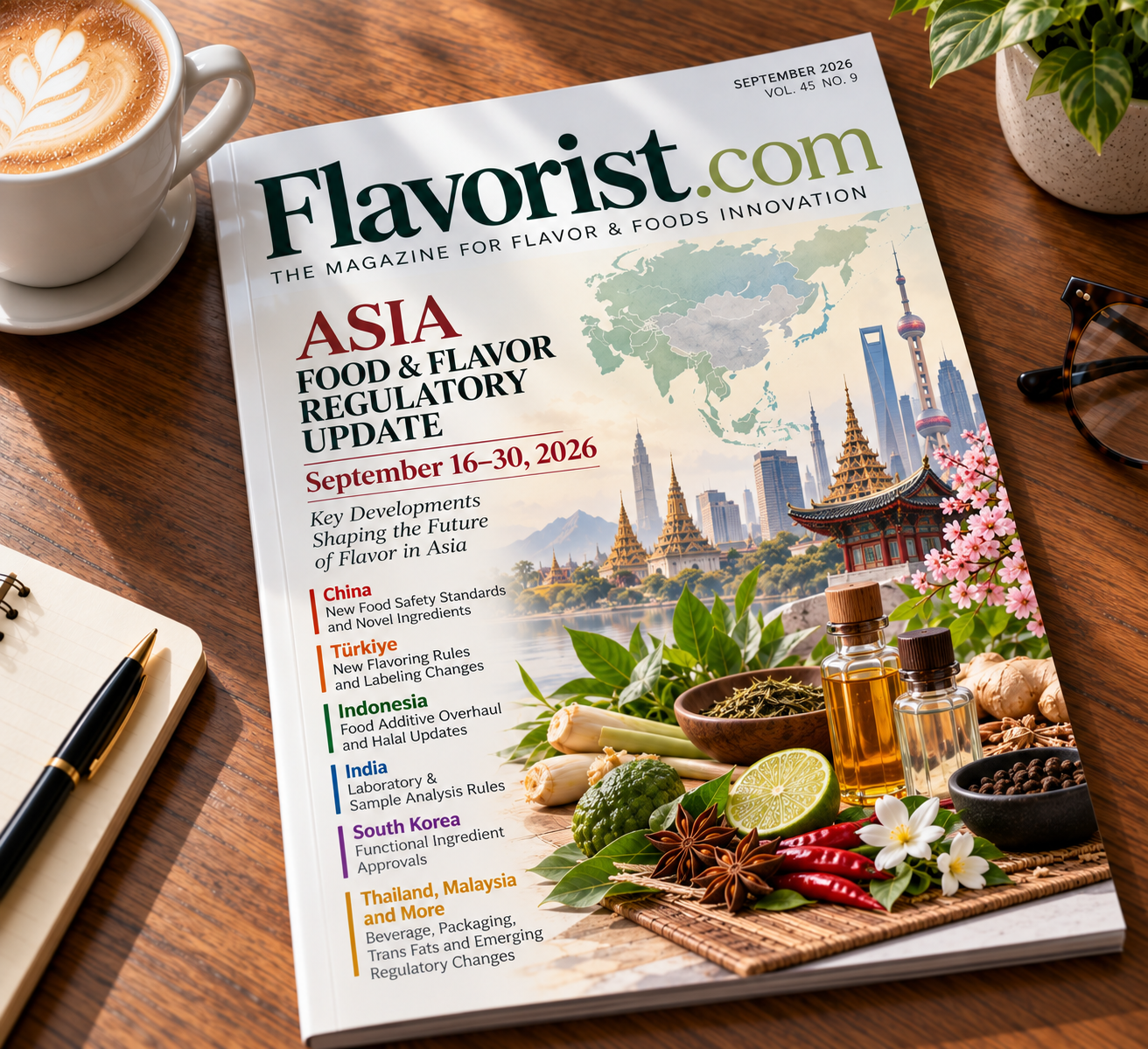
The Asian regulatory digest is based on news from regulator websites and regulatory/legal reporting across major Asian markets for developments released between September 16 and September 30, 2026. The news updates are related to material food, beverage, flavor, additive, ingredient, labeling, import and food-contact developments but not ordinary recalls and routine inspection announcements.
1. Indonesia proposes major overhaul of food-additive regulation — September 16/24
Indonesia's Food and Drug Authority, BPOM, released a draft replacing/updating BPOM Regulation No. 11 of 2019 on Food Additives. The proposal is particularly important for flavor houses, beverage formulators and ingredient suppliers because it is intended to bring Indonesia's permitted additive framework closer to Codex standards while incorporating hundreds of special authorizations granted since the current regulation was issued.
The draft revises permitted uses and maximum levels of additives in processed foods and addresses carry-over principles and regulatory treatment of additives used during food production. Regulatory reporting indicates that more than 400 special permits issued since 2019 are being integrated into the revised framework. BPOM's formal draft was released for stakeholder consultation in September, with comments requested in early October and final harmonization expected later. Companies selling colors, sweeteners, preservatives, emulsifiers, flavor-related ingredients and other additives into Indonesia should compare existing product approvals against the proposed schedules. Food Compliance International
Food Compliance International — Indonesia Food Additives Proposal
2. Thailand revises requirements for beverages in sealed containers — September 16
Thailand's Ministry of Public Health issued Notification No. 473, representing the fourth amendment to the country's requirements for beverages in sealed containers. The measure was published in the Royal Gazette and entered into force on September 16.
The rules are particularly relevant to beverage and flavor companies because Thailand's sealed-beverage framework governs product composition, permitted ingredients and certain labeling requirements across a broad range of packaged drinks. Regulatory reporting identifies changes affecting caffeine-containing beverages and products incorporating plant-derived ingredients, among other categories. The amendment should therefore be reviewed by manufacturers of flavored waters, functional beverages, energy-type drinks, botanical drinks and concentrates supplied for beverage manufacture. Because the notification entered into force upon publication rather than merely opening a consultation, affected businesses should determine whether existing formulations and labels remain compliant. Exporters should also check whether their Thai importer has updated product dossiers and specifications to reflect Notification No. 473. Foodmate
Food Safety and Compliance Service — Thailand Beverage Requirements
3. Thailand proposes tougher food-contact plastic requirements — September 16
The Thai FDA opened consultation on revisions to Ministry of Public Health Notification No. 435 (2022) governing plastic food containers. Although technically a packaging measure, it has substantial relevance to flavor, extract, beverage and ingredient manufacturers because migration from containers can directly affect concentrated liquid ingredients and finished foods.
The draft would expand or revise authorized plastics while introducing restrictions involving bisphenol A (BPA), polycarbonate materials, epoxy derivatives and PFAS, together with updated specific migration limits. Thailand's proposal therefore reflects the wider international shift toward tighter controls on substances migrating from food-contact materials. The consultation is scheduled to remain open through December 31, 2026. Flavor companies should pay particular attention where concentrated flavors, essential oils, acidic beverage bases or solvent-containing extracts are packaged in plastics, since compatibility and migration profiles can differ substantially from ordinary foods. Packaging specifications and supplier declarations may consequently require review if the proposal is finalized. ChemLinked
ChemLinked — Thailand Plastic Food-Contact Regulation Draft
4. China advances multiple “Three New Foods” additive and ingredient applications — September 16
China's National Health Commission continued its “Three New Foods” regulatory process covering new food raw materials, new food additives and new food-related products. A September 16 regulatory summary reported ten extension notices and six review opinions, illustrating significant activity in the country's ingredient-authorization pipeline.
Additives under review included commercially important ingredients such as 3-fucosyllactose, beta-carotene, galactooligosaccharides and lacto-N-tetraose. Extension notices generally mean additional information is required following technical review rather than that the substance has been rejected. The development matters to international flavor and ingredient manufacturers because China requires regulatory authorization before many novel ingredients or new additive uses can enter the market. The pipeline also provides useful visibility into emerging opportunities involving specialty carbohydrates, colors, nutrition ingredients and fermentation-derived substances. Companies pursuing Chinese approvals should distinguish these application-stage developments from final authorizations and monitor subsequent NHC/CFSA decisions before commercializing products based on the substances concerned. CIRS Group
CIRS — China Three New Foods Regulatory Update
5. China clarifies infant and young-child formula labeling — September 20
China's State Administration for Market Regulation (SAMR) issued an official Q&A clarifying labeling requirements for infant and young-child formula foods, including powdered and liquid infant formula. The guidance supports implementation of China's broader Food Labeling Supervision and Administration Measures.
Among other requirements, production and expiration dates must appear in a dedicated area; required allergen information must appear near the ingredient list; and companies making milk-source claims must identify the country or specific source. Importantly, identical formulas marketed by the same company must use consistent label content, format and colors rather than differentiating products merely through packaging colors, caps or container shapes. Changes made to comply with the updated requirements generally do not trigger formula re-registration, but revised labels must be filed with provincial market-regulation authorities. Products manufactured before the new labeling rules take effect on March 16, 2027 receive differentiated treatment depending on whether existing labels violate express prohibitions. SAMR
SAMR — Official Infant Formula Labeling Q&A
6. Malaysia reinforces trans-fat restrictions on imported processed foods — September 21/22
Malaysia's Ministry of Health reminded importers that processed foods containing more than 2 grams of trans fatty acids per 100 grams of total fat cannot be imported and sold to final consumers. The requirement derives from Regulation 38B of Malaysia's Food Regulations 1985 and has been in force since September 2025; the September 2026 notice emphasizes enforcement and importer compliance.
The rule is especially relevant to products containing partially hydrogenated vegetable oils, including shortenings, margarines, bakery products, cookies, snacks, fillings and certain flavor-delivery systems. Naturally occurring trans fats in animal fats such as dairy and meat are excluded from the restriction. Although the September announcement does not create an entirely new trans-fat limit, its significance lies in Malaysia's renewed import-compliance focus. International manufacturers should ensure certificates of analysis, specifications and formulation records demonstrate compliance, particularly where compound coatings, bakery fats or flavor carriers contain hydrogenated oils. Food Compliance International
Food Compliance International — Malaysia Trans-Fat Import Requirements
7. Türkiye tightens sugar, flavoring and “natural” rules for drinking milk — September 22
Türkiye amended its Food Codex rules for drinking milk through Communiqué No. 2026/19, introducing significant formulation and labeling requirements for flavored milk.
The amendment establishes a maximum 5% added sugar by mass, subject to a maximum total sugar content of 9.5%, while requiring flavoring ingredients to account for at least 1% where applicable. Of particular importance to flavor manufacturers, the revised regime restricts flavorings used in these products to natural flavorings. Manufacturers must also disclose the percentage of added sugar and milk-fat classification prominently on the principal display panel. The term “natural” is restricted for certain products: skimmed, semi-skimmed and lactose-free milk cannot use the designation under the specified conditions, while qualifying whole milk without additives can. The measure creates direct formulation, natural-flavor sourcing and label-review implications for dairy manufacturers and their flavor suppliers. Food Compliance International
Food Compliance International — Türkiye Drinking Milk Amendment
8. Bangladesh proposes tighter energy-drink standard — September 23
The Bangladesh Standards and Testing Institution (BSTI) circulated Amendment 1:2026 to BDS 2043:2025, proposing revised composition, safety and labeling requirements for energy drinks.
The proposal would establish a caffeine range of 146–300 mg/L and limits for functional ingredients, including taurine at 2,000 mg, glucuronolactone at 1,200 mg and inositol at 100 mg under the specified conditions. The draft also introduces contaminant tolerances for substances including lead, arsenic and copper and would prohibit ethanol, hormones and certain prohibited stimulants. Labeling provisions include safe daily-consumption information based on serving/container size and warnings where non-nutritive sweeteners are present. The official certification mark would also be required. The measure is particularly relevant to flavor companies because energy drinks typically combine complex flavor systems, sweeteners, acids, caffeine, botanical ingredients and functional components. Reformulation could therefore affect both sensory profiles and flavor-system design. Food Compliance International
Food Compliance International — Bangladesh Energy Drink Standard Proposal
9. South Korea approves mealworm hydrolysate as health-functional-food ingredient — September 23
South Korea's Ministry of Food and Drug Safety (MFDS) approved hydrolyzed mealworm larvae—known commercially as Gosoae—as a functional ingredient for health functional foods.
The ingredient is manufactured by enzymatically hydrolyzing defatted mealworm powder, breaking proteins into lower-molecular-weight peptides to improve solubility and digestibility. Regulatory reporting indicates that the recognized function relates to helping maintain muscle strength that decreases with aging. Supporting research included clinical evaluation involving adults aged 50–75, using approximately 2 grams per day. The authorization creates opportunities for the ingredient in health supplements and potentially protein-based functional products subject to applicable Korean requirements. From the flavor industry's perspective, insect-derived proteins present substantial sensory challenges—including characteristic roasted, cereal, earthy and sometimes bitter notes—making masking and flavor optimization potentially important to commercialization. The approval also demonstrates South Korea's continued regulatory development of alternative-protein and individually recognized functional-food ingredients. Food Compliance International
Food Compliance International — South Korea Mealworm Hydrolysate Approval
10. China releases major package of 50 national food-safety standards — September 22/24
China's NHC and SAMR announced a substantial package of 50 national food-safety standards and amendments, making this one of the most consequential Asian regulatory developments of the period.
The package addresses contaminant controls, analytical methods, ingredients and food-additive specifications. Reported standards include controls relating to acrylamide, lead and tin, together with specifications affecting dairy proteins and numerous food additives and flavor-related ingredients. Updated standards reportedly cover ingredients including erythritol, paprika oleoresin and sodium alginate, with revised requirements concerning heavy metals and impurities. Analytical provisions also address substances including mycotoxins, trans fats and PFAS. Because China's GB food-safety standards are mandatory, ingredient manufacturers should not treat the package as guidance. Each relevant standard needs to be checked individually for its implementation date, transitional provisions and superseded requirements. Flavor houses should particularly review specifications applying to colors, extracts, carriers, stabilizers and other substances used within compound flavor systems. Foresight
Food Compliance International — China's 50 Food-Safety Standards
11. Türkiye substantially revises Food Codex rules specifically governing flavorings — September 24
This is arguably the most directly flavor-industry-specific regulatory development in the September 16–30 Asian window. Türkiye's Ministry of Agriculture and Forestry updated its Food Codex framework governing flavorings and food ingredients with flavoring properties.
The revised framework prohibits the production, circulation and import of additives/flavoring materials derived from pigs and insects under the specified rules and prohibits ten identified flavoring substances, including substances referenced under FL numbers 04.029, 05.100 and 15.131. Additional restrictions apply to FL 05.062 and FL 05.099. For a flavor to carry a natural-source designation, at least 95% by weight must derive from the referenced biological source. GMO-derived inputs are subject to authorization requirements. The regulation also restricts marketing using alcoholic-beverage names and establishes detailed labeling requirements for business-to-business flavorings. Industry receives a transition period extending through December 31, 2026. Food Compliance International
Food Compliance International — Türkiye Food Codex Flavoring Amendment
12. India reforms food laboratory and sample-analysis rules — September 25
India's Food Safety and Standards Authority of India (FSSAI) promulgated updated Food Safety and Standards rules covering laboratories and sample analysis, replacing/reforming elements of the older 2011 framework.
The regulations introduce defined timelines for testing and reporting. Regulatory samples and appeals handled by reference laboratories generally receive a maximum 14-day reporting period, while import samples receive a much shorter five-day timeline. Importantly, laboratories may use validated analytical methods from internationally recognized organizations—including AOAC, ISO and Codex Alimentarius—when an applicable parameter is absent from FSSAI's official testing manuals. Documentation requirements are also streamlined through revised forms. For flavor and ingredient companies, laboratory rules matter because enforcement disputes frequently concern identity, purity, contaminants, additives, adulteration and compliance with maximum permitted levels. Faster import testing could also affect clearance times. FSSAI separately issued a September 18 advisory emphasizing timely analysis and reporting by notified referral laboratories. Food Compliance International
FSSAI — Official Advisories and Regulatory Notices
13. China accepts D-allulose and other novel ingredient applications — September 28
China's National Health Commission disclosed additional activity involving applications for new food raw materials, including D-allulose, an ingredient of particular interest to the global sweetener and flavor industries.
The September regulatory update identified an application acceptance dated September 20 for D-allulose, alongside recent applications involving tagatose, L-ergothioneine, PQQ disodium salt and Hippocampus abdominalis. Acceptance of an application should not be confused with authorization: it means the substance has entered or progressed through China's regulatory review system. Nevertheless, D-allulose is commercially significant because food and beverage manufacturers increasingly use rare sugars and other alternative sweetening systems to reduce conventional sugar while attempting to preserve sweetness quality, mouthfeel and flavor delivery. Chinese authorization could therefore materially affect formulation opportunities for beverages, dairy products, confectionery and other reduced-sugar applications. Manufacturers should wait for a final NHC authorization defining permitted scope, specifications and conditions before treating D-allulose as generally approved. Food Compliance International
Food Compliance International — China New Food Ingredient Applications
14. Singapore grants temporary BCRS labeling grace period to qualifying retailers — September 18/29
Singapore's National Environment Agency (NEA) provided a limited grace period associated with implementation of its Beverage Container Return Scheme (BCRS). Smaller qualifying retailers and nonprofit organizations can apply to continue clearing existing beverage inventory without BCRS labels through October 31, 2026.
The measure follows the six-month transition period and addresses businesses that made genuine efforts to exhaust older inventory but still held non-BCRS-labelled beverages. By September 29, NEA reported receiving more than 2,000 applications, predominantly from provision shops, neighborhood convenience stores and standalone food retailers. Although fundamentally an environmental packaging regulation rather than a food-safety measure, BCRS directly affects beverage packaging, labeling, inventory and market access and therefore warrants inclusion for beverage/flavor-industry regulatory monitoring. Beverage manufacturers and importers should distinguish this narrow retailer grace period from a general postponement of BCRS obligations; it does not eliminate the underlying labeling and container-return requirements. National Environment Agency
Singapore NEA — BCRS Label Grace Period
15. Indonesia clarifies which food inputs are exempt from mandatory halal certification — September 30
Indonesia's Halal Product Assurance Agency (BPJPH) clarified three categories of raw materials and inputs exempt from mandatory halal certification under the country's halal framework.
The first category covers specified naturally derived materials—including plant materials, qualifying non-slaughtered animal materials, natural water and microbial-fermentation products—that have not undergone complex processing or addition of other additives or processing aids. A second category covers materials considered to pose no meaningful risk of containing or being contaminated by prohibited substances, including specified mineral and synthetic materials. A third encompasses certain non-hazardous chemical substances produced through mineral refining or chemical synthesis without contact with prohibited components. Examples identified as exempt include fresh fruits, dehydrated vegetables, cereals, tubers, fresh eggs, raw milk, natural water, seafood and certain frozen or salted fish. The clarification is important for flavor manufacturers determining which raw materials require halal certification within complex formulations and supply chains. Food Compliance International
Food Compliance International — Indonesia Halal Ingredient Exemptions
16. South Korea strengthens controls while simplifying imported-food procedures — September 30
South Korea's MFDS promulgated an amendment to the Enforcement Rule under the Special Act on Imported Food Safety Management, effective September 30. The reform combines regulatory simplification for lower-risk imports with stronger inspection of potentially hazardous products.
Among other changes, Korea expands eligibility for automated acceptance of import declarations for repeatedly imported, lower-risk foods submitted through qualifying online purchasing agents. Facility requirements for certain import/sales businesses are relaxed, and administrative procedures for high-performing importers are simplified. Conversely, enforcement becomes stricter for problematic products: where an imported food has previously failed inspection and presents a potential safety concern, MFDS may require intensive testing for as many as 20 subsequent importations, compared with the previous five-test approach. Online purchasing agents must also provide consumers with access to MFDS safety information concerning directly purchased overseas foods. For foreign flavor and ingredient exporters, Korea's compliance history therefore becomes even more consequential to future border-clearance treatment. CIRS Group Korea
South Korea MFDS — Food and Regulatory Legislation
What matters most specifically to flavor companies
Four developments deserve particularly close attention from flavor manufacturers and ingredient suppliers: Türkiye's revised Food Codex flavoring rules, because they directly change permitted substances, natural-flavor criteria and B2B labeling; Indonesia's proposed additive overhaul, because it may materially change permitted uses and maximum levels; China's 50-standard package, because it updates mandatory additive/flavor specifications and contaminant controls; and Thailand's beverage amendment, because changes to packaged-beverage composition requirements flow directly into beverage flavor-system formulation. Food Compliance International
Scope note: “All” here means all material, publicly searchable law/regulatory developments identified as of October 1, 2026 across Asian markets during the exact September 16–30 release window.
###