ISO Certification Essentials for Flavorists: An SFC Syllabus–Based Study Guide
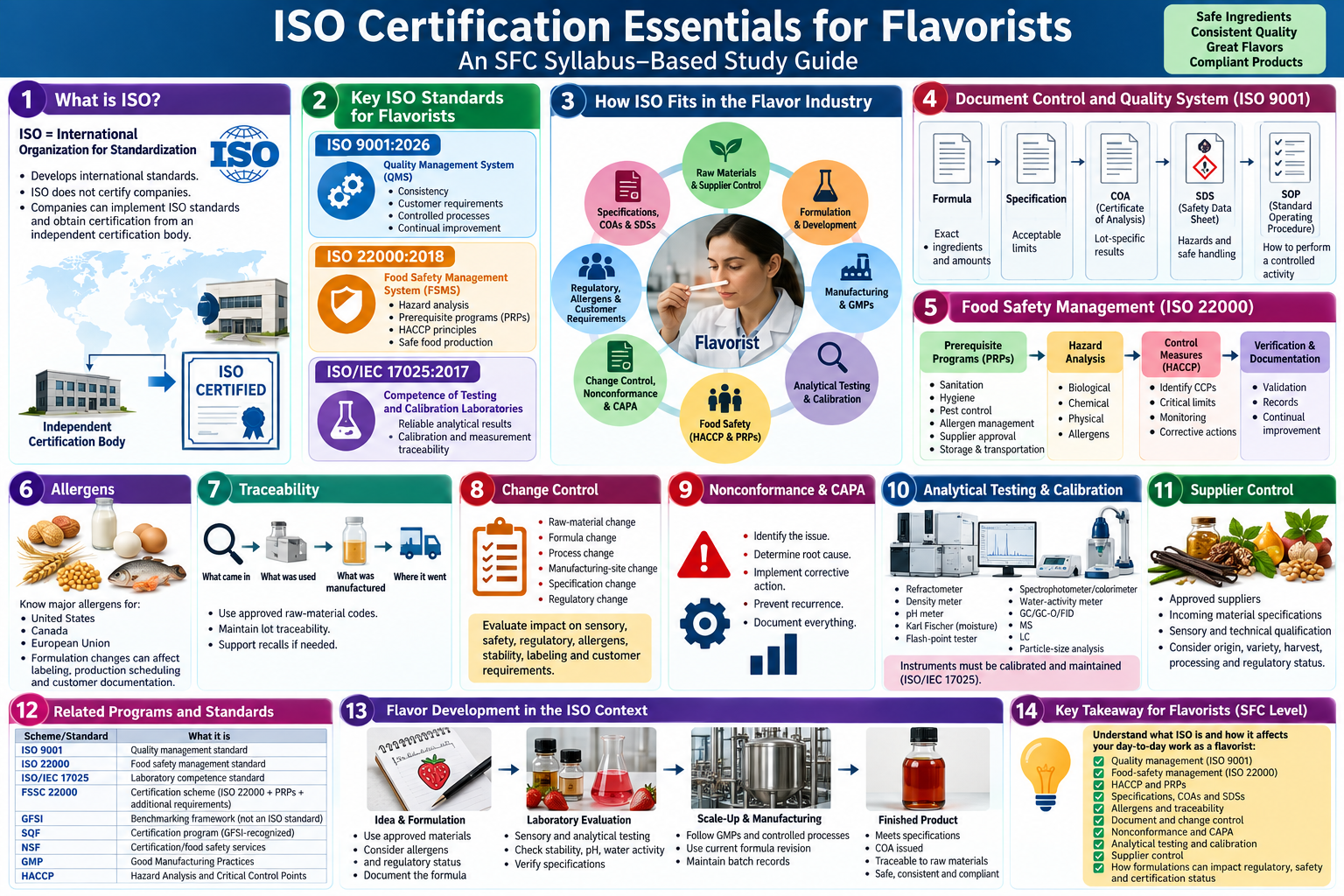
According to the January 2026 Society of Flavor Chemists (SFC) syllabus, a flavorist is expected to have basic knowledge of what ISO certification stands for and where it is used in the flavor industry. ISO sits in SFC Section VII alongside HACCP, GMPs, specifications, COAs, SDSs, FSSC, GFSI, SQF, NSF, and related quality/food-safety systems. The SFC does not require a flavorist to be an ISO auditor or memorize every clause. Flavor Chemists
Below is what flavorists may want to know.
1. First: what “ISO certification” means
ISO = International Organization for Standardization.
ISO develops international standards. ISO itself does not certify flavor companies. A company can implement an ISO standard and, if desired, obtain certification from an independent certification body. ISO specifically notes this distinction for ISO 22000. ISO
For flavorists, the three standards worth recognizing are:
| Standard | Flavorist should associate it with |
|---|---|
| ISO 9001:2026 | Quality Management System — consistency, customer requirements, controlled processes, continual improvement |
| ISO 22000:2018 | Food Safety Management System — hazards, PRPs, HACCP principles, safe food |
| ISO/IEC 17025:2017 | Competence of testing/calibration laboratories — reliable analytical and calibration results |
ISO 9001:2026 is now the current ISO 9001 edition, having replaced ISO 9001:2015 in September 2026. ISO 22000:2018 remains the published ISO 22000 standard, although a third edition is currently under development. ISO/IEC 17025:2017 remains current. ISO
2. ISO 9001 — what a flavorist should understand
Think:
“Can we repeatedly make what we said we would make?”
ISO 9001 is about a Quality Management System (QMS). The organization establishes controlled processes so products/services consistently meet requirements, problems are addressed systematically, and processes continually improve. ISO
For a flavorist, that translates into very practical behavior.
You develop:
Strawberry Flavor ABC-123
The approved formula says:
- Material A = 2.500%
- Material B = 0.750%
- Material C = 0.125%
- PG = balance
Once approved, production cannot casually substitute Material A, change a concentration, or alter processing conditions because somebody thinks the replacement "smells about the same."
There needs to be a controlled change process.
Documents a flavorist encounters
You should understand the purpose of:
Formula / formulation record
Defines exactly what goes into the flavor.
Raw-material specification
Defines acceptable characteristics of an ingredient.
Finished-product specification
Defines acceptance criteria for the flavor.
Examples:
- appearance
- odor
- taste
- specific gravity/density
- refractive index
- Brix
- pH
- moisture
- flash point
- microbiological limits
- GC profile where appropriate
Certificate of Analysis (COA)
Provides lot-specific test results or conformity information.
SDS
Communicates occupational/chemical hazards and safe handling information.
Batch record
Documents what was actually manufactured.
SOP
Defines how a controlled activity must be performed.
Change control
Documents and evaluates an intentional change.
Deviation/nonconformance
Documents something that did not meet an established requirement.
CAPA
Corrective and Preventive Action/systematic corrective action: determine why something went wrong, correct it, and reduce recurrence.
The SFC syllabus specifically identifies specifications, COAs, SDSs, GMPs and related QA/QC documentation as expected knowledge. Flavor Chemists
3. ISO 22000 — the most important ISO concept for food flavorists
Think:
“Can this flavor be manufactured and used without creating an unacceptable food-safety hazard?”
ISO 22000 applies to organizations throughout the food chain and combines management-system principles with prerequisite programs and HACCP principles. ISO
A flavorist should therefore understand four ideas extremely well:
PRPs → Hazard analysis → Control measures → Verification/documentation
4. PRPs — Prerequisite Programs
PRPs establish the basic hygienic operating environment.
Examples relevant to flavor manufacturing include:
- personnel hygiene
- sanitation
- pest control
- chemical control
- allergen management
- supplier approval
- receiving controls
- storage
- equipment cleaning
- preventive maintenance
- foreign-material control
- rework control
- waste handling
- cross-contamination prevention
- warehousing
- transportation
A flavorist usually doesn't manage every PRP, but their formulation and process decisions can affect them.
For example:
A flavorist introduces peanut extract into a previously allergen-free product.
That isn't simply a creative/formulation decision. It can affect:
allergen status → storage → production scheduling → sanitation → labeling → specifications → customer documentation.
5. HACCP
SFC explicitly expects knowledge of Hazard Analysis and Critical Control Points (HACCP). Flavor Chemists
A flavorist should recognize the classic HACCP logic:
- Conduct hazard analysis.
- Determine CCPs.
- Establish critical limits.
- Establish monitoring.
- Establish corrective actions.
- Establish verification.
- Establish records/documentation.
But more important than memorizing the list is knowing how to think about hazards.
Biological hazards
Examples:
- Salmonella
- pathogenic E. coli
- Listeria
- yeast/mold where relevant
- microbial growth in aqueous flavors
Flavorists therefore need to understand why the SFC syllabus specifically mentions:
pH and water activity (aW). Flavor Chemists
A liquid flavor containing substantial water may present very different microbial concerns from an ethanol-based flavor or dry flavor.
6. Chemical hazards
For flavorists, this is especially important.
Potential considerations include:
- allergens
- cleaning chemical residues
- incorrect ingredient concentration
- contaminants in raw materials
- undeclared processing aids
- excessive use of restricted ingredients
- chemical migration/contamination
- heavy metals where applicable
- pesticide residues where applicable
- naturally occurring toxins
- regulatory use-level restrictions
The flavorist needs to understand that:
“Food-grade” does not mean “unlimited use.”
An ingredient can be permitted but still have:
- use restrictions,
- category restrictions,
- purity requirements,
- solvent/residue limits,
- customer limitations,
- regional regulatory differences.
That connects ISO food-safety thinking directly to the regulatory sections of the SFC syllabus.
7. Allergens
This is a major interface between flavor creation and food safety.
The SFC syllabus explicitly expects candidates to know major allergens for the:
- United States
- Canada
- European Union. Flavor Chemists
A flavorist must therefore be able to look beyond the aroma chemicals.
Suppose you're making a creamy flavor.
Potential ingredients might include:
- dairy-derived materials
- enzyme-modified cheese
- butter extracts
- whey-derived materials
- carriers
- natural extracts
The question isn't merely:
“Does this give me the right creamy note?”
It is also:
“What does this material do to the allergen declaration and customer documentation?”
The same thinking applies to soy-, wheat-, sesame-, nut-, egg-, fish- and crustacean-derived materials where relevant.
8. Traceability
A flavor company should be able to determine:
What came in → what lot was used → what was manufactured → where it went.
For a flavorist, that means formulas should identify approved raw-material codes, not ambiguous descriptions.
Bad:
“Orange oil”
Better:
RM-10457 Orange Oil Valencia 5X
The distinction matters because multiple materials can have similar organoleptic profiles but different:
- suppliers
- origins
- specifications
- regulatory status
- allergen status
- natural status
- composition
- processing history.
9. Specifications
This is especially likely to matter in an SFC interview because Specifications appear explicitly in Section VII. Flavor Chemists
A specification answers:
What constitutes acceptable material?
For a flavor raw material, you may see:
Identity
- material name
- FEMA number
- CAS number
- internal code
Physical
- appearance
- color
- physical state
Organoleptic
- odor
- taste/profile
Analytical
- specific gravity
- refractive index
- assay
- GC profile
- optical rotation
- acid value
- Brix
- moisture
- pH
Microbiological, where appropriate.
Regulatory/documentary
- allergen
- GMO
- natural/artificial status
- kosher
- halal
- country of origin
- residual solvents
- regulatory compliance
Not every specification contains every item.
10. COA versus Specification
This is a very useful distinction.
Specification
“These are the acceptable limits.”
Example:
Specific gravity: 0.950–0.970
COA
“This particular lot tested at X.”
Example:
Lot 260918A
Specific gravity: 0.961
So:
Specification = requirement.
COA = evidence/results for a particular lot or shipment.
11. Document control
This is where ISO becomes very visible to working flavorists.
Imagine:
Formula 1234 Rev. 4
A flavorist changes ethyl butyrate from 0.50% to 0.70%.
The new formula becomes:
Formula 1234 Rev. 5
The company needs controls so manufacturing doesn't accidentally produce Rev. 4.
A flavorist therefore needs to respect:
- revision numbers
- approvals
- effective dates
- controlled formulas
- obsolete documents
- electronic permissions
- version history
- authorized changes.
Never assume:
“I changed it in my notebook, so production knows.”
12. Change control
Changes that can trigger review include:
Raw-material change
Supplier A → Supplier B.
Formula change
Ingredient concentration changes.
Process change
Mixing order, temperature or time changes.
Manufacturing-site change
Plant A → Plant B.
Specification change
Different acceptance limit.
Regulatory change
A material becomes restricted or its permitted conditions change.
The change may require evaluation of:
- sensory performance
- analytical results
- stability
- labeling
- allergens
- natural status
- kosher/halal status
- customer requirements
- food safety
- shelf life
- regulatory compliance.
13. Nonconformance and CAPA
Suppose production manufactures a vanilla flavor and the specific gravity is outside specification.
Nonconformance:
Specific gravity failed specification.
But CAPA asks:
Why?
Possible root causes:
- weighing error
- incorrect raw material
- wrong formula revision
- equipment calibration problem
- temperature effect
- transcription error
- supplier variation
- mixing/process problem.
A proper system doesn't simply say:
“Adjust batch.”
It asks whether the underlying cause needs correction.
14. Calibration
This connects beautifully with the analytical section of the SFC syllabus.
SFC expects working knowledge of instruments including:
- refractometer
- density meter
- pH meter
- flash-point tester
- Karl Fischer/moisture analyzer
- spectrophotometer/colorimeter
- water-activity meter
- GC/GC-O/FID
- MS
- LC
- particle-size analysis. Flavor Chemists
An ISO-oriented flavorist should additionally ask:
“How do I know the measurement is reliable?”
That introduces:
calibration, verification, reference standards, maintenance, records and measurement traceability.
ISO/IEC 17025 specifically addresses competence and consistent operation of testing/calibration laboratories and the reliability of their results. ISO
15. Supplier control
Flavor creation depends heavily on supplier quality.
A natural raw material can vary dramatically because of:
- botanical variety
- geographic origin
- harvest
- weather
- processing
- extraction
- storage
- oxidation
- adulteration.
This is especially relevant to SFC syllabus materials such as:
- essential oils
- extracts
- oleoresins
- vanilla
- citrus oils
- spices
- animal-derived materials
- yeast extracts/HVP
- natural aroma materials. Flavor Chemists
Therefore an ISO/food-safety system normally controls approved suppliers and incoming materials.
The flavorist may participate in sensory/technical qualification:
Does the alternate orange oil meet the sensory and functional requirements of our approved material?
16. Risk-based thinking for flavorists
A useful flavorist habit is:
Every formulation change has multiple dimensions.
For example, replacing ethanol with propylene glycol could affect:
Sensory
Volatility and flavor release.
Physical
Solubility and clarity.
Microbiological
Preservation characteristics.
Processing
Mixing and handling.
Regulatory
Ingredient declaration or customer requirements.
Safety
Flash point and transportation classification.
Stability
Oxidation or precipitation.
That type of multidimensional reasoning is exactly where ISO principles intersect with flavor creation.
17. ISO 22000 versus FSSC 22000 versus GFSI
Flavorists frequently confuse these.
ISO 22000
An international food-safety management-system standard.
FSSC 22000
A certification scheme built around ISO 22000 plus sector-specific prerequisite-program requirements and additional FSSC requirements. The current FSSC Scheme is Version 7, released in May 2026. FSSC
For food manufacturing, FSSC V7 incorporates the newer ISO 22002 PRP series; FSSC explains that manufacturers use ISO 22002-100:2025 common PRPs together with ISO 22002-1:2025 sector-specific requirements. FSSC
GFSI
GFSI is not an ISO standard.
It benchmarks food-safety certification programs/schemes.
So a useful exam distinction is:
ISO 22000 = standard
FSSC 22000 = certification scheme incorporating ISO 22000 + PRPs + additional requirements
GFSI = benchmarking framework/initiative
18. GMP versus HACCP versus ISO
Another distinction worth knowing cold:
GMP
How should we operate hygienically and consistently?
Examples: sanitation, personnel practices, equipment, facility practices.
HACCP
What significant food-safety hazards exist, and how will we control them?
ISO 22000
How does the organization manage the entire food-safety system?
It incorporates systematic food-safety management, PRPs, communication and HACCP principles. ISO
These aren't competing concepts. They work together.
19. What an ISO auditor could ask a flavorist
A flavorist should be comfortable answering questions such as:
“Show me how you know you're using the current formula.”
“How is a new raw material approved?”
“What happens when you change a supplier?”
“How do you determine the allergen impact of a formulation?”
“How do you know this pH meter is giving reliable results?”
“Where is the specification for this raw material?”
“What do you do when a material is outside specification?”
“How are experimental materials identified?”
“How do you prevent an unapproved laboratory formula from reaching manufacturing?”
“How are formula revisions controlled?”
“How do you communicate a change that affects regulatory or allergen status?”
“Can this raw material be traced to its supplier lot?”
The correct mindset is not memorizing ISO clauses.
It is being able to demonstrate:
“I follow the documented process, and here is the evidence.”
20. What SFC actually expects you to know
This distinction is important.
The January 2026 SFC syllabus says candidates should know the basic scope of work of relevant international organizations and standards and have basic knowledge of what certifications stand for and where they are used in the industry. ISO Certification is specifically listed in that certification group. Flavor Chemists
Therefore, for an SFC Certified Flavorist interview, I would prioritize these concepts:
- Know what ISO is.
- Know that organizations, not individual flavorists, generally have management systems certified.
- Distinguish ISO 9001 from ISO 22000.
- Understand HACCP and PRPs.
- Know GMP.
- Know SDS vs specification vs COA.
- Understand pH and water activity as food-safety factors.
- Understand allergen control.
- Understand traceability.
- Understand document/formula control.
- Understand change control.
- Understand nonconformance and corrective action.
- Understand why instruments require calibration/verification.
- Understand supplier/raw-material approval.
- Understand why flavor formula changes can affect regulatory, safety, labeling and certification status.
- Distinguish ISO 22000, FSSC 22000, GFSI and SQF at a conceptual level.
You do not need to memorize ISO clauses to satisfy what the SFC syllabus describes as basic certification knowledge.
The single answer I'd memorize for an SFC interview
If the committee asks “What is ISO certification and why is it relevant to a flavorist?”, a strong answer would be:
ISO develops international standards for management systems and other activities. In the flavor industry, ISO 9001 relates primarily to quality management and consistent controlled processes, while ISO 22000 relates to food-safety management and incorporates prerequisite programs and HACCP principles. For a flavorist, these systems affect formula and document control, specifications, raw-material approval, traceability, allergen and hazard assessment, change control, calibration, nonconformance management and recordkeeping. Certification is normally performed by an independent certification body rather than ISO itself.
That is roughly the SFC-appropriate depth: understand the system and demonstrate how it affects your day-to-day work as a flavorist, rather than trying to become an ISO auditor. ISO
Society of Flavor Chemists — 2026 Syllabus
ISO 22000 food-safety management standard
ISO 9001 quality-management standard
###