Order Now: Flavor Emulsion Technology – a Comprehensive Technical Training and Troubleshooting Reference for Flavor Emulsion Science and its Industrial Applications
For those who are determined to excel
Limited Copies Available — Secure Yours Today!
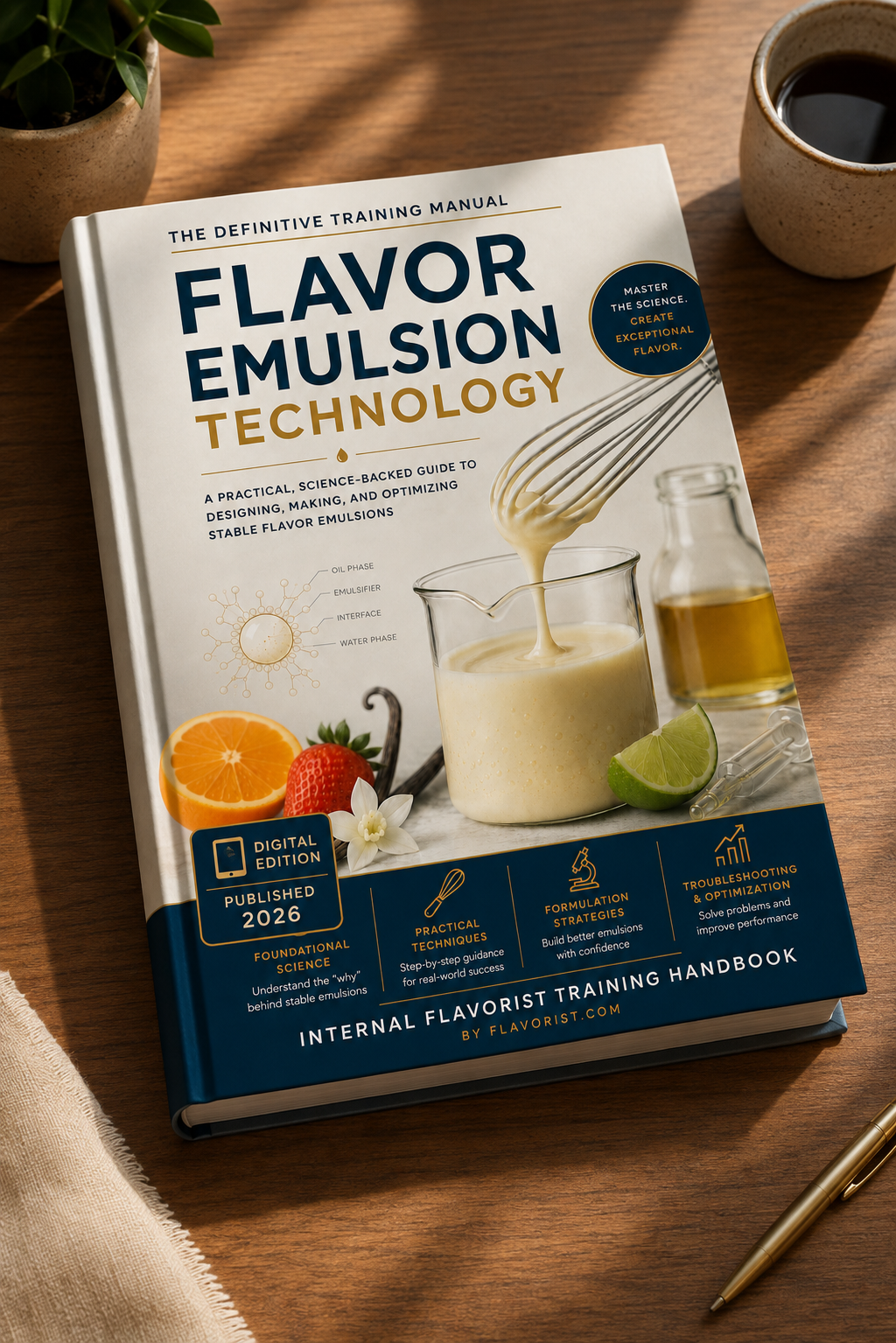
The 488-page book in PDF format is now available for purchase. The list price is $290 per user. The book is formatted for easy navigation and browsing, and all cross-section references and external links are clickable.
Editor's Note: Mastery of emulsion technology is critical for food and flavor formulators, as well as application technologists. In any system containing both oil and water phases, phase separation presents a persistent challenge that must be addressed. When a system lacks adequate emulsification, the fat phase will separate from the aqueous phase during processing or storage, compromising the uniform distribution and delivery of flavor throughout the food matrix. Flavor Emulsion Technology offers foundational and advanced knowledge essential to every product formulator's professional toolkit.
1) About the Book
Comprehensive, textbook-grade resources on flavor emulsion technology are exceedingly rare. Most formulators pick up fragmented knowledge through on-the-job exposure—a tip here, a trick there—but rarely gain access to the complete, systematic understanding required to excel.
Flavor Emulsion Technology, drafted with assistance from a senior flavorist who has a doctorate and a strong background in chemistry and engineering, changes that. Designed as an internal training cornerstone for Flavorist.com, this manual is now available to the public for the first time. It is arguably the most complete and rigorously structured book on the subject available today.
A. Content & Scope
This 488-page book covers everything a flavor formulator or application technologist needs to know—from first principles to advanced problem-solving. The scope includes:
- Part 1 — Foundations: Introduction to flavor emulsions, colloid science, and emulsion types.
- Part 2 — Raw Materials: The dispersed phase, emulsifiers, weighting agents, stabilizers, and supporting ingredients.
- Part 3 — Formulation: Principles of formulation, cloud vs. flavor emulsions, and scaling from concentrate to finished beverage.
- Part 4 — Processing: Equipment, process parameters, scale-up, and powdered/encapsulated flavors.
- Part 5 — Stability: Destabilization mechanisms, beverage-specific defects, shelf-life testing, and accelerated methods.
- Part 6 — Analysis & QC: Characterization techniques, sensory evaluation, and QC specifications.
- Part 7 — Applications & Emerging Areas: Application matrices and cutting-edge technologies.
- Part 8 — Regulatory: Navigating the global regulatory landscape.
- Part 9 — Troubleshooting: The most valued chapter—a practical, quick-reference problem-solution guide for real-world manufacturing issues.
- Part 10 — 15 Appendices: including glossary (168 terms), HLB tables, density-match worksheet, comparison charts, logP table, test methods, supplier reference, the answer key (all 210 self-assessment answers), and mathematical review (46 equations)
Every chapter follows the same architecture, so the book reads consistently and rewards familiarity. Each opens with learning objectives and a nomenclature table giving every symbol its meaning and units. Each carries four recurring sidebars: The Why Behind the Rule (the reason a practice exists), the Master’s Note (hard-won professional judgment), a Worked Calculation (the numbers done in full), and a Failure File (a typical defect diagnosed symptom-to-fix). Each closes with a working method, a summary, and a six-question self-assessment whose answers are collected in Appendix H.
Behind the main text sit fifteen appendices (A–O) built as working tools: a glossary and a consolidated mathematical review; HLB, logP, emulsifier, and stabilizer reference tables; a density-match worksheet; comparison charts; test-method and supplier guidance; an ingredient-interaction chart; visual decision trees; and — importantly — worked, end-to-end case studies with sample starting-point formulations.
A Distinctive Feature: Unlike many practical manuals, this book employs mathematical equations to describe physical concepts and processes in a clear, approachable way. These equations are not hurdles—they are tools used to give you an easier, more precise understanding of why emulsions behave the way they do.
B. Technicality & Scientific Rigor
This is not a superficial overview. The content is advanced and grounded in scientific rigor, making it equally valuable for:
- Beginners who want to build a solid, comprehensive foundation from the ground up.
- Senior and Master-Level Formulators who desire to deepen their knowledge, challenge their assumptions, and refine their skills with advanced theory and troubleshooting methodologies.
C. Who Should Use This Book?
This book is designed for those who work with flavor and emulsions, including professionals such as product developers, formulation scientists, application scientists and technologists, process chemists, process engineers in a variety of industries including:
- Food & Beverage
- Flavor Manufacturing
- Nutraceuticals
- Cosmetics
- Pharmaceuticals (where flavor and emulsion systems are involved)
Additionally, it serves as an excellent training resource or formal textbook for undergraduate and graduate students preparing for careers in these industries. Professors can confidently adopt it for specialized courses on colloid science or flavor technology.
D. Prerequisite Knowledge
To fully benefit from this material, readers should have a solid working knowledge of algebra. The mathematical content is used to clarify, not complicate, but comfort with basic equations is essential to unlocking the full depth of the text.
2) Why This Book?
The food and beverage industry is evolving rapidly, and with it, the demand for specialized technical expertise is skyrocketing. Emulsion technology, which flavorists are required by the Society of Flavor Chemists to master, is no longer a "nice-to-have" skill—it is an essential pillar of every flavor formulator's and application technologist's toolkit.
As products become more complex and consumer expectations for stability and mouthfeel rise, professionals with deep knowledge, hands-on skills, and practical experience in emulsion science are becoming increasingly competitive in the job market. Whether you are aiming for a promotion, transitioning into R&D leadership, or simply future-proofing your career, mastering emulsion technology gives you a distinct edge.
This book was created to meet that industrial demand head-on.
3) Important Notice — Licensing Agreement
Flavor Emulsion Technology is the intellectual property of Flavorist.com. When you purchase this digital book, you are acquiring a license to use the material under the following terms:
- Single-User License: Each license permits one individual user to store and access the material on any device without restriction.
- Prohibited Uses: Licensed users may not sell, resell, share, distribute, or transmit the content to others by any means—electronic, physical, or otherwise.
- Multi-User Scenarios: If a flavor house or company wishes to train multiple employees (e.g., 5 flavorists) using this book, the company must purchase a separate license for each user.
- The digital book in PDF format will be lightly watermarked with the licensee's name and, if applicable, their affiliated organization.
Get your copy today — before it's off the shelves
Invest in your expertise. Gain the competitive advantage that comes with mastery of emulsion technology.
Flavor Emulsion Technology — Published by flavorist.com. Elevate your craft. Master the science.