Food Safety Considerations for Quality Assurance and Control
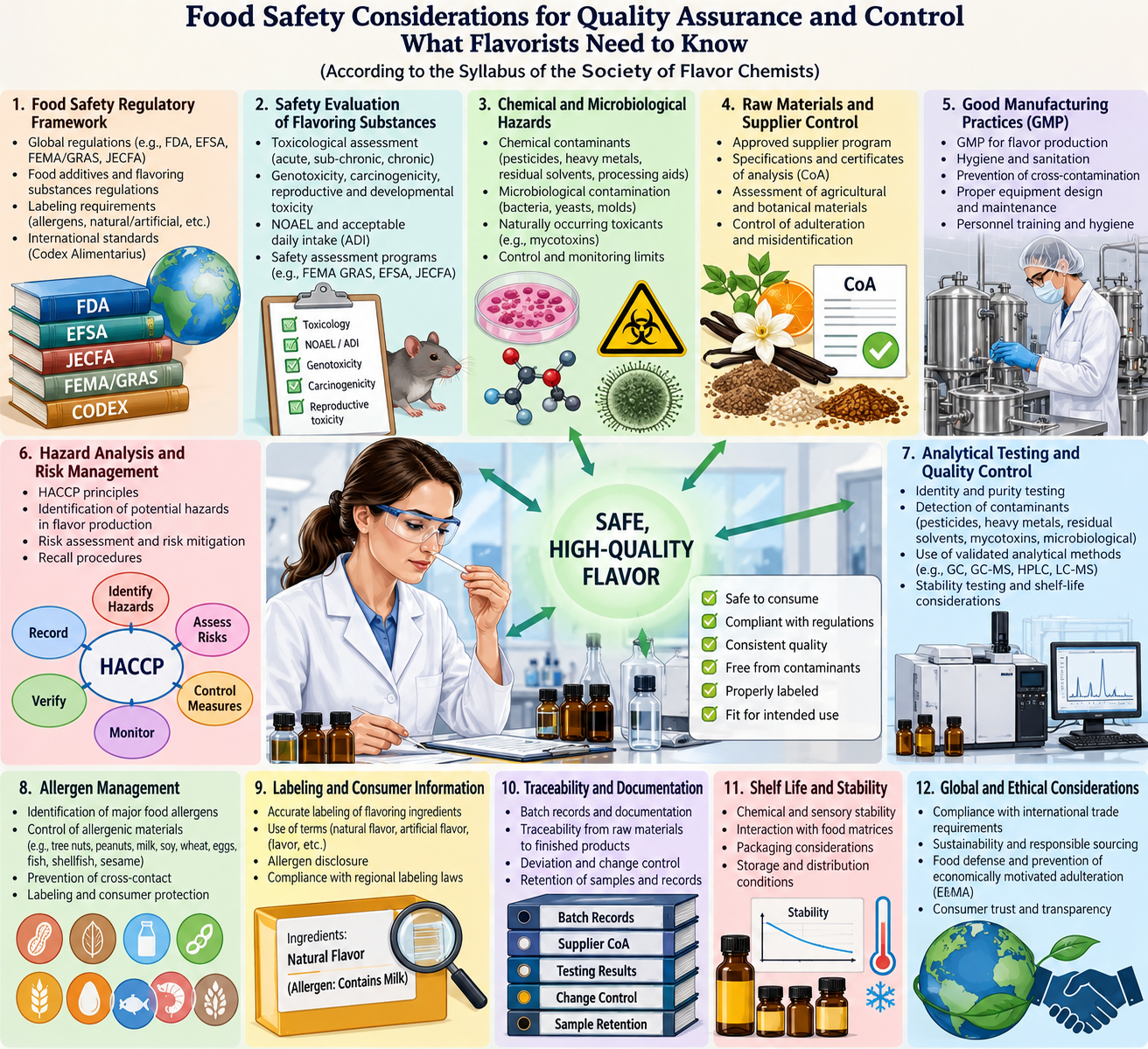
A study guide for Society of Flavor Chemists (SFC) certification
The SFC syllabus lists "Food Safety Considerations – aw (water activity), pH, etc." under Section VII, Flavor Organizations, Certifications, and Documentation, in the Quality Assurance/Control subsection.
The January 2026 syllabus places several closely related competencies alongside it:
- Hazard Analysis and Critical Control Points (HACCP)
- Safety Data Sheets (SDS)
- Specifications and Certificates of Analysis (COA)
- Good Manufacturing Practices (GMPs)
- Natural certification and continuing letters of guarantee
- Food safety considerations, especially water activity (aw) and pH
Other sections of the syllabus cover microbiological and chemical stability, preservatives, analytical methods, allergens, flavor forms, regulations, and manufacturing practices.
Scope of this guide. The syllabus names the knowledge areas a candidate is expected to master but does not explain them in depth. This guide develops those areas into the scientific principles, practical applications, calculations, and troubleshooting knowledge needed for both the written examination and the oral interview.
1. Fundamentals of food safety in flavor manufacturing
Food safety is the prevention of biological, chemical, physical, and allergenic hazards that could make a food or flavor ingredient unsafe for its intended use.
Food safety, quality assurance, and quality control are related but distinct:
| Concept | Main purpose | Flavor-industry example |
|---|---|---|
| Food safety | Prevent harm to consumers | Preventing Salmonella contamination in a spice-derived flavor |
| Quality Assurance (QA) | Establish systems that prevent problems | Supplier approval, HACCP, GMPs, validation, audits |
| Quality Control (QC) | Test and verify materials and products against requirements | Measuring pH, water activity, microbial counts, GC profiles |
| Product quality | Meet sensory, physical, and performance expectations | Maintaining a consistent orange aroma or clear beverage appearance |
A flavor can pass sensory evaluation and still be unsafe. Conversely, a flavor can be microbiologically safe and still fail its organoleptic specification.
Four categories of food-safety hazards
| Hazard | Examples relevant to flavorists | Typical controls |
|---|---|---|
| Biological | Salmonella, pathogenic E. coli, Listeria, microbial toxins | Validated processing, sanitation, ingredient controls, pH and aw management |
| Chemical | Pesticide residues, heavy metals, unauthorized substances, mycotoxins, cleaning chemicals | Supplier qualification, analytical testing, regulatory review |
| Physical | Glass, metal fragments, hard plastic, stones | Filtration, sieving, magnets, metal detection, equipment inspection |
| Allergenic | Milk, soy, wheat, peanuts, tree nuts, and other regulated allergens | Allergen management, segregation, cleaning validation, accurate labeling |
HACCP systems often classify allergens as chemical hazards. They are treated separately here because of their importance in flavor formulation and labeling.
Hazards must be evaluated across the whole chain: raw-material sourcing, storage, processing, packaging, transportation, and the intended finished-food application, not only in the finished flavor concentrate.
2. Water activity (aw)
2.1 Definition
Water activity describes how available water is for microbial growth and for chemical or enzymatic reactions. It is not the same as moisture content.
aw = p / p0
where p is the equilibrium vapor pressure of water above the sample and p0 is the vapor pressure of pure water at the same temperature.
At equilibrium, water activity also corresponds to equilibrium relative humidity (ERH):
aw = ERH / 100
Water activity ranges from 0 to 1.
2.2 Microbial growth limits
Different microorganisms require different minimum water activities.
| Microorganism group | Approximate lower growth limit |
|---|---|
| Most Gram-negative foodborne bacteria | 0.95–0.97 |
| Clostridium botulinum, nonproteolytic strains | 0.97 |
| Clostridium botulinum, proteolytic strains | 0.94 |
| Many ordinary yeasts | 0.88 |
| Staphylococcus aureus (under favorable conditions) | 0.86 |
| Many ordinary molds | 0.80 |
| Xerophilic molds | ~0.61 |
| Osmophilic yeasts | ~0.60–0.62 |
| All known microorganisms | No demonstrated growth below ~0.60 |
These are approximate biological limits, not product-safety criteria. Actual minimums depend on temperature, pH, nutrients, oxygen, preservatives, and other conditions.
A product with aw below 0.60 will not support microbial growth, but that does not mean pathogens or their toxins are absent. Salmonella, for example, can survive for long periods in spices, powders, and other low-moisture ingredients even though it cannot multiply there.
2.3 Water activity versus moisture content
| Parameter | Powder A | Powder B |
|---|---|---|
| Moisture content | 5% | 5% |
| Water activity | 0.25 | 0.65 |
| Growth potential | Generally too low to support microbial growth | Certain specialized yeasts and molds may grow |
Both powders contain the same amount of water, but less of it is available in Powder A. Sugars, salts, proteins, starches, gums, and other matrix components bind or immobilize water to different degrees.
In short: moisture content measures how much water is present; water activity measures how available that water is.
2.4 Water activity across flavor forms
| Flavor form | Key considerations |
|---|---|
| Aqueous liquid flavors | Often high aw; may need preservatives, validated processing, or refrigeration |
| High-Brix syrups | Dissolved sugars lower aw, but the value must be measured, not assumed |
| Flavor pastes | Water distribution and ingredient composition drive microbial risk |
| Spray-dried flavors | Low aw improves storage stability, but pathogens can survive drying |
| Plated flavors | Carrier hygroscopicity and ambient humidity affect aw |
| Encapsulated flavors | Moisture migration can affect capsule integrity, caking, and stability |
| Oil-soluble flavors | Bulk oil does not generally support growth, but contamination and any aqueous phase must be considered |
| Emulsions | The water phase can support growth depending on composition and controls |
2.5 Controlling water activity
Water activity can be lowered by drying, by increasing the level of suitable solutes, by reformulating, by controlling ambient humidity, and by choosing appropriate packaging. In practice:
- Adding water usually raises aw, though the size of the change depends on the formula.
- Sugars, salts, and polyols lower aw with differing effectiveness.
- aw cannot be reliably calculated from Brix alone.
- Combining high- and low-aw ingredients can cause moisture migration.
- Moisture-sensitive powders need packaging that protects them from humidity.
- aw must be measured at a controlled temperature after the sample has equilibrated.
2.6 Measuring water activity
The two common instrument types are chilled-mirror dew-point meters and electronic (capacitance or resistive) humidity-sensor meters.
Good QC practice covers instrument verification against calibration standards, temperature equilibration, representative sampling, awareness of interference from volatile components, and recording test conditions.
High levels of volatile solvents or aroma compounds can interfere with some sensor types, so the instrument and method must suit the flavor matrix.
3. pH and acidity
3.1 Definition
pH expresses the acidity or basicity of an aqueous system in terms of hydrogen-ion activity:
pH = −log10(aH+)
The scale is logarithmic: a drop of one pH unit corresponds to roughly a tenfold increase in hydrogen-ion activity.
pH affects:
- Microbial growth and survival
- Preservative effectiveness
- Chemical and enzymatic reaction rates
- Flavor stability and ingredient compatibility
- Protein precipitation and emulsion stability
- Color stability
- Perceived sourness
3.2 The pH 4.6 boundary
In U.S. regulation, pH 4.6 is the key value for controlling Clostridium botulinum in certain food categories.
FDA defines low-acid canned foods as those with a finished equilibrium pH above 4.6 and aw above 0.85, with specified exceptions. Acidified foods are low-acid foods to which acid is added to reach a finished equilibrium pH of 4.6 or below, with aw above 0.85.
These definitions apply to specific regulated categories. They are not universal pass/fail limits for flavor concentrates. pH 4.6 relates to botulism control; it does not mean all pathogens are eliminated:
- Salmonella and pathogenic E. coli can survive acidic conditions.
- Yeasts and molds can spoil acidic flavors.
- Acidification does not automatically replace a validated thermal treatment.
- A flavor's pH can change substantially once it is added to the finished product.
3.3 pH versus titratable acidity
| Parameter | pH | Titratable acidity (TA) |
|---|---|---|
| Measures | Hydrogen-ion activity | Total acid titratable to a defined endpoint |
| Typical method | pH meter | Titration with standardized base |
| Main relevance | Microbial behavior, reaction conditions, preservative effectiveness | Acid loading, buffering, flavor balance |
| Units | pH units | % as a named acid, g/L, meq/kg, etc. |
Two flavors can have the same pH but very different titratable acidity and buffering capacity. A well-buffered system resists pH change when water or another ingredient is added.
3.4 Organic acids and antimicrobial activity
Common acidulants in flavors include citric, malic, lactic, acetic, phosphoric, tartaric, and fumaric acids.
The antimicrobial activity of a weak acid depends largely on the fraction that remains undissociated. The Henderson–Hasselbalch equation gives:
pH = pKa + log10([A−] / [HA])
For a simple monoprotic weak acid, the undissociated fraction is approximately:
fHA = 1 / (1 + 10^(pH − pKa))
Undissociated molecules pass through microbial cell membranes more readily and disrupt intracellular function.
Worked example: benzoic acid (pKa ≈ 4.2)
| pH | Undissociated fraction |
|---|---|
| 3.0 | ~94% |
| 3.6 | ~80% |
| 4.2 | 50% |
| 5.0 | ~14% |
| 6.0 | ~1.6% |
This estimates acid speciation only; it does not predict actual antimicrobial efficacy or shelf life. It does explain why sodium benzoate is mainly useful in acidic formulations.
3.5 Measuring pH correctly
- Calibrate with fresh standard buffers that bracket the expected value.
- Account for temperature effects on both the electrode and the sample.
- Use an electrode suited to the matrix.
- Allow the reading to stabilize.
- Clean, store, and maintain the electrode properly.
- Record any dilution procedure.
- Distinguish direct measurement from pH measured after dilution.
The pH of a 10% aqueous dilution is not necessarily the pH of the concentrate. For essentially nonaqueous or oil-based flavors, a conventional aqueous pH reading may have no meaningful direct interpretation.
4. Combining pH and water activity: hurdle technology
Hurdle technology relies on several preservation factors working together rather than on any single control. Common hurdles include:
- Low pH
- Reduced water activity
- Heat treatment
- Refrigeration
- Antimicrobial preservatives
- Modified atmosphere and packaging
- Hygienic manufacturing and prevention of recontamination
Each hurdle must be appropriate to the specific hazards, product, process, and storage conditions.
Example: water-soluble strawberry flavor. A flavor containing water, sugar, citric acid, aroma chemicals, and a permitted preservative may depend on several factors at once:
- Citric acid lowers the pH.
- Sugar lowers the water activity.
- The preservative inhibits susceptible organisms.
- Sanitary manufacturing keeps the initial microbial load low.
- Packaging limits later contamination.
If the flavor is diluted, its pH, aw, preservative concentration, and microbial stability can all change. A formulation change can alter the safety of a flavor even when its sensory profile is nearly identical.
5. Microbiological hazards and testing
5.1 Organisms of concern
| Organism or group | Main concern | Flavor applications of concern |
|---|---|---|
| Salmonella spp. | Foodborne illness; survival in dry ingredients | Spices, herbs, powders, some botanicals |
| Shiga toxin-producing E. coli | Serious foodborne illness | Agricultural and susceptible aqueous ingredients |
| Listeria monocytogenes | Foodborne illness; environmental contamination | Ready-to-eat products and wet processing environments |
| Staphylococcus aureus | Enterotoxin formation under permissive conditions | Contaminated or mishandled ingredients |
| Bacillus cereus group | Spoilage and foodborne illness | Starches, powders, cereal-derived materials |
| Clostridium botulinum | Botulinum neurotoxin | Inadequately controlled low-acid, oxygen-limited foods |
| Yeasts | Fermentation, gas, turbidity, off-flavors | Syrups, fruit preparations, aqueous flavors |
| Molds | Spoilage; mycotoxins from certain species | Spices, botanicals, poorly stored powders |
Which organisms matter depends on the product and how it will be used. Not every organism listed needs routine testing in every flavor.
5.2 Common microbiological QC tests
- Aerobic plate count (total viable count)
- Yeast and mold count
- Coliforms
- Enterobacteriaceae
- E. coli
- Salmonella
- Listeria, where appropriate
- Specific organisms or toxins identified by the hazard analysis
Candidates should be able to distinguish indicator organisms, spoilage organisms, and pathogens. A low aerobic plate count, for instance, says nothing about whether Salmonella is present.
Microbiological specifications should reflect ingredient risk, product characteristics, legal requirements, customer expectations, and the validated safety system in place.
5.3 Why finished-product testing is not enough
No sampling plan can prove that a heterogeneous batch is free of pathogens. Salmonella in a large lot of dry spice, for example, may be unevenly distributed and easily missed.
Food-safety management therefore relies on:
- Qualified suppliers
- Validated lethality or other hazard-control steps
- Sanitation and cross-contamination prevention
- Verification testing
- Process monitoring
- Traceability
5.4 Flavor-specific scenarios
Spray-dried flavor. Outlet moisture and final aw may meet specification, but spray drying is not automatically a validated pathogen kill step.
Oil-based flavor. Low water availability limits growth, but oil does not necessarily kill organisms introduced with contaminated botanicals.
Meat reaction flavor. The process must be assessed for hazards from animal-derived raw materials, time-temperature conditions, post-process contamination, and the intended finished product.
Flavor emulsion. Microorganisms can grow in the aqueous phase even when the formula contains a large proportion of oil.
6. Preservatives and antimicrobial systems
Antimicrobial and antioxidant preservatives are covered under Section IV, Non-Flavor Ingredients, of the syllabus. Candidates should understand how they work, how to use them, how they interact, and where they fall short.
6.1 Main preservative categories
| Preservative or system | Primary function | Considerations |
|---|---|---|
| Sodium benzoate / benzoic acid | Inhibits susceptible bacteria, yeasts, and molds | Most effective at low pH |
| Potassium sorbate / sorbic acid | Controls susceptible yeasts and molds | pH-dependent; not broad-spectrum |
| Propionates | Effective against certain molds | Application- and pH-dependent |
| Ethanol | Inhibits microorganisms at sufficient concentration | Final concentration, volatility, legality, and application |
| Organic acids | Acidification and, in some cases, direct antimicrobial action | pH, pKa, buffering, organism-specific behavior |
| Antimicrobial process treatments | Reduce microbial load | Require validated parameters and equipment |
Permitted preservatives and use levels vary by jurisdiction, food category, and conditions of use.
6.2 Antimicrobials versus antioxidants
These serve different purposes. Antimicrobial preservatives inhibit or control microorganisms. Antioxidants slow oxidative deterioration such as rancidity, terpene oxidation, and aroma loss. Examples include tocopherols, ascorbic acid, rosemary extracts, BHA, and BHT, where permitted.
A flavor containing an antioxidant can still spoil microbiologically, and a microbiologically stable flavor can still develop oxidized off-notes.
6.3 Factors affecting preservative performance
- Final pH and water activity
- Concentration in the relevant phase
- Partitioning between oil and water
- Binding to proteins, gums, or other matrix components
- Interaction with packaging
- Microbial species and initial load
- Storage temperature
- Dilution in the finished product
In a beverage emulsion, for example, part of the preservative may partition into the oil phase, lowering its effective concentration in the water phase where organisms grow. A preservative system that works in one flavor cannot be assumed to work in another.
7. Chemical hazards
Flavorists handle a large number of reactive substances at widely varying concentrations, which makes chemical safety a central concern.
7.1 Legality and safe use
The following are separate questions:
- Is the substance permitted for the intended food use?
- Does it have GRAS status for the specified conditions of use?
- Does it meet food-grade purity requirements?
- Is it safe to handle without protective measures?
For U.S. formulations, this means knowing the relevant FDA regulations, FEMA GRAS evaluations, use-level limits, and the intended application. GRAS status does not permit unlimited use in every food.
7.2 Chemical contaminants
| Contaminant class | Examples | Possible sources |
|---|---|---|
| Mycotoxins | Aflatoxins, ochratoxin A | Certain spices and agricultural raw materials |
| Heavy metals | Lead, cadmium, arsenic | Soil, water, botanicals, processing equipment |
| Pesticide residues | Agricultural pesticides | Herbs, citrus, spices, botanical extracts |
| Residual solvents | Extraction solvent residues | Extracts and oleoresins |
| Process contaminants | Acrylamide, furans, 3-MCPD where relevant | Thermal and other processing |
| Cleaning residues | Detergents, sanitizers | Inadequate cleaning or rinsing |
| Packaging migrants | Plasticizers and other packaging chemicals | Incompatible packaging |
| Unwanted reaction products | Oxidation and degradation products | Storage, heating, ingredient incompatibility |
Not every contaminant applies to every material. A risk-based testing program is more effective than testing everything for everything.
7.3 Natural versus synthetic
Origin does not determine safety. A natural essential oil may contain restricted or toxicologically significant constituents such as coumarin, estragole, methyl eugenol, or thujone, depending on botanical source and jurisdiction. A synthetic flavoring substance can be entirely appropriate when its identity, purity, exposure, and regulatory status are in order.
The relevant questions are:
- What is the chemical identity and purity?
- What is the toxicological concern?
- What is the concentration in the finished food?
- How much will consumers ingest?
- Is the use legally permitted?
- Are there restrictions on the material or its constituents?
7.4 Exposure calculations
Flavorists should be able to calculate how much of a substance ends up in the finished food.
If a flavor contains 100 ppm of Substance X and is used at 0.2% in a beverage:
C(finished) = 100 ppm × 0.002 = 0.2 ppm
This calculation underpins use-level decisions, regulatory compliance, impurity assessment, and responses to customer inquiries. Units and concentration basis (w/w, w/v) must be consistent.
8. Allergen management
The syllabus requires knowledge of the major allergens in the United States, Canada, and the European Union.
8.1 Major allergen requirements
| Jurisdiction | Main requirements |
|---|---|
| United States | Nine major allergens: milk, eggs, fish, crustacean shellfish, tree nuts, peanuts, wheat, soybeans, sesame |
| Canada | Priority allergens: peanuts, tree nuts, milk, eggs, soy, wheat and triticale, sesame, fish, crustaceans, molluscs, mustard, and added sulphites; gluten sources must also be declared |
| European Union | Fourteen allergen categories, including celery, mustard, lupin, molluscs, sesame, and sulphur dioxide/sulphites above the threshold, among others |
Labeling rules, exemptions, treatment of derivatives, and thresholds differ between jurisdictions.
8.2 Allergen sources specific to flavors
- Butter flavors made with dairy-derived ingredients
- Cheese flavors and enzyme-modified cheeses
- Soy-derived ingredients and hydrolyzed vegetable proteins
- Wheat-derived carriers and hydrolysates
- Nut-derived extracts
- Mustard or celery in savory flavors
- Crustacean or fish extracts
- Allergen-containing processing aids or compound ingredients
An aroma chemical with a buttery note does not contain milk protein, and a flavor labeled "artificial" is not necessarily allergen-free.
8.3 Cross-contact
Allergen control extends beyond the formula to shared balances, scoops, piping, blenders, filling lines, rework, airborne dust, and equipment cleaning. Adding even a small amount of a new ingredient can change a flavor's allergen status.
Declared allergen ingredients require correct labeling. Unintended cross-contact requires preventive controls; a precautionary statement is not a substitute for adequate manufacturing controls.
9. HACCP and preventive controls
HACCP (Hazard Analysis and Critical Control Points) is a preventive system for identifying, evaluating, and controlling significant food-safety hazards.
The seven HACCP principles
- Conduct a hazard analysis. Identify reasonably foreseeable hazards and determine which require control.
- Determine critical control points (CCPs). Identify the steps where control is essential to food safety.
- Establish critical limits. Set scientifically justified, measurable limits for each CCP.
- Establish monitoring procedures. Define how and how often limits are checked.
- Establish corrective actions. Define what happens when control is lost.
- Establish verification procedures. Confirm the system is implemented and working as intended.
- Establish recordkeeping. Keep evidence of monitoring, deviations, corrective actions, and verification.
Example: spice-derived flavor
| Stage | Potential hazard | Possible control |
|---|---|---|
| Spice receipt | Salmonella | Supplier verification and validated upstream treatment |
| Storage | Contamination or moisture uptake | Controlled environment, intact packaging |
| Extraction | Survival or transfer of pathogens | Validated process where applicable |
| Blending | Cross-contamination | Sanitary equipment and controlled handling |
| Filling | Post-process contamination | Hygienic filling and packaging controls |
Whether a given step is a CCP depends on the actual hazard analysis and should never be assigned arbitrarily.
HACCP and FSMA preventive controls
The U.S. Food Safety Modernization Act (FSMA) introduced a broader preventive-controls framework for covered facilities. It can include process controls, allergen controls, sanitation controls, supply-chain controls, and a recall plan. Not every preventive control is a HACCP CCP.
Key terms:
- Monitoring: measuring critical parameters during operation.
- Validation: scientific evidence that a control can effectively control the hazard.
- Verification: evidence that the control is being implemented and is working as intended.
- Corrective action: the response when a requirement is not met.
For example, if a validated process specifies a minimum temperature and hold time, achieving the desired cooked aroma is not evidence that adequate pathogen reduction has occurred.
10. Good Manufacturing Practices (GMPs)
GMPs set out the basic conditions needed to manufacture food safely. For many U.S. food manufacturers, the requirements are in 21 CFR Part 117.
| Area | Key practices |
|---|---|
| Personnel | Hand hygiene, protective clothing, training, illness reporting |
| Equipment | Cleanable design, maintenance, calibration, sanitary operation |
| Facility | Pest control, sanitary conditions, separation of incompatible operations |
| Raw materials | Receiving inspection, supplier approval, identity verification |
| Storage | Temperature, humidity, container integrity, contamination prevention |
| Production | Approved formulas, batch records, weighing verification, line clearance |
| Cleaning | Documented procedures, verification, validated cleaning where required |
| Packaging | Food-contact suitability, seal integrity, label accuracy |
| Traceability | Ingredient lot tracking, batch identification, distribution records |
| Corrective action | Product hold, investigation, disposition, prevention of recurrence |
GMP risks in the flavor laboratory
Flavor labs handle many ingredients and switch between formulas frequently. Common risks include:
- Using the wrong aroma chemical or the wrong dilution
- Cross-contaminating ingredients through shared pipettes or scoops
- Introducing an allergen during bench compounding
- Returning material to its original container
- Using degraded or expired ingredients
- Failing to document substitutions
- Scaling a bench formula to production without reassessing hazards
A formula that works at the bench does not by itself establish a safe production process.
11. Specifications, Certificates of Analysis, and SDSs
11.1 Specifications
A specification defines the requirements a raw material or finished flavor must meet.
| Category | Examples |
|---|---|
| Identity | Product name, material identification, appearance |
| Sensory | Aroma, flavor, color |
| Physical | Specific gravity, refractive index, Brix, viscosity |
| Chemical | pH, acidity, solvent content, marker compounds |
| Microbiological | Pathogen requirements, yeast and mold limits |
| Safety | Relevant contaminants, allergen status |
| Stability | Shelf life, storage conditions, packaging |
Parameters should fit the product. Water activity may be critical for a powder, while pH and microbiological limits matter more for a liquid beverage flavor.
11.2 Certificate of Analysis (COA)
A COA reports test results for a specific lot, according to the supplier's documented procedures. Flavorists should be able to:
- Compare COA results against approved specifications.
- Determine whether the tests are lot-specific or typical values.
- Understand the methods, units, and acceptance criteria.
- Spot missing or questionable results.
- Recognize when further testing or investigation is needed.
A COA does not show that a material is free of every possible hazard.
11.3 Safety Data Sheet (SDS)
An SDS communicates the hazards of handling a chemical substance or mixture: hazard classification, first aid, firefighting, spill response, handling and storage, exposure controls, and related information.
An SDS supports workplace chemical safety. It does not replace a food-safety assessment, a product specification, an allergen statement, or a COA.
11.4 Natural certification and continuing letters of guarantee
Documentation supporting claims about composition, regulatory compliance, and sourcing may include:
- Natural-status declarations
- Continuing letters of guarantee
- Allergen statements
- GMO / bioengineered statements
- Organic certificates
- Country-of-origin information
- Kosher and halal certificates
- Supporting ingredient and process information
Each document has its own scope and legal weight. None is a guarantee of microbiological safety.
12. Shelf life and stability
Microbiological shelf life is distinct from chemical, physical, and sensory shelf life.
| Type of deterioration | Example | Typical monitoring |
|---|---|---|
| Microbiological | Yeast fermentation in a liquid fruit flavor | Microbial testing, pH, aw |
| Chemical | Oxidation of citrus terpenes | GC analysis, peroxide value where appropriate, sensory |
| Physical | Emulsion separation | Particle size, visual examination, stability testing |
| Moisture-related | Powder caking | aw, moisture, flowability |
| Sensory | Loss of top notes | Sensory evaluation, GC profiling |
| Packaging-related | Aroma loss through packaging | Compatibility and storage trials |
Designing a stability study
A useful stability program considers:
- Initial quality and safety characteristics
- The expected storage environment
- Temperature and humidity exposure
- Light and oxygen sensitivity
- Packaging compatibility
- Periodic analytical and microbiological testing
- Changes in pH and aw over time
- Sensory and physical performance
- End-of-shelf-life acceptance criteria
Accelerated aging can help predict chemical and sensory change, but it cannot establish microbiological safety without a sound scientific basis.
Challenge studies
Microbial challenge studies determine whether relevant organisms survive or grow under defined product conditions. They are used to evaluate preservative systems, formulation changes, and storage conditions. They require a validated protocol and qualified microbiologists, and are carried out in appropriate laboratories, never by inoculating production or development samples in-house.
13. QC instrumentation
The syllabus expects working knowledge of the theory, function, reporting, advantages, and limitations of analytical instruments. The following are especially relevant to safety and stability.
| Instrument or method | Measures | QA / food-safety relevance |
|---|---|---|
| Water activity meter | aw | Microbial growth potential, powder stability |
| pH meter | Acidity | Acidification, preservative effectiveness |
| Karl Fischer titration | Water content | Moisture-sensitive formulations |
| Refractometer | Refractive index / Brix | Identity, soluble-solids consistency |
| Density meter | Density / specific gravity | Formulation and batch consistency |
| GC-FID / GC-MS | Volatile composition | Identity, impurities, solvents, degradation |
| HPLC / LC-MS | Nonvolatile analytes | Preservatives, contaminants, residues |
| Spectrophotometer | Absorbance / color | Consistency, certain assays |
| Flash-point tester | Flash point | Storage, handling, transport classification |
| Particle-size analyzer | Particle distribution | Emulsion and powder stability |
| FTIR | Infrared spectrum | Identity and compositional screening |
| Titration | Titratable acidity and other analytes | Acid balance, formulation consistency |
Microbiological testing is normally carried out by a dedicated microbiology laboratory using validated methods rather than with the instruments a flavorist uses day to day, but flavorists should understand its role.
Method suitability
A result is only as reliable as the method behind it. Key concepts:
- Accuracy and precision
- Calibration
- Repeatability and reproducibility
- Measurement uncertainty
- Limits of detection and quantitation
- Matrix interference
- Representative sampling
- Method validation and verification
These matter particularly for flavor concentrates, where mixtures of solvents, oils, emulsifiers, and volatiles can interfere with methods developed for simpler food matrices.
14. Changing flavor forms
A change in delivery system can change the safety profile of a flavor.
Liquid to powder. Possible changes include lower aw, different microbial survival characteristics, new carriers such as maltodextrin or gum arabic, dust and cross-contact hazards, hygroscopicity and moisture migration, new packaging needs, and different equipment and sanitation.
Oil-soluble to emulsion. An aqueous phase is introduced, increasing the potential for microbial growth. Preservative partitioning changes, new emulsifiers and stabilizers are added (with possible allergen implications), and new microbiological specifications are needed.
Reduced-salt process flavor. Lowering salt may improve the nutritional profile but can raise aw, change microbial growth potential, alter protein functionality, and affect stability. QA and food-safety staff should confirm that the existing preservation system is still adequate.
Dairy-containing to dairy-free. All ingredients and derivatives must be verified, equipment cross-contact assessed, supplier statements reviewed, specifications updated, and finished-food labeling confirmed.
15. Thermal process flavors
The syllabus also references the International Organization of the Flavor Industry (IOFI) guidelines for thermal process flavorings. Relevant factors include:
- Temperature and residence time
- Maillard reaction chemistry
- Protein and sugar composition
- pH and water activity
- Reaction rate
- Aroma development
- Formation of undesirable compounds
- Product stability
Heating produces desirable compounds such as pyrazines and sulfur-containing volatiles, but it can also generate unwanted reaction products or cause excessive degradation. Flavorists should understand:
- How reaction conditions shape the chemical profile.
- Why processing limits (such as maximum temperature and time) must be respected.
- Why good aroma development does not demonstrate pathogen destruction.
- How post-process contamination can compromise the product.
- Why regulatory requirements and IOFI guidance must be reviewed for the intended flavor category.
16. Supplier quality, traceability, recalls, and change control
Food safety depends on the entire supply chain, not only on formulation and finished-product testing.
Supplier qualification
This covers supplier risk assessment, raw-material specifications, audit history, regulatory documentation, and verification activities. Higher-risk materials, such as botanicals and spices with agricultural contamination risk, warrant tighter controls.
Traceability
Traceability links raw-material lots to finished batches and onward distribution. Batch records must capture ingredient identities, quantities, lot numbers, substitutions, process details, and approval status.
Product hold and recall
When an ingredient is suspected of contamination, affected materials are controlled while authorized QA and food-safety staff investigate. Steps may include:
- Placing affected lots on hold
- Assessing the hazard and potential exposure
- Tracing affected batches
- Deciding product disposition
- Initiating a recall where necessary
- Implementing corrective and preventive actions
A suspected food-safety failure must never be addressed by masking an off-note or making an unapproved formula adjustment.
Change control
Changes to ingredients, suppliers, processes, equipment, packaging, concentrations, or intended use may require a new safety assessment. This applies particularly to changes in water content, acidulants, preservatives, allergens, or processing conditions.
17. Food-safety certification and regulatory bodies
The syllabus requires basic knowledge of relevant certifications and how they are used in the industry.
| Program or organization | Role |
|---|---|
| GFSI | Benchmarks food-safety certification programs; does not certify facilities itself |
| SQF | Food-safety and quality certification program |
| FSSC 22000 | Food-safety management system certification scheme |
| ISO 22000 | International food-safety management system standard |
| ISO 9001 | Quality management system standard |
| AIB International | Food-safety inspections, audits, and related services |
| NSF | Standards development, testing, auditing, and certification |
| Codex Alimentarius | International food standards, guidelines, and codes of practice |
| FDA | U.S. food regulatory authority |
| CFIA / Health Canada | Canadian food inspection and health regulation |
| EFSA / European Commission | EU scientific risk assessment and regulation, respectively |
Flavorists need not be certified auditors, but they should understand how these systems relate to formulation, manufacturing controls, verification, and customer requirements.
18. Practice questions
These questions test the application of principles rather than recall of definitions.
1. A powdered flavor has 3% moisture and aw = 0.32. Is it automatically safe? No. The low aw prevents microbial growth, but pathogens such as Salmonella can survive in dry materials. Safety depends on ingredient controls, processing, and hygiene, not on aw alone.
2. An aqueous fruit flavor has pH 3.2. Can it be considered microbiologically safe? Not on that basis alone. The pH is below 4.6 and limits many organisms, but acid-tolerant yeasts and molds can still spoil it, and some pathogens (Salmonella, E. coli O157:H7) can survive. Preservatives, aw, hygiene, and storage conditions all contribute.
3. What happens if a flavor preserved with sodium benzoate is adjusted from pH 3.0 to pH 5.0? With a pKa of about 4.2, the undissociated fraction falls from roughly 94% to roughly 14%, so the preservative becomes much less effective. The preservation system must be reassessed.
4. A dry spice with aw below 0.60 contains Salmonella. Does the low aw eliminate the hazard? No. Low aw stops growth but not survival. The contaminated material remains hazardous, especially if it is used in a moist food or one without a kill step.
5. A stable oil-soluble flavor is converted into an oil-in-water emulsion. Why must microbial hazards be reassessed? The emulsion introduces a water phase that can support growth. Preservatives may partition into the oil phase, and new ingredients such as gums and emulsifiers can bring their own microbial load and allergen considerations. New specifications are needed.
6. Can a Certificate of Analysis replace a supplier food-safety assessment? No. A COA reports selected results for one lot. A supplier assessment evaluates the supplier's hazard controls, processes, history, and audits.
7. A batch meets GC and sensory specifications but fails an established microbiological safety criterion. Can it be released? No. It must be held and investigated, with disposition decided by QA. Conformance on GC and sensory has no bearing on microbiological safety.
8. Why might two flavor syrups with identical Brix have different microbiological stability? Brix measures soluble solids by refractive index, not water availability. Different solutes lower aw to different extents, and the syrups may also differ in pH, buffering, preservatives, and initial microbial load.
19. Review checklist
Candidates should be able to explain each of the following without notes.
- [ ] Foundational microbiology: foodborne pathogens, spoilage organisms, microbial survival, growth, and contamination.
- [ ] Water activity: definition, calculation, microbial growth limits, the difference from moisture content, and measurement.
- [ ] pH and acidity: definition, the regulatory significance of pH 4.6, titratable acidity, and acid preservation.
- [ ] Preservation systems: antimicrobial preservatives, antioxidants, weak-acid behavior, and hurdle technology.
- [ ] Chemical and allergen safety: contaminants, use restrictions, regulatory considerations, and cross-contact.
- [ ] HACCP and FSMA: hazards, CCPs, critical limits, monitoring, corrective action, validation, verification, and preventive controls.
- [ ] GMPs and sanitation: personnel hygiene, cleaning, and contamination prevention.
- [ ] Quality documents: specifications, COAs, SDSs, letters of guarantee, and supplier certifications.
- [ ] Testing and stability: analytical instruments, microbiological specifications, shelf-life studies, and method limitations.
- [ ] Formulation safety: what changes when a flavor is diluted, dried, emulsified, heated, or reformulated.
- [ ] Quality systems: supplier approval, traceability, change control, product hold, recalls, and certification programs.
20. Sample oral-exam answer
Question: "What food-safety considerations must a flavorist understand in quality assurance and control?"
A flavorist must understand biological, chemical, physical, and allergenic hazards throughout flavor development and manufacture. Water activity and pH are particularly important because they govern microbial growth, survival, and preservative effectiveness. Water activity is not the same as moisture content, and pH is not the same as titratable acidity.
Microbial hazards differ across aqueous flavors, emulsions, powders, botanicals, dairy ingredients, and reaction flavors. Preservatives, processing conditions, sanitation, packaging, and storage all form part of the control system.
On the quality-assurance side, a flavorist should understand HACCP, GMPs, FSMA preventive controls, specifications, Certificates of Analysis, allergen management, traceability, supplier qualification, and verification, as well as the analytical instruments used and how formulation changes affect safety.
Above all, safety cannot be established by sensory quality, low pH, low water activity, or any single test result. It rests on a scientifically justified, risk-based system of preventive controls suited to the intended application.
References
The primary source is the SFC January 2026 syllabus. The others provide scientific and regulatory background for the topics it lists.
- Society of Flavor Chemists — Syllabus, January 2026 (PDF)
- FDA — Water Activity (aw) in Foods
- FDA — Acidified and Low-Acid Canned Foods
- FDA — Current Good Manufacturing Practices (CGMPs)
- 21 CFR 117.135 — Preventive Controls
For exam preparation, give particular attention to water activity, pH, microbial growth and survival, preservatives, HACCP, and the effects of formulation changes. These topics connect the food-safety item in Section VII to the rest of the syllabus.
###