North America Food & Flavor Regulatory Digest: October 1–15, 2026
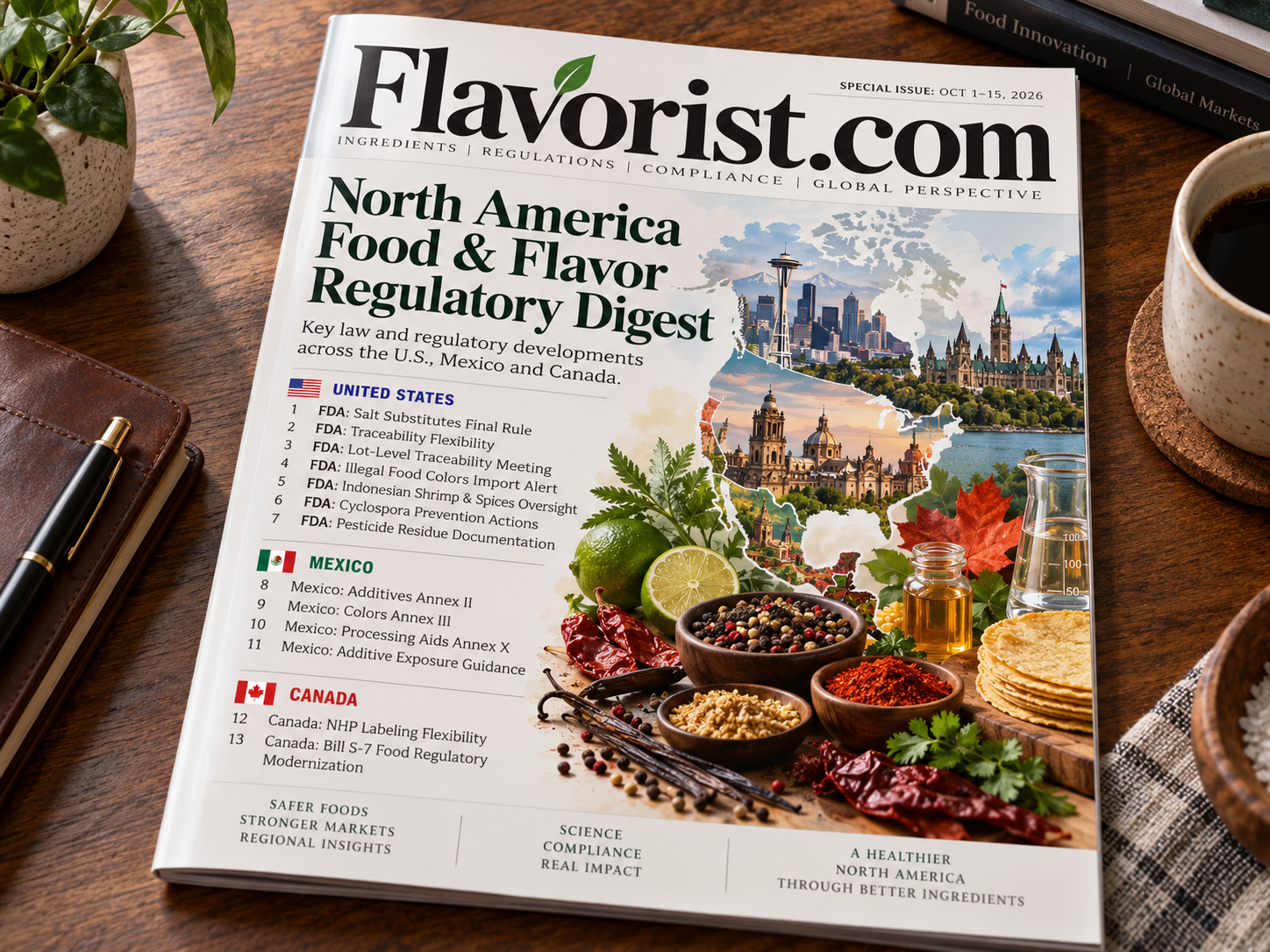
Sodium reduction and ingredient oversight led the first half of October. FDA finalized a rule opening 139 standardized foods to salt substitutes, and it continued to promote its proposal to make GRAS notification mandatory. Mexico posted updated lists of permitted additives, colors and processing aids ahead of its new additive framework taking effect. Canada moved on packaging oversight, natural health product labeling and broad regulatory streamlining.
At a glance
| Date | Jurisdiction | Development |
|---|---|---|
| Oct 1 | U.S. | FDA revises Import Alert 45-02 on illegal or undeclared colors |
| Oct 2 | U.S. | FDA announces 10-point Cyclospora prevention plan |
| Oct 5 | U.S. | FDA reports on Indonesian Cs-137 spice and shrimp certification |
| Oct 5 | U.S. | FTC grants early termination in Unilever–McCormick transaction |
| Oct 5 | Mexico | COFEPRIS guides on additive exposure and supplement classification |
| Oct 7 | Mexico | COFEPRIS posts Annexes II, III and X (additives, colors, processing aids) |
| Oct 7 | Canada | Bill S-7, the Cutting Red Tape for all Canadians Act |
| Oct 8 | U.S. | FDA draft traceability relief for smaller retailers and restaurants |
| Oct 8 | U.S. | FDA comment request on pesticide-residue channels-of-trade records |
| Oct 9 | U.S. | FDA public meeting on lot-level traceability announced |
| Oct 9 | Canada | Comment deadline on mandatory food-packaging notification |
| Oct 9/13 | U.S. | FDA final rule: salt substitutes in 139 standardized foods |
| Oct 13 | California | CalRecycle receives the SB 54 packaging producer responsibility plan |
| Oct 13 | Canada | Natural Health Product Licensing Bulletin No. 13 |
| Oct 14 | Canada | Genetically modified brewer's yeast BY-989 cleared for tropical beer aromas |
| Oct 14–15 | U.S. | GRAS proposal: threshold-of-regulation expansion surfaces; FDA webinar |
| October | U.S. | Federal ultra-processed food definition remains under White House review |
United States: Federal
FDA opens 139 standardized foods to salt substitutes
Announced Oct 9; published Oct 13; effective Dec 14, 2026
FDA finalized a rule permitting salt substitutes in foods whose standards of identity list salt as a required or optional ingredient.
- Scope. The rule amends 80 standards directly and 59 more by cross-reference. It covers staples such as cheese, bread, canned vegetables, condiments, mayonnaise and salad dressing.
- Definition. A salt substitute is now defined as any safe and suitable ingredient, or combination of ingredients, that replaces some or all added salt and does salt's job in the food.
- No approved list. The rule names no specific substitutes, so potassium chloride, herbs, spices, yeast extracts and amino-acid systems all qualify, provided the food keeps its basic nature and essential characteristics.
- Labeling. Substitutes must be declared by their common or usual names.
- Deadline. Objections on the dairy standards are due November 12.
IDFA and CSPI both backed the rule. For flavor houses, it widens demand for savory systems and masking technology for bitter or metallic potassium notes.
FDA announcement · Federal Register · Keller and Heckman · Food Dive · CSPI
GRAS reform: FDA webinar, and a quieter threshold-of-regulation change
Oct 14–15; comments due Dec 9, 2026
FDA held a public webinar on October 15 on its August 10 proposal to make GRAS notification mandatory. The proposal would require notices both for new substances and for those already in the food supply. At the webinar, FDA's Kristi Muldoon Jacobs said GRAS status attaches to a substance's specific conditions of use, not to the substance itself.
A day earlier, Food Safety Magazine reported a second change in the same proposal. It would extend the Threshold of Regulation (TOR) exemption beyond food-contact substances to directly added ingredients. TOR currently covers non-carcinogenic substances that reach the diet at less than 0.5 parts per billion. For flavor companies, this could matter for very-low-use flavoring substances.
Companies relying on FEMA GRAS or self-GRAS conclusions should map their exposure before comments close. Comments go to docket FDA-2025-N-3262.
FDA webinar · Food Safety Magazine on TOR · NutraIngredients · CRS legal sidebar
FDA revises import alert on illegal or undeclared colors
Oct 1
FDA updated Import Alert 45-02, which allows detention without physical examination of imported foods containing unauthorized or undeclared color additives. The revision consolidates earlier color-related import actions. It touches confectionery, bakery, beverages, sauces, seasonings and compounded flavor-and-color systems.
A color approved abroad is not automatically permitted in the U.S. Importers should confirm the identity, authorization and declaration of every color component, especially in blends sourced overseas.
Federal ultra-processed food definition still under review
October
The proposed definition of ultra-processed foods from HHS, FDA and USDA remains under review at the Office of Management and Budget. OMB's calendar shows meetings on the "White Paper: Proposed Definition of Ultra-Processed Food" running into October, and the text has not been released.
The definition is framed as a research tool, but lawyers expect it to surface in enforcement and litigation. Texas, for example, opened several investigations into health claims and ingredient disclosures this year. Existing UPF definitions often single out flavoring agents and flavor enhancers, so flavor suppliers have a direct stake in the final wording.
Greenberg Traurig · Food Engineering · HHS
Traceability: relief for smaller operators and a lot-code meeting
Oct 8–9; comments due Nov 23, 2026
FDA issued draft guidance proposing not to enforce the Food Traceability Rule against retail food establishments and restaurants with average annual food sales between $250,000 and $1 million. The figures are adjusted for inflation from a 2020 baseline. The rule's compliance date remains July 2028, and Congress has barred FDA from spending funds to enforce it before then.
Separately, FDA announced a public meeting, "Challenges and Solutions in Lot-Level Food Traceability," focused on how traceability lot codes and key data elements move through complex supply chains.
- Speakers must register by October 26.
- General registration closes November 5.
The underlying rule is unchanged for manufacturers, processors and distributors.
FDA announcement · Draft guidance notice · Public meeting notice · Food Safety Magazine
Indonesian spice and shrimp certification passes FDA review
Oct 5
FDA found that Indonesia's Cesium-137 import certification program is operating as required. The finding follows a May 4–8 in-country assessment of six shrimp processors, five spice processors and three testing laboratories in Banten, West Java and East Java.
MFQAA remains the certifying entity for shrimp and BPOM for spices. Import Alert 99-52 stays in force for products from Java and Lampung Province. The program dates to the 2025 detections of Cs-137 in shrimp and cloves, and clove and spice buyers still need shipment-specific BPOM certificates.
FDA assessment report · Food Safety Magazine · Import Alert 99-52
FDA sets 10-point Cyclospora plan ahead of 2027 season
Oct 2
FDA closed its investigation of the summer outbreak linked to shredded iceberg lettuce from Mexico. The outbreak sickened nearly 13,000 people, hospitalized about 560 and killed two. Before the 2027 growing season, the agency plans to:
- publish an outbreak investigation report;
- increase surveillance of commodities historically linked to Cyclospora;
- expand outreach to growers;
- develop a single genotyping standard with CDC;
- track environmental factors such as weather events;
- step up Foreign Supplier Verification Program inspections to check that importers address Cyclospora in their hazard analyses.
Importers of fresh herbs and produce should expect closer review next season.
FDA announcement · Food Safety News · Just Food
Pesticide-residue records for foods already in commerce
Oct 8; comments due Dec 7, 2026
FDA is seeking comment on renewing the information collection behind its channels-of-trade policy. The policy covers foods that remain in distribution after EPA revokes, suspends or modifies a pesticide tolerance. Companies relying on it must show that residues came from lawful use under the earlier tolerance. In practice, that means keeping treatment, harvest, processing and shipment records for herbs, spices, fruits and botanical extracts.
No residue limits change.
FTC clears waiting period in Unilever–McCormick transaction
Oct 5
The Federal Trade Commission granted early termination of the Hart-Scott-Rodino waiting period for transaction 20262304, involving Unilever PLC and McCormick & Company. Early termination lets the parties proceed without waiting out the full statutory period. It is not a broader endorsement of the deal, and reviews in other jurisdictions may continue.
United States: California
SB 54 packaging plan lands at CalRecycle
Oct 13
CalRecycle received the producer responsibility plan submitted by Circular Action Alliance under SB 54, the Plastic Pollution Prevention and Packaging Producer Responsibility Act. The agency has 75 days to review the plan; submission does not mean approval.
Packaged-food, beverage and ingredient companies selling into California should confirm whether they qualify as producers and which of their packaging is covered. Bulk and business-to-business shipments may be treated differently from consumer-ready packs.
Industry pushes back on California's non-UPF label
Law signed Sept 28; reaction Oct 2–9
AB 2244 creates a voluntary "non-ultra-processed certified" label. Products do not qualify if they contain dyes, flavor enhancers, non-sugar sweeteners or processing aids used to manipulate taste or quality. Large retailers will have to display certified products, and the state must accredit certifiers by June 1, 2029.
The California Grocers Association objected to last-minute changes to the definition. Food and ingredient groups warned it may conflict with the 2025 Real Food, Healthy Kids Act (AB 1264). The flavor-enhancer exclusion makes this one to watch for formulators.
Governor's office · SupplySide FBJ · The Shelby Report · New Hope
Mexico
COFEPRIS posts updated additive, color and processing-aid annexes
Oct 7
COFEPRIS published three annexes listing evaluated and approved substances that have not yet been incorporated into the additive agreement in the Official Gazette (DOF). COFEPRIS says listed substances may be used immediately under the applicable rules.
- Annex II: multifunctional additives permitted under Good Manufacturing Practices.
- Annex III: colors with established acceptable daily intakes (ADIs).
- Annex X: processing aids for foods, beverages and supplements, including enzymes, solvents and filtration agents.
A new posting does not necessarily mean new approvals. The COFEPRIS register shows earlier revision dates for these annexes: August 2022 for Annex II, May 2026 for Annex III and October 2024 for Annex X. Compare the current lists against your formulas and earlier versions rather than assuming new permissions.
Annex II · Annex III · Annex X
New guides on additive exposure and supplement classification
Oct 5
COFEPRIS issued two non-binding guides:
- Additive exposure. Explains how to estimate dietary exposure to additives with an ADI when applying for a new additive or an expanded use. A supporting database is provided in Annex III of the guide.
- Supplement classification. Helps determine whether a product is a food supplement under Mexican law, which drives permitted ingredients, labeling, claims and advertising rules.
Neither guide creates new obligations or authorizations. Both support compliance with the new additive agreement, published in the DOF on August 21, 2026. That agreement replaces the 2012 framework and takes effect 60 business days after publication, around late November.
COFEPRIS non-regulatory guides · ADN Sureste · Bergeson & Campbell
Canada
Mandatory food-packaging notification: first comment round closes
Oct 9
Health Canada's proposed framework would require companies to notify the department, through an online portal, of the food-contact materials used with food sold in Canada. Notifications would include the chemical composition of every substance in the material and its expected distribution in Canada. Materials or uses that don't match Health Canada's public knowledgebase could trigger a full evaluation.
A second consultation is expected from November 2026 to January 2027, with recommendations by spring 2027.
REACH24H · Bergeson & Campbell · National Law Review
Bill S-7 targets red tape across 31 federal statutes
Oct 7
The proposed Cutting Red Tape for all Canadians Act would:
- amend the Food and Drugs Act to remove inconsistencies that hinder Canadian food exporters;
- clarify the CFIA's authority to deliver services electronically;
- reduce duplicate reporting;
- streamline recognition of trusted foreign regulatory systems for agricultural inputs.
The bill still needs Parliament's approval, and current obligations are unchanged.
More time for monograph-driven natural health product label changes
Oct 13
Natural Health Product Licensing Bulletin No. 13 tells licence holders they can defer certain label updates tied to revised monographs until a transition period that will accompany upcoming regulatory amendments. Draft amendments are expected in spring 2027, with a transition extending beyond June 2028.
Safety-related label changes ordered by Health Canada are not covered and must still meet their deadlines. The bulletin does not apply to conventional foods.
Brewer's yeast engineered for tropical aromas cleared
Oct 14
Health Canada approved commercial use of BY-989, a genetically modified Saccharomyces cerevisiae strain for brewing. Derived from London Ale Yeast, BY-989 releases the thiol 3MH during fermentation, producing guava, passion fruit and grapefruit notes. The yeast is removed during brewing, leaving only trace levels in finished beer. FDA reviewed the same strain earlier under GRAS.
The clearance adds to the regulatory precedent for producing aroma compounds by fermentation rather than through added flavors or aroma hops.
Food Compliance International · FDA GRAS response
On the radar
- Mexico additive agreement: takes effect around late November 2026, replacing the 2012 rules. Colorants previously allowed under Good Manufacturing Practices may now carry numerical limits.
- Texas SB 25 warning labels: still on appeal at the Fifth Circuit. The labeling trigger is January 1, 2027.
- California AB 418: the Red 3, potassium bromate, BVO and propylparaben ban takes effect January 1, 2027.
- FDA chemical reassessments: reviews of BHT and azodicarbonamide, announced in May, are ongoing.
- FDA new dietary ingredient guidance: final guidance issued October 19, just after this period.
Notes for you, not for publication:
- Merged items. I combined the two traceability items and the two Mexico guidance items, and folded the second audit's caveat about the Mexican annexes into that story.
- Removed material. I cut the editorial priority tables, the date-distinction notes, the research-limitations section and the item counts.
- FTC item. I couldn't confirm it myself. The link in the audit filtered for a different transaction number, so I linked the general notices page. Check transaction 20262304 before publishing.
- BY-989 date. It comes from a regulatory tracker, not Health Canada's own notice.
- Bill S-7 and NHP Bulletin No. 13. These come from your second report; I didn't independently verify them.
- Mexico guide dates. I used October 5 for the COFEPRIS guides, as both of your reports had it. Press coverage ran on October 8.