California Creates First Statewide ‘Non-Ultraprocessed’ Food Label as UPF Debate Intensifies
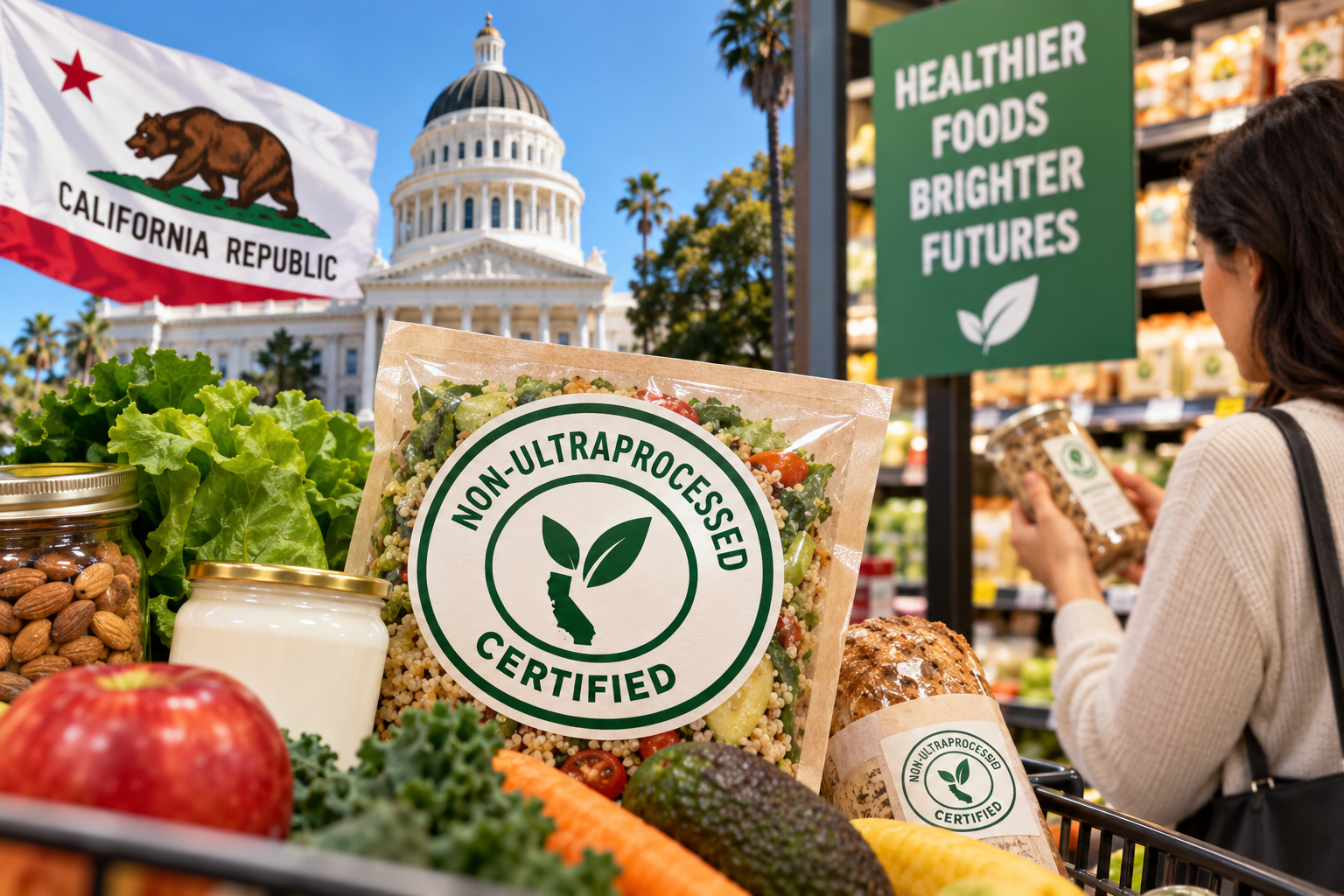
Tuesday September 29, 2026 – California is taking another major step into the national debate over ultra-processed foods, becoming the first U.S. state to establish an official certification and labeling program for foods that qualify as non-ultraprocessed.
Governor Gavin Newsom signed AB 2244, authored by Assemblymember Jesse Gabriel, on September 28, 2026. The legislation creates a state-backed “Non-Ultraprocessed Certified” food standard designed to make qualifying products easier for consumers to identify. The move follows California’s 2025 legislation establishing a legal framework for defining ultra-processed foods and restricting certain products in public schools.
The new law represents an important development for food manufacturers and retailers because California’s large consumer market has historically given its regulations influence beyond the state’s borders.
How California’s Non-Ultraprocessed Food Label Will Work
Participation in California’s certification program is voluntary. Food manufacturers whose products satisfy the state standard will be able to use the certification to identify those products as non-ultraprocessed.
According to Food Dive, large grocery stores that sell at least 25 products carrying the certification will also be required to display qualifying products prominently, giving the program an in-store merchandising component rather than limiting it to package labeling.
California officials describe the program as a consumer-information initiative. The Newsom administration says the label will provide front-of-package information while helping shoppers locate qualifying products through improved placement inside stores. State officials have compared the voluntary approach to certification systems such as USDA Organic: manufacturers can choose whether to participate, while consumers decide how much importance to attach to the certification.
The initiative is notable because it approaches the UPF debate from the opposite direction of a warning label. Instead of marking foods as “ultraprocessed,” California is creating an affirmative certification for products meeting its non-UPF standard.
What Does California Consider an Ultra-Processed Food?
The question is more complicated than it might initially appear.
There is currently no universally accepted definition of an ultra-processed food in the United States. Different classification systems can categorize the same product differently, depending on whether they emphasize industrial processing methods, ingredients and additives, nutritional composition, or a combination of factors.
California moved ahead of federal regulators in 2025 with the Real Food, Healthy Kids Act, AB 1264. The law established a state framework that looks at industrial additives and ingredients as well as nutritional characteristics such as saturated fat, sodium and added sugar. California law also excludes several categories, including raw agricultural commodities and certain minimally processed foods.
That distinction matters because “processed” and “unhealthy” are not necessarily synonymous.
Food processing includes everything from freezing and pasteurization to fermentation and fortification. Processing can improve food safety, extend shelf life and make nutritious foods more accessible. Critics of broad UPF classification systems therefore caution that products such as yogurt, tofu and whole-grain bread can sometimes fall into ultra-processed categories even though they may contribute useful nutrients to a balanced diet.
California’s model consequently places significant emphasis on both ingredients and nutritional composition rather than treating industrial processing alone as the determining factor.
Why Ultra-Processed Foods Have Become a Major Policy Issue
The California legislation arrives amid growing attention to ultra-processed foods from scientists, policymakers and consumers.
The U.S. Food and Drug Administration says researchers have found associations between high consumption of foods commonly categorized as ultra-processed and outcomes including obesity, cardiovascular disease and certain cancers. At the same time, federal regulators acknowledge that significant scientific questions remain about exactly how and why UPFs may affect health.
The issue is especially significant because ultra-processed foods make up a substantial portion of the American diet. The FDA estimates that about 70% of the U.S. food supply consists of foods commonly considered ultra-processed and says children obtain more than 60% of their calories from such products.
Association, however, does not mean that every product classified as ultra-processed carries the same nutritional or health implications. That is one reason the definition itself has become central to the regulatory debate.
FDA and USDA Are Working on a Federal UPF Definition
California is moving faster than Washington on the issue.
In July 2025, the FDA and U.S. Department of Agriculture launched an effort to develop a uniform federal definition of ultra-processed foods. Regulators requested input on whether a definition should consider additives, processing techniques, nutritional composition, energy density, palatability and other characteristics.
Federal officials have said a common definition could provide consistency for scientific research and future food and nutrition policies. The FDA has also partnered with the National Institutes of Health on nutrition regulatory science research intended to improve understanding of the relationship between ultra-processed foods and health.
The absence of a completed national standard has created an opening for states such as California to develop their own approaches.
Food Industry Raises Concerns About Multiple Standards
That state-by-state movement is also generating concern within the food industry and scientific community.
The Institute of Food Technologists has warned that manufacturers could eventually encounter different definitions of “ultra-processed” depending on the jurisdiction. According to Food Dive, the organization argues that a consistent, science-based framework would help prevent conflicting requirements and consumer confusion.
The stakes extend beyond package labels. How governments ultimately define ultra-processed foods could affect school meals, government nutrition programs, product reformulation, dietary recommendations and front-of-package labeling.
Private certification programs are also emerging. Food Dive notes that programs including the Non-GMO Project’s Non-UPF Verified Standard and the nonprofit Non-UPF Program already offer their own approaches to identifying foods considered non-ultraprocessed.
As a result, consumers could encounter several different “non-UPF” claims based on standards that are not identical.
California Is Already Targeting UPFs in Schools
The certification program is part of a broader California food-policy strategy.
Under the Real Food, Healthy Kids Act, signed in October 2025, the California Department of Public Health is developing regulations for “Ultraprocessed Foods of Concern” and “Restricted School Foods.” The law establishes a long-term process for reducing certain foods in California public schools.
State budget documents say schools are expected to begin phasing out designated foods by July 1, 2029, with their sale prohibited beginning July 1, 2035, subject to the definitions and regulations developed under the law.
Those definitions are still being developed. In September 2026, California officials opened a public-input process asking stakeholders what the Department of Public Health should consider when defining the relevant categories.
What California’s UPF Label Could Mean for Food Manufacturers
For food companies, California’s certification could create both marketing opportunities and operational challenges.
Brands whose products qualify may use the non-UPF certification to differentiate themselves as consumer demand for simpler ingredients and greater food transparency grows. Manufacturers whose products fall outside the standard may have additional incentives to reconsider ingredients, sodium, added sugars, saturated fat or certain additives.
The larger question is whether California’s policy becomes a model for other states.
If additional jurisdictions adopt similar programs using different definitions, national food manufacturers could face a fragmented regulatory environment. Conversely, California’s approach could contribute to pressure for a single federal standard.
Either outcome makes the definition of “ultra-processed food” increasingly important to the U.S. food industry.
California has now moved the debate from academic research and dietary guidance into grocery-store labeling and merchandising. Whether its “Non-Ultraprocessed Certified” seal becomes a widely recognized consumer signal will depend on manufacturer participation, implementation of the state standard, consumer response and the direction ultimately taken by federal regulators.
What is already clear is that ultra-processed foods have moved rapidly from a nutrition-science debate into a significant food policy, labeling and product-development issue for the U.S. packaged food industry.
###