Can Your Reaction Flavor Be Made in a Large Reactor?
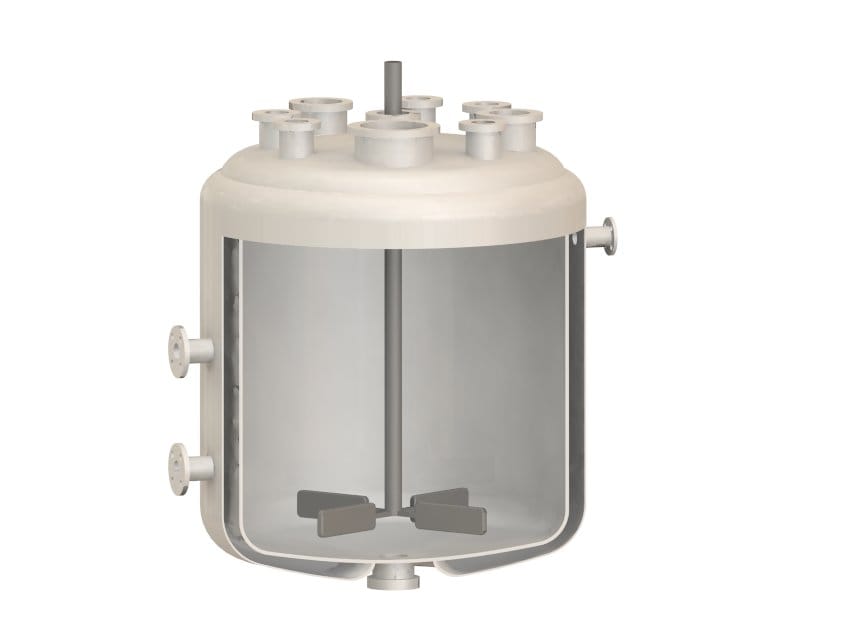
Editor's note
The problem presented here seems to take issue with the reactor’s capacity. Admittedly, every reactor has a limited cooling rate. However, the cooling rate depends not only on the reactor’s configuration and capacity but also on the reaction composition. For example, if the reaction product becomes too viscous—due to the use of certain gums or low water content—then the reaction may not be suitable for a large reactor, as larger reactors typically require longer cooling times. Flavorists should keep this in mind when formulating reaction flavors.
The cooling rate of an actual reactor for a specific flavor product—particularly important for USDA-inspected meat flavors—is something a chemical engineer must consider when scaling up from lab to production. Just because a reaction flavor can be produced in a smaller reactor does not mean it can be successfully produced in a larger one.
This problem illustrates how reactor size and configuration affect cooling time. However, cooling time is also influenced by the product composition. If cooling a reaction flavor to room temperature takes 5.7 hours in a 1200-gallon reactor—a duration that could be problematic for a meat flavor—what steps can you, as a flavorist, take to shorten the cooling time?
⚛️ Reactor Cooling Time Analysis
Heat Transfer in Cylindrical Vessels | Mathematical Approach
Two cylindrical reactors have identical heights. The larger reactor has a volume of 1200 gallons, while the smaller has 600 gallons. The 600-gallon reactor requires 4 hours to cool from \(100^\circ \text{C}\) to room temperature under specific cooling conditions. Determine the cooling time for the 1200-gallon reactor under identical conditions.
🔵 Small Reactor
🔴 Large Reactor
For a cylinder with constant height \(H\), the volume is proportional to the square of the radius:
Given the volume ratio:
Therefore, the radius ratio is:
The heat transfer area (side wall) is given by:
Thus, the area ratio becomes:
For a well-mixed reactor with constant coolant temperature, the cooling process follows Newton's law of cooling. The energy balance gives:
Integrating from initial temperature \(T_i\) to final temperature \(T_f\):
Where:
- \(m\) = mass of fluid
- \(c_p\) = specific heat capacity
- \(U\) = overall heat transfer coefficient
- \(A\) = heat transfer area
- \(T_c\) = coolant temperature (constant)
Since the logarithmic term is identical for both reactors (same temperatures), the cooling time ratio is:
The 1200-gallon reactor takes approximately \(\sqrt{2} \approx 1.414\) times longer to cool than the 600-gallon reactor because:
- It contains twice the mass of fluid: \(\displaystyle \frac{m_1}{m_2} = 2\)
- The heat transfer area only increases by a factor of \(\sqrt{2}\): \(\displaystyle \frac{A_1}{A_2} = \sqrt{2}\)
- Therefore, the cooling time scales as: \(\displaystyle \frac{t_1}{t_2} = \frac{m_1/m_2}{A_1/A_2} = \frac{2}{\sqrt{2}} = \sqrt{2}\)
Thus, cooling time is proportional to the square root of the volume for cylinders of equal height.
| Parameter | 600-gallon Reactor | 1200-gallon Reactor | Ratio |
|---|---|---|---|
| Volume \(V\) | 600 gal | 1200 gal | \(2\) |
| Radius \(R\) | \(R_2\) | \(\sqrt{2}R_2\) | \(\sqrt{2}\) |
| Area \(A\) | \(A_2\) | \(\sqrt{2}A_2\) | \(\sqrt{2}\) |
| Mass \(m\) | \(m_2\) | \(2m_2\) | \(2\) |
| Cooling Time \(t\) | 4.00 h | 5.66 h | \(\sqrt{2}\) |