Citrus Derivatives - Production Methods: What Flavorists Need to Know
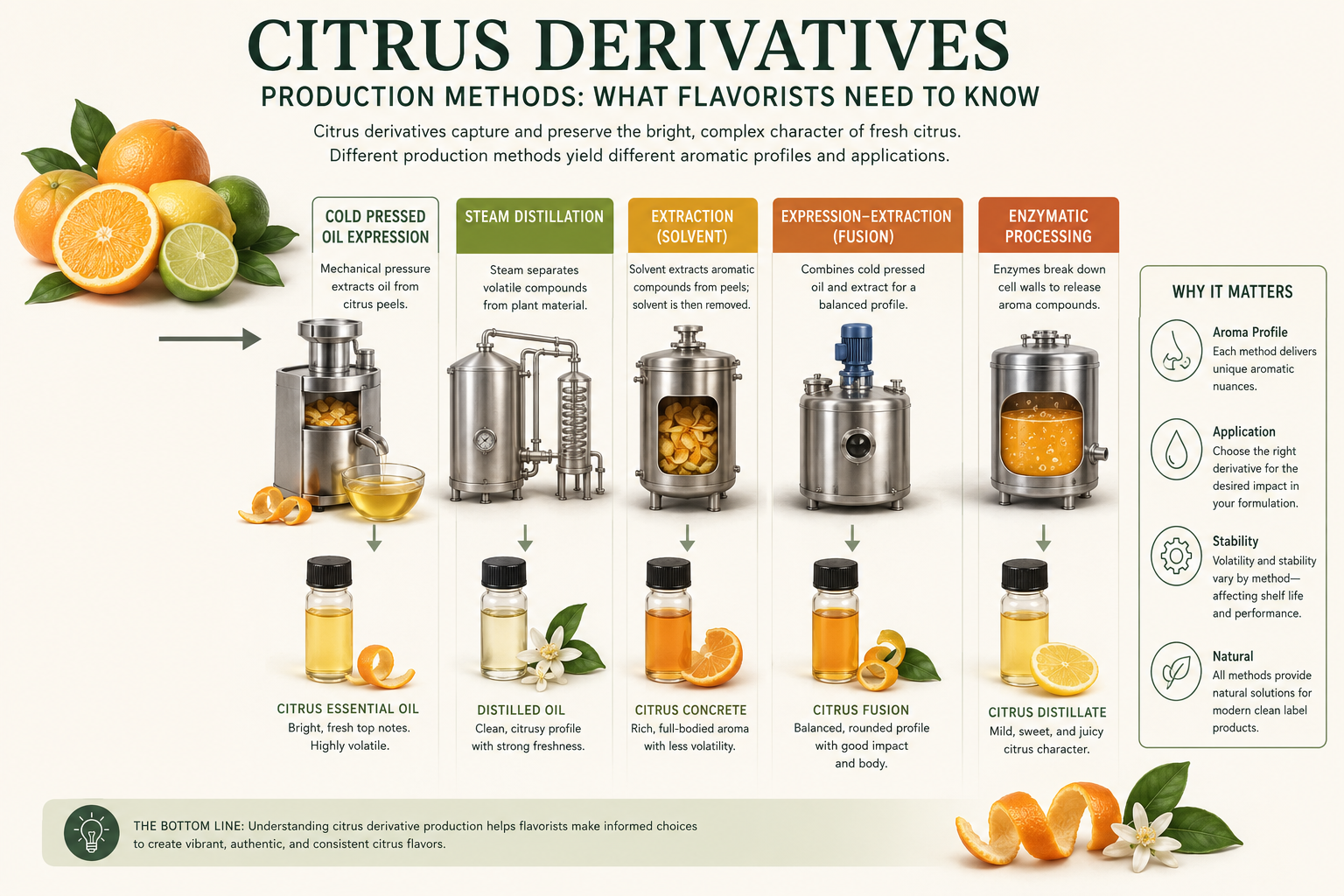
A Flavorist's Training Reference
1. Why This Matters to a Flavorist
Citrus is the most heavily used flavor family in the world, spanning beverages, confectionery, dairy, bakery, savory, and household/fine fragrance. What makes citrus distinctive for a flavorist is that a single fruit yields many different commercial materials, each with a different aroma profile, strength, stability, cost, and regulatory status — and each is a direct consequence of how it was produced.
Understanding the process is not academic. The reason cold-pressed lime smells bright and green while distilled lime smells candied and "cola-like" is entirely a processing artifact. If you can read a material's process history, you can predict its behavior in a base, its shelf life, and where it will drift.
The core principle to internalize: citrus aroma lives in three physically separate places in the fruit, and each production method targets a different one.
- The flavedo (colored outer peel) — houses oil sacs full of essential oil. This is where cold-pressing and peel distillation draw from. Dominated by terpene hydrocarbons plus the "top note" aldehydes and esters.
- The juice sacs (endocarp) — hold the juice and its dissolved/entrained volatiles. This is the source of essence products recovered during juice concentration. Delicate, water-soluble, true-to-fruit notes live here.
- The whole fruit / albedo and tissue — accessed by comminution, extraction, and maceration for products like folded oils' feedstock, oleoresins, and comminuted bases.
2. Anatomy and Composition (Orientation)
| Fruit part | Flavor-relevant contents | Products drawn from it |
|---|---|---|
| Flavedo (flavor + color layer) | Essential oil in oil glands; carotenoids | Cold-pressed oil, distilled peel oil |
| Albedo (white pith) | Bitter flavonoids (naringin, limonin precursors), pectin | Generally avoided; source of bitterness |
| Endocarp / juice vesicles | Juice, sugars, acids, water-phase volatiles | Juice, essence oil, aqueous essence, concentrate |
| Seeds | Bitter limonoids, oil | Avoided in flavor streams |
Representative aroma chemistry by fruit (useful mental anchors):
- Sweet orange: 90–96% d-limonene; character carried by aldehydes (octanal, decanal, citronellal), esters, and trace sinensal and valencene. Limonene itself is a weak, generic "citrus-terpene" note — the character is in the minor fraction.
- Lemon: high limonene, but character defined by citral (geranial + neral), plus β-pinene, γ-terpinene.
- Lime: distilled vs. expressed diverge sharply (see §4). Key notes citral, terpinen-4-ol, α-terpineol.
- Grapefruit: trace nootkatone (from oxidation of valencene) and 1-p-menthene-8-thiol — an extraordinarily potent sulfur note — carry the character despite being present in the parts-per-million-and-below range.
- Bergamot: linalool and linalyl acetate dominate; the fine-fragrance citrus.
- Mandarin/tangerine: methyl N-methylanthranilate gives the characteristic "petitgrain/floral-fishy" edge; thymol traces in some.
Note the recurring lesson: the impact molecules are almost never the majority molecules. Limonene is bulk; character is trace.
3. Cold-Pressing (Expression) — The Primary Route for Peel Oils
Cold-pressed oils are the benchmark "natural, true-to-fruit" peel oils. Because no heat is applied, heat-labile top notes and the natural aldehyde balance are preserved. Almost all commercial orange, lemon, and grapefruit oils are cold-pressed, typically recovered in-line during juice extraction.
The physical goal
Rupture the oil glands in the flavedo and wash the released oil away with water before it can re-absorb or oxidize, then separate oil from the water/solids by centrifugation.
Major industrial systems
a) FMC In-Line Extraction The whole fruit is squeezed between interlocking cups with cutting tubes. As the fruit is crushed, the peel oil is released on the outside while juice is expressed on the inside through a strainer tube. Simultaneously a water spray washes the emulsion of oil and ruptured peel off the cups. This is elegant because oil and juice are recovered in one pass. The oil-bearing emulsion is screened and then centrifuged in two stages (a desludging/polishing centrifuge train) to yield finished oil.
b) Brown / Sfumatrice ("Brown Oil Extractor" and Italian sfumatrice) Here peel is processed separately from juicing. The peel is abraded or the whole fruit is rolled against a rasping/spiked surface (scarification) that punctures the oil glands. Water carries away the oil-water emulsion, which is then centrifuged. The sfumatrice ("pelatrice/sfumatrice" line) is the classic Mediterranean approach for lemon and bergamot, where peel is pressed against rollers.
c) Screw-press / pressing of peel residues After juicing, spent peel still contains oil. It may be pressed or the earlier wash emulsion recovered, giving a secondary, generally lower-grade oil.
Recovery and finishing steps common to all cold-press routes
- Screening/finishing — remove peel solids from the emulsion.
- Primary centrifugation (desludging) — separate the bulk of solids and water.
- Polishing centrifugation — produce a clear oil.
- Winterization (optional) — chill the oil to precipitate waxes and the non-volatile residue (which includes coumarins/furocoumarins and other heavies), then filter. Reduces cloud and cold-haze and lowers phototoxic constituents.
- Cold storage under inert gas (N₂) — critical; see §10.
What the flavorist should expect from cold-pressed oil
- Bright, fresh, true top note; the "just-zested fruit" character.
- Contains natural non-volatile residue (~1–5%): waxes, pigments, coumarins, furocoumarins (e.g., bergapten in bergamot, oxypeucedanin, bergamottin). These matter for phototoxicity in topical/fragrance use and for regulatory limits (bergapten in bergamot especially).
- Prone to oxidation because the full terpene load is present.
Phototoxicity flag: expressed bergamot, lime, and some other peel oils contain furocoumarins that are phototoxic on skin. "FCF" (furocoumarin-free) grades are produced by distillation or by removing the furocoumarin fraction. Not a food-safety issue at flavor use levels, but essential knowledge for any dual food/fragrance material.
4. Distillation-Derived Peel Oils
Applying heat changes the material profoundly. Distilled oils are furocoumarin-free (heavies don't carry over), more stable, colorless-to-pale, and cheaper to standardize — but the aroma is altered: fresh top notes are lost or transformed, and acid-catalyzed reactions during distillation create new compounds.
Steam distillation of peel
Peel (often the spent peel after juicing, or purpose-macerated peel) is steam distilled; volatile oil co-distills with water and is separated in a Florentine flask/separator. Suited to producing stable, standardized oils and to defunctionalizing away the phototoxic residue.
The classic case study: Distilled Lime
This is the single most important teaching example of "process makes the flavor."
- Cold-pressed (expressed) lime: fresh, green, zesty — smells like a cut lime.
- Distilled lime: the fruit is typically crushed whole with the acidic juice, and the mixture is distilled. In that acidic, hot environment, acid-catalyzed rearrangements occur — citral and other terpenes convert to compounds like α-terpineol, terpinolene, p-cymene, and 1,8-cineole-type notes. The result is the sweet, "cola," candied, less-fresh lime familiar from soft drinks.
Neither is "better" — they're different tools. A cola or hard-candy brief wants distilled lime; a fresh margarita or sparkling-water brief wants expressed lime.
The flavorist's takeaway on distillation
- Gain: stability, FCF status, color, standardization, lower cost.
- Loss/change: fresh top character; creation of "processed/cooked/candied" notes via acid catalysis and thermal effects.
5. Essence Recovery (From Juice Concentration)
When single-strength juice is concentrated to 60–65 °Brix (e.g., FCOJ — frozen concentrated orange juice), water is evaporated — and the fruit's most delicate, water-associated aroma volatiles boil off with it. Rather than lose them, modern plants capture them from the evaporator vapors. This gives two prized, highly "true-to-fruit" materials:
a) Aqueous (water-phase) essence The condensed, water-soluble aroma fraction. Very natural, juicy, "inside-of-the-fruit" character — quite different from peel oil, which is "outside-of-the-fruit." Low in concentration, delicate, and used to add authenticity and juiciness, especially in beverages. Poor stability; usually stored frozen.
b) Essence oil (oil-phase essence) The oily aroma fraction separated from the same vapor condensate. Richer in the fresh aldehydes and light esters than cold-pressed peel oil; extremely prized for a "fresh-squeezed juice" top note. More potent and more perishable than aqueous essence.
Mental model: peel oil = zest; essence = juice. A convincing orange juice flavor usually blends peel oil (or its folded/terpeneless fractions), essence oil, and aqueous essence, because each represents a different physical compartment of the real fruit.
6. Folding and Deterpenation (Concentration of Peel Oils)
The single biggest weakness of cold-pressed citrus oil is that it's ~90%+ terpene hydrocarbons (mostly limonene) that are: (1) aroma-weak, (2) oxidation-prone (limonene → carvone, carveol, limonene oxide → stale/turpentine off-notes), and (3) poorly soluble in water/ethanol beverage systems. Removing terpenes concentrates the character, boosts stability, and improves solubility.
Folded oils ("X-fold")
Vacuum (reduced-pressure) distillation strips out a portion of the volatile terpene fraction, leaving the oxygenated/character compounds concentrated. Terminology: a "5-fold" oil has had terpenes removed until it is roughly five times as strong (by weight, relative to starting oil, in oxygenated content) as the single-fold. Common grades: 2-, 3-, 5-, 10-fold.
- Higher fold = stronger, more stable, more soluble, more expensive per kg, but character can shift if the fold is aggressive (loss of the lightest top notes, relative enrichment of heavier notes).
Terpeneless and sesquiterpeneless oils
- Terpeneless: most/all monoterpene hydrocarbons removed.
- Sesquiterpeneless: additionally strip sesquiterpenes. Produced by vacuum fractional distillation and/or solvent partition (e.g., partitioning oxygenated compounds into dilute aqueous ethanol, leaving hydrocarbon terpenes behind, then recovering). These are highly stable, water/ethanol-soluble, and clear — ideal for clear beverages and where limonene haze/instability is unacceptable.
The byproduct: d-limonene
The removed terpene fraction isn't waste — d-limonene is a huge-volume commodity: cleaning solvent, natural flavor/fragrance building block, feedstock for synthesizing carvone (spearmint) and other derivatives. A flavorist should recognize d-limonene as both a cheap natural "citrus lift" and a stability liability if used raw and unprotected.
7. Isolation of Individual Aroma Chemicals
Beyond whole/concentrated oils, individual isolates are pulled from citrus streams by fractional distillation (often multi-plate vacuum columns), and sometimes crystallization or chemical derivatization. These are the flavorist's fine brushes.
Key naturally-derived citrus isolates:
- d-Limonene — from orange/citrus terpene fractions (see §6).
- Citral (geranial + neral) — the lemon/lime impact aldehyde; isolable from lemongrass/litsea more economically than from citrus, but also from citrus fractions. Notoriously unstable in acid (degrades to off-notes), which is why lemon flavors in low-pH beverages are a stability challenge.
- Linalool / linalyl acetate — bergamot/floral-citrus; from bergabot fractions or synthesized.
- Valencene → Nootkatone — valencene is isolated from orange oil; controlled oxidation converts it to nootkatone, the grapefruit impact compound. A textbook example of making a high-value character molecule from a cheap terpene precursor.
- Decanal, octanal, citronellal — the "fatty-aldehydic" orange-peel top notes.
- Terpinen-4-ol, α-terpineol — earthy/piney fractions, prominent in distilled lime.
Teaching point on process → property: many isolates (citral, aldehydes, nootkatone) are potent but chemically fragile or reactive, especially under the acid + oxygen + light conditions of beverages. Much of applied citrus flavorism is stability engineering around these molecules.
8. Solvent Extraction Products (Oleoresins, Extracts, Absolutes)
When volatile-only oils don't capture the full profile, or when a liquid non-oil carrier is needed:
- Oleoresins: peel (or whole fruit) extracted with a food-grade solvent (hexane, ethanol, CO₂ historically less common for citrus), solvent removed, yielding a viscous concentrate of volatile + non-volatile flavor + color. Standardized and often diluted for use.
- Supercritical CO₂ extraction: clean, solvent-residue-free, selective; can produce very "natural"-smelling extracts and can be tuned (pressure/temperature) to fractionate. Increasingly used where a fresh, complete profile without thermal damage is wanted.
- Tinctures / extracts / distillates: peel or fruit macerated in ethanol/water; used directly (e.g., in beverages, bitters) or redistilled to give a citrus distillate with a soft, rounded profile.
- Folded/terpeneless oils dissolved in ethanol are also common delivery forms for water-miscible applications.
9. Juice, Concentrate, and Comminuted Products
Not aroma materials per se, but core to beverage flavorists' toolkits:
- Single-strength juice / NFC (not-from-concentrate): pasteurized, minimally processed; carries native flavor + acidity + body.
- Concentrate (e.g., 65 °Brix): evaporated (with essence recovery, §5); economical, shelf-stable, reconstituted downstream. Evaporation strips volatiles — hence essence add-back to restore character.
- Freeze concentration: water removed as ice rather than by boiling; gentler, retains more delicate flavor than thermal evaporation, but costlier.
- Comminuted bases ("comminutes"): the whole fruit (peel + juice + pulp) is milled into a slurry/homogenate, sometimes with pectinase or heat treatment. Used heavily in orange/lemon squash and carbonated soft drinks to give a rounded, cloudy, "whole-fruit" character and mouthfeel that peel oil alone can't provide.
- Cloud / pulp wash / cell fractions: provide turbidity, mouthfeel, and subtle flavor in beverages.
10. Stability, Degradation, and Storage (Critical Applied Knowledge)
Citrus materials are among the least stable in the flavor cabinet. A flavorist who ignores this ships flavors that turn "old/turpentine/soapy/candied" within weeks.
The main degradation pathways:
- Terpene oxidation (autoxidation): limonene + O₂ → carvone, carveol, limonene-1,2-oxide → "old/turpentine/plastic" off-notes. Accelerated by heat, light, metals (Cu, Fe catalyze it).
- Acid-catalyzed reactions (esp. in beverages, pH ~2.5–3.5): citral degrades to p-cresol/p-methylacetophenone-type "off/plasticky" notes and to cyclized terpene alcohols; this is the classic lemon-lime soft-drink instability. Also drives the "distilled-lime" candied shift when it happens deliberately in-process.
- Photodegradation: light drives radical oxidation; furocoumarin-bearing oils also raise skin phototoxicity.
Mitigation levers (process and formulation):
- Use folded/terpeneless oils to strip the oxidation-prone limonene load.
- Add antioxidants (natural: tocopherols, rosemary extract; or permitted synthetics like BHA/BHT where allowed) and chelators (citric acid, sequestrants) to tie up metals.
- Store oils cold, dark, under nitrogen, in full/sealed containers (minimize headspace O₂).
- For beverages, favor stabilized citral systems, encapsulation, or citral-light lemon constructions.
- Encapsulation / spray-drying (with maltodextrin, gum acacia, modified starch) protects volatiles and converts oils to free-flowing powders for dry mixes — at the cost of some top-note loss during drying.
11. Quality Control and Analytical Tools
A flavorist should be able to read a citrus material's spec sheet and CoA:
- GC-FID / GC-MS: the workhorse — verify composition, detect adulteration (e.g., added limonene, orange-terpene cutting of lemon), confirm fold/terpeneless status.
- Chiral GC: distinguishes natural vs. synthetic (e.g., enantiomeric ratio of linalool) — key for "natural" claims and detecting adulteration.
- Refractive index, specific gravity, optical rotation: quick physical fingerprints (d-limonene is strongly dextrorotatory).
- Aldehyde content ("% aldehydes as citral/decanal"): a traditional strength spec for lemon and orange oils.
- Sensory / GC-O (olfactometry): locate the impact compounds (nootkatone, the grapefruit thiol) that hide below FID sensitivity but define character.
- Furocoumarin/bergapten assay: for phototoxicity-relevant grades.
Common adulteration to watch for: cutting expensive oils with cheap d-limonene or orange terpenes; adding synthetic citral to lemon; ethanol/solvent stretching. Chiral ratios and full GC fingerprints are the defense.
12. Putting It Together — A Formulator's Mental Map
When you build a citrus flavor, you're reassembling the fruit from parts that were separated by these processes. A robust construction often layers:
- Top / fresh zest: cold-pressed peel oil and/or essence oil (the freshness).
- Juicy / true-fruit body: aqueous essence, comminute, juice concentrate.
- Strength / stability / solubility: folded or terpeneless oil for the character without the terpene liability.
- Character definition (the signature molecule): the right isolate — citral for lemon/lime, nootkatone for grapefruit, linalyl acetate for bergamot, aldehyde blend for orange.
- Stability system: antioxidants, chelation, encapsulation, pH-appropriate choices.
Every one of those choices is really a choice about which production process's output you trust for that job.
13. Quick-Reference Glossary
| Term | Meaning |
|---|---|
| Flavedo | Colored outer peel; holds the oil glands |
| Albedo | White pith; bitter, generally avoided |
| Cold-pressed / expressed oil | Peel oil recovered without heat; fresh, true, phototoxic residue present |
| Distilled oil | Peel/whole-fruit oil recovered by (steam) distillation; FCF, stable, altered profile |
| Essence oil | Oil-phase aroma recovered from juice-concentration vapors ("fresh juice" note) |
| Aqueous essence | Water-phase aroma from the same vapors; delicate, juicy |
| Fold (X-fold) | Terpene-reduced oil, ~X times concentrated in oxygenated character |
| Terpeneless / sesquiterpeneless | Oils with monoterpene (and sesquiterpene) hydrocarbons removed |
| d-Limonene | Dominant citrus terpene; byproduct of folding; cheap building block, oxidation-prone |
| Oleoresin | Solvent extract containing volatile + non-volatile flavor and color |
| Comminute | Whole-fruit slurry base used in beverages for rounded, cloudy character |
| Furocoumarins (bergapten, etc.) | Non-volatile, phototoxic peel constituents; removed in FCF grades |
| Nootkatone | Grapefruit impact ketone, made by oxidizing valencene |
| Citral | Geranial + neral; lemon/lime impact aldehyde; acid-unstable |
Prepared as internal flavorist training material. Composition figures are representative ranges; always validate against supplier CoAs and current regulatory limits (e.g., IFRA/JECFA/regional food-additive rules) for the specific market and application.
###