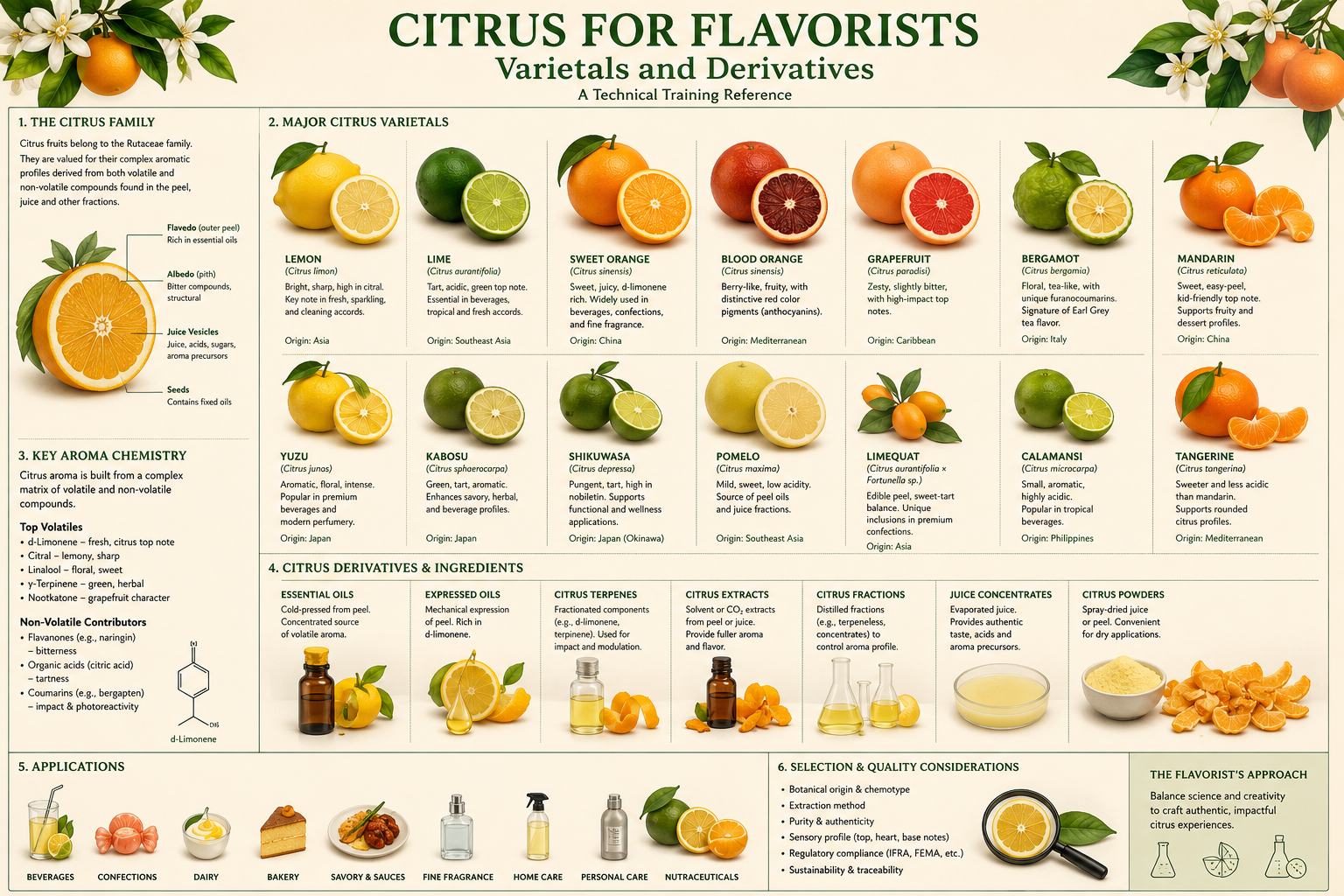
Citrus for Flavorists: Varietals and Derivatives - A Technical Training Reference
For flavor development, application, and QC personnel.
Table of Contents
Front matter
- How to use this document
Part 1 — Botanical and Genetic Foundation
- 1.1 The genus
- 1.2 The three ancestral species
- 1.3 The ancestry map
Part 2 — Commercial Varietals
- 2.1 Sweet Orange (Citrus sinensis)
- 2.2 Bitter / Sour / Seville Orange (Citrus × aurantium)
- 2.3 Mandarin / Tangerine group (Citrus reticulata)
- 2.4 Lemon (Citrus × limon)
- 2.5 Lime (Citrus × aurantiifolia and relatives)
- 2.6 Grapefruit (Citrus × paradisi)
- 2.7 Pummelo / Pomelo (Citrus maxima)
- 2.8 Citron (Citrus medica)
- 2.9 Bergamot (Citrus × bergamia)
- 2.10 Specialty and East Asian citrus
Part 3 — Citrus Derivatives (the material forms)
- 3.1 Cold-Pressed (Expressed) Oil
- 3.2 Essence Oils and Aqueous (Water) Essences
- 3.3 Distilled Oils
- 3.4 Folded / Terpeneless / Sesquiterpeneless Oils
- 3.5 Juice, Concentrate, and NFC
- 3.6 Oleoresins
- 3.7 Extracts, Tinctures, and Distillates
- 3.8 Isolates and Natural Fractions
- 3.9 Natural-flavor building blocks and label terms
Part 4 — Character-Impact Chemistry Quick Reference
Part 5 — Stability, Oxidation, and Handling
- 5.1 Terpene oxidation
- 5.2 Citral instability in acidic beverages
- 5.3 The grapefruit thiol problem
- 5.4 Solubility and clouding
- 5.5 Delayed bitterness (juice QC)
Part 6 — Practical Formulation Notes
- 6.1 Building a citrus flavor (a mental model)
- 6.2 Application-driven derivative selection
- 6.3 Cost, authenticity, and label triangle
Back matter
- Chemistry Sources
- Glossary