Citrus Greening: What Flavorists Need to Know
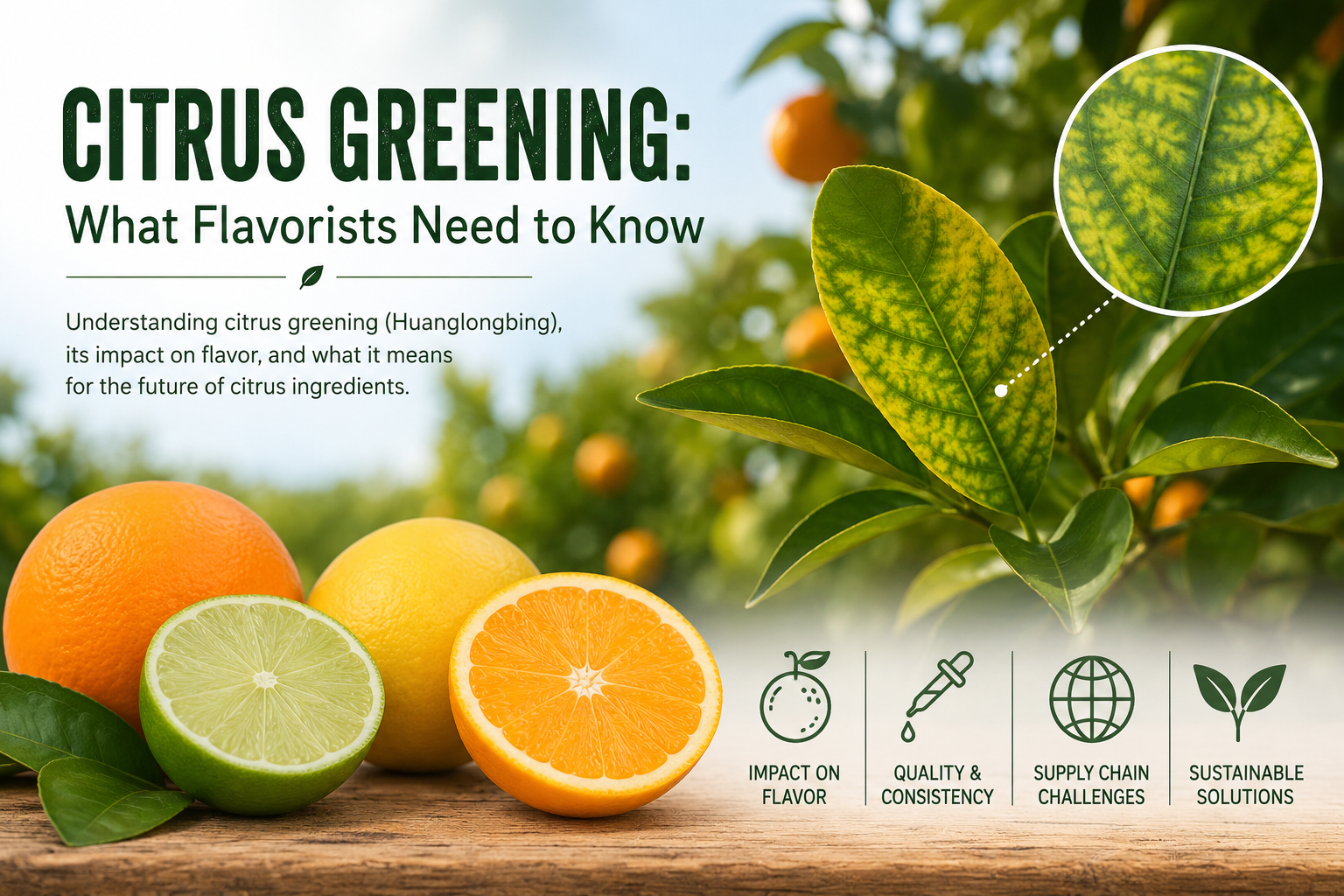
What is citrus greening, and how does it affect flavor quality? What do flavorists need to know about this disease, and what steps can they take to minimize its impact on their work?
What citrus greening (HLB) is
Citrus greening—more formally Huanglongbing (HLB)—is currently the most destructive citrus disease worldwide. It's associated with the phloem-restricted bacterium Candidatus Liberibacter (typically Ca. L. asiaticus in the Americas), which affects tree health, fruit development, ripening, and the quality of both fruit and juice. It's spread by the Asian citrus psyllid, has no cure, and both shrinks supply and degrades flavor.
Practically every commercial citrus species and cultivar is vulnerable. Infected fruit can be symptomatic or asymptomatic—and this distinction matters enormously for flavor. Symptomatic oranges are small, asymmetrical, and greener than healthy fruit (the fruit stays partly green at the stylar end, which is where the name comes from).
How it affects flavor quality
The flavor damage comes from a measurable shift in the fruit's chemistry, in three main directions:
Basic taste chemistry shifts toward "unbalanced." Symptomatic oranges show higher titratable acidity and lower soluble solids, solids/acids ratio, total sugars, and malic acid. The result is fruit that's more sour and less sweet, with a degraded sugar/acid ratio—the single most important driver of perceived "orange" quality.
Desirable aroma volatiles drop; off-note volatiles rise. This is the part most relevant to aroma work. Among flavor volatiles, ethyl butanoate, valencene, decanal, and other ethyl esters are lower, while many monoterpenes are higher in symptomatic fruit compared to healthy or asymptomatic fruit. More granularly, HLB-symptomatic juice is low in ethyl butyrate and ethyl 2-methylbutyrate (fruity notes) and in octanal and decanal (waxy/aldehydic), but higher in hexanal (green notes) and α-terpineol. That last point is telling—while linalool (fruity/floral) is desirable, terpene alcohols like α-terpineol, 4-terpineol, and carveol are markers of oxidation and poor quality.
Bitter/off-flavor secondary metabolites increase. HLB drives up secondary metabolites in peel and pulp, including hydroxycinnamic acids, limonin, nomilin, narirutin, and hesperidin. Limonin and nomilin are the classic bitter limonoids; the flavanones add to bitterness and astringency.
Put together, trained sensory panels describe HLB juice with a consistent set of negative descriptors: astringency, tingling, harshness, bitterness, metallic taste, low sweetness, saltiness/umami, mustiness, sourness/fermented, pungent/peppery, and low citrusy character—generally traced to the chemical imbalance in the affected fruit.
One practically important threshold: earlier work found that HLB off-flavor was not detectable (by chemistry or sensory) in juice made with up to about 25% symptomatic fruit blended into healthy juice, but higher proportions produce a detectable, recognizable off-flavor. That blending tolerance is now under pressure because in regions like Florida it's increasingly difficult to find fruit not showing HLB symptoms.
What flavorists need to know
Three things really matter for someone formulating or sourcing:
1. Natural citrus is now a more variable raw material, not a stable commodity. HLB both shrinks supply and degrades flavor (more bitter, sour, green, off-balance), so natural citrus should be treated as variable, requiring tighter QC and diversified origins. The asymptomatic-vs-symptomatic split means even "clean-looking" lots can carry drift.
2. The supply/cost squeeze is real and current. This isn't hypothetical background risk:
- In the 2024–2025 season, Florida's orange production dropped roughly 30%, its lowest since World War II, and Brazil's OJ production was projected to fall about 15%, with Brazilian wholesale prices more than doubling to over $6,500/tonne.
- Citrus greening, alongside climate stress, has lessened yields across Brazil, Florida, Mexico and beyond, pushing down forecasted volumes of the raw materials needed for natural citrus flavors and raising procurement costs—even as consumer demand stays high.
- The shortage specifically hits peel-oil and essence streams: IFF's VP of citrus innovation described a "perfect storm" of climate extremes, greening, and shifting juice demand that produced short essential oil supply against rising demand, with soaring prices as the knock-on effect.
3. It's an active, moving target—not a settled situation. HLB has moved from Asia through Africa into the Americas; Florida's industry is severely reduced, and the disease continues spreading in California, where USDA APHIS and California CDFA repeatedly expanded quarantine zones across Orange, Riverside, and San Bernardino Counties through 2025–2026. Sourcing and spec strategy should be reviewed on an ongoing basis rather than set once.
How to minimize the impact
Drawing the practical threads together, here's what the industry guidance points to:
Tighten and widen incoming specifications. Enforce broader incoming specs—Brix/acid ratio, citral %, limonin/bitterness, and a GC fingerprint—so drifting lots get caught before they reach a batch. Because the HLB signature is a pattern of volatile shifts (esters and desirable aldehydes down; monoterpenes, α-terpineol, and limonoids up), a GC-MS fingerprint compared against a healthy reference is more diagnostic than any single marker.
Diversify sourcing origins. Diversify supply across citrus groves from North through Central and South America to Europe, South Africa and Asia so a bad season or expanding quarantine in one region doesn't take out your whole raw-material stream. This pairs with qualifying alternative flavor systems and strengthening supplier continuity plans tied to orchard-health monitoring.
Keep nature-identical and WONF "type" backups ready. Maintaining robust nature-identical and WONF "type" versions lets you hold a target profile when natural oils shift or spike in cost. The idea is that you can reconstruct the missing desirable notes (the fruity esters, valencene, decanal/octanal, linalool) and dial back the off-notes rather than being fully hostage to the current crop.
Use blending strategically—but know its ceiling. Processors already blend juices of different color and chemical composition to maintain uniform flavor within acceptable-OJ criteria. The ~25% symptomatic-fruit tolerance gives some headroom, but as clean fruit gets scarcer this lever weakens, which is exactly why the reconstruction/backup approach is gaining importance.
Lean on biotech-derived key aromatics. A structural response the majors are pursuing: merging traditional extraction with bio-derived technology so the supply of critical flavor components stays stable despite crop volatility—for example fermentation-derived valencene, nootkatone, and other citrus aromatics, plus recent launches like BASF/Isobionics' natural alpha-farnesene for lime applications. These let you shore up the specific notes HLB depletes.
Watch the "bitter as a feature" angle. Interestingly, part of the market is leaning into citrus bitterness: emerging flavors with higher naringin and limonin—grapefruit, bitter orange, finger lime—are trending, along with hops as a bitter-citrusy profile. That won't rescue an off-balance orange, but it's a reminder that some HLB-adjacent chemistry maps onto profiles consumers now want.
What causes citrus greening?
The pathogen
HLB is caused by a bacterium in the genus Candidatus Liberibacter — a gram-negative alphaproteobacterium that lives exclusively in the phloem, the tissue that transports sugars from leaves to the rest of the tree. Three species cause the disease:
| Species | Region | Notes |
|---|---|---|
| Ca. L. asiaticus (CLas) | Asia, Americas — Florida, Brazil, California, Texas | The one that matters commercially; heat-tolerant |
| Ca. L. americanus (CLam) | Brazil | Was prominent in the early 2000s, since largely displaced by CLas |
| Ca. L. africanus (CLaf) | Africa | Heat-sensitive; symptoms fade in hot lowlands |
The "Candidatus" prefix is the tell: it means the organism has never been reliably grown in pure culture. That's not a footnote — it's central to why there's still no cure. You can't easily screen therapies against a bacterium you can't cultivate, and because it sits inside the phloem, sprays and systemic antibiotics struggle to reach it at meaningful concentrations.
The vector
The bacterium can't move on its own. It's carried by psyllids — tiny sap-sucking insects:
- Asian citrus psyllid (Diaphorina citri) — transmits CLas and CLam; the vector in Florida, Brazil, California
- African citrus psyllid (Trioza erytreae) — transmits CLaf
The transmission is persistent and propagative: a psyllid feeding on an infected tree's phloem picks up the bacterium, which then multiplies inside the insect and moves to its salivary glands. Once infective, the psyllid stays infective for life. Nymphs feeding on young flush acquire it far more efficiently than adults, which is why flush timing drives epidemics.
The other transmission route is grafting — infected budwood or nursery stock. This is how the disease jumps continents and how it seeds new regions before anyone knows it's there. It is not meaningfully spread by seed, pruning tools, or casual contact.
Why the tree declines (and the fruit goes off)
This is the part that connects back to your flavor question. The bacteria multiply in the sieve tubes, and the tree responds by depositing callose and phloem protein — plugging its own plumbing. Sieve tubes collapse and die.
The consequences cascade:
- Sugar transport blocks. Photosynthate can't leave the leaves, so starch accumulates — producing the blotchy mottle and the yellow shoots that give the disease its Chinese name, huánglóngbìng, "yellow dragon disease."
- Roots starve first. Significant root loss typically precedes visible canopy symptoms, often by a wide margin. The tree is dying from the bottom up while it still looks fine.
- Nutrient and water uptake fail. Hence the zinc-deficiency-like leaf patterns.
- Fruit is starved and aborted. Insufficient sugar delivery is precisely why symptomatic fruit shows lower soluble solids, lower total sugars, and a wrecked sugar/acid ratio — and why it stays green at the stylar end, sets aborted seeds, and grows lopsided. The bitter limonoid and flavonoid increases are a stress response layered on top.
There's a genuine ongoing debate worth knowing about: a substantial body of work argues the tree is largely killing itself. The bacterial titer is often low relative to the damage, and much of the harm looks like an autoimmune-style overreaction — reactive oxygen species and excessive callose deposition. If that's right, the fruit-quality collapse is the tree's defensive response, not direct bacterial destruction.
Why it spreads so effectively
The latent period is the crux. Months to years can pass between infection and visible symptoms — during which the tree is fully infectious to psyllids. By the time a grove looks sick, the surrounding area is already seeded. Add reservoir hosts like orange jasmine (Murraya paniculata), a popular ornamental hedge that psyllids breed on happily, plus untreated backyard citrus that no one scouts, and you get an epidemic that's very hard to contain by removing symptomatic trees alone.
That latency also explains the asymptomatic/symptomatic distinction from your flavor question: asymptomatic fruit comes from trees that are infected but haven't yet hit the threshold where phloem damage disrupts fruit loading. It's not "clean fruit" — it's fruit from a tree earlier on the same trajectory, which is why incoming lots drift over seasons rather than failing cleanly.
What flavor compounds does citrus greening affect?
Here's the compound-level picture, drawn primarily from the USDA-ARS/Florida body of work (Baldwin, Plotto, Bai, Manthey) and the Symrise group (Kiefl et al.), as consolidated in the Dala-Paula et al. review.
One framing note first: unlike grapefruit, lemon, and lime — which each have one or two impact compounds — orange flavor is a combination of volatiles in specific proportions. That's why HLB is so damaging: it doesn't knock out one marker, it detunes the ratios across the whole set.
Volatiles that go DOWN
Esters — the biggest loss. Monoterpenes tend to be higher and esters lower in HLB juice. This matters because esters carry the fruity character:
| Compound | Note | Status |
|---|---|---|
| Ethyl butanoate | sweet fruity | ↓ — among the most odor-active in OJ |
| Ethyl 2-methylbutanoate | fruity | ↓ |
| Ethyl acetate | sweet fruity | ↓ |
| Ethyl hexanoate | sweet fruity | ↓ |
| Ethyl 3-hydroxyhexanoate | sweet, fruity | ↓ — one of the major OJ esters |
Ethyl butanoate and ethyl 2-methylbutanoate are the most odor-active compounds in orange juice, and HLB juice's lower ester concentration is exactly why panels describe it as lacking orange flavor. The review's published chromatogram overlay shows ethyl butanoate and the sesquiterpenes visibly diminished in the HLB trace.
Sesquiterpenes. Valencene and sesquiterpenes generally run lower in HLB-affected juice. Dagulo's proposed mechanism is worth knowing: the higher monoterpene / lower sesquiterpene pattern may reflect reduced activity in the enzymatic pathway converting terpenes to sesquiterpenes — i.e., the tree isn't finishing the biosynthesis.
Aldehydes — genuinely contradictory. Octanal, nonanal, and decanal (characteristic citrus odor) were higher in healthy fruit in both Kiefl and Baldwin, but higher in HLB-asymptomatic fruit in Dagulo. Don't treat these as reliable markers.
Volatiles that go UP
- Monoterpenes broadly.
- Oxidation-marker terpene alcohols: α-terpineol, 4-terpineol, and carveol are indicators of oxidation and poor quality — as distinct from linalool (fruity/floral), which is desired. This is why panels report "oxidized oil" and "stale" descriptors.
- Alcohols generally — Dagulo and Hung & Wang both found all alcohols higher in HLB juice.
- Hexanal (green) — the messiest datapoint in the literature. It ran 65–110% higher in unaffected samples (Baldwin), up to 81% higher in symptomatic Valencia (Dagulo), and ~25% higher in HLB-affected fruit (Kiefl). Direction flips by study.
- (Z)-3-hexenol — also contradictory: higher in HLB juice per Dagulo and Baldwin, higher in healthy per Kiefl.
Non-volatile bitter compounds — the clearest signal
This is where the numbers are largest and most consistent. Dala-Paula's March 2013 Valencia comparison (symptomatic vs. healthy juice):
| Compound | Fold increase |
|---|---|
| Nomilin | >20× |
| Limonin | >7.5× |
| Tangeretin | >4× |
| Nobiletin | >2× |
| Diosmin | >2× |
| Heptamethoxyflavone | >1.5× |
| Didymin | >1.5× |
| Vicenin-2 | >1.5× |
| Limonin glucoside | >1.5× |
In absolute terms that study measured limonin at 1.2 → 9.3 mg/L and nomilin at 0.1 → 1.1 mg/L. In pulp, Massenti found narirutin up 148% and 17% (two harvests) and hesperidin up 86% and 94%.
Three threshold facts that matter for formulation:
- Limonin's recognition threshold in orange juice is ~4–6 mg/L, not the 1 mg/L once assumed from water-based work. Only severely affected juice exceeds 4 mg/L.
- Limonin and nomilin are synergistic — their perception thresholds drop when tasted together. And they taste different: limonin reads "bitter," nomilin reads "metallic" to some panelists. That synergy is likely the source of the characteristic HLB metallic note.
- Polymethoxyflavones amplify. Glabasnia identified 10 PMFs that enhance limonin/nomilin bitterness; tasted alone in model solution they raised astringency but not bitterness. So the PMFs aren't bitter themselves — they're modulators.
Critically, the review concludes limonin/nomilin only partially explain HLB bitterness, with hydroxycinnamic acid derivatives (bitter and astringent, more prevalent in symptomatic juice) implicated as well — and the full compound list remains unidentified.
Taste chemistry (the matrix the aroma sits in)
- Sucrose is the key loss — asymptomatic and healthy fruit can carry ~2.5× the sucrose of symptomatic fruit. Total sugars drop too.
- Glucose/fructose is unsettled — earlier studies found no change or slight decreases; only recent work (Baldwin 2018, Dala Paula 2018) found significant increases in symptomatic juice.
- Citric acid up, malic acid down. Raithore's Valencia: citric 0.53 → 1.40 g/100 mL.
- SSC/TA collapse is the headline number. Dagulo's April 2008 Valencia: healthy 13.7 → asymptomatic 10.8 → symptomatic 5.10.
- Ascorbic acid appears largely unaffected.
And the sensory interaction is multiplicative, not additive: lower sugar contents reinforce bitterness perception. You're not just losing sweetness — you're unmasking bitterness.
Amino acids and amines
Asparagine and phenylalanine run over 2× higher in symptomatic Valencia and Hamlin juice, with histidine also raised, while alanine, arginine, leucine, isoleucine, threonine, and valine come in lower. Symptomatic Hamlin specifically shows high synephrine and feruloyl putrescine — the latter not mirrored in Valencia. Proline is contradictory across studies. These likely feed the salty/umami and "brothy" descriptors.
Peel oil — different rules than juice
This deserves separate treatment since it's your raw material:
- Yield: peel oil extracts drop ~30% in symptomatic fruit — a direct supply hit independent of quality.
- Sesquiterpene hydrocarbons are lower, as are some monoterpenes and straight-chain aldehydes.
- Xu et al. found linalool, decanal, citronellol, citral, carvone, and dodecanal all higher in asymptomatic than symptomatic Hamlin and Valencia oil.
- Novel compounds appear only in HLB oil: β-longifolene, perillene, and 4-decenal — though the authors caution more samples are needed. If these hold up, they're candidate authentication markers.
- Watch this inversion: Kiefl's GC-O work on peel oil found odor-active aldehydes were higher in HLB-affected Valencia oil — the opposite of the juice trend. Peel oil and juice don't move together.
Three caveats before you build a spec around any of this
Harvest date dominates disease status. Variation from harvest date is generally more pronounced than variation from the disease, and secondary metabolites are affected more by harvest maturity than by CLas infection. Any marker panel needs a maturity-matched control or you'll misattribute.
Asymptomatic ≈ healthy for volatiles. The review is explicit that asymptomatic juice generally resembles healthy juice in volatile profile. The volatile damage is a late-stage phenomenon.
HLB chemistry mimics immaturity. Dagulo's insight: symptomatic fruit resembles immature fruit — lower sugars, higher acids, higher bitter limonoids — likely because a compromised vascular system slows maturation. This is why HLB effects are more prevalent early in the season, and why early-harvest differences are more obvious on the palate.
The mitigation angle, at compound level
The review's own list of research directions is essentially a flavorist's brief: designing resins that strip bitter limonoids without stripping flavor volatiles; tailoring aroma packages to mask bitterness or enhance sweetness; adding non-volatile orange-derived bitter maskers; binding limonoids for removal; or enzymatically glycosylating limonoids to render them non-bitter. Processors already add back peel oil or essence to standardize juice, which is the existing lever for modulating citrus flavor and sweetness.
There's also a QC angle worth flagging: CLas titer measured by real-time PCR correlates negatively with sweetness and orange/fruity flavor and positively with off-flavor and umami — offering a single upstream predictor that integrates the whole chemical mess.
Kiefl, J.; Kohlenberg, B.; Hartmann, A.; Obst, K.; Paetz, S.; Krammer, G.; Trautzsch, S. "Investigation on Key Molecules of Huanglongbing (HLB)-Induced Orange Juice Off-flavor." J. Agric. Food Chem. 2018, 66 (10), 2370–2377. DOI: 10.1021/acs.jafc.7b00892
First thing worth noting: this is Symrise AG (Holzminden), not a university or USDA lab. That shapes everything about it. The USDA-ARS work asks "what does HLB do to the fruit?" Kiefl asks "what molecules do I need to identify so I can fix this in a flavor system?" It's a flavorist's paper written by flavorists, which is exactly why it's the most useful one in the set for your purposes.
Second: it landed in issue 66(10) immediately after Glabasnia's sensometabolome paper (2354–2369). That issue was effectively a coordinated push on decoding orange juice taste chemistry, and reading the two together is more informative than either alone.
The framing premise is that HLB fruit never fully matures and carries a severe off-flavor described as bitter-harsh, metallic, and lacking juiciness and fruitiness. The published keywords tell you the toolkit up front: LC Taste, gas chromatography–olfactometry, flavanoids, limonin.
The methodology — this is the real contribution
Kiefl ran two parallel investigations, one on aroma and one on taste, using different tools:
Aroma side — AEDA on terpeneless peel oil. Rather than chasing the whole volatile profile, they applied aroma extract dilution analysis to terpeneless oil. That's a smart move: stripping the terpene bulk lets the trace odorants surface. Among 25 odor-active volatiles in healthy orange peel oil, the highest flavor dilution factors belonged to long-chain aldehydes:
- (E,E)-2,4-decadienal
- (Z)-8-tetradecenal
- trans-4,5-epoxy-(E)-2-decenal
- (Z)-4-decenal
- octanal
That list is worth sitting with. (Z)-8-tetradecenal and trans-4,5-epoxy-(E)-2-decenal are not compounds most orange briefs are built around — they're the kind of trace, high-FD material that carries authenticity rather than volume.
Taste side — taste-guided fractionation. Non-volatile compounds were separated using fast centrifugal partition chromatography followed by semi-preparative HPLC, then fractions were tasted to find which carried the off-note, then those fractions were chemically identified and the finding sensory-validated. This is the Hofmann-school "sensomics" approach applied to a disease problem. FCPC matters here — it's a liquid-liquid method with no solid stationary phase, so you don't lose polar taste-actives to irreversible adsorption the way you can on silica.
What they found
Bitter compound levels. Limonin 7.8× and nomilin 21.6× higher in HLB juice versus healthy — closely mirroring Dala-Paula's independent >7.5× and >20× figures. Significant differences (P<0.05) also appeared across pH, TA, SSC, SSC/TA, total sugars, citric acid, secondary metabolites, and sensory.
The specific limonoid numbers from their harvest series (mg/L, healthy → HLB-symptomatic):
| Sample | Limonin glucoside | Limonin | Nomilin |
|---|---|---|---|
| Hamlin, Nov 2014 | 110 → >250 | 8.3 → 16 | 9.7 → 11 |
| Hamlin, Jan 2015 | 140 → >250 | <LOQ → 13 | <LOQ |
| Valencia, Feb 2015 | 240 → >250 | 10 → 11 | <LOQ |
| Valencia, Mar 2015 | 180 → >250 | <LOQ → 8 | <LOQ |
| Valencia, Apr 2015 | 220 → >250 | <LOQ | nd |
Note the season gradient: the Nov/Dec/Jan early harvests show the dramatic gaps; by April there's essentially nothing to see. This is the "HLB mimics immaturity" pattern showing up cleanly within one study.
Volatiles. HLB juice ran low in ethyl butyrate and ethyl 2-methylbutyrate (fruity) and in octanal and decanal (soapy/waxy), and high in hexanal (green, ~25% up) and α-terpineol. Octanal, nonanal, and decanal were all higher in the healthy juice.
The peel oil inversion. Here's the finding I flagged last time and it deserves emphasis: in peel oil, the odor-active aldehydes were mostly higher in HLB-affected Valencia oil — the reverse of the juice trend. Same compound class, opposite direction, depending on which stream you're looking at. If you're specifying oil and reasoning from juice literature, you will get this backwards.
The central argument — and where it gets interesting
Kiefl tried to reconstruct the bitterness by spiking limonin, PMFs, poncirin, and hesperidin — alone and in combination. The result: bitterness increased only from the full flavonoid mixture plus limonin, and they couldn't resolve which individual flavonoid drove which descriptor.
The conclusion from the taste-guided fractionation was that flavonoids such as hesperidin may act as a modulator — evoking the harsh, metallic character rather than being bitter themselves. That's a meaningfully different claim from "HLB juice is bitter because limonin went up."
And this is reinforced from two directions:
- PMFs are innocent by concentration. Batenburg showed tangeretin and nobiletin are the main bitter PMFs in peel-derived preparations (tangeretin 2–3× more bitter than nobiletin) — but in juice they sit far below detection threshold, making direct bitterness contribution unlikely. Even at Dala-Paula's >4× tangeretin increase, you're multiplying a sub-threshold number.
- Dala-Paula's fractionation found the bitterness elsewhere. Seven of ten bitter-described fractions contained no limonoids, PMFs, or hesperidin at all.
So the emerging picture across both labs: HLB bitterness is a modulation phenomenon, not a concentration phenomenon. The bitter compounds go up, yes — but often not enough to cross threshold on their own. What's happening is a matrix effect: reduced sugar unmasks, flavonoids modulate, limonoids synergize with each other, and unidentified hydroxycinnamates contribute. That's why simple limonin removal doesn't fully solve it.
The caveat you must not miss
The "healthy" control was infected. qPCR gave the HLB juice a Ct of 27 versus 33 for the healthy juice. Lower Ct means higher titer — so the control wasn't CLas-free, it was merely less infected. Roughly six cycles is on the order of a ~64-fold titer difference, but it's a difference in degree, not in kind.
This is not sloppiness; it's the Florida reality the Dala-Paula review names directly — uninfected trees have become genuinely difficult to find. But the consequence is real: every effect size in this paper is likely an underestimate, because the comparison is high-titer vs. low-titer rather than infected vs. clean. It also means the Ct value functions as a continuous severity variable, which connects to the USDA finding that CLas titer correlates negatively with sweetness and fruity flavor and positively with off-flavor and umami.
What Kiefl built on top of it
This is where the paper pays off commercially, and it's the part most people miss.
Raithore, Kiefl, et al. 2020 (JAFC 68, 1038–1050) — Symrise Inc. Teterboro teamed with USDA-ARS to test the mitigation hypothesis. They spiked "from the named fruit" (FTNF) compounds — sourced from orange juice and peel molasses — into off-flavored HLB reference juice and ran difference-from-reference sensory. Results:
| Compound | Effect |
|---|---|
| Feruloyl putrescine | reduced bitterness, astringency, and aftertaste; enhanced sweetness |
| Neodiosmin | reduced bitterness; enhanced sweetness |
| Taxifolin | reduced bitterness |
The fraction OJ-E — mostly feruloyl putrescine and vicenin-2 — showed significant HLB off-taste masking, confirmed across both the 2014 and 2015 juices. Meanwhile fractions carrying limonoids, hydroxycinnamates, hesperidin, and PMFs did the opposite: enhanced sourness, bitterness, astringency, aftertaste, and suppressed sweetness.
The FTNF angle is the commercially clever part. Feruloyl putrescine is already in orange — recall it's elevated in HLB-symptomatic Hamlin juice specifically. So you're not adding a foreign masker; you're topping up an endogenous one. That has obvious label implications.
Symrise patent US 12,262,725 B2, "Improving taste profile of orange juice" (Kiefl, Paetz, Ley, Backes, Hans; PCT filed Nov 2015, granted Apr 2025). The claim construction reads like a spec sheet for exactly the problem the paper characterized:
- Substrate: HLB-infected orange juice, sour and bitter, containing ≥3 ppm limonin, ≥5 ppm polymethoxylated flavanones, and ≥200 ppm hesperidin
- Addition: ~5–1000 ppm of a racemic (1:1) enantiomeric mixture of neoflavonoids — 4-aryl-chroman-2-ones (dihydroxy-4-(hydroxy-methoxyphenyl)chroman-2-ones and relatives)
- Constraint: limonin-to-neoflavonoid ratio held between 1:1.3 and 1:3.6
- Claimed effect: reduced sourness, reduced bitterness, increased sweetness
Notice the patent defines its substrate by hesperidin and PMF content, not just limonin — which is the paper's modulation thesis converted directly into claim language. And the fixed limonin:modifier ratio implies dosing against a measured limonin value rather than a flat addition rate.
Honest limitations
- Small and specific. One region, two cultivars, two seasons. The volatile literature is riddled with study-to-study contradictions (hexanal flips direction three ways across Baldwin/Dagulo/Kiefl), and this paper doesn't resolve them.
- Terpeneless oil ≠ oil. The AEDA result is about what's odor-active once you remove the terpenes. Useful for finding trace impact compounds; not directly transferable to a cold-pressed oil spec.
- The mechanism is still open. They identified that flavonoids modulate, not how or which. The review's verdict stands — more work is needed to complete the compound list behind the unpleasant taste and mouthfeel.
- Commercial authorship cuts both ways. Symrise had a patent application filed in 2015, before the 2018 paper. That's not misconduct — it's normal industrial sequencing, and the JAFC declaration reported no competing interest — but the research question was shaped by a product hypothesis. Read the hesperidin-as-modulator finding knowing that the patent claims hesperidin-containing juice as its substrate.
What to know when formulating a flavor
- Your restoration targets aren't just ethyl butyrate and valencene. The high-FD long-chain aldehydes — (E,E)-2,4-decadienal, (Z)-8-tetradecenal, trans-4,5-epoxy-(E)-2-decenal, (Z)-4-decenal — are where the authenticity lives, and they're what terpeneless AEDA surfaces.
- Fight the modulation, not just the limonin. Debittering resins address one term in a multi-term problem. The Raithore data says feruloyl putrescine and neodiosmin are the levers, and they're FTNF.
- Spec hesperidin and PMFs, not only limonin. The patent's own substrate definition tells you which numbers actually predict the off-flavor.
- Dose against measured limonin. The 1:1.3–1:3.6 ratio implies the correction scales with severity — a fixed addition rate will under- or over-shoot.
- Season is a variable, not noise. Their own limonoid table collapses to nothing by April.
###