Concretes: What the Society of Flavor Chemists Wants Flavorists to Know
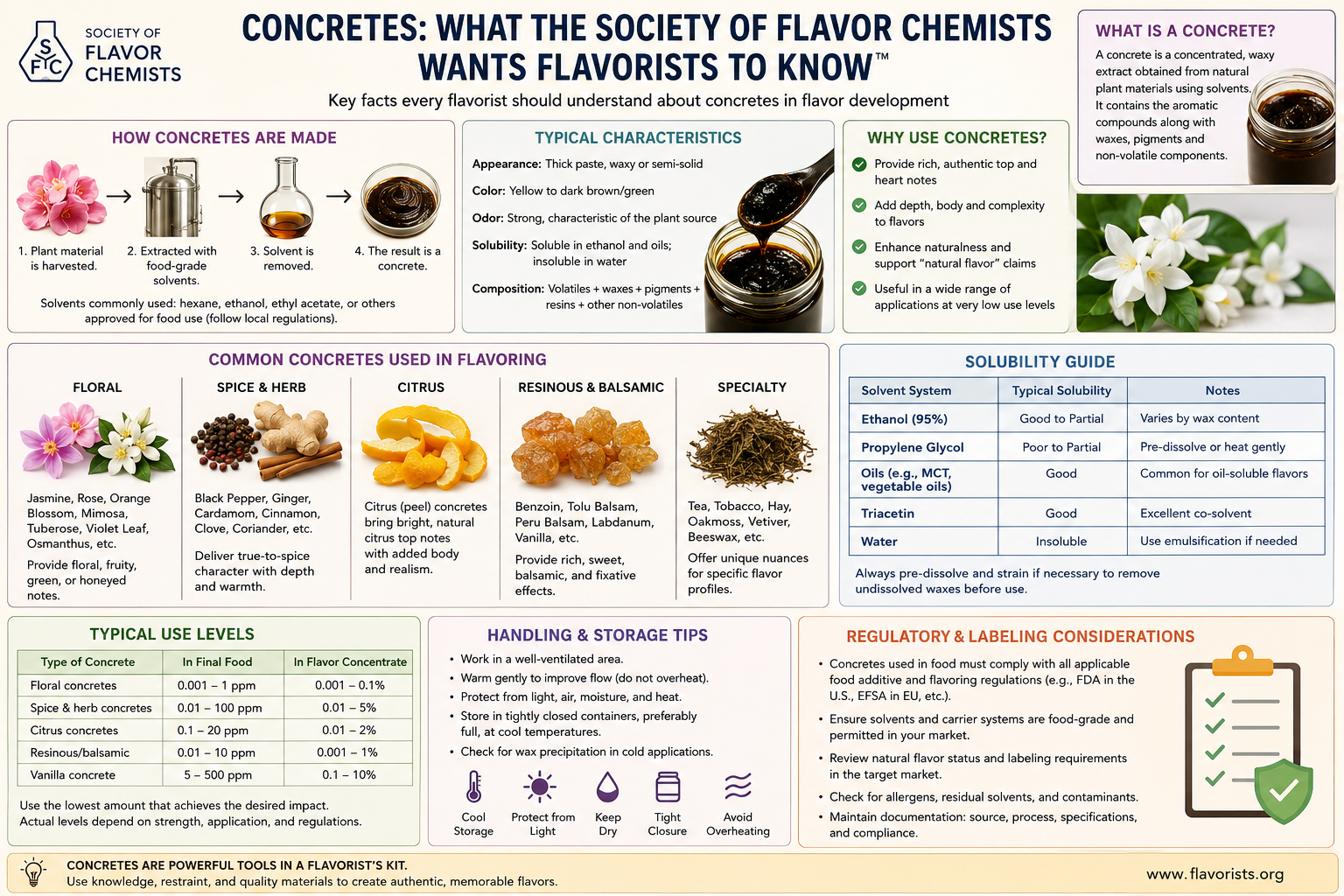
Presented below is a flavorist training guide for commercial “concretes” and concrete-like solvent extracts.
1. What “concrete” means
A concrete is a concentrated natural aromatic extract made by solvent extraction of plant material, usually fresh flowers or other aromatic botanicals. It contains volatile aroma compounds plus nonvolatile waxes, pigments, resins, lipids, and plant extractives. It is usually waxy, semi-solid, pasty, or resinous, not freely water-soluble. Many concretes are converted into absolutes by ethanol washing and chilling to remove waxes.
In food flavor work, true floral concretes are less common than oleoresins, absolutes, essential oils, CO₂ extracts, and botanical extracts, but the same handling principles apply.
2. Production method
Typical process:
- Fresh or dried botanical is extracted with an approved solvent such as hexane, ethanol, ethyl acetate, acetone, or supercritical CO₂, depending on jurisdiction and product.
- The solvent is evaporated under vacuum.
- The residue is the concrete: aroma + wax + color + resin.
- Optional ethanol extraction gives an absolute with less wax and better alcohol solubility.
Flavorists must request a supplier specification showing botanical source, extraction solvent, residual solvent limits, food-grade status, allergen status, country regulatory status, microbiology, pesticides/heavy metals, and recommended storage. IOFI notes that extraction-solvent lists and residue limits require jurisdiction-specific due diligence, not blind reliance on a generic list. (Erratic Warthog)
3. Physical form and solubility
| Type | Physical form | Solubility | Flavorist handling |
|---|---|---|---|
| Floral concrete | Waxy paste, semi-solid, often dark yellow/brown/green | Soluble in ethanol partly; soluble in oils/triacetin/PG depending on wax load; insoluble in water | Warm gently, pre-dilute 1–10%, filter if wax precipitates |
| Floral absolute from concrete | Viscous liquid or soft paste | Better ethanol solubility; usually oil/PG soluble; not water soluble | Easier for beverage and fine-flavor compounding |
| Spice/herb concrete or oleoresin | Thick paste to viscous liquid | Oil soluble; limited PG/ethanol solubility; water insoluble without emulsifier | Use at very low dose; powerful color/stain risk |
| Resin/balsam concrete/resinoid | Sticky resin or hard mass | Alcohol/oil soluble; water insoluble | Adds fixative, balsamic, smoky, sweet depth |
| CO₂ “concrete-like” extract | Paste, waxy mass, or thick oil | Oil soluble; variable ethanol solubility | Cleaner solvent story; may contain waxes and heavy fractions |
4. Organoleptic profile by market family
| Commercial family | Examples | Organoleptic character | Typical applications |
|---|---|---|---|
| Jasmine concrete/absolute | Jasminum grandiflorum, sambac | Floral, indolic, fruity, tea-like, animalic, honeyed | Tea, peach, apricot, berry, tropical, dairy, confectionery |
| Rose concrete/absolute | Rosa damascena, centifolia | Rosy, honey, waxy, spicy, green, phenethyl-alcoholic | Red fruit, lychee, Turkish delight, beverages, dairy |
| Orange blossom / neroli concrete | Citrus aurantium flower | Floral, citrus, green, honeyed, soapy if overdosed | Orange, citrus blossom, tea, cola, confectionery |
| Mimosa concrete/absolute | Acacia dealbata | Powdery, violet, cucumber, honey, waxy | Floral fruit, tea, confectionery, cosmetic-style flavors |
| Violet leaf concrete/absolute | Viola odorata leaf | Green, leafy, cucumber, metallic, watery | Cucumber, melon, berry, tea, herbal beverages |
| Tuberose concrete/absolute | Polianthes tuberosa | Creamy floral, lactonic, narcotic, tropical | Mango, coconut, cream, fantasy floral |
| Orris concrete/butter | Iris rhizome | Powdery, woody, violet, buttery | Premium berry, tea, vanilla, confectionery |
| Hay / beeswax / tobacco absolutes | Hay, beeswax, tobacco | Coumarinic, honey, wax, dried fruit, smoky | Brown flavors, honey, tobacco-type, vanilla, rum |
| Vanilla oleoresin/resinoid | Vanilla planifolia | Sweet, balsamic, phenolic, woody, creamy | Vanilla, dairy, bakery, chocolate |
| Spice oleoresins | Ginger, pepper, capsicum, cinnamon, clove, cardamom | True-to-spice, pungent, warm, resinous | Savory, sauces, meat, snacks, beverages |
| Citrus wax/concrete fractions | Orange, lemon, lime waxy extracts | Peel, wax, aldehydic, bitter, terpenic | Citrus bases, beverage emulsions, peel realism |
5. Approximate dosage guide
Always start with a 1% or 10% dilution.
| Material class | Finished food dosage | In flavor concentrate |
|---|---|---|
| Floral concretes/absolutes | 0.001–1 ppm | 0.001–0.1% |
| Strong indolic florals: jasmine, tuberose | 0.001–0.1 ppm | 0.0005–0.05% |
| Violet leaf, green absolutes | 0.005–0.5 ppm | 0.001–0.1% |
| Vanilla oleoresin/resinoid | 5–500 ppm | 0.1–10% |
| Spice oleoresins | 0.1–100 ppm | 0.01–5% |
| Capsicum oleoresin | trace–5 ppm | trace–0.1% |
| Resin/balsam extracts | 0.01–10 ppm | 0.001–1% |
| Citrus wax/concrete fractions | 0.1–20 ppm | 0.01–2% |
These are starting ranges, not legal limits. Actual use depends on strength, solvent, matrix, heat process, and local regulation.
6. Applications in flavors
Concretes are used to add:
Naturalness: They provide botanical complexity that isolates cannot fully reproduce.
Body and mouthfeel: Waxes/resins can round sharp top notes.
Authenticity: Floral traces improve fruit flavors such as peach, apricot, lychee, raspberry, grape, mango, and citrus.
Fixation: Heavy extractives help retain aroma in baked, dairy, confectionery, and chewing gum systems.
Color and haze: Useful or problematic depending on the product. Beverage use often requires filtration, emulsification, or conversion to an absolute.
7. Formulation cautions
Do not add raw concrete directly to water. Pre-dissolve in ethanol, propylene glycol, triacetin, MCT, vegetable oil, or an approved emulsified system.
Watch for:
- wax precipitation in cold beverages;
- turbidity in clear drinks;
- sediment over shelf life;
- strong color carryover;
- oxidation of floral and citrus notes;
- pesticide/heavy-metal risk in botanicals;
- solvent residues;
- allergen and sensitizer declarations;
- natural-source claim support.
Store tightly closed, nitrogen-flushed if possible, cool, dark, and dry. Many floral concretes oxidize quickly after opening.
8. Labeling and regulatory basics
United States
Under FDA flavor labeling rules, “natural flavor” includes essential oil, oleoresin, essence, extractive, distillate, or products of roasting/heating/enzymolysis derived from permitted natural sources, when the significant function is flavoring rather than nutrition. (eCFR)
Foods with added flavor must declare flavoring appropriately, such as “natural flavor,” “artificial flavor,” “natural and artificial flavor,” or a more specific name. FDA rules also distinguish characterizing-flavor claims such as “strawberry flavor” versus “artificially flavored.” (eCFR)
Extraction solvents and carriers must be permitted for food use. For example, FDA lists ethyl acetate as a permitted substance with uses including flavoring agent/adjuvant and solvent/vehicle. (HFP App External)
European Union
EU Regulation 1334/2008 governs flavorings and food ingredients with flavoring properties. It defines categories such as flavoring substances, flavoring preparations, thermal process flavorings, smoke flavorings, flavor precursors, and other flavorings. (EUR-Lex)
In the EU, a concrete used as a flavor is typically assessed as a flavouring preparation if produced from food or natural source material by appropriate physical, enzymatic, or microbiological processes. Regulation 1334/2008 also includes restrictions on certain naturally occurring undesirable substances in Annex III. (Food Safety Authority of Ireland)
9. Flavorist checklist before using any concrete
Ask the supplier for:
- Food-grade declaration.
- Natural flavor status by target market.
- Botanical name and plant part.
- Extraction solvent and residual solvent results.
- FEMA/GRAS, EU, JECFA, IOFI, or local status where applicable.
- Allergen statement.
- Pesticides, heavy metals, PAHs if smoky/resinous.
- Solubility data in ethanol, PG, oil, triacetin, and water/emulsion.
- Recommended use level.
- Stability data in acid, heat, light, and alcohol.
- Halal/kosher/vegan/non-GMO status if needed.
- IFRA only if the same material is used in fragrance or oral-care crossover work.
10. Training rule of thumb
Use concretes when you need depth, botanical realism, waxy naturalness, or fixative character. Use absolutes or refined extracts when you need cleaner solubility, lower wax, better clarity, and easier beverage handling. Never assume a perfumery-grade concrete is suitable for food.
###