FDA Nominee Warns More Resources Are Needed to Implement Major GRAS Food Ingredient Reforms
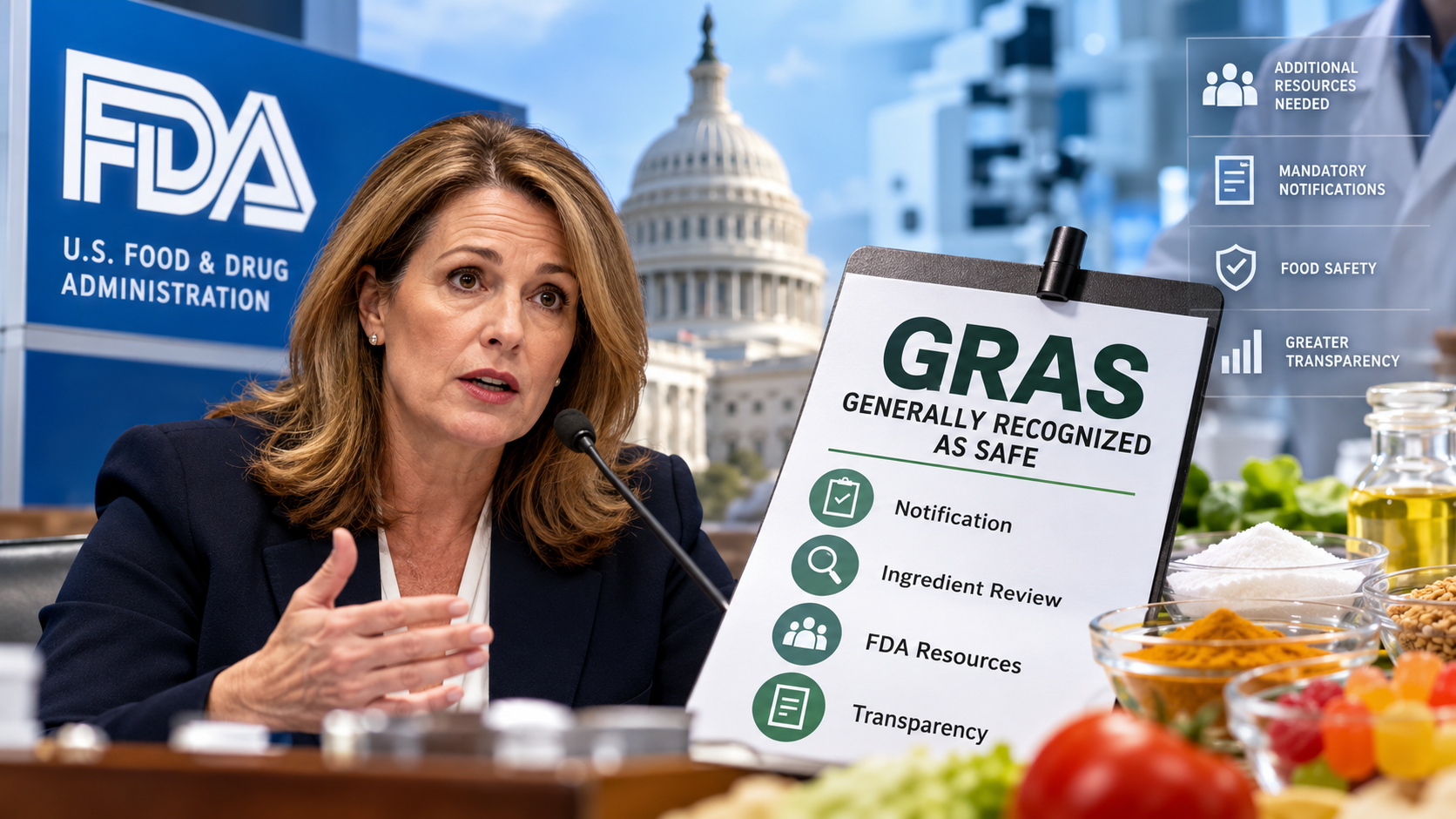
Tuesday September 29, 2026 – President Donald Trump’s nominee to lead the U.S. Food and Drug Administration (FDA) is warning that the agency may need additional resources to carry out one of the federal government’s most significant proposed changes to food ingredient oversight in decades.
During a Senate confirmation hearing, FDA commissioner nominee Dr. Heidi Overton said the agency’s Human Foods Program would require additional resources to properly handle mandatory notifications under the proposed reforms to the Generally Recognized as Safe (GRAS) system.
The comments highlight a central challenge facing the FDA: expanding federal oversight of food ingredients at a time when the Department of Health and Human Services (HHS) and FDA have undergone significant workforce reductions.
The issue could have substantial consequences for food and beverage manufacturers, ingredient suppliers and consumers because the GRAS framework governs how many substances can enter the U.S. food supply without going through the conventional FDA food-additive approval process.
What Did the FDA Nominee Say About GRAS Reform?
At her September 24, 2026 Senate Health, Education, Labor and Pensions Committee confirmation hearing, Overton was asked whether the FDA currently has sufficient resources to conduct the ingredient-safety work associated with GRAS reform.
She responded that, based on her understanding, the agency’s Human Foods Program would need more resources to properly process the mandatory notifications contemplated by the new system. She also pointed to congressional proposals addressing the issue.
Overton was nominated on September 14 to succeed Martin Makary as Commissioner of Food and Drugs, and the Senate HELP Committee held her nomination hearing on September 24.
Her comments are significant because the FDA is simultaneously being asked to increase scrutiny of food ingredients and manage a potentially much larger flow of regulatory submissions.
According to Food Dive, the FDA has more than 1,200 GRAS notices on file and estimates it could receive approximately 194 submissions per year under the proposed system. Roughly half of those estimated annual notices would come from companies newly subject to mandatory notification requirements.
What Is GRAS?
GRAS stands for “Generally Recognized as Safe.”
The concept dates to the 1958 Food Additives Amendment to the Federal Food, Drug, and Cosmetic Act. Under federal law, substances intentionally added to food generally qualify as food additives requiring FDA premarket approval unless an exemption applies.
One major exemption covers substances whose use is generally recognized by qualified experts as safe under their intended conditions of use.
The distinction is important.
A conventional food additive generally goes through FDA premarket review and approval. A substance that legitimately qualifies as GRAS does not require that same premarket approval.
The FDA says GRAS uses nevertheless must satisfy the same underlying safety standard as food additives: there must be a reasonable certainty of no harm under the intended conditions of use. The evidence supporting a GRAS conclusion must also be generally available and recognized among qualified experts.
Common GRAS substances can include familiar ingredients such as vinegar, canola oil and black pepper. The controversy surrounding the system is therefore not about whether the GRAS concept itself means an ingredient is dangerous. Rather, much of the policy debate concerns how GRAS determinations are made, documented and disclosed to regulators.
Why Is the Current GRAS System Controversial?
Under the existing framework, a company that concludes an ingredient's intended use qualifies as GRAS can voluntarily submit a GRAS notice to the FDA.
But notification has not been mandatory.
That means manufacturers have been able to reach their own GRAS conclusions without necessarily notifying the FDA before introducing the substance into commerce.
This practice is often referred to as “self-GRAS” or GRAS self-affirmation.
HHS says manufacturers have been permitted to make such determinations since the GRAS framework was established, while the FDA has operated a voluntary notification program.
Critics argue that the arrangement creates an information gap because the FDA may not have a complete inventory of substances being introduced into foods under GRAS conclusions.
Supporters of the GRAS framework emphasize that a GRAS determination still has to meet statutory scientific standards and cannot simply be based on a manufacturer's unsupported assertion that an ingredient is safe.
Why Did the FDA Move Toward a Notification System?
The roots of the modern system stretch back decades.
After Congress established the GRAS exemption in 1958, the FDA initially maintained lists and conducted more resource-intensive processes for evaluating substances.
In 1997, the agency proposed replacing its GRAS affirmation petition process with a notification procedure. One reason was efficiency: FDA's historical records show that industry-sponsored GRAS affirmation petitions could take more than 72 months to complete, while the newer notification approach dramatically shortened typical response times.
That history creates an important irony in the current debate.
The notification system was partly designed to address the FDA's resource constraints. Nearly three decades later, the government is proposing to make notification mandatory — and the FDA's prospective commissioner is again warning that staffing and resources could become a limiting factor.
What Is the FDA Proposing to Change?
On August 10, 2026, the FDA proposed a major overhaul of the GRAS notification framework.
Under the proposal, companies making certain GRAS conclusions for substances used in human or animal food would be required to notify the FDA, rather than choosing whether to submit a notice.
The proposed regulation would also expand the FDA's public inventory of GRAS notices, giving regulators, researchers, consumers and other companies greater visibility into substances entering the food supply.
For substances already being marketed based on previous self-GRAS conclusions, the proposal would create a time-limited streamlined submission process allowing companies to inform the FDA about those existing uses.
According to HHS, the objective is to give the agency a clearer picture of substances in the food supply and help it prioritize post-market safety evaluations.
Importantly, the proposal should not be confused with a requirement that every GRAS ingredient receive conventional FDA premarket approval.
The proposal primarily changes notification, disclosure and oversight. A substance that legitimately qualifies as GRAS remains exempt from the standard food-additive premarket approval requirement.
That distinction could easily be lost in discussions describing the proposal as simply “closing the GRAS loophole.”
GRAS Reform Is Part of a Broader Federal Food Policy Push
GRAS reform has become a prominent part of HHS Secretary Robert F. Kennedy Jr.'s Make America Healthy Again (MAHA) agenda.
HHS has presented mandatory GRAS notification as a way to close information gaps and increase transparency surrounding substances entering the food supply.
The administration's broader food-policy agenda also includes work involving ultra-processed foods, nutrition research, food dyes and post-market evaluation of food chemicals.
The FDA's Human Foods Program has identified food chemical safety as a major 2026 priority. In addition to GRAS reform, the program has outlined work involving post-market reviews of chemicals already used in food and efforts related to alternatives to petroleum-based synthetic food colors.
The Staffing Question Could Become a Major Obstacle
Expanding ingredient oversight requires scientists, toxicologists, regulatory specialists and other personnel capable of evaluating submissions and identifying potential safety concerns.
That makes the FDA's staffing situation particularly relevant.
In March 2025, HHS announced a broad restructuring that included plans to reduce its workforce by approximately 10,000 full-time employees through the restructuring itself. Combined with other departures, HHS said its workforce would decline from approximately 82,000 to 62,000 employees.
HHS said the FDA itself would lose approximately 3,500 full-time positions, with reductions focused in part on administrative functions.
The FDA's Human Foods Program is particularly important because it is responsible for a broad portfolio extending well beyond GRAS notifications, including food safety, chemical safety, nutrition and efforts to prevent foodborne illness.
The program itself emerged from a major FDA reorganization that took effect in 2024 and affected more than 8,000 employees across the agency.
Overton's comments therefore raise a practical policy question: Can the FDA substantially expand its ingredient oversight responsibilities without simultaneously expanding the resources available to the Human Foods Program?
What Could Mandatory GRAS Notifications Mean for Food Companies?
For food and ingredient manufacturers, mandatory notification could substantially change compliance practices.
Companies relying on self-GRAS conclusions may face additional documentation and submission requirements. Manufacturers could need to devote more resources to assembling scientific evidence, documenting intended uses and exposures, preparing GRAS notices and responding to FDA questions.
Ingredient suppliers could also face greater demands from their customers for documentation supporting safety conclusions.
At the same time, a more comprehensive public GRAS database could benefit companies by making regulatory information easier to find and reducing uncertainty about how other ingredients have been assessed.
The exact compliance burden will depend on the final regulation, which could change following the public-comment and rulemaking process.
The FDA is accepting comments on the proposed rule through December 9, 2026.
State Food Ingredient Laws Add Another Layer of Pressure
The federal debate is unfolding as states increasingly pursue their own food ingredient restrictions and labeling requirements.
Food Dive reports that New York has proposed its own approach involving GRAS, while other states have considered or enacted restrictions on particular ingredients or additional labeling requirements.
This trend matters to national food manufacturers because different state requirements can create a regulatory patchwork.
A product formulation that complies with federal rules could potentially face different restrictions or labeling obligations depending on where it is sold. Manufacturers may then have to reformulate products nationally, create state-specific versions or adjust labels and distribution strategies.
That dynamic helps explain why parts of the food industry have supported stronger federal involvement: a uniform national framework can provide greater regulatory consistency than dozens of differing state systems.
During her confirmation hearing, Overton expressed support for considering a national ingredient standard after a sufficient number of states have acted, although she did not specify exactly what threshold should trigger federal action.
What Does GRAS Reform Mean for Consumers?
For consumers, the most immediate potential effect is likely to be greater transparency rather than an overnight change in supermarket products.
If the proposed rule is finalized, mandatory notifications could give the FDA a more complete picture of substances entering the U.S. food supply.
Publicly available notices could also provide researchers, consumer groups and manufacturers with more information about why particular ingredient uses have been determined to qualify as GRAS.
The additional information could then help the FDA identify substances warranting further post-market review.
However, mandatory notification does not automatically mean that every ingredient would undergo a full FDA premarket approval process. That distinction is essential when evaluating how much the proposed rule would change food safety oversight.
Why FDA Resources Could Determine Whether the Reform Works
The debate is ultimately about more than whether companies should submit additional paperwork.
Mandatory notification would potentially provide the FDA with significantly more information. But information has regulatory value only if the agency has enough capacity to process it, analyze safety evidence, identify potential problems and conduct follow-up reviews when necessary.
The FDA itself says a mandatory system could help it determine whether GRAS conclusions have an adequate scientific basis and identify potentially unsafe uses more effectively.
That means implementation capacity could become just as important as the wording of the final regulation.
A large increase in submissions without sufficient scientific and regulatory staffing could create bottlenecks. Conversely, sufficient resources combined with a comprehensive notification database could give the FDA significantly greater visibility into ingredients used throughout the American food supply.
What Happens Next?
The GRAS proposal is still in the rulemaking stage, so mandatory notification is not yet the final regulatory framework.
Stakeholders can submit comments to the FDA through December 9, 2026. The agency can then revise the proposal before issuing a final rule.
At the same time, Overton's nomination is moving through the Senate confirmation process, placing questions about FDA staffing, ingredient regulation and the future direction of the Human Foods Program directly before lawmakers.
For food manufacturers, the key issues to watch are the final scope of mandatory GRAS notifications, requirements for ingredients already on the market, FDA review timelines, potential congressional action affecting the agency's authority or resources, and the continuing expansion of state-level ingredient laws.
The larger takeaway is that U.S. food ingredient regulation appears to be moving toward greater disclosure and federal visibility. Whether that produces a substantially stronger oversight system will depend not only on the final GRAS rule, but also on whether the FDA has the personnel, scientific expertise and funding needed to put it into practice.
Source: The news development was first summarized here from Food Dive's September 29, 2026 report, supplemented with information from FDA, HHS and Senate materials.
###