FDA GRAS Reform and Ultra-Processed Food Definition Could Reshape U.S. Food Regulation
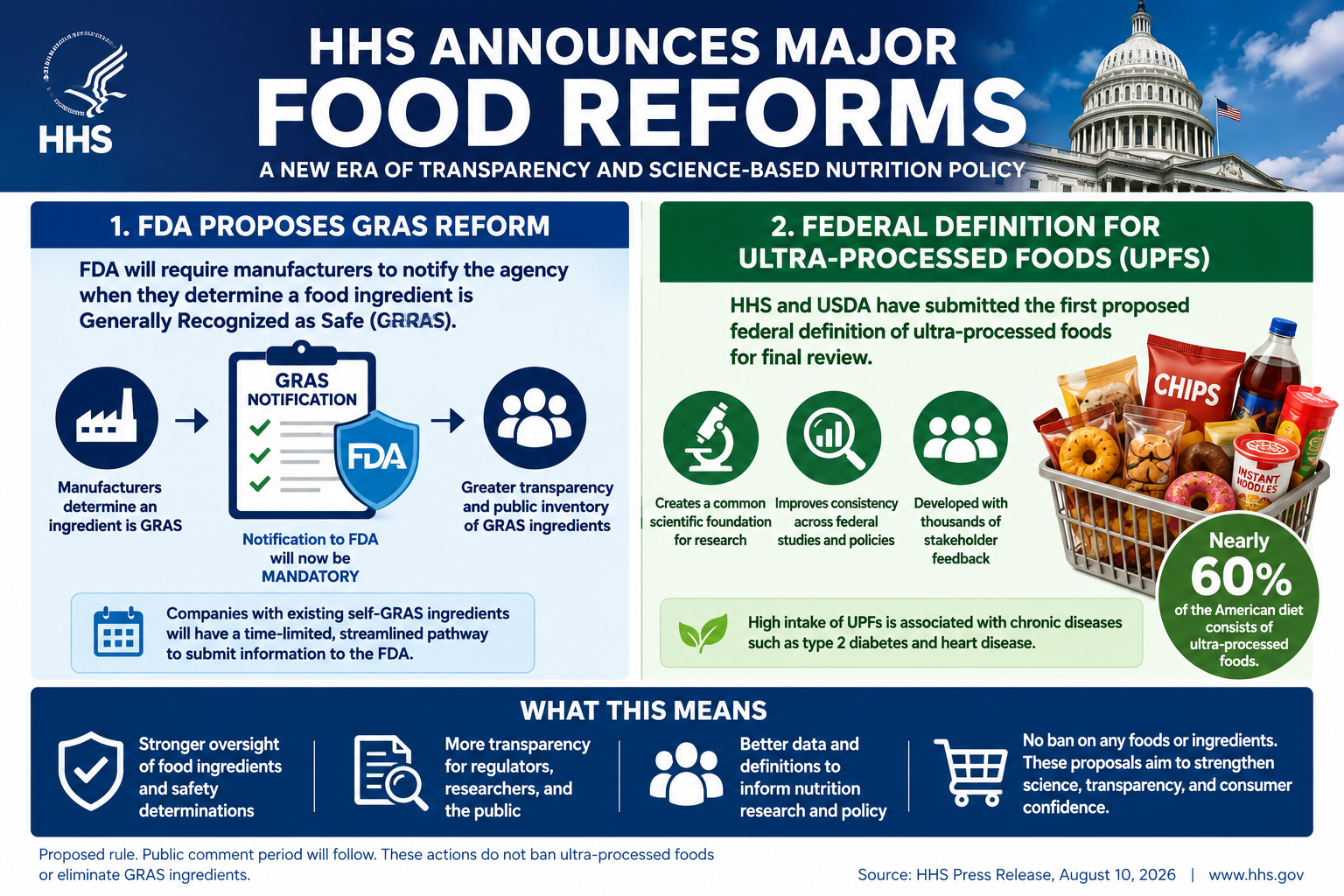
Wednesday August 12, 2026 – The United States is moving toward one of its most significant changes to food ingredient oversight in years, with federal health officials targeting both the GRAS system for food ingredients and the growing debate over ultra-processed foods.
On August 10, 2026, the U.S. Department of Health and Human Services announced two major food-policy actions. First, the Food and Drug Administration proposed requiring manufacturers to notify the FDA when they determine that an ingredient added to human or animal food is Generally Recognized as Safe, or GRAS. Second, HHS and the U.S. Department of Agriculture submitted the federal government's first proposed definition of ultra-processed foods, or UPFs, for final review.
The changes could have far-reaching implications for food manufacturers, ingredient suppliers, researchers and consumers.
According to the HHS announcement on GRAS reform and ultra-processed foods, the goal is to increase transparency around food ingredients while creating a more consistent scientific framework for studying ultra-processed foods.
However, an important distinction is necessary: these actions do not immediately ban ultra-processed foods or eliminate GRAS ingredients. The GRAS measure is a proposed rule, while the ultra-processed-food initiative concerns developing a standardized federal definition.
What Is the FDA’s Proposed GRAS Reform?
The biggest regulatory change involves the FDA's Generally Recognized as Safe system.
Under current federal law, substances intentionally added to food generally qualify as food additives requiring FDA premarket approval unless an exemption applies.
One of the most important exemptions is GRAS.
As the FDA explains in its GRAS guidance, an ingredient can qualify as GRAS when qualified experts generally recognize that its intended use has been adequately demonstrated to be safe.
The safety standard itself is substantial. Scientific GRAS determinations require the same quantity and quality of scientific evidence needed for food-additive approval, and that evidence generally must be publicly available.
The controversial part of the system concerns notification.
Companies can independently conclude that an ingredient's use meets the GRAS standard without being required to notify the FDA.
HHS says its proposed rule would change that.
FDA Wants GRAS Notifications to Become Mandatory
Under the 2026 proposed GRAS rule, manufacturers would have to notify the FDA when they conclude that a substance added to human or animal food qualifies as GRAS.
In other words, the proposal does not simply change the scientific meaning of “safe.” It addresses an information gap between manufacturers and regulators.
The current GRAS notification system is voluntary.
The FDA's 2016 GRAS final rule formalized a voluntary notification procedure. FDA has strongly encouraged companies to submit GRAS conclusions, but notification has not been mandatory.
The newly proposed system would make those notifications compulsory.
HHS says that would give the FDA greater visibility into substances entering the U.S. food supply while creating a larger public inventory of GRAS notices.
What Happens to Existing Self-GRAS Ingredients?
The proposal also addresses ingredients already being used in foods based on independent GRAS conclusions.
HHS says manufacturers would have access to a time-limited, streamlined submission pathway through which they could provide FDA with information about existing uses.
That could be important because independently determined GRAS substances may already be present in the food supply without having gone through the voluntary FDA notification process.
Bringing more of those substances into a centralized system could help FDA determine which ingredients deserve additional post-market evaluation.
At the same time, HHS says the streamlined process is intended to avoid unnecessary regulatory burdens.
Why Does the GRAS System Exist?
Understanding the controversy requires going back nearly seven decades.
Congress created the GRAS exemption through the 1958 Food Additives Amendment to the Federal Food, Drug, and Cosmetic Act.
The basic idea was practical.
Not every substance added to food required an elaborate new approval process. Some ingredients had long histories of ordinary food use or were already broadly recognized by qualified experts as safe under particular conditions.
The FDA's history of the GRAS system shows how the regulatory framework subsequently evolved.
FDA published its original GRAS list in 1958. Following safety questions surrounding some substances in later years, the agency conducted broader reviews and developed different procedures for GRAS determinations.
In 1997, FDA proposed replacing its more resource-intensive GRAS affirmation petition system with a notification procedure.
That notification approach was ultimately formalized through the FDA's 2016 final rule.
The 2026 proposal represents another major evolution: changing notification from voluntary to mandatory.
Is This the End of the “GRAS Loophole”?
Critics have sometimes referred to independent GRAS determinations as a “GRAS loophole,” arguing that companies should not be able to make safety determinations about ingredients without informing FDA.
The proposed rule would directly address the notification issue.
But saying that the proposal simply “ends GRAS” would be inaccurate.
The GRAS category would continue to exist. What would change is manufacturers' ability to make GRAS conclusions without notifying the agency.
FDA would consequently have more information about which substances companies are introducing under GRAS determinations.
That could strengthen post-market oversight and make ingredient information more visible to regulators and the public.
Federal Government Moves to Define Ultra-Processed Foods
The second major announcement concerns ultra-processed foods.
HHS and USDA have submitted for final review what HHS describes as the federal government's first proposed definition of ultra-processed foods.
That may sound like a technical exercise, but establishing a definition could have substantial long-term consequences for nutrition research and potentially future policy.
“Ultra-processed food” has become an increasingly common term in nutrition research and public discussion, yet the United States has not had one standardized federal definition that agencies consistently use.
HHS says this has made research less consistent across the federal government.
The proposed definition is intended to provide a common scientific foundation.
According to HHS, the government developed the proposal after receiving feedback from thousands of stakeholders, including researchers, consumer organizations, industry representatives and members of the public.
What Exactly Is Ultra-Processed Food?
This is where the debate becomes complicated.
Food processing exists on a spectrum.
Washing vegetables, pasteurizing milk, freezing fruit, grinding wheat and canning beans are all forms of processing. Calling something “processed” therefore does not automatically mean it is unhealthy.
The term ultra-processed food is generally intended to distinguish more extensively formulated industrial products from minimally processed foods and ordinary culinary preparations.
But exactly where that boundary should be drawn remains contested.
Researchers frequently use classification systems such as NOVA to categorize foods according to the nature and purpose of processing. Yet applying broad processing categories to real-world foods can produce disagreements.
That is one reason a standardized federal definition matters.
If government agencies, researchers and policymakers use different definitions of UPFs, comparing studies or developing consistent policy becomes more difficult.
Why Is HHS Focusing on Ultra-Processed Foods?
HHS says nearly 60% of the American diet consists of ultra-processed foods and points to research associating high UPF consumption with chronic diseases including type 2 diabetes and heart disease.
The agency is pursuing the definition as part of the Trump administration's Make America Healthy Again, or MAHA, strategy.
However, association and causation are important to distinguish.
People who consume diets high in foods categorized as ultra-processed may differ in many ways from people who eat less of them. Nutritional composition also varies dramatically within broad food categories.
A standardized definition therefore doesn't settle the scientific debate over UPFs.
Instead, it could give researchers a more consistent tool for investigating the question.
What Could the New Food Rules Mean for Manufacturers?
For food and ingredient companies, the mandatory GRAS notification proposal could have more immediate operational consequences than the UPF definition.
Manufacturers using independent GRAS conclusions could face new reporting obligations.
Ingredient suppliers may need to maintain more extensive documentation, while companies could need to review the regulatory status of substances already incorporated into products.
Greater public disclosure could also attract additional scrutiny from consumers, researchers and advocacy groups.
The proposed UPF definition could have a different type of impact.
A definition by itself doesn't necessarily prohibit products or ingredients. But once government agencies have an agreed classification system, it could eventually influence federal research, dietary recommendations, procurement policies or future regulations.
Exactly how far that influence extends will depend on subsequent government actions.
What Does This Mean for Consumers?
Consumers shouldn't expect supermarket shelves to change overnight.
The announcement does not mean the FDA has suddenly declared thousands of ingredients unsafe, nor does it constitute a federal ban on ultra-processed food.
Instead, the changes concern how government oversees and studies the food supply.
The GRAS proposal aims to give FDA better visibility into safety determinations being made by manufacturers.
The UPF initiative aims to establish a common definition that researchers and federal agencies can use when studying the relationship between processing, diet and health.
Those may sound like bureaucratic changes, but both could lay the groundwork for more consequential policies later.
FDA GRAS Reform Could Mark a Major Shift in Food Ingredient Oversight
The FDA's proposed GRAS reform represents a potentially significant change in the relationship between food manufacturers and federal regulators.
Since the modern notification system emerged, manufacturers have been able to voluntarily tell FDA about GRAS conclusions while also having the option to reach independent determinations without notification.
The 2026 proposal would change that by making GRAS notifications mandatory.
At the same time, HHS and USDA are attempting to answer another increasingly important food-policy question: What exactly counts as an ultra-processed food?
Neither initiative immediately bans ingredients or foods.
Instead, both focus on information—giving regulators more information about ingredients entering the food supply and giving researchers a standardized way to study ultra-processed foods.
Whether these proposals ultimately lead to major changes in formulations, labeling, dietary guidance or food regulation will depend on how the policies develop.
But the direction is clear: federal health officials are seeking a more active and transparent role in understanding what goes into America's food and how that food is classified.
Sources: HHS — 2026 Food Policy and GRAS Reform Announcement | HHS — Proposed GRAS Rule Fact Sheet | FDA — Generally Recognized as Safe (GRAS) | FDA — History of the GRAS System | FDA — 2016 GRAS Final Rule
###