Flavor Declaration: 21 CFR §101.22: What Flavorists Need to Know
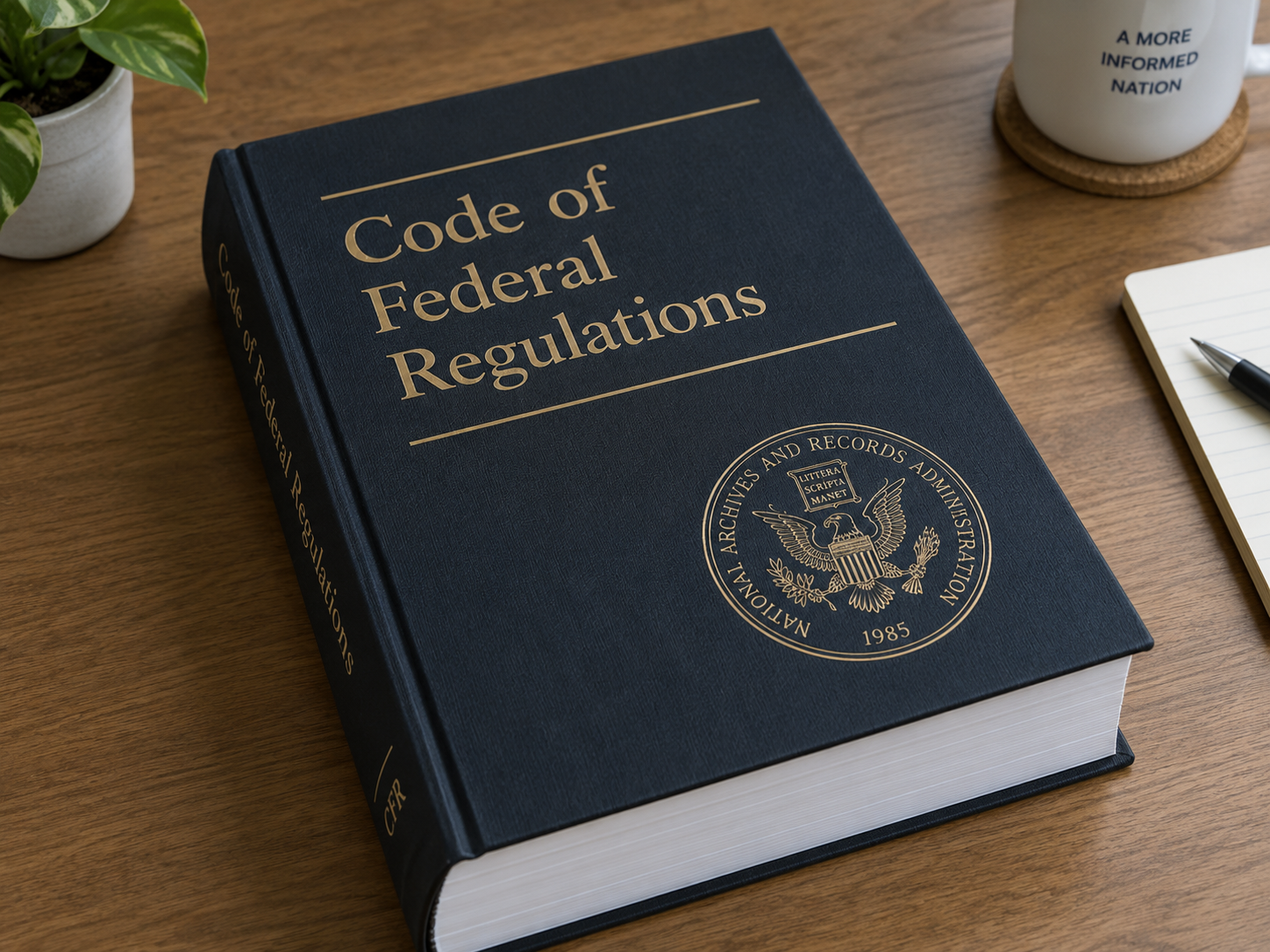
Below is a summary of 21 CFR § 101.22. At the end, the original six-page document is attached. CFR stands for Code of Federal Regulations.
§ 101.22 sits in Subpart B — Specific Food Labeling Requirements of 21 CFR Part 101. Its full title is "Foods; labeling of spices, flavorings, colorings and chemical preservatives," and it implements section 403(k) of the FD&C Act. It originated at 42 FR 14308 (March 15, 1977) and was last amended at 74 FR 216 (January 5, 2009) — so the text a flavorist is examined on has been stable for well over a decade.
(a) Definitions — the foundation
Artificial flavor / artificial flavoring (a)(1). Any substance whose function is to impart flavor and which is not derived from a spice, fruit or fruit juice, vegetable or vegetable juice, edible yeast, herb, bark, bud, root, leaf or similar plant material, meat, fish, poultry, eggs, dairy products, or fermentation products thereof. It includes the substances listed in §§ 172.515(b) and 182.60, except where those are derived from natural sources.
The critical point for the exam: the definition is source-based, not structure-based. Vanillin from lignin and vanillin from vanilla beans are chemically identical but regulatorily opposite. The European "nature-identical" category does not exist in U.S. law — a material is natural or artificial depending solely on its origin and process.
Spice (a)(2). Any aromatic vegetable substance in whole, broken, or ground form, excluding substances traditionally regarded as foods such as onions, garlic and celery; whose significant function in food is seasoning rather than nutritional; that is true to name; and from which no portion of any volatile oil or other flavoring principle has been removed. The enumerated list runs from allspice through turmeric. Paprika, turmeric, and saffron — spices that are also colors — must be declared as "spice and coloring" unless declared by their common or usual name.
Note the four-part test: aromatic vegetable substance, seasoning function, true to name, and nothing removed. An oleoresin fails the fourth prong and is therefore a natural flavor, not a spice.
Natural flavor / natural flavoring (a)(3). The essential oil, oleoresin, essence or extractive, protein hydrolysate, distillate, or any product of roasting, heating or enzymolysis, which contains the flavoring constituents derived from a spice, fruit or fruit juice, vegetable or vegetable juice, edible yeast, herb, bark, bud, root, leaf or similar plant material, meat, seafood, poultry, eggs, dairy products, or fermentation products thereof, whose significant function in food is flavoring rather than nutritional. Natural flavors include the natural essence or extractives obtained from plants listed in §§ 182.10, 182.20, 182.40, and 182.50 and part 184, and the substances listed in § 172.510.
Two things worth memorizing: the permitted processes are a closed list (roasting, heating, enzymolysis, plus the named physical isolates), and the function test — flavoring rather than nutritional — is what separates a natural flavor from a food ingredient. Also note the source list here says "seafood" where (a)(1) says "fish."
Artificial color (a)(4). Any "color additive" as defined in § 70.3(f).
Chemical preservative (a)(5). Any chemical that, when added to food, tends to prevent or retard deterioration, but excluding common salt, sugars, vinegars, spices, or oils extracted from spices, substances added by direct exposure to wood smoke, or chemicals applied for insecticidal or herbicidal properties.
(b)–(f) General placement and exemptions
A food subject to 403(k) must bear labeling even if it is not in package form (b), and the statement of artificial flavoring, coloring, or chemical preservative must be placed on the food, its container, or its wrapper — or any combination — so as to be likely read by the ordinary person under customary conditions of purchase and use (c). Specific artificial colors must be identified when part 74 so requires.
Three exemptions follow: unpackaged foods whose units are too small to carry the statement conspicuously (d); food received in bulk at retail and displayed either with the bulk container's labeling in view or with a counter card or sign carrying the 403(k) information (e); and fruits or vegetables treated pre-harvest with a chemical preservative applied as a pesticide chemical (f).
(g) Labeling of flavors shipped business-to-business
This is the paragraph governing what a flavor house puts on a drum going to a food manufacturer — not to a consumer. It applies unless a standard of identity has been promulgated for the flavor, in which case the standard controls.
- Single-ingredient flavor: declare by its common or usual name.
- Two or more ingredients: either declare each ingredient by common or usual name, or state "All flavor ingredients contained in this product are approved for use in a regulation of the Food and Drug Administration." Any flavor ingredient not covered by such a regulation, and any nonflavor ingredient, must be listed separately.
That second option is the legal basis for the industry practice of shipping flavors without disclosing the formula. It is not a blanket shield: unapproved flavor ingredients and all nonflavor components (solvents, carriers, antioxidants, emulsifiers) still have to appear.
- Naming convention: solely natural flavor is labeled e.g. "strawberry flavor," "banana flavor," or "natural strawberry flavor"; a mix of natural and artificial is labeled e.g. "natural and artificial strawberry flavor"; solely artificial is labeled e.g. "artificial strawberry flavor."
(h) Declaration in the ingredient statement of the finished food
Spice, natural flavor, and artificial flavor may be declared as "spice," "natural flavor," or "artificial flavor," or any combination thereof — the collective-name allowance. The remaining subparagraphs are the carve-outs, and they are heavily tested:
- An incidental additive originating in a spice or flavor need not be declared if it meets § 101.100(a)(3).
- Substances obtained by cutting, grinding, drying, pulping, or similar processing of fruit, vegetable, meat, fish, or poultry tissue — powdered or granulated onion, garlic powder, celery powder — are understood by consumers to be food rather than flavor and must be declared by their common or usual name.
- Salt must be declared as "salt"; monosodium glutamate must be declared as "monosodium glutamate." Neither may hide inside "natural flavor."
- Pyroligneous acid and other artificial smoke flavors may be declared as artificial flavor or artificial smoke flavor, but no representation may be made, directly or by implication, that the food has been smoked or has a true smoked flavor.
- Because protein hydrolysates function as both flavorings and flavor enhancers, none used for its flavor effect may be declared simply as "flavor," "natural flavor," or "flavoring" — it must be declared by its specific common or usual name per § 102.22 (e.g., "hydrolyzed soy protein").
(i) Characterizing flavor — the core of the section
The trigger: if the label, labeling, or advertising makes any direct or indirect representation about the primary recognizable flavor — by word, vignette (e.g., a depiction of a fruit), or other means — or if the manufacturer otherwise wishes to designate the flavor type outside the ingredient statement, that flavor is the characterizing flavor and the following naming rules attach. A picture of a strawberry is as much a representation as the word.
(i)(1) No artificial flavor simulating, resembling, or reinforcing the characterizing flavor. The name of the food on the principal display panel is accompanied by the common or usual name of the characterizing flavor — e.g., "vanilla" — in letters not less than one-half the height of the letters in the name of the food. Three sub-rules:
- (i)(1)(i) If the food is one commonly expected to contain a characterizing food ingredient (strawberries in "strawberry shortcake") and it contains natural flavor derived from that ingredient plus an amount of the ingredient insufficient to independently characterize the food — or none of the ingredient at all — the flavor name may be preceded by "natural" and must be followed by "flavored," in letters not less than half the height of the characterizing flavor name: "natural strawberry flavored shortcake" or "strawberry flavored shortcake."
- (i)(1)(ii) If none of the natural flavor used is derived from the product whose flavor is simulated, the food must be labeled either with the flavor of the product the flavor actually came from, or as "artificially flavored." This is the provision that turns an all-natural flavor into an "artificially flavored" declaration when the botanical source doesn't match the claim.
- (i)(1)(iii) If the food contains both characterizing flavor from the actual product and other natural flavor that simulates, resembles, or reinforces it, the name of the food must be immediately followed by "with other natural flavor," in letters not less than half the height of the characterizing flavor name. This is the WONF designation.
(i)(2) Any artificial flavor simulating, resembling, or reinforcing the characterizing flavor. The characterizing flavor name appears at not less than half the height of the food name, and must itself be accompanied by "artificial" or "artificially flavored" in letters not less than half the height of the characterizing flavor name — e.g., "artificial vanilla," "artificially flavored strawberry," "grape artificially flavored."
Note that the trigger is any artificial flavor performing that simulating/resembling/reinforcing role — there is no de minimis threshold. A trace of artificial vanillin used to round out a natural vanilla profile converts the whole declaration.
(i)(3) Placement. Wherever the characterizing flavor name appears conspicuously enough to be easily seen under customary purchase conditions, the required words must immediately and conspicuously precede or follow it with no intervening written, printed, or graphic matter, subject to three exceptions: trademark or brand matter may intervene if the required words remain clearly related to the characterizing flavor; where multiple flavors are present the statement need appear only once per statement of characterizing flavors ("artificially flavored vanilla and strawberry"); and where there are three or more distinguishable characterizing flavors, or a blend with no primary recognizable flavor, a descriptive generic term may be used in lieu of naming each — "artificially flavored fruit punch."
(i)(4) Supplier certification. A flavor supplier must certify in writing that any flavor designated as containing no artificial flavor does not, to the best of his knowledge and belief, contain any artificial flavor and that he added none. A guarantee under section 303(c)(2) of the act containing such a statement satisfies the requirement. A flavor user must make his own written certification only where he adds to or combines another flavor with a supplier-certified flavor; otherwise he may rely on the supplier's certification. Certifications must be retained throughout the period the flavor is supplied and for a minimum of three years afterward.
The five conditions attached are worth knowing because they define what FDA may and may not see in your plant:
- Certifications must be available on request at reasonable hours to FDA; they are treated as reports to the government and as guarantees under section 301(h), exposing the certifier to penalties under 18 U.S.C. 1001 and section 303(a).
- FDA should verify a reasonable, representative sample of certifications rather than requesting all of them.
- If no authorized person is available at inspection, the certifying party may arrange to have the person and records ready as soon as practicable — unless FDA has reason to believe the period would be used to alter inventories or records, in which case additional time is not permitted.
- The certifying party must provide a qualitative statement of composition sufficient for FDA to determine which raw materials, finished materials, and flavor ingredient records are needed; the examination is limited to those certifications being verified.
- Review of flavor ingredient records is limited to the qualitative formula and shall not include the quantitative formula. Notes and records removed from the premises must be kept as separate documents in FDA files, not copied into other reports, and not disclosed publicly except in a judicial proceeding.
That quantitative-formula protection is the statutory basis for flavor trade-secret confidentiality during inspection.
(j) Chemical preservatives
A food to which a chemical preservative is added must, unless exempt under § 101.100, bear a label declaration stating both the common or usual name of the ingredient and a separate description of its function — e.g., "preservative," "to retard spoilage," "a mold inhibitor," "to help protect flavor," "to promote color retention." The dual requirement (identity plus function) is the point; naming the chemical alone is insufficient.
(k) Colors
Colorings are declared in the ingredient statement per (k)(1) and (k)(2), except that colorings in butter, cheese, and ice cream may follow (k)(3), and foods under §§ 105.62 and 105.65 follow those sections.
- Certified colors (subject to certification under 721(c)) are declared by the name listed in part 74 or part 82, though the "FD&C" prefix and "No." may be dropped; "Lake" must be included for a lake (e.g., "Blue 1 Lake"). An alternative name may be given parenthetically.
- Exempt-from-certification colors not otherwise required by part 73 to be named may be declared as "Artificial Color," "Artificial Color Added," or "Color Added" (or an equally informative term), or alternatively as "Colored with " or " color," filled in with the part 73 name.
- Coloring added to butter, cheese, or ice cream need not be declared unless part 73 or 74 requires it for safe conditions of use, though voluntary declaration is recommended.
What to hold onto for the exam
The three decision points a flavorist is expected to work through automatically: is it natural or artificial (source and process test under (a)(1) and (a)(3)); what goes on the drum versus what goes in the ingredient statement ((g) vs. (h)); and what the front panel must say once a flavor is characterized ((i), with the natural / natural-flavored / WONF / artificial ladder and the one-half-letter-height rule at every rung). Then remember the carve-outs that cannot hide in "natural flavor": salt, MSG, protein hydrolysates, and dried vegetable powders.
Original document: