Flavor Materials that Contribute to Candy Flavor Notes: What Flavorists Need to Know
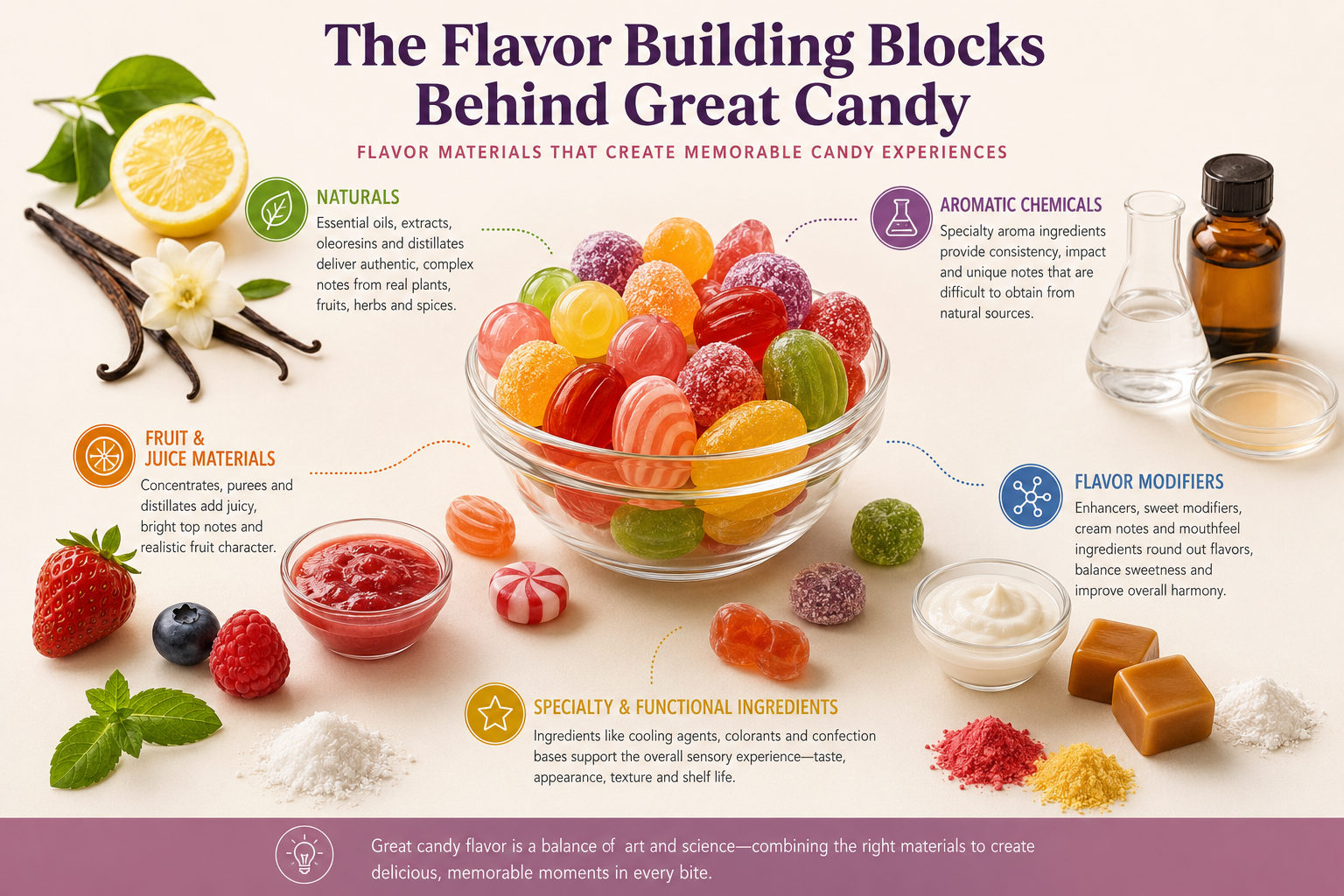
Candy notes are among several dozen flavor attributes that the Society of Flavor Chemists expects certified flavorists to understand and effectively manipulate during flavor formulation. Candidates may also encounter questions related to flavor materials that influence candy note during the qualification examination or interview.
This reference document is intended for educational and training purposes only. To foster professional growth, trainees are encouraged to independently develop and expand their own knowledge base throughout their careers.
Candy Flavor Notes: A Flavorist Training Compendium
Flavor Compounds, FEMA/CAS Identification, Applications, Dosage Guidance, and Technical Notes
This compendium covers ~33 compounds organized by functional family (sweetness/caramel enhancers, vanilla-dairy, fruity esters, cherry-almond, mint-licorice, citrus-green top notes, and trace "naturalizer" notes), each with FEMA/CAS numbers cross-checked against femaflavor.org, JECFA, and supplier documentation, plus dosage guidance, solubility/stability notes, and safety flags (diacetyl/acetoin respiratory hazard, piperonal's precursor-chemical sourcing status, methyl salicylate's toxicological dose ceiling).
It also includes process-compatibility guidance by candy format (hard candy vs. gummies vs. gum vs. chocolate vs. panned vs. tablets), classic flavor "accords" (cotton candy, bubblegum, butterscotch, root beer, etc.) flavorists build from these building blocks, and a regulatory framework section (FEMA GRAS vs. JECFA vs. EU Flavis vs. "natural" labeling vs. IFRA scope).
A couple of entries (acetoin, ethyl methylphenylglycidate, hexyl acetate, methyl cinnamate, γ-nonalactone) are flagged for FEMA-number verification as their current authoritative numbers need to be double checked against the live FEMA library before you rely on them in production documentation.
How to Use This Document
This compendium is organized by functional flavor family ("note") rather than alphabetically, because that is how flavorists actually think when building a candy flavor — you reach for the caramel/sweet-enhancer family first, then layer fruit, dairy, and modifying top notes on top of it.
For every compound you will find:
| Field | Meaning |
|---|---|
| FEMA No. | Flavor and Extract Manufacturers Association GRAS (Generally Recognized As Safe) number — the primary U.S. regulatory identifier for flavor ingredients |
| CAS No. | Chemical Abstracts Service registry number — use this to cross-reference SDS, JECFA, and EU Flavis listings |
| JECFA/Flavis | Cross-reference numbers where noted, for international (EU/Codex) work |
| Sensory Profile | Odor and taste descriptors as commonly cited in industry monographs (Arctander, Fenaroli, FEMA) |
| Candy Applications | Specific confectionery categories where the material is a workhorse |
| Suggested Dosage | Two numbers are given deliberately: (1) the level within the flavor compound itself as the flavorist builds it, and (2) the resulting use level in the finished candy, assuming the compound is dosed into the candy base at a typical 0.05–0.3% usage rate. These are starting points for bench trials, not fixed rules — always taste-build incrementally. |
| Technical Notes | Solubility, stability, regulatory, and safety information relevant to formulation |
Critical disclaimer for trainees: FEMA numbers, GRAS status, and permitted use levels are periodically updated, reassigned, or expanded by the FEMA Expert Panel and FDA. The identifiers below were verified against femaflavor.org, JECFA/WHO monographs, and supplier technical data sheets at the time of writing, but before any commercial formulation work, always confirm current status against the live FEMA GRAS Flavor Ingredient Library (femaflavor.org/flavor-library), the FDA Substances Added to Food inventory, the EU Flavis database, and your raw material supplier's current Certificate of Analysis. Treat every dosage figure here as a teaching starting point, never a finished-product specification.
1. The Sweetness / Caramel / Burnt-Sugar Family
This is the foundation family of candy flavor work. These molecules don't just taste "sweet" in the way sugar does — several of them are genuine taste modulators that potentiate perceived sweetness and roundness even when present below their own recognizable odor threshold. A flavorist who understands this family can rescue a thin, flat candy flavor faster than with almost any other tool in the kit.
1.1 Ethyl Maltol
| FEMA No. | 3487 |
| CAS No. | 4940-11-8 |
| Chemical Class | Pyranone (cyclic enol) |
| Sensory Profile | Intensely sweet, caramellic, cotton-candy, ripe-strawberry/jammy; roughly 4–6× the potency of maltol |
Candy Applications: The single most important "candy smell" molecule in the flavorist's palette. Defines cotton candy, foundational to bubblegum bases, used as a top-note lift in virtually every fruit hard candy, gummy, and marshmallow flavor. Also doubles as a genuine sweetness enhancer, allowing sugar or high-intensity sweetener reduction in the perceived sweetness profile without changing the actual sugar content.
Suggested Dosage: 0.1–2.0% in the flavor compound; typically yields 10–150 ppm in the finished candy. Note the dose-response curve plateaus quickly and is markedly non-linear — doubling the dose does not double the sweetness lift. If converting a formula from maltol, start at roughly 1/10th the maltol level and titrate up in small increments.
Technical Notes: White crystalline powder, water-soluble (~1 g/55 mL water), also soluble in propylene glycol — making it equally usable in PG-based liquid compounds and dry/powder flavor systems for compressed tablets or panned candy. Heat-stable enough for hard candy cook temperatures (145–155 °C boil), though some loss occurs with prolonged high-heat exposure, so late addition after the cook (post-boil, pre-pull/cast) is preferred for maximum top-note impact. Synergizes powerfully with vanillin/ethyl vanillin (the classic "bakery-candy" combination) and with light fruity esters. Self-limiting: above its sweet spot it can read as artificial/"candy-shop" rather than fruit-true, so it is usually a supporting player, not a base note, in fine fruit flavors.
1.2 Maltol
| FEMA No. | 2656 |
| CAS No. | 118-71-8 |
| Chemical Class | Pyranone (parent compound of ethyl maltol) |
| Sensory Profile | Sweet, caramel, cooked-sugar, bready; softer and less "candy-pink" than ethyl maltol |
Candy Applications: Caramel and toffee candies, malt-driven confections, bread/bakery-adjacent candy flavors, and as a milder sweetness enhancer where ethyl maltol would read too "cotton-candy."
Suggested Dosage: Requires roughly 10× the dose of ethyl maltol for comparable effect — typically 1–5% in the flavor compound, yielding 100–1000 ppm in finished candy.
Technical Notes: Naturally occurs in roasted malt, pine needles, and larch bark (hence the name). Like ethyl maltol, it is a metal chelator (binds Fe³⁺, Al³⁺) — a property occasionally relevant to discoloration issues in iron-fortified products. Water-soluble; melting point 161–162 °C. EU designation E636.
1.3 Furaneol (4-Hydroxy-2,5-dimethyl-3(2H)-furanone / DMHF / Strawberry Furanone)
| FEMA No. | 3174 |
| CAS No. | 3658-77-3 |
| Flavis No. | 13.010 |
| Chemical Class | Hydroxyfuranone |
| Sensory Profile | Concentration-dependent: caramellic/burnt-pineapple at high concentration, true ripe-strawberry/fruit-jam sweetness at low (sub-ppm) dilution |
Candy Applications: The character-impact molecule for natural-style strawberry and pineapple candy, gummy, and beverage flavors. Essential for moving a strawberry flavor from "strawberry ester soap" toward "ripe macerated strawberry."
Suggested Dosage: Extremely potent — typically dosed at only 0.01–0.3% in the flavor compound, yielding low single-digit ppm in finished product. Always trial at the low end first; overdosing collapses the fruit character into a burnt-sugar/caramel note.
Technical Notes: Naturally occurs in strawberry, pineapple, mango, tomato, and roasted coffee. Chirally active — the (R)-enantiomer dominates the desirable strawberry character in most commercial natural extracts. Reasonably water-soluble; sensitive to oxidation and to pH extremes, so test stability in highly acidic sour-candy systems. Pairs exceptionally well with ethyl butyrate, cis-3-hexenol (trace), and ethyl maltol.
1.4 Sotolon (3-Hydroxy-4,5-dimethylfuran-2(5H)-one)
| FEMA No. | 3634 |
| CAS No. | 28664-35-9 |
| Chemical Class | Hydroxyfuranone (butenolide) |
| Sensory Profile | One of the most powerful odorants known to flavor chemistry; sweet, caramellic, maple, brown-sugar, fenugreek/curry at higher concentration |
Candy Applications: The character-impact molecule for maple candy and maple-fudge flavors, and a useful trace addition to deepen butterscotch, brown-sugar, and aged-rum-style confections. Historically, maple flavors were built almost entirely from fenugreek extract because fenugreek is naturally rich in this same molecule.
Suggested Dosage: Sub-ppm to low single-digit ppm in the finished candy is typical — this is one of the lowest-dose materials in the entire flavorist toolkit (odor detection threshold reported in the parts-per-trillion range for the sweet-smelling enantiomer). In the flavor compound itself, dose at 0.01–0.1% and adjust by very small increments.
Technical Notes: Chiral; the two enantiomers have distinctly different character (one reads sweet/milky, the other smoky/herbaceous/curry-like) and very different odor thresholds, so sourcing consistency between batches matters. Because of its extreme potency, accurate weighing (and often pre-dilution to a 1% or 0.1% working solution) is mandatory — this is not a material to weigh directly into a production batch.
1.5 Cyclotene (Methylcyclopentenolone / Maple Lactone / Corylone)
| FEMA No. | 2700 |
| CAS No. | 80-71-7 (also cited as 765-70-8 for the keto tautomer) |
| Chemical Class | Cyclopentenolone |
| Sensory Profile | Cooked-sugar, maple-syrup-like, bready, slightly nutty |
Candy Applications: Supporting note in maple, brown-sugar, butterscotch, and nut-praline candy flavors; rounds out caramel profiles without the intensity (or cost) of sotolon.
Suggested Dosage: 0.5–3% in the flavor compound; can be used at relatively high levels in obviously "brown" flavors compared to most of this family.
Technical Notes: Exists as a keto-enol tautomer (hence the dual CAS listings you'll see across suppliers — confirm which form your supplier ships). Found widely in nature wherever sugars have been thermally processed (roasted, baked, caramelized).
1.6 Diacetyl (2,3-Butanedione)
| FEMA No. | 2370 |
| CAS No. | 431-03-8 |
| Chemical Class | Vicinal diketone |
| Sensory Profile | Intensely buttery, creamy |
Candy Applications: Butterscotch, butter-toffee, caramel, and brown/bakery-style confections — almost always used together with acetoin rather than alone, to give a rounder, less one-dimensional "butter" effect.
Suggested Dosage: Used at very low ppm in finished product (commonly single-digit ppm); in the flavor compound, typically a small fraction of a percent.
⚠️ Mandatory safety note for flavorists: Diacetyl is classified by FEMA as a high-priority respiratory hazard substance. Chronic inhalation exposure to diacetyl vapor — historically in microwave-popcorn and flavor-manufacturing settings — is a documented cause of bronchiolitis obliterans ("popcorn lung"). NIOSH has published recommended exposure limits (REL-TWA 5 ppb, STEL 25 ppb) specifically for this compound. Always handle diacetyl and diacetyl-containing butter flavors under proper local exhaust ventilation, with the controls specified on the SDS — this applies to weighing, mixing, and any heated application step (e.g., pouring hot butter flavor into a heated candy mixing tank), which is the highest-exposure scenario documented in industry hygiene literature. Many flavor houses have shifted toward diacetyl-reduced or diacetyl-free butter flavor systems for exactly this reason; know your company's policy before working with this material.
Technical Notes: Flammable, volatile yellow liquid; occurs naturally in fermented dairy and alcoholic beverages. Self-limiting in finished food — overdose reads as rancid/cheesy rather than buttery.
1.7 Acetoin (3-Hydroxybutan-2-one)
| CAS No. | 513-86-0 |
| Chemical Class | Acyloin (hydroxyketone), the reduced form of diacetyl |
| Sensory Profile | Bland, soft, yogurt-like, creamy-buttery (much gentler than diacetyl) |
Candy Applications: Used alongside diacetyl in butterscotch and caramel candy to round and soften the sharp, dominant top note of diacetyl alone; contributes a dairy/creamy background to fudge and toffee.
Suggested Dosage: Typically dosed at a higher level than diacetyl (often several-fold) because it is far less potent; verify current FEMA GRAS listing and supplier-recommended use levels before formulating, as exact published use-level data should be confirmed for your specific application.
Technical Notes: Also flagged by FEMA among the high-priority substances for occupational respiratory hazard alongside diacetyl — the same workplace-ventilation caution applies. Fully water-miscible; also used industrially as the marker analyte in the Voges–Proskauer microbiological test, an interesting cross-disciplinary fact worth knowing if you ever collaborate with microbiologists on starter-culture-derived dairy flavors.
2. The Vanilla / Creamy-Dairy Family
2.1 Vanillin
| FEMA No. | 3107 |
| CAS No. | 121-33-5 |
| Chemical Class | Phenolic aldehyde (4-hydroxy-3-methoxybenzaldehyde) |
| Sensory Profile | Classic warm, sweet, vanilla-balsamic |
Candy Applications: Universal background warmer and sweetness rounder — present in some amount in nearly every candy flavor type, from chocolate to fruit to caramel, because it smooths harsh top notes and adds perceived richness/body.
Suggested Dosage: 1–5% in the flavor compound is common; finished-candy levels of roughly 200–1000 ppm are typical for flavors where vanilla is a featured (not just background) note.
Technical Notes: White crystalline solid, the original "first flavor" synthesized industrially (1874). Synthetic vanillin (from guaiacol or, increasingly, ferulic acid/lignin routes) and natural vanilla extract are chemically related but organoleptically distinct — natural extract contains hundreds of trace co-occurring compounds. Can discolor (pinking) under alkaline or light-exposed conditions over shelf life — worth monitoring in clear hard-candy or gummy systems stored in clear packaging.
2.2 Ethyl Vanillin
| FEMA No. | 2464 |
| CAS No. | 121-32-4 |
| Chemical Class | Phenolic aldehyde (3-ethoxy-4-hydroxybenzaldehyde) |
| Sensory Profile | Vanilla, but 2–4× more potent than vanillin, with a sharper, "creamier," slightly less natural edge |
Candy Applications: Used where a stronger, more cost-efficient vanilla lift is needed than vanillin alone provides — common in chocolate-adjacent candy, bakery-candy crossover items, and as a booster layered with vanillin rather than a full replacement (the two are not organoleptically identical, and an all-ethyl-vanillin profile can read as one-dimensional).
Suggested Dosage: Typical published guidance allows up to roughly 200 ppm in the finished flavor application, and up to ~8% of the total flavor compound at the high end — though in practice, most candy applications use far less (a few hundred ppm in the compound) since the potency-cost tradeoff rewards restraint.
Technical Notes: White-to-pale-yellow crystals; less stable in storage/transport than vanillin in some formats, but generally preferred industrially for cost efficiency at equivalent vanilla impact. Self-limiting — excess produces an off, slightly bitter/chemical edge.
2.3 Piperonal (Heliotropin)
| FEMA No. | 2911 |
| CAS No. | 120-57-0 |
| Chemical Class | Methylenedioxybenzaldehyde |
| Sensory Profile | Sweet, powdery, floral-vanilla, with a "cherry-pie"/heliotrope-flower character; structurally related to vanillin and benzaldehyde |
Candy Applications: A supporting player in cherry candy (adds a powdery-sweet floral lift behind benzaldehyde's almond-cherry top note), and occasionally in vanilla-adjacent and coconut-style confections where its hay-like, powdery sweetness rounds the profile.
Suggested Dosage: Low — typically a small fraction of a percent in the flavor compound, used as a trace modifier rather than a base note.
Technical Notes — sourcing/regulatory: Piperonal is listed as a DEA List I controlled chemical precursor in the United States (and under equivalent precursor-control categories internationally), because of its relationship to safrole-derived synthesis routes for controlled substances. This does not affect its GRAS food-use status, but it does mean bulk procurement, import, and recordkeeping for piperonal are subject to additional regulatory paperwork (DEA registration/reporting requirements) beyond standard flavor-ingredient purchasing. Flavorists and purchasing teams should be aware of this when sourcing the material, as lead times and supplier documentation requirements can differ from typical aroma chemicals.
2.4 The Creamy-Peach Lactone Trio: γ-Decalactone, γ-Undecalactone, γ-Dodecalactone
These three closely related lactones are grouped together because they are almost always used in combination, with the balance between them shifting the perceived character from "aroma-forward peach" toward "creamy, fatty, dairy-adjacent."
| Compound | FEMA No. | CAS No. | Character |
|---|---|---|---|
| γ-Decalactone | 2360 | 706-14-9 | The backbone peach note — fresh, oily-waxy, peach-coconut-buttery |
| γ-Undecalactone (Aldehyde C-14) | 3091 | 104-67-6 | Peach/apricot, slightly less fatty, more aromatic top-note lift |
| γ-Dodecalactone | 2400 | 2305-05-7 | Shifts the balance toward creamy/fatty and away from pure aroma — useful in dairy-adjacent candy (peaches-and-cream type profiles) |
Candy Applications: Peach, apricot, and plum hard candy and gummies; also a useful "creaminess" booster in vanilla, caramel, and dairy-style candy flavors at trace levels, since the fatty-lactonic character reads as richness even outside a fruit context.
Suggested Dosage: γ-Decalactone is typically the dominant lactone at roughly 1,500–2,500 ppm within the flavor compound for a true peach profile (yielding low single-digit to ~10 ppm in the finished candy at typical use rates); γ-undecalactone and γ-dodecalactone are usually added at lower supporting levels to round and soften the decalactone's powerful, somewhat one-note peach character.
Technical Notes: All three are oil-soluble, heat-stable lactones well suited to hard-candy cook temperatures. They occur naturally in peach, apricot, strawberry, butter, and dairy products. γ-Dodecalactone in particular is prized for adding "creamy-fatty wax" body to gourmand-style flavor profiles.
2.5 γ-Nonalactone
| CAS No. | 104-61-0 |
| Chemical Class | γ-lactone |
| Sensory Profile | Creamy, coconut, fruity — sits between the short-chain caramel lactones and the long-chain peach lactones |
Candy Applications: Coconut candy, creamy/dairy candy bases, and as a rounding note in tropical-fruit gummy and hard candy flavors.
Suggested Dosage: Low-to-moderate ppm range within the flavor compound; verify current FEMA listing before formulation.
Technical Notes: Oil-soluble; heat-stable; a useful bridge note when a flavor needs "creaminess" without the heavier fat-like character of γ-dodecalactone.
3. The Fruity Ester / Fermentation-Note Family
Esters are the workhorse top notes of nearly every fruit candy flavor. As a class they are generally oil-soluble, volatile (meaning they are best added late in hot processes, or used in flavor systems designed for cold/low-heat application such as gummies and panned candy), and prone to hydrolysis back to their parent acid and alcohol under acidic, aqueous, long-shelf-life conditions — a real concern in sour hard candy and gummies, where citric/malic/tartaric acid is present at significant levels.
3.1 Isoamyl Acetate
| FEMA No. | 2055 |
| CAS No. | 123-92-2 |
| Chemical Class | Ester (banana oil) |
| Sensory Profile | Banana, fruity, sweet pear undertone |
Candy Applications: The character-impact molecule for banana candy; also a common minor component of tropical and bubblegum fruit blends.
Suggested Dosage: 1–5% in the flavor compound is typical for a banana-forward profile; dose down for trace tropical-fruit complexity.
Technical Notes: Colorless, volatile, nearly insoluble in water — formulate in oil/PG-based systems or pre-emulsify for water-based gummy syrups. Highly volatile, so candy applications involving high heat (hard candy boil) should add late in the process.
3.2 Isoamyl Butyrate
| FEMA No. | 2060 |
| CAS No. | 106-27-4 |
| Chemical Class | Ester |
| Sensory Profile | Fruity, apricot, pineapple, banana, sweet |
Candy Applications: Tropical-fruit and banana flavor blends; adds a rounder, less sharp banana character than isoamyl acetate alone.
Suggested Dosage: Trace-to-moderate, typically used as a supporting ester rather than a base note.
3.3 Ethyl Butyrate
| FEMA No. | 2427 |
| CAS No. | 105-54-4 |
| Chemical Class | Ester |
| Sensory Profile | Fruity, pineapple, juicy-sweet |
Candy Applications: A foundational fruit-ester base note across pineapple, tropical, and general "fruit punch" style candy and gummy flavors; a key contributor to commercial orange-juice flavor enhancement as well, relevant to citrus-candy crossover work.
Suggested Dosage: Commonly 1–8% in the flavor compound depending on how fruit-forward the target profile is.
Technical Notes: Soluble in propylene glycol and mineral/paraffin oil; fairly volatile (flash point 26 °C), flammable — standard aroma-chemical handling precautions apply.
3.4 Ethyl Isovalerate
| FEMA No. | 2463 |
| CAS No. | 108-64-5 |
| Chemical Class | Ester |
| Sensory Profile | Fruity, apple, sweet |
Candy Applications: Green-apple and mixed-fruit candy blends, often paired with hexyl acetate and trace cis-3-hexenol for a "fresh-cut apple" effect.
Suggested Dosage: Trace-to-low percentage in the compound; very potent, easy to overdose into a "nail-polish-remover"-adjacent fermented character.
3.5 Allyl Hexanoate (Allyl Caproate)
| FEMA No. | 2032 |
| CAS No. | 123-68-2 |
| Chemical Class | Ester |
| Sensory Profile | Fruity-sweet, distinctly pineapple, with a juicy realism that pure ethyl esters lack |
Candy Applications: Pineapple hard candy and gummies, tropical-fruit blends, and as a "juiciness" booster in apple, apricot, peach, and citrus profiles.
Suggested Dosage: FEMA-published average maximum use levels (cross-industry, all food categories) cite figures in the range of roughly 25–210 ppm in finished product depending on category (e.g., ~32 ppm typical in confectionery, ~210 ppm in chewing gum) — useful reference points, though always confirm current published levels.
Technical Notes: Occurs naturally in pineapple. The pure material carries GHS hazard statements (irritant; environmental hazard) relevant to handling/storage, though this does not affect its food-use GRAS status at the low levels used in flavor compounding.
3.6 Methyl Anthranilate
| FEMA No. | 2682 |
| CAS No. | 134-20-3 |
| Chemical Class | Anthranilate ester (amino-benzoate) |
| Sensory Profile | Strong, unmistakable Concord-grape character, with musty/floral berry nuances at lower concentration (orange-blossom-like) |
Candy Applications: The character-impact molecule for "purple grape" candy in the North American style — defines the grape note in hard candy, gummies, and bubblegum. Also a component of classic "fruit punch" and foxy-grape profiles when blended with esters like ethyl heptanoate.
Suggested Dosage: Trace-to-low percentage in the compound — this is an extremely recognizable, dominant note, so small changes in level produce large perceptual shifts. Start low (well under 1% of compound) and build up.
Technical Notes: Has a light blue-violet fluorescence under UV — a fun, occasionally useful identification/QC trick. Slightly soluble in water, fully soluble in ethanol and propylene glycol. Stable in most candy systems; reacts (forms Schiff bases) with aldehydes over time in blended compounds, which can mute both the grape note and the aldehyde's character — be mindful when formulating grape flavors that also contain significant aldehyde content.
3.7 Ethyl Methylphenylglycidate ("Strawberry Aldehyde" / Aldehyde C-16)
| CAS No. | 77-83-8 |
| Chemical Class | Glycidate ester |
| Sensory Profile | The quintessential "artificial strawberry" top note — sweet, candy-like, unmistakably strawberry in a stylized, confectionery sense rather than a true-fruit sense |
Candy Applications: The signature note in classic strawberry hard candy, strawberry gummy, and strawberry bubblegum — the smell most consumers associate with "strawberry candy" specifically (as distinct from the more natural Furaneol-driven "ripe strawberry" character used in premium/natural-style flavors).
Suggested Dosage: Low-to-moderate percentage of the compound; commonly blended with Furaneol, ethyl butyrate, and a touch of vanillin for a fuller strawberry-candy accord. Confirm current FEMA status and recommended use levels with your supplier before formulating, as this material's regulatory listing should be verified directly.
Technical Notes: Despite the trivial name "strawberry aldehyde," it is structurally a glycidate ester, not an aldehyde. Oil-soluble; one of the most recognizable single-molecule "candy" smells in the entire aroma-chemical palette — useful to memorize on the bench, since trainees often identify it instantly once they've smelled it once.
3.8 Hexyl Acetate
| CAS No. | 142-92-7 |
| Chemical Class | Ester |
| Sensory Profile | Fruity, green-apple, pear |
Candy Applications: Green-apple and pear candy profiles, typically paired with ethyl 2-methylbutyrate and trace cis-3-hexenol for a fresh, slightly tart "orchard fruit" effect.
Technical Notes: Verify current FEMA GRAS listing before formulation; widely used as an apple-note building block across the industry.
3.9 Methyl Cinnamate
| CAS No. | 103-26-4 |
| Chemical Class | Cinnamate ester |
| Sensory Profile | Sweet, fruity-balsamic, strawberry-grape adjacent, with a soft spiced edge |
Candy Applications: Used as a blending/rounding note in grape and mixed-berry candy flavors, and occasionally in cinnamon-adjacent fruit blends.
Technical Notes: Verify current FEMA GRAS listing before formulation.
3.10 Raspberry Ketone
| FEMA No. | 2588 |
| CAS No. | 5471-51-2 |
| Chemical Class | Aromatic ketone |
| Sensory Profile | Sweet, fruity-powdery, true raspberry character |
Candy Applications: The character-impact molecule for raspberry hard candy, gummies, and red-berry blends; also lends a soft powdery-fruity background note when used in trace amounts in other red-fruit profiles (cherry, strawberry-raspberry blends).
Suggested Dosage: Potent — typically used at low fractional-percent levels in the compound.
Technical Notes: Naturally occurs in raspberries (though at very low natural abundance, which is why natural raspberry ketone commands a high price and most commercial supply is nature-identical/synthetic, or produced via fermentation/bioconversion routes). White solid; soluble in ethanol and propylene glycol.
4. The Cherry / Almond / Stone-Fruit Family
4.1 Benzaldehyde
| FEMA No. | 2127 |
| CAS No. | 100-52-7 |
| Chemical Class | Aromatic aldehyde |
| Sensory Profile | Bitter almond, cherry-pit, sharp and penetrating |
Candy Applications: The character-impact molecule for cherry candy (the classic "black cherry" cough-drop/candy smell) and for marzipan/almond confections. Almost never used as the sole note in a cherry flavor — it needs fruity esters and a touch of sweetness (vanillin, ethyl maltol) to read as "cherry" rather than "almond extract" or "maraschino medicinal."
Suggested Dosage: Moderate percentage of the compound for a true cherry profile (often 2–10% depending on target intensity); much lower for a background almond-marzipan accent.
Technical Notes: Colorless liquid, almond odor; industrially produced both synthetically and via a "natural" retro-aldol route from cassia-oil-derived cinnamaldehyde (the natural-vs-synthetic distinction here is a genuinely interesting case study for trainees, and isotope-ratio NMR is used industrially to verify naturalness claims). Oxidizes readily to benzoic acid on storage exposure to air/light — keep containers tightly closed and use an antioxidant-stabilized grade if long shelf life is required.
4.2 Benzyl Acetate
| FEMA No. | 2135 |
| CAS No. | 140-11-4 |
| Chemical Class | Ester |
| Sensory Profile | Sweet, fruity-floral (jasmine-adjacent), pear-like undertone |
Candy Applications: A blending and rounding note in cherry, pear, and tropical-fruit candy flavors — softens benzaldehyde's sharp almond edge and adds floral-fruity body.
Suggested Dosage: Trace-to-low percentage as a supporting/blending note.
4.3 Cinnamaldehyde
| FEMA No. | 2286 |
| CAS No. | 104-55-2 |
| Chemical Class | Aromatic aldehyde |
| Sensory Profile | Pungent, spicy, classic "red hot" cinnamon — sweet and warm at low concentration, sharp/burning at high concentration |
Candy Applications: The character-impact molecule for cinnamon hard candy ("fire" candies), cinnamon gum, and red-hot-style confections; also a minor warming note in some spiced fruit and holiday-candy blends.
Suggested Dosage: Highly application-dependent — cinnamon "heat" candy intentionally pushes this material to levels that would be considered overdosed in any other context; conversely, as a background spice note in fruit candy it is used at only trace fractional-percent levels.
Technical Notes: A known skin sensitizer at the concentrated raw-material stage — standard PPE (gloves, eye protection) is mandatory during weighing and compounding. Naturally the major component of cinnamon bark oil and cassia oil. Reactive (can polymerize/discolor over time, especially in the presence of amines or at elevated temperature) — monitor color stability in clear hard-candy applications over shelf life.
5. The Mint / Wintergreen / Licorice-Anise Family
5.1 Methyl Salicylate
| FEMA No. | 2745 |
| CAS No. | 119-36-8 |
| Chemical Class | Salicylate ester |
| Sensory Profile | Intensely medicinal-minty, classic wintergreen; also reads as "root beer/birch beer" and contributes to certain caramel/almond accords at very low trace levels |
Candy Applications: The character-impact molecule for wintergreen candy and gum; a defining trace component of root beer and birch beer hard candy; occasionally used at extremely low trace levels as a complexing note in cherry-medicinal cough-drop style candy.
Suggested Dosage: For a true wintergreen profile, typically several hundred to low-thousands ppm in the finished candy; FEMA-published regulatory context cites a European maximum permitted level of 8400 mg/kg (8400 ppm) in the relevant food category, with an ADI of 0.5 mg/kg body weight — useful upper-bound regulatory reference points, not target use levels.
Technical Notes: Pharmacologically active (related to aspirin/salicylate chemistry) — this is the basis for its regulated maximum-use-level status, and it is one of the few flavor materials where the toxicological dose ceiling is a genuinely binding formulation constraint, not just a sensory one. Never approach the regulatory maximum casually; work with your regulatory/QA team on any wintergreen formulation. Naturally the major component of true oil of wintergreen and birch oil.
5.2 Anethole (trans-Anethole)
| FEMA No. | 2086 |
| CAS No. | 4180-23-8 |
| Chemical Class | Phenylpropene (alkoxypropenylbenzene) |
| Sensory Profile | Sweet, warm, spicy anise/licorice; the characteristic black-licorice candy smell |
Candy Applications: The character-impact molecule for licorice and anise candy and gum; also used at very low trace levels as a "sweetening" complexing note in root beer and certain spice-candy blends.
Suggested Dosage: For true licorice/anise candy, moderate-to-high percentage of the compound is typical, since this is meant to be a dominant, unmistakable note; for trace complexing use elsewhere, only a few hundred ppm of the compound.
Technical Notes: Naturally the major aromatic component of anise seed and star anise oil, and a significant component of fennel oil. Crystallizes near room temperature (melting point 20–21 °C) — solutions can solidify in cool storage/shipping conditions, so warm and re-mix before use rather than assuming a separated/cloudy material is degraded.
6. The Citrus / Green / Top-Note Modifier Family
These materials rarely carry a candy flavor on their own; their job is to add lift, freshness, and realism at the top of the profile.
6.1 Citral
| FEMA No. | 2303 |
| CAS No. | 5392-40-5 |
| Chemical Class | Acyclic monoterpene aldehyde (mixture of geranial + neral isomers) |
| Sensory Profile | Strong, fresh lemon |
Candy Applications: Lemon and citrus hard candy and gummies; a top-note lift in lemon-lime and tropical-fruit blends.
Suggested Dosage: Low-to-moderate percentage of the compound depending on lemon intensity desired; citral is potent and easy to overdose into a soapy/harsh character.
Technical Notes: Oxidizes readily, especially on exposure to light, air, and trace metal ions — this is a genuinely significant shelf-life concern in citrus candy and can produce off, "cardboard"/stale-lemon notes over time. Store cool, dark, and consider an antioxidant-stabilized grade for long-shelf-life products. The major aromatic component of lemongrass and lemon peel oil.
6.2 Linalool
| FEMA No. | 2635 |
| CAS No. | 78-70-6 |
| Chemical Class | Acyclic monoterpene alcohol |
| Sensory Profile | Floral, fresh, slightly spicy/woody, lightly citrus-adjacent |
Candy Applications: A top-note rounding agent across citrus, floral-fruit (lychee, rose, lavender-adjacent), and tropical-fruit candy profiles — adds freshness and lift without contributing a strong character of its own.
Suggested Dosage: Trace-to-low percentage as a top-note modifier rather than a base note.
Technical Notes: Naturally occurs in dozens of essential oils (rosewood, lavender, coriander, citrus peel). Two enantiomers exist with different odor character (one more "soapy-coriander," the other more "woody-floral-lavender") — sourcing can affect the exact character you get.
6.3 D-Limonene
| FEMA No. | 2633 |
| CAS No. | 5989-27-5 |
| Chemical Class | Cyclic monoterpene |
| Sensory Profile | Fresh orange/citrus peel |
Candy Applications: The backbone top-note in orange candy and citrus blends; also used at trace levels in tropical and general "fruit-fresh" profiles to add a bright citrus lift.
Suggested Dosage: Moderate-to-high percentage of the compound for a true orange profile (it is the major component of cold-pressed orange oil itself); used at lower levels as a top-note modifier elsewhere.
Technical Notes: Highly volatile and oxidation-prone (oxidizes over time to carvone and other off-notes that read as "stale citrus") — same storage cautions as citral apply, and this is one of the more common sources of shelf-life complaints in citrus hard candy if the raw material or finished good is not adequately protected from heat, light, and air.
6.4 cis-3-Hexenol ("Leaf Alcohol")
| FEMA No. | 2560 |
| CAS No. | 928-96-1 |
| Chemical Class | Unsaturated alcohol |
| Sensory Profile | Fresh-cut grass, green leaf, unripe banana/green fruit |
Candy Applications: A trace top-note modifier essential to realistic green-apple, watermelon, kiwi, and unripe-fruit candy profiles — without a trace of "green," these fruit flavors can read as overripe or candy-sweet rather than fresh and true-to-fruit.
Suggested Dosage: Extremely low — typically well under 0.1% of the compound. This material is powerful and easy to overdose into a "cut grass/vegetal" character that reads as off rather than fresh.
Technical Notes: A genuine plant pheromone/semiochemical in nature (released by damaged plant tissue). Verify current FEMA listing before formulation; widely cross-referenced in patent and industry literature as a green-note building block, frequently esterified (cis-3-hexenyl acetate, etc.) for a softer, more "green-banana-candy" version of the same character rather than the sharper free alcohol.
7. Complexing / Rose-Tobacco / "Mystery Depth" Note
7.1 β-Damascenone
| FEMA No. | 3420 |
| CAS No. | 23696-85-7 (natural form) / 23726-93-4 |
| Chemical Class | Rose ketone (norisoprenoid) |
| Sensory Profile | Extraordinarily complex and potent — fruity, rose-like, plum/cooked-apple, with tobacco/wine-like depth; defies simple single-word description |
Candy Applications: Used in vanishingly small trace amounts to add unexplainable "depth," "naturalness," and roundness to fruit candy flavors (plum, apple, grape, and red-fruit blends especially) — the kind of addition that, when removed, makes a flavor taste noticeably flatter even though no taster could identify the missing molecule by name.
Suggested Dosage: Sub-ppm to very low single-digit ppm in the finished compound; this is one of the most potent odorants in the entire flavor industry and must be handled as a pre-diluted working solution (e.g., 0.1–1% in PG or alcohol) rather than weighed neat into production batches.
Technical Notes: Naturally occurs (at trace levels) in rose, grape, apple, and many fruits and is a significant contributor to wine and tea aroma. Demonstrates a core flavorist principle worth teaching explicitly: character-impact does not require high concentration — some of the most important "naturalizing" tools in the entire palette are dosed in the parts-per-billion range.
8. Cross-Cutting Technical Knowledge for Flavorists
8.1 Format and Process Compatibility
Candy manufacturing isn't one process — it's several very different thermal and matrix environments, and matching your flavor compound's physical/chemical profile to the process is as important as getting the sensory profile right.
| Candy Format | Typical Process Conditions | Flavorist Implications |
|---|---|---|
| Hard candy (boiled/pulled) | Sugar/glucose syrup boiled to ~145–155 °C, then flavor added during the cool-down/pulling stage | Favor heat-stable, oil-soluble compounds (lactones, most esters survive if added late); highly volatile top notes (citral, esters) must be added as late as possible, ideally just before casting/forming, to minimize flash-off loss |
| Gummies / jellies (gelatin or pectin-set) | Cooked at lower temperature (~110–120 °C for the sugar/gum slurry), then flavor and acid added at depositing temperature | More forgiving of volatile top notes than hard candy; but gummies have a long shelf life in a moist, often acidic matrix — ester hydrolysis and Furaneol/aldehyde degradation over shelf life are real concerns, so stability testing under accelerated shelf-life conditions matters |
| Chewing gum | Flavor blended directly into gum base (a hydrophobic elastomer matrix), often with encapsulated or high-intensity flavor for sustained release | Favor oil-soluble materials and consider flavor encapsulation technology for longer-lasting flavor release through chewing; very high flavor loading is typical compared to other candy formats |
| Chocolate / enrobed candy | Flavor blended into the fat phase (cocoa butter or compound coating) at moderate temperature | Must be fully oil/fat-soluble — water-soluble crystalline materials like maltol or vanillin in their plain form may need a fat-dispersible carrier or pre-dissolution step |
| Panned/coated candy | Flavor sprayed onto a rotating sugar or chocolate panning batch in successive thin layers | Favor materials stable to repeated thin-layer drying cycles; flavor is applied at relatively low temperature compared to hard-candy cooking, so this format is more forgiving of volatile top notes |
| Compressed tablets (mints, etc.) | Dry-blended powder compression — no heat/water exposure at all | Favor dry, crystalline, or spray-dried/encapsulated flavor forms (e.g., powdered maltol, encapsulated citrus oils) rather than liquid PG/oil-based compounds, for both processing compatibility and shelf stability |
8.2 Solubility and Carrier Selection
- Water/PG-soluble crystalline solids: maltol, ethyl maltol, vanillin, ethyl vanillin, raspberry ketone — these dissolve readily in propylene glycol or warm water/syrup systems and are the easiest family to use across gummy, hard candy, and beverage-style applications.
- Oil-soluble liquids: most esters, lactones, terpenes (citral, limonene, linalool), and aldehydes (benzaldehyde, cinnamaldehyde) — require an oil or high-proof alcohol carrier, or emulsification, for use in aqueous candy systems like gummies; straightforward in chocolate/fat-based applications.
- Emulsified flavor systems: for clear or near-clear hard candy and gummy applications where an oil-soluble flavor must remain stable and non-clouding in an aqueous matrix, flavor houses commonly supply pre-emulsified (weighted or gum-arabic/modified-starch stabilized) versions rather than asking the candy manufacturer to emulsify neat aroma chemicals on their own line.
8.3 Stability Considerations Specific to Candy
- Acid (sour candy) systems: Citric, malic, and tartaric acid at the levels used in sour candy (often several percent) accelerate ester hydrolysis over shelf life, slowly converting esters back to their parent acid + alcohol and dulling the fruit top note. Accelerated shelf-life testing (elevated temperature/humidity) is essential before finalizing a sour-candy flavor at a target dose.
- Light exposure: Citral, limonene, and vanillin are all light-sensitive to varying degrees; clear-wrapped or clear-jar hard candy and gummies are more vulnerable to flavor degradation and discoloration over retail shelf life than opaque-packaged products.
- Maillard/browning interactions: In high-sugar, high-heat hard candy cooking, reducing sugars and amino-acid-containing ingredients (e.g., dairy solids in caramel/toffee) can generate their own in-situ Maillard flavor compounds (including some of the same furanones and pyrazines flavorists add deliberately) — meaning the same finished flavor profile may need a different added-flavor dose depending on the base recipe's own browning chemistry.
- Metal chelation: Maltol and ethyl maltol both chelate trace metal ions (iron especially); in iron-fortified gummy vitamins or candy, this can occasionally cause subtle color or stability shifts worth screening for during product development.
8.4 Classic Candy Flavor "Accords" — Building Blocks Worth Memorizing
Experienced flavorists think in accords (functional combinations), not single molecules. Some industry-standard starting frameworks:
- Cotton candy: ethyl maltol (dominant) + vanillin/ethyl vanillin + a light fruity ester (often a trace of ethyl butyrate or isoamyl acetate) for roundness.
- Bubblegum: isoamyl acetate and/or ethyl butyrate (fruity base) + methyl anthranilate (grape-berry lift) + vanillin + ethyl maltol (sweetness) — the "classic pink bubblegum" smell is essentially this combination at the right ratios.
- Cherry candy/cough drop: benzaldehyde (dominant almond-cherry) + a fruity ester base + trace ethyl methylphenylglycidate or Furaneol for sweetness + occasionally a whisper of methyl salicylate for the "medicinal cherry" cough-drop effect specifically.
- Butterscotch/caramel: maltol or ethyl maltol (sweetness) + diacetyl/acetoin (buttery) + vanillin (warmth) + a trace of cyclotene or sotolon for depth.
- Root beer/birch beer: methyl salicylate (dominant wintergreen-medicinal) + vanillin + trace anethole, with additional spice/herbal notes (clove, sassafras-type) layered depending on target authenticity.
- Green apple: hexyl acetate and/or ethyl 2-methylbutyrate (apple ester base) + a trace of cis-3-hexenol (freshness) + a touch of acid for tartness perception.
- Grape: methyl anthranilate (dominant) + ethyl heptanoate or similar "foxy" ester + maltol/ethyl maltol for sweetness.
- Strawberry (two distinct styles): (a) "candy-style" — ethyl methylphenylglycidate + ethyl butyrate + vanillin; (b) "natural/ripe-fruit-style" — Furaneol-forward, with ethyl butyrate and trace cis-3-hexenol for freshness. Knowing which style a client/product wants is one of the first clarifying questions to ask in a real briefing.
8.5 Regulatory and Documentation Framework
- FEMA GRAS is a U.S. industry self-determination process (independent Expert Panel) whose conclusions are submitted to FDA for inclusion in the Substances Added to Food inventory — it is the primary U.S. reference point, but is not automatically equivalent to EU or other jurisdictions' approval status.
- JECFA (Joint FAO/WHO Expert Committee on Food Additives) provides the international safety evaluation many FEMA assessments are cross-referenced against.
- EU Flavis (the EU's own flavoring substance database, referenced by Flavis number in this document where available) is the relevant framework for EU-market products, and use levels/approval status can differ from the U.S. FEMA listing for the same molecule.
- "Natural" labeling is a distinct question from GRAS/regulatory safety status — in the U.S., calling a flavor "natural" invokes FDA 21 CFR 101.22 sourcing requirements (the molecule must be derived from a natural source via specified processes), regardless of whether the nature-identical synthetic version is also FEMA GRAS. Always confirm sourcing documentation matches the labeling claim your client needs.
- IFRA standards govern fragrance (skin-contact/inhalation) use and are generally not the relevant framework for ingested candy flavors — don't conflate IFRA restriction categories with food-use limits when cross-referencing a material that is also used in perfumery (several compounds in this document, like ethyl maltol and the lactones, are dual-use).
- Maximum use levels published by FEMA/JECFA by food category are not optional guidance for materials with toxicological dose ceilings (methyl salicylate is the clearest example in this document) — for most GRAS aroma chemicals at typical flavor-compounding doses you will be far below any ceiling, but it remains good professional discipline to check published average maximum use levels for your specific food category before finalizing a formula, not just rely on sensory judgment.
8.6 Handling and Safety Summary
- Respiratory hazard flagged materials in this document: diacetyl and acetoin (both FEMA high-priority substances) — require local exhaust ventilation during weighing, mixing, and especially heated application steps.
- Skin sensitizers requiring standard PPE during compounding: cinnamaldehyde and benzaldehyde, among others.
- Controlled-precursor sourcing consideration: piperonal (DEA List I in the U.S.) — does not affect food-use GRAS status but affects procurement paperwork and lead time.
- General bench practice: the most potent materials in this document (sotolon, β-damascenone, Furaneol, ethyl methylphenylglycidate, raspberry ketone) should be kept and dosed as pre-diluted working solutions (commonly 1% or 0.1% in propylene glycol or ethanol) rather than weighed neat at production scale — neat weighing error on a microgram-sensitive material is one of the most common causes of an off-spec batch in flavor compounding.
Quick-Reference Summary Table
| Compound | FEMA No. | CAS No. | Primary Candy Note |
|---|---|---|---|
| Ethyl Maltol | 3487 | 4940-11-8 | Cotton candy / sweetness enhancer |
| Maltol | 2656 | 118-71-8 | Caramel / malt |
| Furaneol (DMHF) | 3174 | 3658-77-3 | Ripe strawberry / pineapple |
| Sotolon | 3634 | 28664-35-9 | Maple |
| Cyclotene | 2700 | 80-71-7 | Maple / brown sugar |
| Diacetyl | 2370 | 431-03-8 | Butterscotch / butter |
| Acetoin | — | 513-86-0 | Creamy butter (paired w/ diacetyl) |
| Vanillin | 3107 | 121-33-5 | Vanilla / universal rounder |
| Ethyl Vanillin | 2464 | 121-32-4 | Stronger vanilla |
| Piperonal (Heliotropin) | 2911 | 120-57-0 | Powdery floral-vanilla / cherry support |
| γ-Decalactone | 2360 | 706-14-9 | Peach |
| γ-Undecalactone | 3091 | 104-67-6 | Peach/apricot top note |
| γ-Dodecalactone | 2400 | 2305-05-7 | Creamy/fatty peach |
| γ-Nonalactone | — | 104-61-0 | Coconut / creamy |
| Isoamyl Acetate | 2055 | 123-92-2 | Banana |
| Isoamyl Butyrate | 2060 | 106-27-4 | Tropical/banana |
| Ethyl Butyrate | 2427 | 105-54-4 | Pineapple / general fruit base |
| Ethyl Isovalerate | 2463 | 108-64-5 | Apple |
| Allyl Hexanoate | 2032 | 123-68-2 | Pineapple |
| Methyl Anthranilate | 2682 | 134-20-3 | Grape |
| Ethyl Methylphenylglycidate | — | 77-83-8 | "Candy" strawberry |
| Hexyl Acetate | — | 142-92-7 | Green apple / pear |
| Methyl Cinnamate | — | 103-26-4 | Grape/berry blending note |
| Raspberry Ketone | 2588 | 5471-51-2 | Raspberry |
| Benzaldehyde | 2127 | 100-52-7 | Cherry / almond |
| Benzyl Acetate | 2135 | 140-11-4 | Floral-fruity blender |
| Cinnamaldehyde | 2286 | 104-55-2 | Cinnamon "red hot" |
| Methyl Salicylate | 2745 | 119-36-8 | Wintergreen / root beer |
| Anethole | 2086 | 4180-23-8 | Licorice / anise |
| Citral | 2303 | 5392-40-5 | Lemon |
| Linalool | 2635 | 78-70-6 | Floral top-note lift |
| D-Limonene | 2633 | 5989-27-5 | Orange |
| cis-3-Hexenol | 2560 | 928-96-1 | Green / fresh-fruit trace note |
| β-Damascenone | 3420 | 23696-85-7 | Trace depth / naturalizer |
This compendium is intended as foundational training material. It does not replace current regulatory databases, supplier technical documentation, or your organization's internal formulation and safety procedures — always verify before commercial use.
###