Flavor Materials That Contribute to Mouthfeel: What the Society of Flavor Chemists Wants you to Know
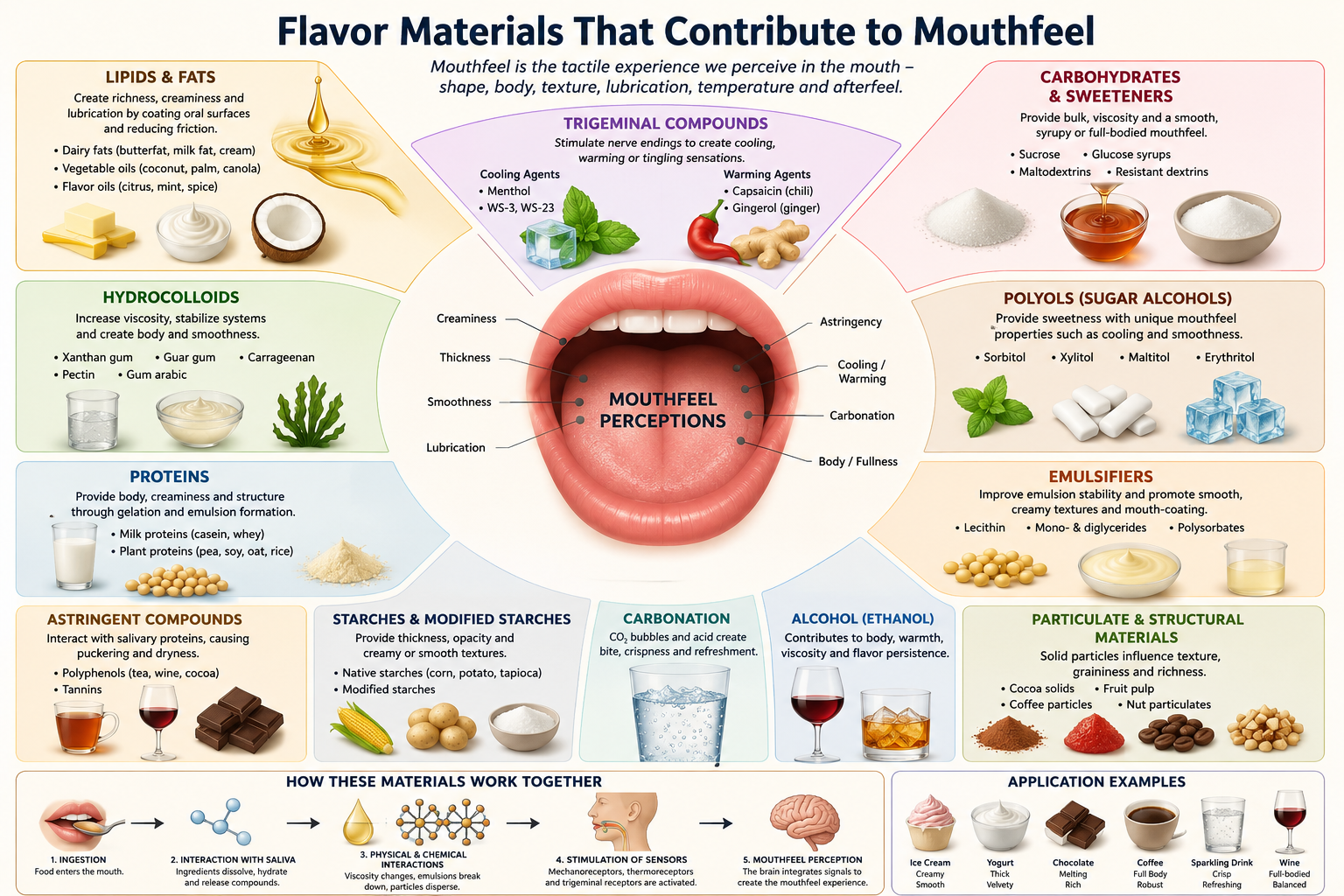
Mouthfeel is one of several dozen flavor attributes that the Society of Flavor Chemists expects certified flavorists to understand and effectively manipulate during flavor formulation. Candidates may also encounter questions related to flavor materials that influence mouthfeel during the qualification examination or interview.
Introduction
Mouthfeel is one of the most important yet often overlooked dimensions of flavor perception. While taste and aroma receive significant attention in flavor science, the tactile sensations experienced in the mouth profoundly influence how consumers perceive food and beverages. Mouthfeel encompasses physical sensations such as viscosity, creaminess, smoothness, thickness, astringency, lubrication, cooling, warming, carbonation, and particulate texture. These sensations arise from interactions between flavor materials, food matrices, saliva, and oral tissues.
Flavor materials that contribute to mouthfeel may not always possess a distinct taste or aroma. Instead, they modify the physical and physiological experience of consuming a product. In modern food and beverage development, formulators use a wide range of ingredients—including hydrocolloids, fats, proteins, carbohydrates, polyols, emulsifiers, flavor compounds, and sensory modulators—to engineer desirable mouthfeel characteristics.
This discussion examines the major categories of flavor materials that contribute to mouthfeel, their mechanisms of action, and their applications in food and beverage systems.
Understanding Mouthfeel
Mouthfeel refers to the sensory attributes perceived through mechanoreceptors, thermoreceptors, and trigeminal nerve endings in the oral cavity. Unlike taste, which is detected by taste receptors, mouthfeel arises from:
- Mechanical stimulation
- Friction and lubrication
- Viscosity and flow behavior
- Temperature perception
- Chemical irritation
- Saliva interactions
Consumers often associate superior product quality with specific mouthfeel characteristics:
| Product | Desired Mouthfeel |
|---|---|
| Ice cream | Creamy, smooth |
| Chocolate | Melting, rich |
| Yogurt | Thick, velvety |
| Wine | Full-bodied, balanced |
| Soft drinks | Crisp, effervescent |
| Coffee | Rich body |
| Plant-based milk | Creamy, dairy-like |
Flavor materials play crucial roles in generating these sensations.
Lipids and Fat-Based Flavor Materials
Role of Fats in Mouthfeel
Fats are among the most powerful contributors to mouthfeel. They create sensations of:
- Creaminess
- Richness
- Smoothness
- Lubrication
- Body
Fat molecules coat oral surfaces, reducing friction and generating a luxurious sensory experience.
Mechanism
Fat droplets act as lubricants between oral tissues. During mastication, they spread across the tongue and palate, creating smoothness and reducing perceived roughness.
Dairy Fats
Common examples include:
- Butterfat
- Cream
- Milk fat
- Anhydrous milk fat
These materials provide:
- Velvety texture
- Full-bodied sensation
- Slow flavor release
The melting profile of milk fat is particularly important because it melts near body temperature, producing a pleasant melt-in-mouth effect.
Vegetable Oils
Examples include:
- Coconut oil
- Palm oil
- Sunflower oil
- Canola oil
These oils are frequently used in:
- Plant-based beverages
- Vegan cheeses
- Dairy alternatives
Structured fats can mimic the creaminess of dairy fat while reducing saturated fat content.
Flavor Oils
Flavor oils contribute not only aroma but also mouth-coating properties.
Examples:
- Citrus oils
- Mint oils
- Spice oils
These oils influence:
- Perceived body
- Lingering sensation
- Flavor persistence
Hydrocolloids
Hydrocolloids are among the most widely used texture-modifying ingredients.
They increase viscosity, stabilize emulsions, and improve body.
Xanthan Gum
Xanthan gum provides:
- Thickening
- Suspension
- Smooth flow
Characteristics:
- High viscosity at low concentration
- Shear-thinning behavior
- Excellent stability
Applications:
- Salad dressings
- Beverages
- Sauces
Xanthan creates a rich mouthfeel without excessive thickness.
Guar Gum
Guar gum contributes:
- Creaminess
- Thickness
- Enhanced body
It is frequently used in:
- Dairy beverages
- Ice cream
- Plant-based milks
Guar gum creates a fuller sensory profile while maintaining smoothness.
Carrageenan
Derived from seaweed, carrageenan creates:
- Gel structure
- Creamy mouthfeel
- Protein stabilization
In chocolate milk and dairy beverages, carrageenan prevents phase separation and enhances body.
Pectin
Pectin contributes:
- Smooth viscosity
- Fruit fullness
- Reduced watery perception
Common applications include:
- Fruit beverages
- Jams
- Yogurts
Gum Arabic
Gum arabic provides:
- Mouth-coating properties
- Flavor carrying capacity
- Improved beverage body
It is especially valuable in flavor emulsions.
Proteins and Protein-Based Mouthfeel Agents
Proteins significantly influence texture and oral perception.
Milk Proteins
Casein
Casein contributes:
- Creaminess
- Opacity
- Smooth body
Casein micelles create colloidal structures that mimic fat-like sensations.
Whey Proteins
Whey proteins provide:
- Thickness
- Smoothness
- Foam stability
They are widely used in protein beverages and nutritional products.
Plant Proteins
Examples:
- Pea protein
- Soy protein
- Oat protein
- Rice protein
These proteins contribute body but may also introduce:
- Chalkiness
- Dryness
- Graininess
Formulators often combine hydrocolloids and flavor modulators to overcome these limitations.
Carbohydrates and Sweeteners
Carbohydrates influence viscosity, lubrication, and bulk properties.
Sucrose
Beyond sweetness, sucrose contributes:
- Density
- Syrupy body
- Smooth mouthfeel
High sugar content increases perceived richness.
Glucose Syrups
These materials provide:
- Thickness
- Reduced crystallization
- Enhanced body
Common in:
- Confectionery
- Beverages
- Frozen desserts
Maltodextrins
Maltodextrins are widely used mouthfeel enhancers.
Benefits include:
- Bulking
- Fat mimicking
- Increased viscosity
They are particularly useful in reduced-fat products.
Resistant Dextrins
Resistant dextrins provide:
- Fiber enrichment
- Mouthfeel enhancement
- Minimal flavor impact
These ingredients are increasingly used in functional beverages.
Polyols and Sugar Alcohols
Polyols provide unique sensory properties.
Examples include:
- Sorbitol
- Xylitol
- Maltitol
- Erythritol
Cooling Effect
Polyols absorb heat when dissolved.
This creates cooling sensations that contribute to mouthfeel.
Xylitol
Produces strong cooling.
Applications:
- Chewing gum
- Breath mints
- Oral care products
Erythritol
Provides:
- Clean cooling
- Rapid dissolution
- Reduced sugar perception
Emulsifiers
Emulsifiers improve texture and sensory perception.
Examples include:
- Lecithin
- Mono- and diglycerides
- Polysorbates
Lecithin
Lecithin contributes:
- Smoothness
- Improved flow
- Enhanced creaminess
In chocolate, lecithin reduces viscosity while maintaining richness.
Mono- and Diglycerides
These compounds:
- Stabilize emulsions
- Improve fat distribution
- Enhance mouth-coating effects
Trigeminal Flavor Compounds
Certain flavor compounds stimulate trigeminal receptors, producing tactile sensations.
Cooling Agents
Menthol
Menthol activates TRPM8 receptors.
Effects include:
- Cooling
- Freshness
- Oral lubrication perception
Applications:
- Mint confectionery
- Beverages
- Oral care products
Synthetic Cooling Agents
Examples:
- WS-3
- WS-23
- WS-5
Advantages:
- Long-lasting cooling
- Minimal mint flavor
- Controlled intensity
Widely used in beverages and confectionery.
Warming Agents
Capsaicin
Found in chili peppers.
Produces:
- Heat
- Tingling
- Lingering warmth
Low levels can enhance flavor complexity.
Gingerol
Derived from ginger.
Provides:
- Warmth
- Mild pungency
- Increased salivation
Astringent Compounds
Astringency is an important mouthfeel attribute.
It is perceived as:
- Dryness
- Puckering
- Roughness
Polyphenols
Found in:
- Tea
- Wine
- Cocoa
Polyphenols interact with salivary proteins, causing precipitation.
This reduces lubrication and creates dryness.
Tannins
Tannins contribute:
- Structure
- Body
- Dry finish
In wine, tannin levels strongly influence perceived mouthfeel.
Different tannin structures create sensations ranging from silky to aggressive.
Flavor Modulators and Mouthfeel Enhancers
Modern flavor technology includes ingredients specifically designed to modify mouthfeel.
Fat Replacers
Examples:
- Microparticulated proteins
- Maltodextrins
- Modified starches
These ingredients simulate:
- Creaminess
- Lubrication
- Richness
while reducing calorie content.
Kokumi Compounds
Kokumi refers to sensations of:
- Continuity
- Mouthfulness
- Thickness
without having a distinct taste.
Examples include:
- Glutathione
- γ-Glutamyl peptides
Kokumi compounds enhance:
- Richness
- Body
- Flavor depth
They are increasingly used in reduced-sodium and reduced-fat products.
Starches and Modified Starches
Starches contribute significantly to texture.
Native Starches
Provide:
- Thickness
- Body
- Opacity
Examples:
- Corn starch
- Potato starch
- Tapioca starch
Modified Starches
Modified starches offer:
- Improved stability
- Controlled viscosity
- Enhanced creaminess
Applications include:
- Sauces
- Dairy products
- Beverage concentrates
Carbonation as a Mouthfeel Contributor
Carbon dioxide affects mouthfeel through:
- Bubble formation
- Carbonic acid generation
- Mechanical stimulation
Consumers perceive:
- Crispness
- Bite
- Refreshment
Carbonation is particularly important in:
- Soft drinks
- Sparkling water
- Beer
Fine bubbles generally create smoother mouthfeel than coarse bubbles.
Ethanol and Alcohol Mouthfeel
Alcohol contributes significantly to beverage mouthfeel.
Effects include:
- Warming sensation
- Increased viscosity
- Enhanced body
- Flavor persistence
In wine and spirits, alcohol concentration directly influences perceived fullness and richness.
Higher alcohol levels often create greater viscosity and mouth-coating sensations.
Particulate and Structural Mouthfeel Materials
Not all mouthfeel contributors are dissolved ingredients.
Solid particles influence oral perception.
Examples:
- Cocoa solids
- Fruit pulp
- Coffee particles
- Nut particulates
Controlled particle size is critical.
Too large:
- Graininess
- Chalkiness
Optimal size:
- Rich body
- Authentic texture
Mouthfeel in Reduced-Fat and Reduced-Sugar Products
One of the greatest challenges in food formulation is maintaining mouthfeel when removing sugar or fat.
Common strategies include:
Fat Reduction
Using:
- Microparticulated whey proteins
- Hydrocolloids
- Modified starches
to mimic creaminess.
Sugar Reduction
Using:
- Polyols
- Fibers
- Mouthfeel enhancers
to replace bulk and viscosity lost from sugar removal.
Emerging Technologies
Recent developments include:
Sensory-Active Flavor Systems
Designed specifically to enhance:
- Creaminess
- Body
- Mouth-coating effects
without increasing calories.
Encapsulation Technologies
Microencapsulation allows controlled release of:
- Lipids
- Flavor oils
- Cooling compounds
creating dynamic mouthfeel experiences.
Plant-Based Mouthfeel Optimization
As plant-based foods grow in popularity, significant research focuses on improving:
- Creaminess
- Lubrication
- Melt characteristics
through combinations of proteins, fats, hydrocolloids, and flavor modulators.
Conclusion
Mouthfeel is a multidimensional sensory attribute that strongly influences consumer acceptance and perceived product quality. A wide variety of flavor materials contribute to mouthfeel, including fats, hydrocolloids, proteins, carbohydrates, polyols, emulsifiers, trigeminal compounds, tannins, and specialized flavor modulators. These materials act through mechanisms such as viscosity modification, lubrication, saliva interaction, thermal stimulation, and trigeminal activation.
Modern food and beverage formulation increasingly relies on a sophisticated understanding of these ingredients to create products that deliver desirable sensory experiences while meeting nutritional, economic, and regulatory objectives. Whether creating the creaminess of ice cream, the body of coffee, the fullness of wine, or the refreshing crispness of a carbonated beverage, mouthfeel-active flavor materials remain essential tools in sensory design and product innovation.
Log in to view a more technical version intended for a flavorist training program.