Book for Sale: Flavor Retention During Baking - a Scientific and Practical Guide
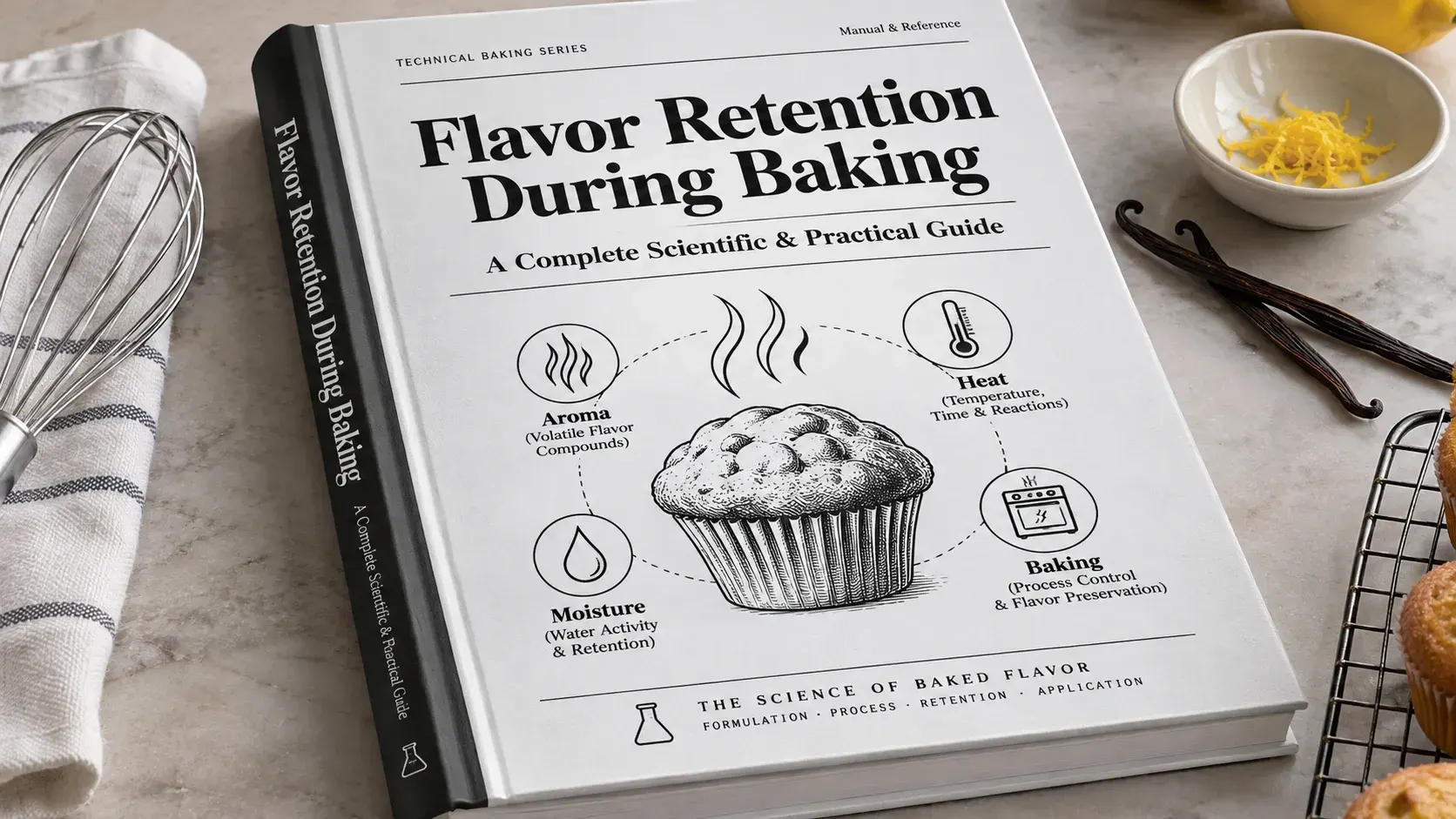
This 90-plus-page flavor retention guide in PDF format is intended for bakery flavorists and bakery product developers who need to understand and prevent flavor loss during baking.
This guide is available for purchase only at flavorist.com. Buy it today while the coupon code holiday30%off may be still valid. The actual price can be $49, almost $21 off the list price $69.99.
Note: Order shipments will begin on December 31, 2026.
About this flavor retention guide
Flavor retention during baking is an important yet often overlooked subject in flavor chemistry and bakery product development. While flavor creation, flavor analysis, and flavor stability are well-established areas of study, flavor retention during thermal processing receives comparatively little dedicated attention. The term flavor retention is not prominently featured as a standalone topic in the Society of Flavor Chemists' educational syllabus, despite its practical importance to flavorists, food scientists, and bakery product developers.
Developing a great bakery flavor is only part of the challenge. The real test is how much of that flavor survives the baking process and how effectively it is delivered in the finished product. A flavor that performs well in an unbaked batter or dough may behave very differently when exposed to high temperatures, moisture evaporation, oxidation, and complex interactions with other ingredients. Understanding and managing these changes is essential for developing baked products with consistent, desirable, and long-lasting flavor.
This Complete Guide to Flavor Retention During Baking is designed to bridge the gap between flavor chemistry, flavor formulation, and practical bakery processing. It brings together the scientific principles, technical considerations, and practical solutions needed to understand, evaluate, and improve flavor retention in cakes, cookies, biscuits, breads, muffins, pastries, and other baked products.
The guide provides a comprehensive examination of the following key areas:
- The fundamental science of flavor retention: Understand how aroma compounds behave during baking, including the roles of volatility, vapor pressure, partition coefficients, diffusion, heat transfer, thermal degradation, oxidation, and interactions with the food matrix.
- The mechanisms of flavor loss during baking: Learn why flavors evaporate, degrade, transform, or become less perceptible during baking, and how moisture movement, steam stripping, oven conditions, and ingredient composition influence these processes.
- Flavor formulation and ingredient selection: Explore how water-soluble and oil-soluble flavors, extracts, emulsions, flavor powders, carrier systems, fats, sugars, proteins, and carbohydrates affect flavor distribution, protection, and release.
- Practical strategies to improve flavor retention: Discover techniques involving baking temperature and time optimization, moisture and water activity control, flavor emulsification, encapsulation, ingredient preparation, and post-bake flavor application.
- Flavor encapsulation and advanced delivery technologies: Examine spray drying, spray chilling, coacervation, cyclodextrin inclusion, and other technologies used to protect sensitive aroma compounds and control their release during processing and consumption.
- Flavor development during baking: Understand how Maillard reactions, caramelization, and fermentation generate desirable flavor compounds, and how to balance the formation of new aromas with the preservation of existing ones.
- Flavor-specific solutions: Learn practical approaches for improving the performance of vanilla, citrus, fruit, chocolate, coffee, spice, nut, butter, and other common bakery flavors, recognizing that different aroma compounds require different protection strategies.
- Application-specific recommendations: Explore flavor-retention considerations for different bakery products, including cakes, cookies, biscuits, breads, brownies, muffins, pastries, and commercial bakery formulations.
- Post-bake flavor preservation: Understand how cooling, packaging, oxygen exposure, moisture migration, and storage conditions influence the stability and sensory quality of flavor in finished bakery products.
- Experimental evaluation and product optimization: Learn how to design comparative baking trials, measure flavor-retention performance, conduct sensory evaluations, and apply analytical techniques such as gas chromatography–mass spectrometry (GC-MS) to support product development.
Throughout the guide, scientific theories are connected with practical applications, formulation recommendations, troubleshooting methods, comparison tables, illustrative examples, and experimental approaches. The objective is not merely to explain why flavors are lost during baking, but to provide actionable solutions that flavorists and bakery product developers can evaluate and apply in real products.
The guide also highlights an important distinction between chemical flavor retention and perceived flavor intensity. Preserving aroma compounds within a product does not always guarantee stronger flavor perception. Successful bakery flavor development requires understanding how flavors survive processing, interact with the food matrix, and are ultimately released during consumption.
Whether you are developing a new heat-stable bakery flavor, improving an existing cake or cookie formulation, investigating flavor loss during baking, or extending the flavor shelf life of commercial bakery products, this guide serves as a technical reference and practical problem-solving resource.
The goal of this guide is to help flavorists and bakery product developers move beyond trial-and-error flavor addition toward a more scientific, systematic, and effective approach to flavor retention—resulting in baked products with stronger, more balanced, more consistent, and longer-lasting flavor.