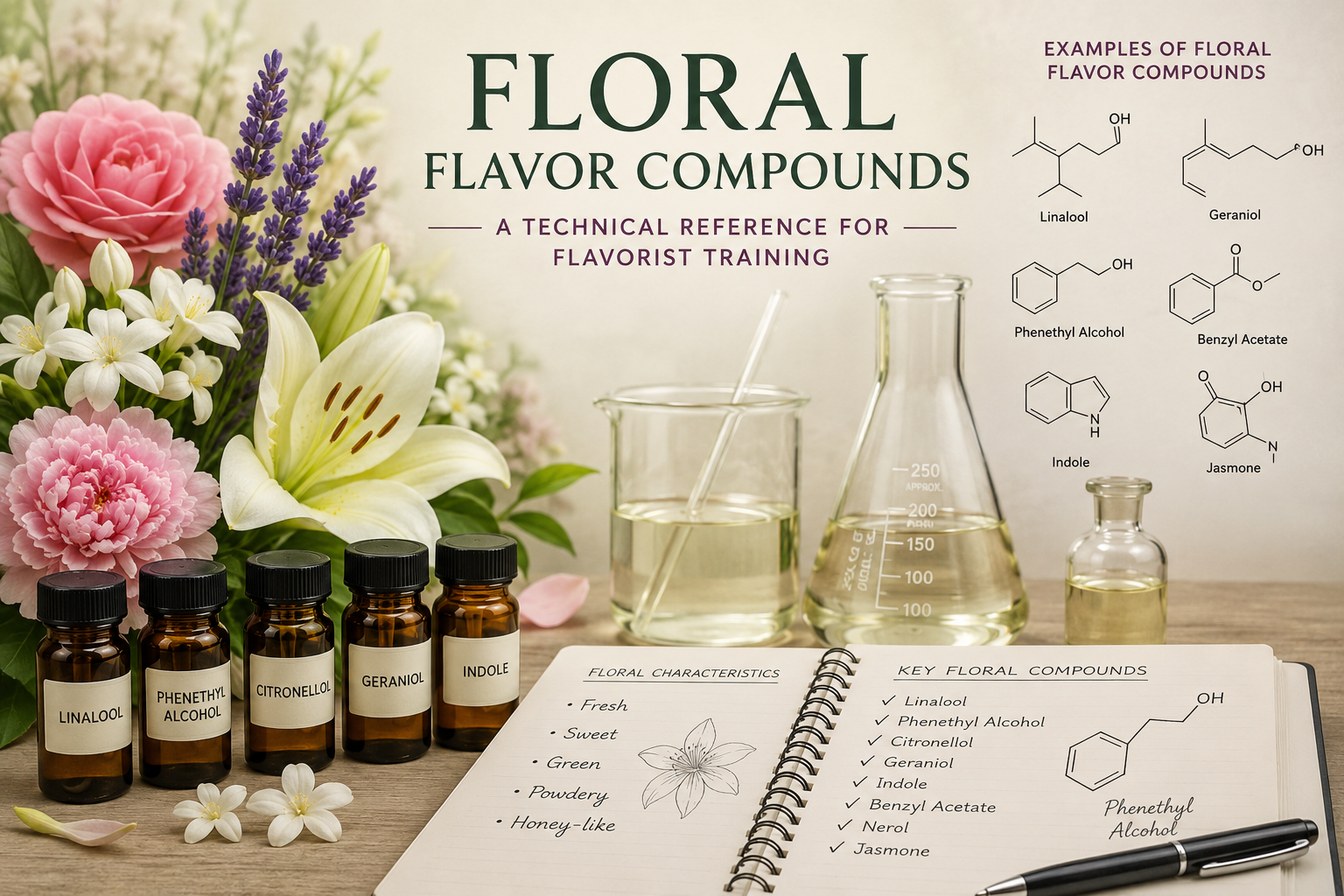
Floral Flavor Compounds: A Technical Reference for Flavorist Training
Purpose and Scope
This document catalogs the principal floral-type flavor and aroma chemicals used in commercial flavor compounding. It is intended as supplementary training material and covers: FEMA GRAS status (where applicable), CAS numbers, organoleptic character, natural occurrence, typical flavor/fragrance applications, suggested use levels, and technical handling notes. Floral notes are rarely used alone in flavor work — they function as top-note lift, bouquet-builders, and "natural identity" contributors in fruit, tea, honey, wine/muscat, and confectionery flavors. Understanding threshold, volatility, and synergy is as important as knowing the raw odor description.
A note on dosage figures: Suggested use levels below are typical ranges seen in finished flavor compounds (the flavorist's working blend, often used at 0.05–0.5% in the final food/beverage) or, where noted, in the finished consumer product. These are illustrative starting points drawn from standard industry practice (Fenaroli's Handbook of Flavor Ingredients, FEMA/FEXPAN publications, Arctander) — not regulatory maxima. Always confirm current FEMA/JECFA status, regional regulatory limits (EU Flavour Regulation 1334/2008 Annex I, IFRA for fragrance use), and supplier COA/IFRA certificates before formulating.
1. Alcohols
1.1 Phenethyl Alcohol (2-Phenylethanol)
- FEMA No.: 2858
- CAS No.: 60-12-8
- Odor/Flavor: Warm, rosy, honey-like, slightly sweet with a mild fruity undertone. The classic "rose" alcohol.
- Natural Occurrence: Rose otto, geranium oil, ylang-ylang, ubiquitous in fermented products (a yeast metabolite — found in wine, beer, honey).
- Applications: Rose, honey, grape, muscat, tea, tobacco, and general floral bouquets; also a fixative/blender in fruit flavors (peach, apricot) to add "bloom."
- Suggested Dosage: 5–50 ppm in finished beverages; up to 0.1–0.5% in flavor compounds. Low threshold (~1 ppm in water) so overdosing quickly reads as "soapy."
- Technical Notes: Also produced via yeast fermentation (Ehrlich pathway from phenylalanine), so it is available as a "natural" flavoring substance (fermentation-derived) as well as via chemical synthesis (Friedel-Crafts route from benzene/ethylene oxide, or hydrogenation of styrene oxide). Miscible with ethanol, slightly soluble in water. Stable but slowly oxidizes to phenylacetaldehyde on storage — store cool, away from light, nitrogen-blanket bulk stock.
1.2 Geraniol
- FEMA No.: 2507
- CAS No.: 106-24-1
- Odor/Flavor: Sweet, rosy, geranium-like, slightly citrus/peachy undertone.
- Natural Occurrence: Major constituent of palmarosa, geranium, and citronella oils; found in rose oil, lemongrass.
- Applications: Rose, peach, apricot, raspberry, grape, muscat wine, tropical fruit blends, black tea.
- Suggested Dosage: 1–20 ppm in finished products; 0.05–0.3% in compound.
- Technical Notes: Isomer of nerol (cis form); commercially often supplied as geraniol/nerol mixtures unless high-purity specified. Oxidizes readily to geranial (citral character) — antioxidant addition (e.g., tocopherol) recommended for bulk storage. Synergizes strongly with citronellol and linalool.
1.3 Citronellol
- FEMA No.: 2308
- CAS No.: 106-22-9 (mixed isomers); (+)-form 1117-61-9; (–)-form 7540-51-4
- Odor/Flavor: Sweet, rosy, citronella-like with a fresh, slightly waxy-green facet.
- Natural Occurrence: Rose oil, geranium oil, citronella oil.
- Applications: Rose and floral fruit accords (peach, lychee, raspberry); softens sharp citrus top notes.
- Suggested Dosage: 1–15 ppm finished product; 0.05–0.2% in compound.
- Technical Notes: The (–)-rotary isomer is considered to have a more refined rose note than the (+)-form. Blends synergistically with phenethyl alcohol and geraniol to build rose accords without relying on damascones.
1.4 Nerol
- FEMA No.: 2770
- CAS No.: 106-25-2
- Odor/Flavor: Sweeter, softer, less "green" than geraniol; rosy with a citrus-neroli tinge.
- Applications: Rose, orange blossom, muscat, tropical blends.
- Suggested Dosage: 1–10 ppm finished product.
- Technical Notes: Cis-isomer of geraniol; more expensive and less stable, so often used only where a softer rose note is specifically needed.
1.5 Linalool
- FEMA No.: 2635
- CAS No.: 78-70-6 (racemic); (R)-(–)-linalool (licareol) 126-91-0; (S)-(+)-linalool (coriandrol) 26489-01-0
- Odor/Flavor: Floral, sweet, woody-citrus, "lavender-like" character (racemic); (R)-form is more floral/petitgrain-like (associated with bergamot/lavender), (S)-form is sweeter/coriander-like.
- Natural Occurrence: Coriander, rosewood (bois de rose), lavender, bergamot, many citrus oils.
- Applications: Citrus flavors (top-note lift), floral fruit blends (peach, blueberry, muscat), tea, root beer/sarsaparilla top note, lavender/floral confectionery.
- Suggested Dosage: 0.5–10 ppm finished product; 0.02–0.2% in compound. Very low threshold — easily dominates a blend.
- Technical Notes: One of the most widely used floral chemicals in the industry due to broad applicability and moderate cost. Chirality matters — supplier should specify enantiomeric ratio for premium natural-identical work. Prone to autoxidation and acid-catalyzed cyclization to alpha-terpineol under acidic/aqueous beverage conditions — a common stability failure point in citrus/floral beverages; monitor headspace over shelf life.
1.6 Tetrahydrolinalool (3,7-Dimethyl-3-octanol)
- FEMA No.: 3763
- CAS No.: 78-69-3
- Odor/Flavor: Soft floral, muted, waxy-floral; far less volatile/diffusive than linalool.
- Applications: Long-lasting floral base note, blender in soft fruity-floral profiles, chewing gum and confectionery for retention.
- Suggested Dosage: 1–20 ppm; useful where linalool's volatility is a stability liability.
- Technical Notes: Saturated analog of linalool — much more oxidatively stable. Useful substitution when a formulation shows linalool degradation issues.
1.7 Dihydromyrcenol
- FEMA No.: 3548
- CAS No.: 18479-58-8
- Odor/Flavor: Fresh, citrus-floral, "clean laundry" lime-like top note; less a classic "flower" and more a fresh-floral modifier.
- Applications: Sparingly in beverage top notes (lemon-lime, sports drink "clean" character); more common in fragrance but crosses into flavor for fresh, aqueous-floral profiles.
- Suggested Dosage: <1–5 ppm; very potent, use sparingly.
- Technical Notes: Extremely diffusive; overdose reads as "detergent."
1.8 Farnesol
- FEMA No.: 2478
- CAS No.: 4602-84-0 (mixed isomers)
- Odor/Flavor: Delicate, sweet floral, linden/lime-blossom, slightly waxy.
- Applications: Linden flower, honeysuckle, muguet (lily of the valley) accords; fixative role due to low volatility.
- Suggested Dosage: 0.5–5 ppm; used at low levels as a blender/fixative rather than a driving note.
- Technical Notes: High molecular weight sesquiterpenoid alcohol — good tenacity, useful for extending floral character through a product's shelf life.
1.9 Cinnamyl Alcohol
- FEMA No.: 2294
- CAS No.: 104-54-1
- Odor/Flavor: Soft, balsamic-floral, mild hyacinth note with a faint spicy-cinnamic background.
- Applications: Rose, floral spice blends, cherry/berry background floralcy.
- Suggested Dosage: 1–10 ppm.
- Technical Notes: Oxidizes to cinnamaldehyde in storage; not a strong standalone floral, used as a supporting note.
1.10 Anisyl Alcohol
- FEMA No.: 2099
- CAS No.: 105-13-5
- Odor/Flavor: Soft, sweet, faintly floral-balsamic with an anise/vanilla-adjacent warmth.
- Applications: Vanilla-floral, cherry, berry, and heliotrope-type blends.
- Suggested Dosage: 2–20 ppm.
- Technical Notes: Low volatility, mild — a blender rather than a top-note driver.
1.11 Benzyl Alcohol
- FEMA No.: 2137
- CAS No.: 100-51-6
- Odor/Flavor: Faint, sweet, slightly floral-fruity; largely a solvent/diluent-grade material odor-wise.
- Applications: Solvent for other flavor chemicals; trace floral contribution in jasmine-type and fruit-floral bases.
- Suggested Dosage: Used more as a carrier solvent than an active floral note; contributes at 10–100+ ppm when used as solvent.
- Technical Notes: Also a known component of ester biosynthesis pathway (precursor to benzyl acetate/benzoate).
2. Aldehydes
2.1 Phenylacetaldehyde
- FEMA No.: 2874
- CAS No.: 122-78-1
- Odor/Flavor: Intense green-floral, hyacinth, honey-like at dilution; harsh/pungent-green at high concentration.
- Natural Occurrence: Found in trace amounts in rose, tea, chocolate, and honey.
- Applications: Honey, hyacinth, narcissus, rose top-note; chocolate and cocoa (contributes to characteristic aroma at trace levels).
- Suggested Dosage: 0.1–2 ppm finished product — this is a powerful material; overdosing produces an unpleasant "green plastic" or geranium-leaf harshness.
- Technical Notes: Highly reactive aldehyde — undergoes aldol condensation and oxidation readily; typically stabilized/diluted or supplied as dimethyl acetal for handling stability. Because of instability, it is frequently used via its acetal form (phenylacetaldehyde dimethyl acetal, FEMA 2876) which hydrolyzes to release the aldehyde in aqueous/acidic media, giving a controlled-release floral top note.
2.2 Phenylacetaldehyde Dimethyl Acetal
- FEMA No.: 2876
- CAS No.: 101-48-4
- Odor/Flavor: Milder, more diffusive green-floral than the free aldehyde; releases phenylacetaldehyde character on hydrolysis.
- Applications: Same floral/honey uses as phenylacetaldehyde but preferred where storage stability is needed.
- Suggested Dosage: 0.5–5 ppm.
- Technical Notes: Hydrolysis rate is pH- and temperature-dependent — useful lever for flavorists needing delayed top-note release in baked or thermally processed goods.
2.3 Hydroxycitronellal
- FEMA No.: 2576
- CAS No.: 107-75-5
- Odor/Flavor: Sweet, intensely floral, lily-of-the-valley (muguet), slightly waxy-green.
- Applications: Muguet, lily, floral fruit blends (peach, apricot), soft floral top notes in beverages and confectionery.
- Suggested Dosage: 1–10 ppm; potent, moderate use levels recommended.
- Technical Notes: One of the classic "muguet" building blocks alongside hydroxycitronellal's derivatives (e.g., the Schiff base with methyl anthranilate — see Section 6). Sensitive to acid conditions; can cyclize.
2.4 Citronellal
- FEMA No.: 2307
- CAS No.: 106-23-0
- Odor/Flavor: Fresh, green-citrus, mild rose-lemon; less overtly "floral" than citronellol but contributes freshness to rose accords.
- Applications: Supporting note in rose/citrus-floral fruit blends.
- Suggested Dosage: 1–8 ppm.
- Technical Notes: Readily cyclizes to isopulegol under acid catalysis; watch stability in low-pH beverages.
3. Esters
3.1 Benzyl Acetate
- FEMA No.: 2135
- CAS No.: 140-11-4
- Odor/Flavor: Sweet, fruity-floral, jasmine-like, pear/strawberry-adjacent.
- Natural Occurrence: Jasmine absolute, ylang-ylang, many fruits (pear, strawberry) in trace amounts.
- Applications: Jasmine, gardenia, tropical fruit (pear, pineapple), strawberry and berry top-note enhancer, honey.
- Suggested Dosage: 2–30 ppm finished product; 0.05–0.5% in compound.
- Technical Notes: One of the most cost-effective, versatile floral esters; workhorse material for jasmine-type bases. Reasonably stable but subject to slow hydrolysis in high-water-activity/low-pH systems — monitor for free benzyl alcohol formation over shelf life (off-note drift).
3.2 Phenethyl Acetate (2-Phenylethyl Acetate)
- FEMA No.: 2857
- CAS No.: 103-45-7
- Odor/Flavor: Fruity-floral, rosy-honey, with a green, slightly fruity (peach/apple) top.
- Applications: Rose, honey, tropical and stone fruit blends (peach, apricot), tea.
- Suggested Dosage: 2–20 ppm.
- Technical Notes: Softer, fruitier than phenethyl alcohol itself; good for rounding sharp aldehydic fruit tops.
3.3 Ethyl Phenylacetate
- FEMA No.: 2455
- CAS No.: 101-97-3
- Odor/Flavor: Sweet, honey-rose, with a distinctive "honeyed floral" character reminiscent of certain honey types.
- Applications: Honey flavor, rose, floral tobacco notes.
- Suggested Dosage: 1–10 ppm.
- Technical Notes: Distinct from methyl phenylacetate in nuance — ethyl ester is rounder/sweeter, methyl ester slightly sharper/greener.
3.4 Methyl Phenylacetate
- FEMA No.: 2733
- CAS No.: 101-41-7
- Odor/Flavor: Sweet, honey-like, floral with a green facet.
- Applications: Honey, floral fruit blends.
- Suggested Dosage: 1–8 ppm.
3.5 Styrallyl Acetate (alpha-Methylbenzyl Acetate)
- FEMA No.: 3021
- CAS No.: 93-92-5
- Odor/Flavor: Sweet, floral-fruity, gardenia/jasmine with a fresh, slightly green top.
- Applications: Gardenia, tropical floral-fruit (e.g., melon-floral), used to add lift to jasmine/gardenia bases.
- Suggested Dosage: 1–10 ppm.
3.6 Linalyl Acetate
- FEMA No.: 2636
- CAS No.: 115-95-7
- Odor/Flavor: Fresh, sweet, floral-fruity with a bergamot/lavender-like top, softer and fruitier than linalool.
- Applications: Citrus-floral, lavender-type, tea, fruity floral fruit tops (pear, bergamot-orange accords).
- Suggested Dosage: 1–15 ppm.
- Technical Notes: Ester hydrolyzes back to linalool + acetic acid under acid/heat — a common source of "linalool drift" and flavor instability in acidic beverages over shelf life; balance against desired fresh top note lifespan.
3.7 Geranyl Acetate
- FEMA No.: 2509
- CAS No.: 105-87-3
- Odor/Flavor: Fresh, fruity-rosy, sweeter and fruitier than geraniol; slightly lavender-like.
- Applications: Rose, muscat, tropical fruit, apple-floral top notes.
- Suggested Dosage: 1–15 ppm.
3.8 Citronellyl Acetate
- FEMA No.: 2313
- CAS No.: 150-84-5
- Odor/Flavor: Fresh, fruity-rosy with a green, slightly apple-like nuance.
- Applications: Rose, apple, pear, floral-fruit blends.
- Suggested Dosage: 1–10 ppm.
4. Ketones
4.1 alpha-Ionone
- FEMA No.: 2594
- CAS No.: 127-41-3
- Odor/Flavor: Woody-violet, sweet floral, slightly fruity (raspberry-adjacent) with a soft powdery-violet character.
- Natural Occurrence: Trace in raspberry, boysenberry, violet leaf.
- Applications: Violet, raspberry, blackberry, boysenberry, and berry fruit flavors — a signature "berry complexity" note.
- Suggested Dosage: 0.5–5 ppm; very potent, extremely low threshold (sub-ppb range in water for some isomers).
- Technical Notes: Ionones are carotenoid-degradation products; naturally occurring versions (from carotenoid oxidative cleavage) qualify as "natural" flavoring substances. Slightly less intense/refined than beta-ionone; often blended together.
4.2 beta-Ionone
- FEMA No.: 2595
- CAS No.: 79-77-6
- Odor/Flavor: Sweet, woody-violet, more intense and "raspberry-like" than the alpha isomer.
- Natural Occurrence: Found in raspberry, tea, grape, and many fruits at trace levels; also a tobacco and wine aroma contributor.
- Applications: Raspberry, blackberry, violet, grape/wine, tea; a key contributor to natural raspberry flavor complexity.
- Suggested Dosage: 0.2–3 ppm — extremely potent; small dosing errors dramatically shift the profile from "fruity" to "woody/violet-heavy."
- Technical Notes: One of the lowest-threshold flavor chemicals in common use (threshold reported in low ppb). Essential trace-level "natural identity" marker in raspberry and blackberry flavor work — its absence is often why synthetic berry flavors taste "flat" or "candy-like" versus true-to-fruit.
4.3 Damascenone (beta-Damascenone)
- FEMA No.: 3565
- CAS No.: 23726-93-4
- Odor/Flavor: Intensely fruity-floral, rose, cooked apple/plum, exotic tropical-floral complexity; extraordinarily powerful.
- Natural Occurrence: Rose oil (trace but character-defining), tea, wine, apple, grape — a major contributor to wine and rose aroma despite ppb-level concentration.
- Applications: Rose, wine/grape, tea, apple, plum, tropical fruit — used at trace levels to add "natural realism" and complexity to fruit and floral flavors.
- Suggested Dosage: 0.01–0.5 ppm (10–500 ppb) in finished product — one of the most potent flavor chemicals known; threshold in water is in the low ppt to ppb range.
- Technical Notes: Considered one of the most important "trace impact" compounds in flavor chemistry. Must be handled as a concentrated dilution (e.g., 1% or 0.1% in propylene glycol/ethanol) for accurate weighing/dosing — never weigh neat material directly into a batch at use levels. Small formulation errors have outsized sensory impact.
4.4 Damascone (alpha-Damascone / beta-Damascone)
- FEMA No.: alpha-damascone 3223; beta-damascone 3244
- CAS No.: alpha 43052-87-5; beta 23726-92-3
- Odor/Flavor: Fruity-floral, plum/rose, less "exotic tropical" than damascenone but still very potent and rounding.
- Applications: Rose, plum, berry, tropical fruit rounding notes.
- Suggested Dosage: 0.05–1 ppm.
- Technical Notes: Structurally related rose ketone family (damascones and damascenones collectively called "rose ketones"); each isomer has a distinct nuance — flavorists typically keep a small set of these as a "rose ketone kit" for fine-tuning fruit and floral bases.
4.5 cis-Jasmone
- FEMA No.: 3549
- CAS No.: 488-10-8
- Odor/Flavor: Warm, herbaceous-floral, jasmine petal character with a green, slightly fruity nuance; less sweet than benzyl acetate-type jasmine notes.
- Natural Occurrence: Jasmine absolute (trace but defining note).
- Applications: Jasmine, tea (particularly jasmine tea), subtle floral top notes in white tea and green tea flavors.
- Suggested Dosage: 0.1–2 ppm — potent, use sparingly.
- Technical Notes: Key "true jasmine" trace note distinguishing natural-type jasmine bases from simple ester-driven (benzyl acetate-heavy) approximations.
4.6 Methyl Jasmonate / Dihydrojasmone
- FEMA No.: Dihydrojasmone 3300 (CAS 1128-08-1); Methyl jasmonate not commonly FEMA-listed for flavor (primarily fragrance use — verify current status before flavor use)
- Odor/Flavor: Dihydrojasmone: sweet, fruity-floral, jasmine with a fruity, slightly minty-herbal facet.
- Applications: Jasmine tea, subtle floral-fruit rounding.
- Suggested Dosage: 0.5–3 ppm.
- Technical Notes: Always verify current FEMA GRAS status before use in flavor (as opposed to fragrance) applications, as some jasmonate-family materials are fragrance-only.
4.7 Raspberry Ketone (4-(4-Hydroxyphenyl)-2-butanone)
- FEMA No.: 2588
- CAS No.: 5471-51-2
- Odor/Flavor: Sweet, fruity-floral, characteristic raspberry note with a phenolic-floral undertone.
- Applications: Raspberry (primary character-impact material), used at trace levels in other berry and stone-fruit flavors for complexity.
- Suggested Dosage: 0.5–5 ppm — potent; excessive use produces a "medicinal/phenolic" off-note.
- Technical Notes: While primarily categorized as a fruit-flavor material, it has genuine floral-phenolic facets and is frequently discussed alongside floral ionones/damascones as part of the "berry complexity kit."
5. Phenols and Phenolic Ethers
5.1 Eugenol
- FEMA No.: 2467
- CAS No.: 97-53-0
- Odor/Flavor: Warm, spicy-clove with a distinct floral-carnation facet at dilution.
- Natural Occurrence: Clove bud oil (major constituent, up to 90%), bay leaf, cinnamon leaf.
- Applications: Carnation, spice-floral blends, clove/spice flavor systems, some rose-spice bouquets (e.g., old-fashioned rose-clove profiles).
- Suggested Dosage: 1–20 ppm for floral nuance; higher (50–200 ppm) when used as primary clove/spice note.
- Technical Notes: Strongly dose-dependent character shift — low levels read "floral-carnation," higher levels read "medicinal-clove." Antioxidant and mild antimicrobial properties are a secondary technical consideration in some applications.
5.2 Methyl Eugenol
- FEMA No.: 2475 (Note: subject to regulatory scrutiny/restriction in several jurisdictions due to genotoxicity/carcinogenicity data — verify current FEMA and EU status before use)
- CAS No.: 93-15-2
- Odor/Flavor: Sweet, spicy-floral, clove-like but softer and sweeter than eugenol.
- Applications: Historically used in spice-floral blends; usage has declined significantly due to safety re-evaluations.
- Technical Notes: Flavorists must check current regulatory status before use — this compound has been the subject of significant regulatory review (JECFA, EFSA) and use levels/permissibility have been substantially restricted in various regions.
5.3 para-Cresol (4-Methylphenol) and para-Cresyl Esters
- FEMA No.: p-Cresol 2337; p-Cresyl acetate no. 2336; p-Cresyl phenylacetate 2338
- CAS No.: p-Cresol 106-44-5
- Odor/Flavor: At trace levels: honeyed, animalic-floral, narcissus/jonquil character. Undiluted: harsh, tar/medicinal, barnyard.
- Applications: Narcissus, honeysuckle, and "animalic floral" trace notes in sophisticated fruit and honey flavors — used exclusively at extremely low levels for realism.
- Suggested Dosage: 0.01–0.2 ppm — extremely potent, narrow usable window between "floral-honey" and "off-note/fecal."
- Technical Notes: Classic example of a compound whose hedonic character flips entirely with concentration — critical teaching example for trainees on the importance of dilution-series evaluation (smelling a compound at multiple dilutions, not just neat) before deciding on inclusion/dosage.
5.4 Heliotropin (Piperonal)
- FEMA No.: 2665
- CAS No.: 120-57-0
- Odor/Flavor: Sweet, powdery floral, heliotrope/cherry-vanilla character with almond-adjacent warmth.
- Applications: Cherry, vanilla-floral, powdery floral bases (violet/heliotrope type), maraschino cherry flavor systems.
- Suggested Dosage: 1–15 ppm.
- Technical Notes: Structurally a methylenedioxy-benzaldehyde; imparts a distinctive "powdery" quality valued in confectionery floral-fruit profiles (e.g., cherry candy).
6. Anthranilates (Schiff Bases and Esters)
6.1 Methyl Anthranilate
- FEMA No.: 2728
- CAS No.: 134-20-3
- Odor/Flavor: Intensely sweet, grape (Concord/labrusca-type), orange blossom-floral character.
- Natural Occurrence: Concord grape, neroli/orange blossom oil, ylang-ylang, jasmine.
- Applications: Grape flavor (primary character-impact for "American grape/Concord" flavor profile), orange blossom, neroli, jasmine, muscat blends.
- Suggested Dosage: 5–50 ppm; the defining note of artificial grape flavor at higher end of range, subtler floral contributor at low end.
- Technical Notes: Highly recognizable and somewhat polarizing note ("candy grape") — flavorists distinguish "American-type" grape flavor (built around methyl anthranilate) from "European/Vitis vinifera-type" grape flavor (built more around esters, without a dominant anthranilate note).
6.2 Methyl-N-Methylanthranilate
- FEMA No.: 2719
- CAS No.: 85-91-6
- Odor/Flavor: Grape-floral, similar to methyl anthranilate but softer, less "candy," more tangerine/mandarin-floral.
- Applications: Mandarin, tangerine, subtler grape-floral profiles, blackcurrant (bud note complexity).
- Suggested Dosage: 2–20 ppm.
6.3 Hydroxycitronellal Methyl Anthranilate (Schiff Base)
- FEMA No.: 2698
- CAS No.: 30364-38-6
- Odor/Flavor: Rich, sweet, muguet-grape floral complex — combines the muguet character of hydroxycitronellal with the grape-floral sweetness of methyl anthranilate.
- Applications: Grape, muscat, complex floral-fruit bases requiring "natural depth."
- Suggested Dosage: 1–10 ppm.
- Technical Notes: A pre-formed Schiff base (imine) — used as a single material for convenience and stability rather than blending the two parent materials fresh each time, though it will hydrolyze slowly to its components under acidic aqueous conditions, which is generally desired since both parent odorants are useful.
7. Lactones (Floral-Adjacent, Fruity-Floral Crossover)
7.1 gamma-Decalactone
- FEMA No.: 2360
- CAS No.: 706-14-9
- Odor/Flavor: Sweet, creamy peach with a distinct floral-fruity roundness; the archetypal "peach" character.
- Applications: Peach, apricot, and other stone fruit; floral-creamy rounding note in tropical fruit blends.
- Suggested Dosage: 2–20 ppm.
- Technical Notes: While primarily classified as a fruit-flavor material, it is included here because of its important floral-rounding role and its frequent co-use with true floral materials (linalool, geraniol) to build complete peach/apricot profiles — a good teaching example of the fuzzy boundary between "floral" and "fruity" categories.
7.2 gamma-Nonalactone
- FEMA No.: 2781
- CAS No.: 104-61-0
- Odor/Flavor: Sweet, coconut-peach with a soft floral-creamy background.
- Applications: Peach, coconut, tropical floral-fruit blends.
- Suggested Dosage: 1–15 ppm.
8. Trace/Specialty "Animalic-Floral" and Indole-Type Notes
8.1 Indole
- FEMA No.: 2593
- CAS No.: 120-72-9
- Odor/Flavor: At trace dilution: warm, sweet, jasmine/orange-blossom floral depth. Undiluted: strongly fecal, mothball-like.
- Natural Occurrence: Jasmine absolute, orange blossom, neroli, and (notably) present in coal tar and fecal matter — the definitive example of the "concentration-dependent hedonics" phenomenon in flavor chemistry.
- Applications: Jasmine, orange blossom, neroli, gardenia — always used as a trace "depth" addition (typically pre-diluted to 1% or 0.1% solution for handling), never as a standalone note.
- Suggested Dosage: 0.01–0.3 ppm in finished product; handled as a 1% or 10% dilution in the lab for accurate low-level dosing.
- Technical Notes: Essential teaching compound: illustrates why "smell it neat" is an insufficient evaluation method, and why trace-level indole is what separates a "photorealistic" jasmine/orange-blossom flavor from a flat, one-dimensional ester-only approximation.
8.2 Skatole (3-Methylindole)
- FEMA No.: Historically listed (2839) but subject to considerable regulatory scrutiny; confirm current FEMA/regulatory status before any use — many flavor houses have discontinued its use in new formulations.
- CAS No.: 83-34-1
- Odor/Flavor: Extremely fecal undiluted; at ultra-trace dilution can contribute a floral-animalic depth similar to indole but more intense.
- Technical Notes: Included here primarily for trainee awareness rather than active recommendation — most modern flavor houses avoid or heavily restrict this material; indole is generally preferred where an animalic-floral trace note is needed.
9. Terpene Oxides and Miscellaneous Floral Modifiers
9.1 Rose Oxide
- FEMA No.: 3462
- CAS No.: 16409-43-1 (cis, natural form predominant)
- Odor/Flavor: Green, metallic-rosy, geranium-leaf character; very distinctive "green rose" top note.
- Applications: Rose, lychee (rose oxide is a signature lychee flavor component), geranium-type floral fruit blends.
- Suggested Dosage: 0.1–2 ppm — potent; the defining note in natural lychee flavor reconstruction.
- Technical Notes: cis-isomer is far more potent and desirable (lower threshold, more "rosy") than trans; natural rose oxide occurs predominantly as the cis form. A must-know material for tropical fruit flavorists (lychee, rambutan profiles).
9.2 Linalool Oxide (furanoid, cis/trans mixture)
- FEMA No.: 3746
- CAS No.: mixture, e.g., 5989-33-3 (trans-furanoid) / 34995-77-2 (cis-furanoid)
- Odor/Flavor: Sweet, floral-woody, earthy-green, tea-like.
- Applications: Tea flavors (especially oolong and black tea reconstruction), subtle floral-woody rounding.
- Suggested Dosage: 0.5–5 ppm.
- Technical Notes: Key contributor to authentic tea aroma profiles — a good example of a "floral" material whose primary commercial use is actually in the beverage/tea category rather than classic fruit-floral work.
9.3 Safranal
- FEMA No.: 3238
- CAS No.: 116-26-7
- Odor/Flavor: Distinctive saffron character with hay-like, floral-woody, slightly leathery facets.
- Applications: Saffron flavor reconstruction, exotic floral-spice profiles.
- Suggested Dosage: 0.1–1 ppm.
10. Summary Table (Quick Reference)
| Compound | FEMA No. | Character | Typical Use Level (finished product) | Primary Application |
|---|---|---|---|---|
| Phenethyl alcohol | 2858 | Rosy, honeyed | 5–50 ppm | Rose, honey, tea, grape |
| Geraniol | 2507 | Sweet rose | 1–20 ppm | Rose, peach, muscat |
| Citronellol | 2308 | Rosy, waxy-green | 1–15 ppm | Rose, lychee, raspberry |
| Nerol | 2770 | Soft rose | 1–10 ppm | Rose, orange blossom |
| Linalool | 2635 | Floral-woody citrus | 0.5–10 ppm | Citrus-floral, tea |
| Tetrahydrolinalool | 3763 | Muted soft floral | 1–20 ppm | Retention/base note |
| Farnesol | 2478 | Linden, waxy | 0.5–5 ppm | Fixative, linden |
| Phenylacetaldehyde | 2874 | Green-floral, honey | 0.1–2 ppm | Honey, hyacinth |
| Hydroxycitronellal | 2576 | Muguet | 1–10 ppm | Lily of the valley |
| Benzyl acetate | 2135 | Jasmine, fruity | 2–30 ppm | Jasmine, pear |
| Phenethyl acetate | 2857 | Rosy-fruity | 2–20 ppm | Rose, peach |
| Linalyl acetate | 2636 | Fresh floral-fruity | 1–15 ppm | Citrus-floral, lavender |
| alpha-Ionone | 2594 | Violet-woody | 0.5–5 ppm | Violet, raspberry |
| beta-Ionone | 2595 | Violet, raspberry | 0.2–3 ppm | Raspberry, grape |
| Damascenone | 3565 | Rose, exotic fruity | 0.01–0.5 ppm | Rose, wine, tea |
| cis-Jasmone | 3549 | Jasmine petal | 0.1–2 ppm | Jasmine tea |
| Eugenol | 2467 | Spicy-carnation | 1–20 ppm | Carnation, spice-floral |
| Methyl anthranilate | 2728 | Grape, orange blossom | 5–50 ppm | Grape, neroli |
| Rose oxide | 3462 | Green metallic rose | 0.1–2 ppm | Rose, lychee |
| Indole | 2593 | Jasmine depth (trace) | 0.01–0.3 ppm | Jasmine, orange blossom |
| p-Cresol | 2337 | Narcissus (trace) | 0.01–0.2 ppm | Honeysuckle, narcissus |
| Heliotropin | 2665 | Powdery floral | 1–15 ppm | Cherry, vanilla-floral |
| gamma-Decalactone | 2360 | Creamy peach-floral | 2–20 ppm | Peach, apricot |
11. Core Concepts Every Flavorist Should Internalize
1. Concentration-dependent hedonics. Several of the most important floral compounds (indole, skatole, p-cresol, phenylacetaldehyde) smell objectionable or "off" at high concentration and become beautifully floral only at trace dilution. Always evaluate a new raw material across a dilution series (e.g., 10%, 1%, 0.1%, 0.01% in DPG or ethanol) — never judge a material solely from the neat bottle.
2. Threshold and potency vary by orders of magnitude. Damascenone and beta-ionone are active at parts-per-billion; phenethyl alcohol requires parts-per-million. Recipes must be dosed and weighed with this in mind — potent trace materials are typically pre-diluted (1%, 0.1%, or 0.01% w/w in a suitable carrier like propylene glycol, triacetin, or ethanol) to allow accurate, reproducible weighing on standard lab balances.
3. "Floral" and "fruity" categories overlap heavily. Many lactones (decalactone, nonalactone) and rose ketones (damascones/damascenones) are simultaneously fruit-flavor and floral-flavor materials. Category labels in reference texts are a convenience, not a rigid boundary — build flavors by function (top note, heart, base/fixative) rather than by category label alone.
4. Natural vs. nature-identical vs. artificial designations matter regulatory and label-wise. Many floral chemicals (phenethyl alcohol, linalool, geraniol, citronellol, beta-ionone, benzyl acetate) can be sourced as "natural" flavoring substances via fermentation, enzymatic, or physical extraction processes, in addition to conventional synthesis. Confirm sourcing/process documentation from suppliers if a "natural flavor" label claim is required (US 21 CFR 101.22; EU Regulation (EC) No 1334/2008 distinguishes "natural flavouring substance" from "flavouring substance").
5. Stability is a first-order formulation concern, not an afterthought.
- Esters (linalyl acetate, geranyl acetate) hydrolyze in acidic/aqueous systems, releasing the parent alcohol and shifting the profile over shelf life.
- Allylic/terpenic alcohols (linalool, geraniol) are prone to acid-catalyzed cyclization and autoxidation; antioxidants (tocopherols, BHA/BHT where permitted) and appropriate packaging (oxygen barrier, headspace nitrogen flush) extend usable shelf life.
- Aldehydes (phenylacetaldehyde) are the least stable class generally — consider acetal forms for materials requiring long shelf life.
6. Structure-odor relationships aid troubleshooting. Isomers of the same molecule can have meaningfully different odor character and threshold (e.g., cis- vs. trans-rose oxide; (R)- vs. (S)-linalool; cis- vs. trans-linalool oxide). When a supplier changes source or process, request updated GC/olfactometry or isomer ratio data, since a shift in isomer ratio can alter perceived character even at identical total concentration.
7. Synergy and blending are where the craft lives. No single floral chemical reconstructs a convincing rose, jasmine, or lily-of-the-valley alone. Classic building blocks:
- Rose: phenethyl alcohol + geraniol + citronellol + rose oxide + trace damascenone.
- Jasmine: benzyl acetate + cis-jasmone + indole (trace) + linalool.
- Muguet (lily of the valley): hydroxycitronellal + farnesol + linalool.
- Violet: alpha/beta-ionone + benzyl acetate (trace) + a touch of orris-type note if available.
- Orange blossom/neroli: methyl anthranilate + linalool + nerol + indole (trace).
8. Regulatory status is not static. FEMA GRAS status, EU Annex I inclusion, and use-level restrictions are periodically reviewed and can change (methyl eugenol and skatole are noted examples above). Flavorists should verify current status via the FEMA GRAS database, the EU Flavis database, and JECFA monographs before finalizing any commercial formulation, rather than relying solely on historical reference texts.
12. Suggested Further Reference Sources
- FEMA GRAS Database (Flavor and Extract Manufacturers Association) — authoritative current FEMA number and status lookup.
- Fenaroli's Handbook of Flavor Ingredients (CRC Press) — classic detailed reference for organoleptic descriptions and use levels.
- Arctander, S. — Perfume and Flavor Chemicals — historical but foundational olfactive descriptions.
- EU Flavis Database — EU flavoring substance regulatory status.
- JECFA (Joint FAO/WHO Expert Committee on Food Additives) monographs — toxicological/safety evaluations underpinning many use restrictions.
- IFRA Standards — relevant where a compound crosses over into fragrance/cosmetic use and tenacity/skin-contact restrictions apply.
This document is intended for educational and training purposes. Always verify current FEMA/regulatory status, supplier specifications, and IFRA/JECFA data before finalizing any commercial flavor formulation.