The “Pulpy” Flavor Attribute: Technical Understanding for Flavorist Training
Introduction
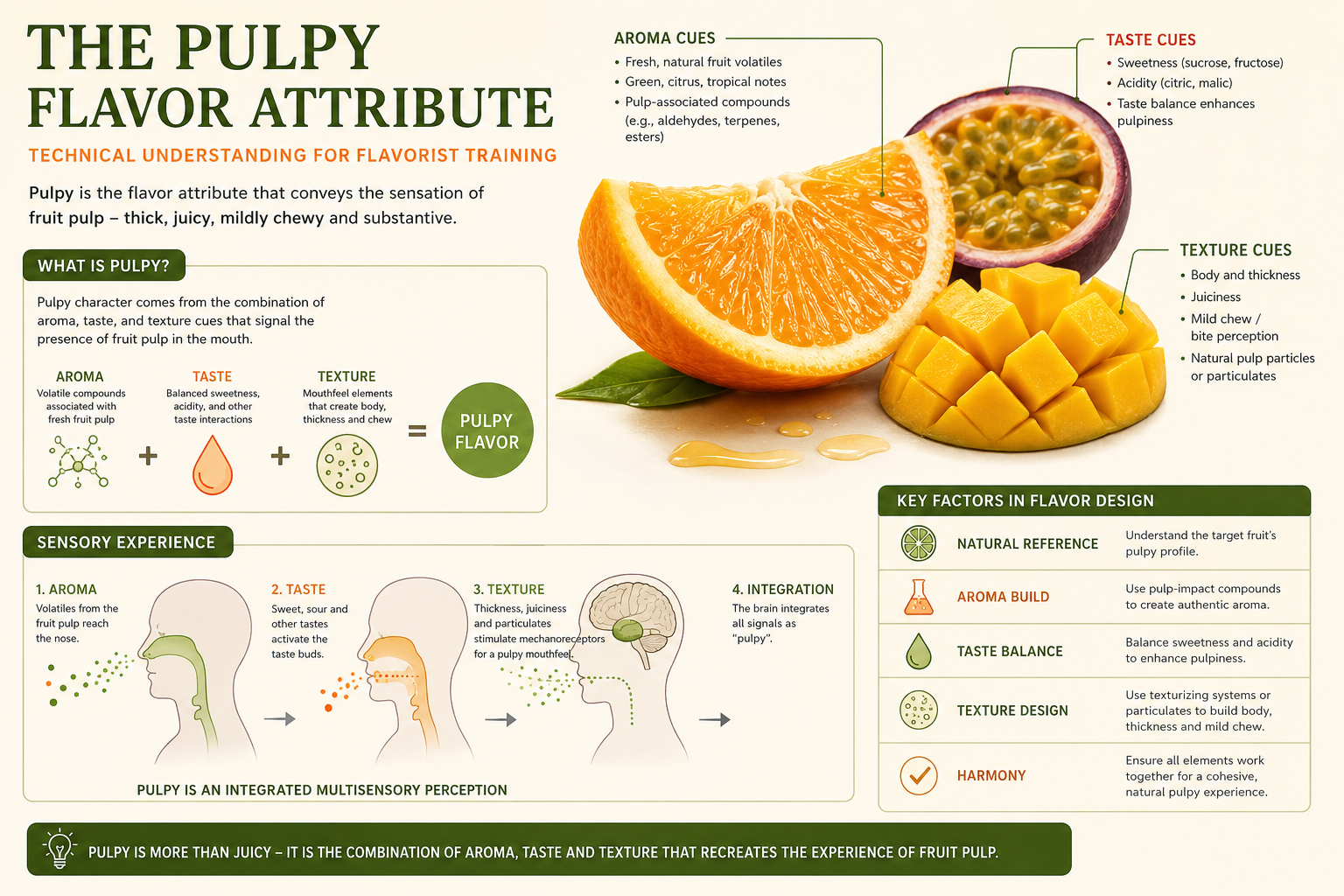
The descriptor “pulpy” is widely used in flavor development, beverage formulation, and sensory evaluation, yet it is often misunderstood. Unlike descriptors such as citrus, tropical, green, sulfurous, or floral, pulpy is not solely an aroma character. Rather, it is a multidimensional sensory construct that combines aroma, taste, mouthfeel, and cognitive associations derived from fresh fruit tissue.
Consumers perceive pulp as evidence of freshness, naturalness, authenticity, and minimally processed fruit. Consequently, flavorists frequently seek to create or reinforce pulpy character in juices, juice drinks, smoothies, nectars, fruit preparations, dairy beverages, confections, and functional beverages.
A successful pulpy profile requires understanding not only the flavor chemicals associated with fresh fruit flesh but also the interactions between volatile compounds, nonvolatile components, texture systems, and sensory expectations.
Defining the Pulpy Attribute
In sensory terms, pulpy refers to the impression of freshly disrupted fruit flesh containing juice sacs, cell fragments, and soluble solids.
The attribute typically includes:
Aromatic Components
- Fresh fruit flesh notes
- Juicy fruit character
- Slight green freshness
- Natural fruit oil nuances
- Mild peel-to-pulp transitions
Taste Components
- Natural sweetness
- Moderate acidity
- Reduced cooked character
- Presence of soluble solids perception
Mouthfeel Components
- Body
- Thickness
- Particulate perception
- Juiciness
- Moistness
Psychological Components
- Freshly squeezed
- Not-from-concentrate
- Hand-processed fruit
- Authentic fruit content
Thus, pulpy is a cross-modal sensory attribute rather than a single flavor note.
Sensory Basis of Pulpy Character
When fruit tissue is mechanically disrupted, several events occur simultaneously:
- Cell walls rupture.
- Intracellular juice is released.
- Volatile compounds are liberated.
- Sugars and acids become more available.
- Pectin contributes viscosity.
- Small particles remain suspended.
Consumers learn to associate this complex sensory experience with pulp.
Therefore, flavorists must recreate multiple sensory signals simultaneously.
Major Chemical Contributors to Pulpy Character
1. Aldehydes
Aldehydes are among the most important contributors to fresh fruit flesh perception.
Hexanal
Aroma:
- Green
- Fresh cut fruit
- Leafy
- Juicy
Contribution:
Hexanal provides the fresh-cut impression that often accompanies newly disrupted fruit tissue.
Typical use levels:
- 0.1–5 ppm in finished beverage
Risk:
Excessive levels become grassy and vegetable-like.
trans-2-Hexenal
Aroma:
- Green apple
- Fresh cut fruit
- Fruity green
Contribution:
Creates the perception of freshly broken fruit cells.
Particularly important in:
- Orange pulp
- Apple pulp
- Pear pulp
- Tropical pulp systems
cis-3-Hexenal
Aroma:
- Fresh leaf
- Green
- Crushed plant tissue
Contribution:
Adds realism to fresh pulp impressions.
Very powerful material.
Typically used at trace levels.
2. Alcohols
Alcohols contribute juicy flesh notes.
cis-3-Hexenol
Aroma:
- Green
- Fresh
- Leafy
- Fruit flesh
Contribution:
Supports freshly cut fruit perception.
Important in:
- Citrus
- Apple
- Pear
- Melon
trans-2-Hexenol
Aroma:
- Green
- Fruity
- Fresh
Contribution:
Provides freshness associated with disrupted fruit tissue.
1-Hexanol
Aroma:
- Green
- Woody
- Fresh fruit
Contribution:
Supports juicy pulp body when used carefully.
3. Esters
Esters create juicy fruit flesh impressions.
While aldehydes provide freshness, esters provide the juicy edible fruit component.
Ethyl Butyrate
Aroma:
- Juicy orange
- Pineapple
- Fresh fruit
Contribution:
Perhaps the most important ester in pulpy citrus systems.
Provides:
- Juiciness
- Fruit flesh
- Fresh squeezed perception
Ethyl 2-Methylbutyrate
Aroma:
- Apple
- Tropical
- Juicy fruit
Contribution:
Creates succulent fruit flesh character.
Useful in:
- Apple pulp
- Citrus pulp
- Tropical pulp
Ethyl Acetate
Aroma:
- Fruity
- Fresh
- Solvent-like at high levels
Contribution:
Low levels enhance fresh juice perception.
Hexyl Acetate
Aroma:
- Apple
- Pear
- Fresh fruit flesh
Contribution:
Excellent for pulpy apple and pear systems.
4. Terpenes
Terpenes are critical in citrus pulp systems.
d-Limonene
Aroma:
- Citrus peel
- Orange oil
Contribution:
Although primarily peel-associated, low levels help bridge peel and pulp perception.
Too much:
- Becomes peel-heavy
- Reduces pulpy authenticity
Myrcene
Aroma:
- Fresh citrus
- Green
- Resinous
Contribution:
Adds realism to fresh orange pulp.
Important in not-from-concentrate profiles.
γ-Terpinene
Aroma:
- Citrus
- Fresh
- Slightly green
Contribution:
Supports freshly squeezed citrus pulp notes.
5. Oxygenated Terpenes
Linalool
Aroma:
- Floral
- Citrus
- Sweet
Contribution:
Provides fresh juice brightness.
Helps simulate recently extracted fruit juice.
Citral
Aroma:
- Lemon
- Citrus flesh
Contribution:
Strong contributor to juicy citrus flesh character.
Must be balanced carefully.
Excessive levels become candy-like.
6. Lactones
Lactones contribute the fleshy aspect of pulp.
γ-Decalactone
Aroma:
- Peach
- Creamy fruit flesh
Contribution:
Creates succulent fruit tissue character.
Especially important in:
- Peach pulp
- Mango pulp
- Apricot pulp
γ-Undecalactone
Aroma:
- Peach
- Fruity
- Rich flesh
Contribution:
Adds thickness and ripe flesh perception.
7. Sulfur Compounds
Many fresh fruit pulps contain trace sulfur compounds.
Examples
- Methional
- Dimethyl sulfide
- 3-Mercaptohexanol
- 3-Mercaptohexyl acetate
Contribution:
Provide realism and freshness.
Particularly important in:
- Citrus
- Tropical fruits
- Passion fruit
- Grapefruit
Used at extremely low levels.
Overuse causes defects.
Important Pulpy Flavor Materials by Fruit Type
Orange Pulp
Key materials:
- Ethyl butyrate
- Octanal
- Decanal
- Hexanal
- trans-2-Hexenal
- Limonene
- Myrcene
- Linalool
- Valencene
Sensory target:
Freshly squeezed orange with suspended juice sacs.
Mango Pulp
Key materials:
- δ-Decalactone
- γ-Decalactone
- Furaneol
- Ethyl butyrate
- Terpinolene
- Myrcene
Sensory target:
Dense ripe fruit flesh.
Peach Pulp
Key materials:
- γ-Decalactone
- γ-Undecalactone
- Benzaldehyde
- Ethyl acetate
- Hexyl acetate
Sensory target:
Soft juicy flesh.
Apple Pulp
Key materials:
- Hexyl acetate
- trans-2-Hexenal
- cis-3-Hexenol
- Ethyl 2-methylbutyrate
Sensory target:
Freshly grated apple flesh.
Pear Pulp
Key materials:
- Hexyl acetate
- Ethyl decadienoate
- cis-3-Hexenol
Sensory target:
Moist juicy fruit tissue.
Role of Juice-Derived Flavor Fractions
Professional flavor houses frequently employ:
Essence Oils
Recovered during juice concentration.
Contain:
- Fresh volatiles
- Juice-top notes
Contribution:
Authentic pulpy juice character.
Aroma Recovery Fractions
Recovered by stripping juice vapors.
Contribution:
Natural pulp authenticity.
Especially important in citrus.
Cold Pressed Oils
Provide:
- Peel-pulp transition
Used carefully because excess peel character decreases pulp perception.
Mouthfeel Contributors to Pulpy Perception
Flavor compounds alone rarely create pulpy character.
Texture is critical.
Pectin
Most important pulpy mouthfeel material.
Contribution:
- Fruit body
- Juice thickness
- Natural fruit texture
Typical levels:
0.05–0.30%
depending on application.
Citrus Fiber
Contribution:
- Particle perception
- Authentic pulp sensation
Increasingly used in clean-label beverages.
Cellulose
Contribution:
- Suspended pulp simulation
- Fiber-like texture
Fruit Purees
Contribution:
- Natural solids
- Authentic mouthfeel
Often provide the strongest pulpy signal.
Sweetness–Acid Balance
Pulpy perception is strongly influenced by taste balance.
Excess Sweetness
Produces:
- Candy
- Nectar
- Syrup
Reduces pulp authenticity.
Excess Acidity
Produces:
- Thin juice
- Sharp beverage
Reduces fleshy perception.
Optimal Balance
Creates:
- Juiciness
- Fruit flesh
- Natural pulp character
Pulpy vs Juicy
These terms are related but distinct.
Juicy
Characterized by:
- Liquid release
- Fresh fruit flavor
- Mouth-watering sensation
Can exist without pulp.
Examples:
- Grape drink
- Watermelon beverage
Pulpy
Includes:
- Juiciness
- Fruit flesh
- Tissue perception
- Suspended solids association
All pulpy flavors are juicy, but not all juicy flavors are pulpy.
Pulpy vs Fresh-Squeezed
Fresh-squeezed includes:
- Bright top notes
- Peel oil
- Volatile freshness
Pulpy includes:
- Flesh character
- Body
- Cell disruption perception
The two attributes overlap substantially but are not identical.
Common Flavor Building Strategy
A typical pulpy citrus flavor architecture might include:
Top Notes
- Acetaldehyde
- Ethyl butyrate
- Hexanal
Middle Notes
- Linalool
- Citral
- Octanal
- Decanal
Flesh Notes
- trans-2-Hexenal
- cis-3-Hexenol
- Ethyl 2-methylbutyrate
Background Notes
- Valencene
- Myrcene
- Trace sulfur compounds
Mouthfeel System
- Pectin
- Citrus fiber
- Small pulp particulates
Together these create the integrated perception of fresh citrus pulp.
Common Defects That Destroy Pulpy Character
Excess Peel Oil
Produces:
- Zesty
- Terpenic
- Bitter
Result:
Orange peel rather than orange pulp.
Excess Ester Load
Produces:
- Candy
- Artificial fruit
Result:
Loss of authenticity.
Excess Cooked Notes
Examples:
- Furfural
- Maltol overload
- Cooked juice notes
Result:
Processed rather than pulpy.
Insufficient Green Notes
Without aldehydes and green alcohols:
- Flavor becomes flat
- Fresh fruit tissue perception disappears
Lack of Texture Support
Even excellent flavor chemistry may fail if beverage viscosity is too low.
Consumers often report:
"Good orange flavor but not pulpy."
This demonstrates the importance of multisensory integration.
Practical Formulation Principles for Flavorists
When developing a pulpy profile:
- Start with authentic fruit flesh chemistry rather than peel chemistry.
- Use aldehydes to create freshly disrupted tissue perception.
- Build juiciness with esters.
- Support realism with trace sulfur compounds where appropriate.
- Incorporate moderate green notes.
- Maintain balanced sweetness and acidity.
- Add mouthfeel systems (pectin, fiber, puree, particulates).
- Avoid excessive candy esters.
- Avoid dominant peel oils.
- Evaluate flavor together with texture, not separately.
Conclusion
The sensory attribute pulpy is one of the most complex fruit descriptors encountered in flavor creation because it arises from the interaction of volatile chemistry, taste balance, texture, and consumer expectation. The most important volatile contributors include hexanal, trans-2-hexenal, cis-3-hexenol, ethyl butyrate, ethyl 2-methylbutyrate, limonene, myrcene, citral, linalool, and selected sulfur compounds, while nonvolatile contributors such as pectin, citrus fiber, fruit solids, and viscosity systems provide the critical mouthfeel cues necessary for authentic pulp perception.
For the professional flavorist, pulpy should never be approached as a single flavor note. It is best understood as a fresh fruit flesh system, requiring the coordinated design of aroma, taste, texture, and appearance to reproduce the sensory experience of freshly disrupted fruit tissue. Mastery of this attribute is essential for modern juice, beverage, dairy, and fruit-preparation flavor development.
###