Global Food Safety Initiative (GFSI) in Flavor Manufacturing: Principles, Industry Application, and SFC Certification Mastery
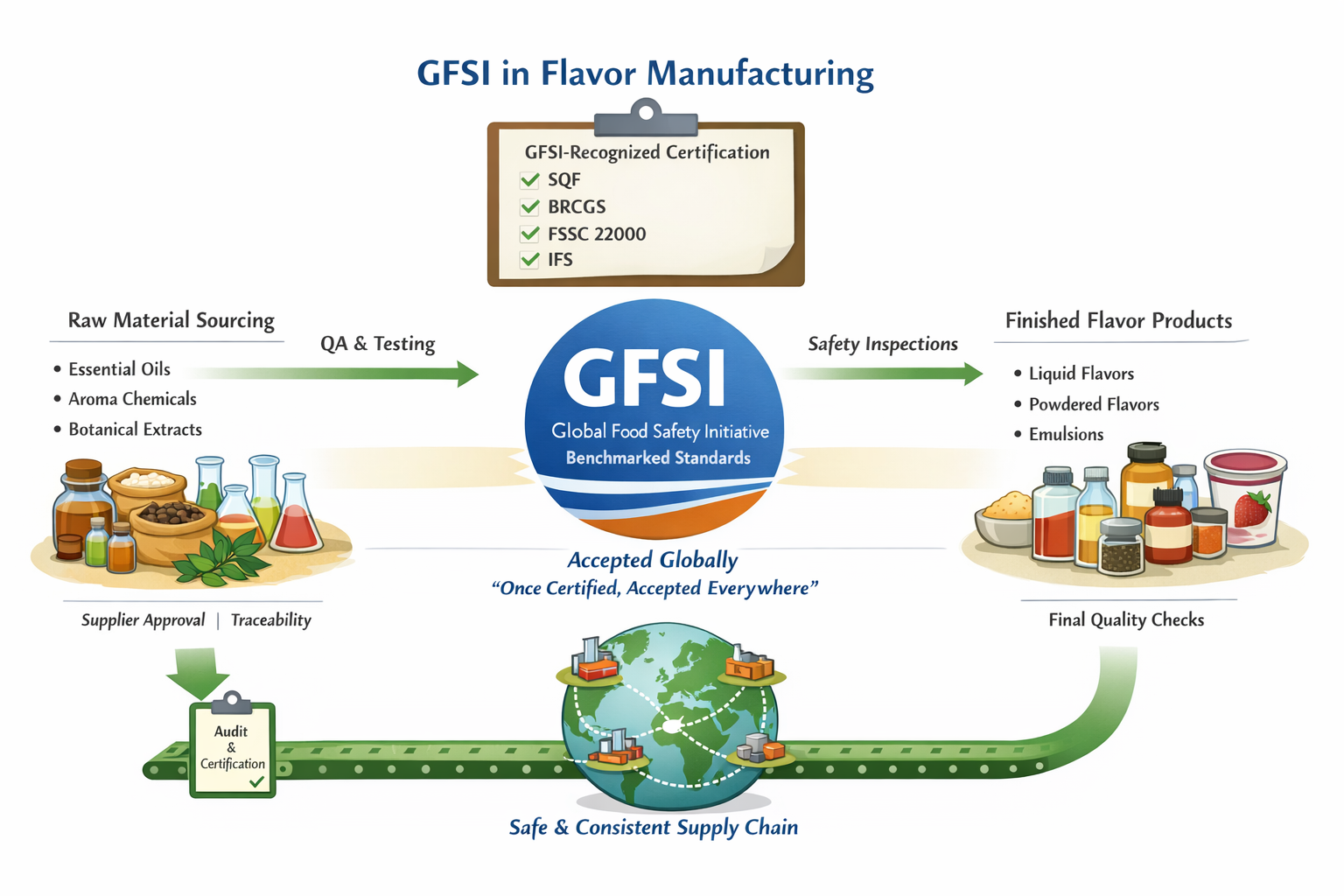
🌍 Global Food Safety Initiative (GFSI): What Flavorists Need to Know
📌 What is GFSI?
The Global Food Safety Initiative (GFSI) is an international, industry-driven program established to standardize and benchmark food safety systems worldwide.
- It was launched by the Consumer Goods Forum, a global network of major food manufacturers and retailers.
- GFSI itself does not certify companies. Instead, it evaluates and recognizes (“benchmarks”) existing food safety certification schemes.
- The goal: “Once certified, accepted everywhere.”
→ This reduces duplicate audits across supply chains.
🧠 Core Concept (Beginner-Friendly Explanation)
Think of GFSI as a “meta-standard”:
- Individual food safety standards = like different textbooks
- GFSI = the accreditation system that ensures all those textbooks meet the same level of rigor
If a certification is GFSI-recognized, it means:
- It meets strict global food safety requirements
- It is trusted by multinational companies (Nestlé, PepsiCo, etc.)
🏭 Where GFSI is Used in the Flavor Industry
1. Flavor Manufacturers (Core Use)
Flavor companies must demonstrate food safety compliance because flavors are food ingredients.
Common uses:
- Qualifying suppliers for large food companies
- Meeting customer audit requirements
- Ensuring safe handling of:
- solvents
- natural extracts
- reaction flavors
- fermentation products
👉 Example:
A flavor house supplying to a global beverage company will almost always need a GFSI-recognized certification.
2. Ingredient Supply Chain
Flavorists rely on raw materials such as:
- essential oils
- aroma chemicals
- botanical extracts
GFSI ensures:
- traceability (where ingredients come from)
- contamination control (e.g., pesticides, heavy metals)
- consistent quality
3. Contract Manufacturing & Blending Facilities
Facilities producing:
- liquid flavors
- spray-dried powders
- emulsions
…must follow strict:
- hygiene controls
- allergen management
- cross-contamination prevention
GFSI-recognized systems ensure these are properly implemented.
📜 Major GFSI-Recognized Certification Schemes
Aspiring flavorists should recognize these names:
🔹 SQF (Safe Quality Food) Program
- Common in North America
- Strong focus on quality + safety
- Widely used by flavor companies
🔹 BRCGS (Brand Reputation Compliance Global Standards)
- Originated in the UK
- Strong emphasis on documentation and traceability
🔹 FSSC 22000
- Based on ISO standards
- More systems-oriented (management systems approach)
🔹 IFS (International Featured Standards)
- Popular in Europe
- Focus on process control and product integrity
👉 Key point:
All of these are different systems, but if GFSI-recognized, they are considered equivalent in rigor.
🧪 Why GFSI Matters Specifically to Flavorists
1. Safety of Complex Chemical Systems
Flavors often contain:
- volatile compounds
- reactive intermediates
- trace-level potent chemicals
GFSI systems ensure:
- proper storage (temperature, light, oxygen)
- controlled handling
- prevention of degradation or contamination
2. Traceability (Critical for Natural Flavors)
Flavorists must track:
- botanical origin
- extraction method
- batch history
GFSI requires:
- full documentation from raw material → finished flavor
3. Allergen Control
Some flavor components may contain:
- nuts
- dairy derivatives
- soy carriers
GFSI systems enforce:
- segregation
- labeling
- cleaning validation
4. Regulatory Compliance Support
GFSI frameworks help companies comply with:
- FDA (U.S.)
- EFSA (Europe)
Even though GFSI is not a law, it supports legal compliance.
📚 What Aspiring Flavorists (SFC Candidates) Are Expected to Know
The Society of Flavor Chemists (SFC) expects foundational—not auditor-level—knowledge.
🎯 1. Definition & Purpose
You should be able to explain:
- What GFSI is
- Why it exists
- Difference between GFSI and certification bodies
🎯 2. Recognition vs Certification
Critical concept:
- GFSI = benchmarks standards
- Certification bodies = issue certificates
🎯 3. Major Schemes (Name Recognition)
You should recognize:
- SQF
- BRCGS
- FSSC 22000
- IFS
…and understand they are GFSI-recognized systems.
🎯 4. Relevance to Flavor Industry
Be able to explain:
- Why flavor companies must comply
- How it impacts:
- formulation
- raw material sourcing
- production
🎯 5. Basic Food Safety Principles Within GFSI
Even at a beginner level, you should understand:
HACCP (Hazard Analysis Critical Control Points)
- Identify risks (chemical, biological, physical)
- Control them systematically
GMP (Good Manufacturing Practices)
- Clean equipment
- Proper handling procedures
Traceability
- Ability to track ingredients forward and backward
🎯 6. Supplier Approval Systems
Flavorists must understand:
- Why approved suppliers are required
- How GFSI ensures supplier reliability
⚠️ Common Beginner Confusions (Clarified)
- ❌ “GFSI certification”
✔️ Correct: GFSI-recognized certification - ❌ “GFSI audits companies”
✔️ Correct: Certification bodies perform audits - ❌ “Only food manufacturers need it”
✔️ Flavor companies are critical users
🧾 Practical Example (Easy to Understand)
You develop a strawberry flavor:
- Raw materials from 5 suppliers
- Produced in a blending facility
- Sold to a yogurt manufacturer
Without GFSI:
- Each customer audits you separately
With GFSI:
- One recognized certification → accepted globally
🧩 Summary (What You Must Remember)
- GFSI is a global benchmarking system for food safety standards
- It ensures consistency, trust, and efficiency across supply chains
- Flavor companies rely on it for:
- safety
- traceability
- customer acceptance
- Aspiring flavorists must understand:
- core concept
- major schemes
- industry relevance
- basic food safety principles
📘 GFSI Mastery Workbook for Flavor Chemists
(Society of Flavor Chemists Exam Preparation Guide + 50+ Questions with Explanations)
🧭 SECTION 1 — Quick Review (Exam Memory Anchor)
Before diving into questions, lock in these essentials:
- Global Food Safety Initiative (GFSI)
→ Benchmarks food safety standards (does NOT certify) - Recognized schemes:
- SQF (Safe Quality Food) Program
- BRCGS (Brand Reputation Compliance Global Standards)
- FSSC 22000
- IFS (International Featured Standards)
- Key principles:
- HACCP
- GMP
- Traceability
- Supplier approval
🧪 SECTION 2 — CORE EXAM QUESTIONS (WITH EXPLANATIONS)
🔹 PART A — FOUNDATIONS (10 Questions)
1. What is the primary role of GFSI?
A. Certify companies
B. Benchmark food safety schemes
C. Enforce food laws
D. Develop flavor regulations
✅ Answer: B
👉 Explanation: GFSI evaluates existing certification programs—not companies.
2. Which organization created GFSI?
A. FDA
B. WHO
C. Consumer Goods Forum
D. ISO
✅ Answer: C
👉 Explanation: Industry-driven initiative from global retailers and manufacturers.
3. Which statement is correct?
A. GFSI performs audits
B. GFSI issues certificates
C. GFSI recognizes certification schemes
D. GFSI regulates flavor compounds
✅ Answer: C
4. What does “GFSI-recognized” mean?
A. Government approved
B. Meets global benchmarking requirements
C. Certified by FDA
D. Organic compliant
✅ Answer: B
5. Why was GFSI created?
A. To replace ISO
B. To reduce duplicate audits
C. To regulate flavors
D. To set tariffs
✅ Answer: B
6. Which is NOT a GFSI-recognized scheme?
A. SQF
B. BRCGS
C. FSSC 22000
D. FDA
✅ Answer: D
7. GFSI applies to:
A. Only farms
B. Only retailers
C. Entire food supply chain
D. Only labs
✅ Answer: C
8. What is the main benefit of GFSI certification?
A. Lower ingredient cost
B. Global acceptance
C. Better flavor
D. Faster reactions
✅ Answer: B
9. Which industry uses GFSI?
A. Automotive
B. Aerospace
C. Food & flavor
D. Construction
✅ Answer: C
10. GFSI ensures:
A. Taste quality
B. Safety and consistency
C. Color uniformity
D. Shelf appeal
✅ Answer: B
🔹 PART B — FLAVOR INDUSTRY APPLICATION (15 Questions)
11. Why do flavor companies need GFSI systems?
A. To improve aroma
B. To ensure food safety compliance
C. To increase volatility
D. To reduce sweetness
✅ Answer: B
12. Which is critical in flavor manufacturing under GFSI?
A. Color intensity
B. Allergen control
C. Sweetness
D. Viscosity
✅ Answer: B
13. Traceability means:
A. Tracking aroma strength
B. Tracking ingredients from source to product
C. Measuring volatility
D. Monitoring pH
✅ Answer: B
14. Which is a common risk in flavor production?
A. Over-sweetness
B. Cross-contamination
C. High viscosity
D. Color fading
✅ Answer: B
15. GFSI helps control:
A. Flavor intensity
B. Chemical hazards
C. Aroma balance
D. Taste perception
✅ Answer: B
16. A flavorist must understand supplier approval because:
A. It improves taste
B. It ensures raw material safety
C. It increases yield
D. It lowers cost
✅ Answer: B
17. Which is an example of a hazard?
A. Strawberry note
B. Microbial contamination
C. Sweetness
D. Color
✅ Answer: B
18. GMP refers to:
A. Good Mixing Practice
B. Good Manufacturing Practices
C. General Material Process
D. Global Monitoring Plan
✅ Answer: B
19. Which area is MOST affected by GFSI?
A. Flavor creativity
B. Safety systems
C. Marketing
D. Branding
✅ Answer: B
20. Which product requires GFSI compliance?
A. Perfume only
B. Food flavors
C. Paint
D. Fuel
✅ Answer: B
21. Allergen control prevents:
A. Flavor loss
B. Consumer health risks
C. Volatility
D. Oxidation
✅ Answer: B
22. Which is part of HACCP?
A. Aroma blending
B. Hazard identification
C. Flavor masking
D. Color fixing
✅ Answer: B
23. Why is documentation important?
A. Improves taste
B. Provides traceability
C. Adds aroma
D. Reduces cost
✅ Answer: B
24. GFSI impacts:
A. Only production
B. Entire supply chain
C. Only packaging
D. Only labeling
✅ Answer: B
25. Which step ensures safe suppliers?
A. Flavor testing
B. Supplier approval program
C. Sensory panel
D. GC analysis
✅ Answer: B
🔹 PART C — CERTIFICATION SCHEMES (10 Questions)
26. Which scheme is common in North America?
A. IFS
B. SQF
C. ISO 9001
D. USDA
✅ Answer: B
27. Which is ISO-based?
A. SQF
B. BRCGS
C. FSSC 22000
D. IFS
✅ Answer: C
28. BRCGS originated in:
A. USA
B. UK
C. Germany
D. Japan
✅ Answer: B
29. IFS is popular in:
A. Asia
B. Europe
C. Africa
D. Australia
✅ Answer: B
30. All GFSI schemes are:
A. Identical
B. Equivalent in rigor
C. Government laws
D. Optional globally
✅ Answer: B
31. Certification is issued by:
A. GFSI
B. Certification bodies
C. FDA
D. Suppliers
✅ Answer: B
32. GFSI ensures schemes meet:
A. Flavor standards
B. Safety benchmarks
C. Aroma levels
D. Pricing rules
✅ Answer: B
33. FSSC 22000 focuses on:
A. Sensory
B. Management systems
C. Color
D. Taste
✅ Answer: B
34. SQF includes:
A. Only safety
B. Safety and quality
C. Only flavor
D. Only packaging
✅ Answer: B
35. BRCGS emphasizes:
A. Taste
B. Documentation
C. Aroma
D. Texture
✅ Answer: B
🔹 PART D — SCENARIO-BASED QUESTIONS (15 Questions)
36. A supplier cannot trace raw materials. What is the issue?
✅ Answer: Traceability failure
👉 Critical violation under GFSI.
37. A facility mixes allergen and non-allergen flavors without cleaning. Risk?
✅ Answer: Cross-contamination
38. Missing batch records indicates:
✅ Answer: Documentation failure
39. A company audited twice by different customers—solution?
✅ Answer: Obtain GFSI-recognized certification
40. Raw materials from unapproved vendors?
✅ Answer: Supplier control failure
41. Improper storage of citrus oils leads to:
✅ Answer: Quality + safety risk (oxidation)
42. No hazard analysis performed:
✅ Answer: HACCP violation
43. Employee hygiene ignored:
✅ Answer: GMP failure
44. No allergen labeling:
✅ Answer: Regulatory + safety risk
45. Contaminated solvent used:
✅ Answer: Chemical hazard
46. No recall system in place:
✅ Answer: Traceability system failure
47. Supplier audit missing:
✅ Answer: Supplier approval breakdown
48. Flavor batch cannot be traced to origin:
✅ Answer: Major GFSI non-conformance
49. Inconsistent cleaning procedures:
✅ Answer: GMP violation
50. No documentation of temperature control:
✅ Answer: Process control failure
🧠 SECTION 3 — HOW TO STUDY (SFC STRATEGY)
🎯 Focus Areas (High Probability Exam Topics)
- Difference between:
- GFSI vs certification
- Major schemes (name recognition)
- HACCP basics
- Traceability concept
- Supplier approval systems
🧩 Memory Trick
“GFSI = Judge, Not Police”
- Judge → evaluates standards
- Police → certification bodies audit
🧾 FINAL SUMMARY
To pass the SFC-level understanding:
You must confidently explain:
- What Global Food Safety Initiative does
- Why it matters in flavor manufacturing
- How it impacts safety, sourcing, and production
- Which certification schemes are recognized
- Basic food safety systems (HACCP, GMP, traceability)
###