GLP-1 Drugs Could Reshape the Snack Industry as $73 Billion in Food Brand Value Faces Risk
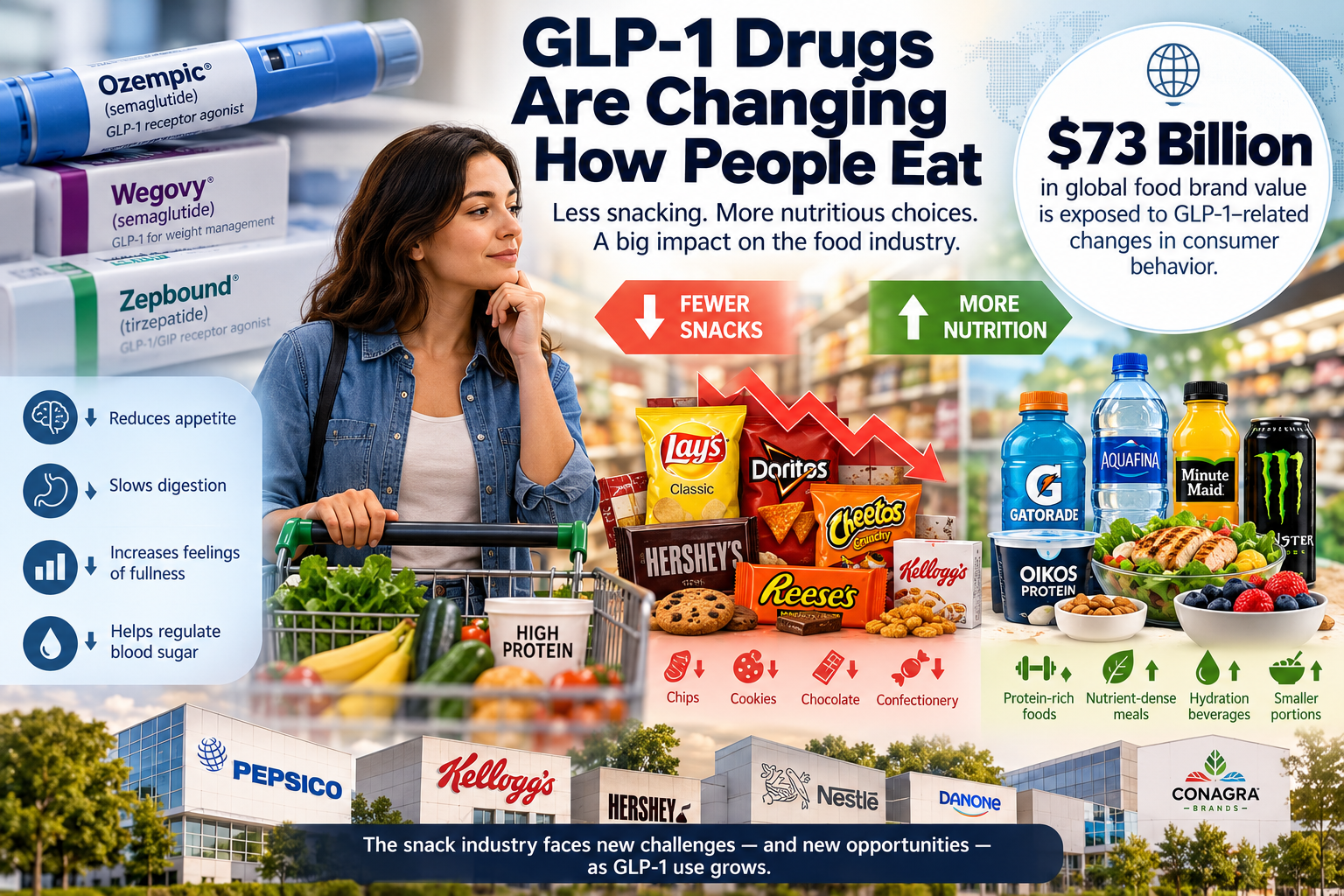
Friday September 25, 2026 – GLP-1 weight-loss drugs such as Ozempic and Wegovy are changing more than waistlines. Their rapid adoption is beginning to influence what consumers eat, how much food they buy, and which products they put in their grocery carts — potentially creating significant consequences for some of the world's largest food and snack brands.
A recent Brand Finance analysis highlighted by Food Dive estimates that $73 billion in brand value among the world's 100 most valuable food brands is exposed to changes in consumer behavior associated with GLP-1 medications. Those 100 brands have a combined value of approximately $278 billion, meaning more than one-quarter of their value is associated with categories that Brand Finance considers vulnerable to GLP-1-driven changes in consumption.
The potential impact is particularly significant for companies that depend heavily on snacking, confectionery and other calorie-dense foods.
Why GLP-1 Drugs Are Becoming Such a Major Consumer Trend
GLP-1 stands for glucagon-like peptide-1, a naturally occurring hormone involved in blood sugar regulation and appetite.
After food is consumed, GLP-1 helps stimulate insulin release when blood glucose is elevated. It also affects appetite and food intake, and GLP-1-based medications can slow gastric emptying, contributing to feelings of fullness.
GLP-1 receptor agonists were initially developed primarily as treatments for type 2 diabetes. Their effects on appetite and body weight, however, led to their development and approval for chronic weight management as well.
For example, semaglutide is marketed as Ozempic for type 2 diabetes and Wegovy for chronic weight management under different indications and doses. Liraglutide is another GLP-1 medication, while tirzepatide — marketed as Zepbound for weight management — acts on both GIP and GLP-1 pathways.
These medications have attracted enormous attention partly because of the magnitude of weight loss observed with newer therapies. Earlier NIDDK reporting noted that semaglutide 2.4 mg produced average weight loss of roughly 15% of initial body weight in clinical research, substantially higher than was typical with many older obesity medications. Individual results vary, and these prescription medications also carry side effects and medical considerations that should be discussed with a healthcare professional.
GLP-1 Use Is Rising Rapidly in the United States
The importance of GLP-1 drugs to the food industry becomes clearer when looking at how quickly their use has grown.
According to Gallup data updated in September 2026, 11% of U.S. adults reported currently using GLP-1 medications specifically for weight loss, compared with just 3% in 2024. Fifteen percent said they had used the drugs for weight loss at some point. Gallup's 2026 results were based on a survey of 5,065 U.S. adults conducted May 28 through June 5.
That means GLP-1 medications are no longer affecting only a small niche of consumers. They are increasingly becoming a factor that food manufacturers, restaurants, retailers and consumer packaged goods companies have to consider when planning future products.
And the issue isn't simply that GLP-1 users may lose weight. Their purchasing behavior appears to change as well.
GLP-1 Users Are Spending Less on Groceries
Research from Cornell University and Numerator provides one of the clearest indications of what this trend could mean for food companies.
Researchers linked information about GLP-1 adoption with household transaction data and found that households containing at least one GLP-1 user reduced grocery spending after adopting the medication.
The latest version of the research reports an average 5.3% decline in grocery spending within six months of GLP-1 adoption, with an 8.2% decline among higher-income households. An earlier version of the research, cited by Food Dive, rounded the overall decline to approximately 6%.
Importantly, consumers aren't cutting every category equally.
The largest reductions were concentrated in calorie-dense and processed foods. The updated research reports a 10.1% decline in spending on savory snacks. Earlier reporting also identified substantial declines in categories such as chips, baked goods and cookies.
That purchasing pattern explains why the rise of GLP-1 drugs has captured the attention of the global snack industry.
Lay's Faces the Greatest GLP-1 Exposure, According to Brand Finance
Brand Finance identified PepsiCo's Lay's as the food brand with the greatest exposure to GLP-1-related changes in consumption.
According to the analysis, approximately $6.8 billion of Lay's $15.1 billion brand value is associated with categories considered structurally exposed to the trend. That represents roughly 45% of the brand's value.
PepsiCo's exposure extends beyond Lay's. Five of its major snack brands collectively account for an estimated $14.1 billion in exposed brand value, according to Brand Finance.
Other major names identified among the most exposed brands include:
- Doritos
- Hershey's
- Cheetos
- Kellogg's
- Reese's
Seven of the 10 brands identified as most exposed globally are U.S.-based.
The broader category numbers are even more revealing. Confectionery, chocolate and savory snacks represent 53% of the brand value considered at risk in Brand Finance's analysis, despite accounting for only 30% of the overall brand value studied.
In other words, the potential disruption is heavily concentrated in the foods consumers often eat between meals or as indulgences.
Why Snacking Could Be Especially Vulnerable to GLP-1 Drugs
The fundamental challenge for snack companies is relatively straightforward: many traditional snack categories depend on consumers eating when they are not necessarily very hungry.
Chips, cookies, candy and similar products frequently benefit from impulse purchases, habitual snacking, convenience and repeat eating occasions.
GLP-1 medications may disrupt that pattern by reducing appetite and increasing feelings of fullness.
The commercial risk therefore doesn't require consumers to stop buying chips or chocolate altogether. Even relatively small behavioral changes — buying a smaller package, snacking one fewer time per day, purchasing treats less frequently or replacing a snack with a protein-rich alternative — could become meaningful when multiplied across millions of consumers.
That distinction is important.
The Brand Finance analysis should not necessarily be interpreted as predicting the disappearance of major snack brands or a literal $73 billion loss. Rather, it identifies brand value exposed to categories where GLP-1 adoption could structurally change consumption patterns.
Food Companies Are Already Responding to the GLP-1 Trend
Major food manufacturers aren't waiting to see what happens.
Several companies have already launched or repositioned products around the nutritional priorities associated with weight management and GLP-1 use.
Nestlé, for example, launched Vital Pursuit in the U.S. in 2024. The product line targets consumers using GLP-1 medications as well as other consumers focused on weight management.
Danone subsequently introduced an Oikos yogurt drink aimed at GLP-1 users, emphasizing protein and maintaining muscle mass.
Conagra Brands has gone even further by placing "GLP-1 friendly" labeling on selected Healthy Choice frozen meals.
Acquisitions could become another strategy.
Food Dive notes that Ferrero, the maker of Nutella, purchased better-for-you oatmeal and granola company Purely Elizabeth in 2026. While individual acquisitions have multiple strategic motivations, expanding into health-oriented categories can help major food companies diversify as consumer preferences evolve.
Protein, Nutrition and Smaller Portions Could Become More Important
The rise of GLP-1 medications could accelerate several food trends that were already underway.
Consumers eating fewer calories have less room in their diets for foods with limited nutritional value. That could increase the importance of nutrient density — getting more protein, fiber, vitamins and minerals from smaller amounts of food.
Protein is particularly relevant because maintaining lean body mass can be an important consideration during substantial weight loss.
This creates opportunities for food manufacturers to rethink both products and portion sizes. Rather than simply offering a "diet" version of an existing snack, manufacturers may increasingly develop products around attributes such as protein, fiber, portion control, hydration and functional nutrition.
For snack companies, that could mean smaller packages, protein-enhanced snacks or products designed around quality and satisfaction rather than volume.
Beverages Could Be a GLP-1 Winner
Interestingly, the GLP-1 trend may not be negative for every food and beverage category.
Brand Finance identified several major beverage brands as potential beneficiaries of changing consumption habits, including Gatorade and Aquafina, both owned by PepsiCo. Coca-Cola's Minute Maid and energy drink brand Monster were also highlighted.
The reason points to a broader shift in consumer priorities.
Even when people consume fewer calories, they still need hydration. Consumers focused on health and weight management may also seek products offering functional benefits.
That could make hydration and certain functional beverages comparatively resilient even as consumption of calorie-dense snack foods declines.
GLP-1 Could Become a Long-Term Food Industry Megatrend
Perhaps the biggest takeaway is that GLP-1 medications are evolving from a pharmaceutical story into a consumer behavior story.
The food industry has experienced major shifts before — including the rise of low-fat foods, low-carb diets, plant-based products, organic foods and high-protein diets. GLP-1 medications are different because they can directly influence hunger and satiety rather than simply encouraging consumers to choose one type of food over another.
That distinction could make the trend unusually significant.
Recent purchasing research provides some evidence of the shift. Beyond the Cornell findings in the U.S., research examining supermarket purchases among GLP-1 users in Denmark found modest reductions in the energy density, sugar and carbohydrate content of purchases, an increase in protein density, and a shift from ultra-processed toward unprocessed goods after GLP-1 initiation.
If GLP-1 adoption continues growing, food companies may therefore face two simultaneous changes: consumers eating less overall and consumers reallocating the calories they do consume toward different categories.
For traditional snack manufacturers, the second change could ultimately be just as important as the first.
What GLP-1 Means for the Future of Big Food
The estimated $73 billion in exposed brand value doesn't mean $73 billion will automatically disappear. Brand valuations depend on assumptions about future demand and other factors, and consumers are unlikely to abandon snacks and confectionery completely.
But the underlying behavioral shift is increasingly difficult for food companies to ignore.
Gallup's finding that 11% of U.S. adults reported using GLP-1 medications for weight loss in 2026 suggests these drugs are already influencing a meaningful segment of the consumer population. Meanwhile, household purchasing research shows measurable reductions in food spending and particularly strong declines in processed snack purchases.
That creates both risk and opportunity.
Companies heavily dependent on chips, candy, cookies and other high-calorie snacks could face pressure if eating occasions decline. At the same time, companies with strong positions in protein, hydration, portion-controlled meals and nutrient-dense foods could gain new avenues for growth.
The next phase of the GLP-1 revolution may therefore take place not only in pharmacies and doctors' offices, but also in grocery aisles, convenience stores and food manufacturers' product-development labs.
For the food industry, GLP-1 is increasingly looking less like a temporary diet trend and more like a structural change in how a growing group of consumers thinks about hunger, nutrition and food.