Hazard Analysis and Critical Control Points (HACCP): What the Society of Flavor Chemists Wants Flavorists to Know
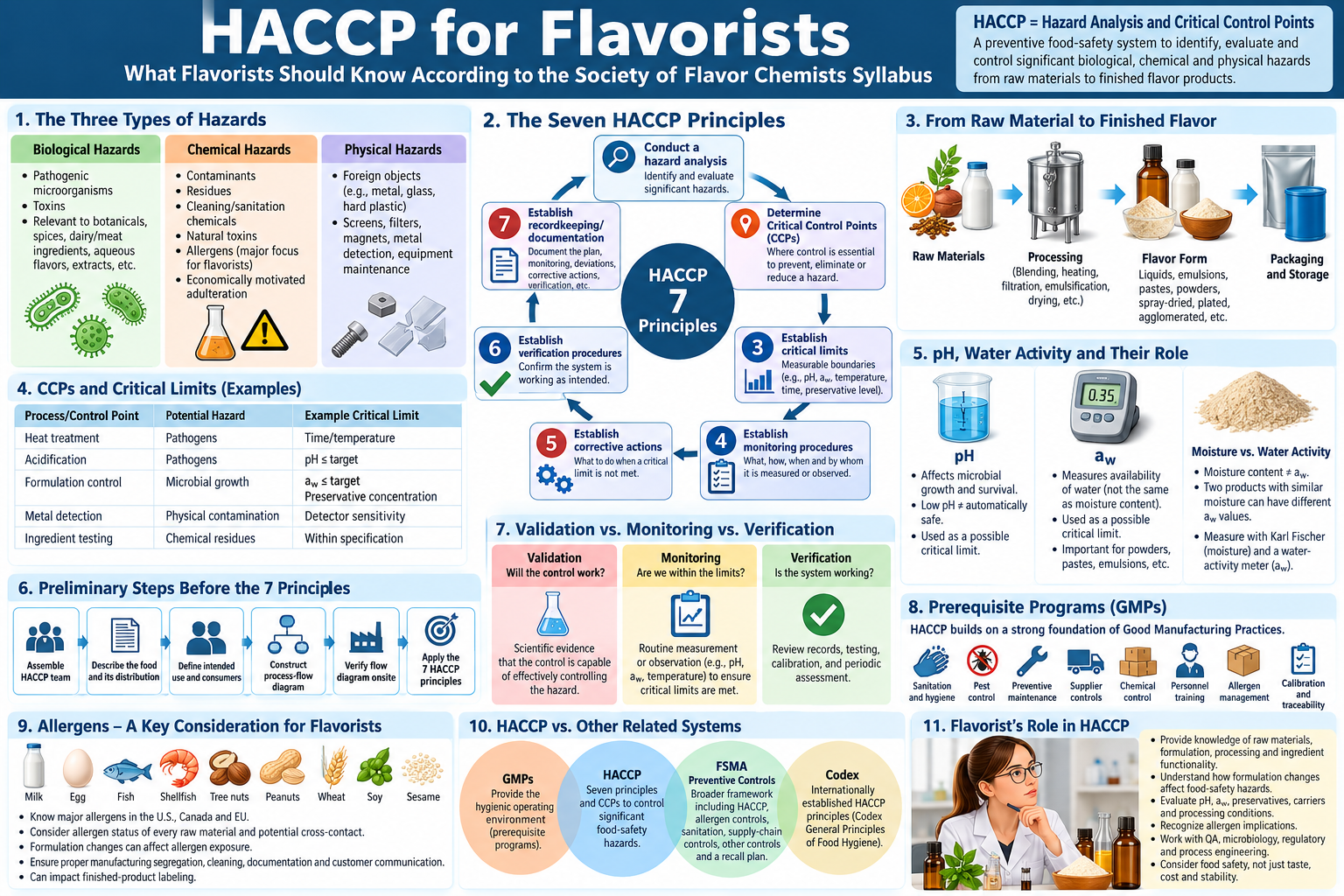
According to the current Society of Flavor Chemists syllabus, HACCP (Hazard Analysis and Critical Control Points) sits under VII. Flavor Organizations, Certifications, and Documentation → Quality Assurance/Control. Importantly, SFC does not provide a separate detailed HACCP curriculum; it expects candidates to understand HACCP together with SDSs, specifications, Certificates of Analysis, GMPs, natural certification/continuing letters of guarantee, and food-safety considerations such as water activity (a_w) and pH. The syllabus is the knowledge base from which SFC develops written and verbal membership questions. Flavor Chemists
To become an SFC-certified flavorist, a candidate or trainee may want to study HACCP to the following depth.
1. What HACCP actually is
HACCP = Hazard Analysis and Critical Control Points.
It is a preventive food-safety system used to identify, evaluate, and control significant food-safety hazards. The emphasis is prevention rather than simply testing the finished flavor and hoping it is safe. FDA describes HACCP as covering hazards from raw-material production and procurement through processing, manufacturing, distribution, and consumption. U.S. Food and Drug Administration
A flavorist should be able to distinguish:
Food safety hazard ≠ quality defect.
For example, oxidation causing an orange flavor to become stale is normally a quality/stability problem, whereas an undeclared milk allergen in a flavor can be a food-safety problem. A wrong refractive index might indicate a quality/specification failure without automatically constituting a HACCP hazard.
That distinction is extremely important in an SFC-style answer.
2. Know the three classical categories of HACCP hazards
Biological hazards
These include pathogenic microorganisms and, where applicable, their toxins.
Flavor-relevant examples include pathogenic contamination of botanical materials, spices, herbs, fruit-derived ingredients, dairy/meat-derived ingredients, aqueous flavor systems, extracts, or other microbiologically susceptible raw materials.
A flavorist should immediately think about how formulation affects microbial growth:
pH + water activity + preservatives + processing + storage temperature + packaging
The SFC syllabus specifically connects food safety with a_w and pH, while its analytical-method section expects working knowledge of pH meters and water-activity meters. Flavor Chemists
Chemical hazards
This category is particularly important for flavorists because flavors contain large numbers of chemically diverse raw materials.
Examples can include unsafe levels of contaminants, residues, toxins, cleaning/sanitation chemicals, or other hazardous chemical contamination. In modern U.S. preventive-control programs, hazards intentionally introduced for economic gain must also be considered when they could affect food safety. U.S. Food and Drug Administration
For a flavorist, food allergens deserve special attention. FDA's preventive-control framework specifically requires controls addressing allergen cross-contact and appropriate labeling. U.S. Food and Drug Administration
Thus, when changing a flavor formula, don't think only:
"Does this taste right?"
Think:
"Did I introduce or change a food-safety hazard?"
Physical hazards
Foreign objects capable of causing injury are physical hazards—for example, metal, glass, hard plastic, or other dangerous foreign material.
Potential controls might involve screens, sieves, filters, magnets, metal detection, equipment maintenance, container inspection, etc., depending on the manufacturing operation and identified hazard.
3. Know the seven HACCP principles cold
For an SFC examination/interview, I would memorize these in order.
| Principle | What you should know |
|---|---|
| 1. Conduct a hazard analysis | Identify and evaluate significant biological, chemical and physical hazards and their controls. |
| 2. Determine Critical Control Points (CCPs) | Determine where control is essential to prevent, eliminate or reduce a significant hazard to an acceptable level. |
| 3. Establish critical limits | Establish measurable boundaries separating acceptable from unacceptable conditions. |
| 4. Establish monitoring procedures | Define what is measured/observed, how, when/how often and by whom. |
| 5. Establish corrective actions | Predetermine what happens when a critical limit is not met. |
| 6. Establish verification procedures | Confirm that the HACCP system is valid and operating as intended. |
| 7. Establish recordkeeping/documentation | Document the hazard analysis, HACCP plan, monitoring, deviations, corrective actions, verification, etc. |
These are FDA's seven HACCP principles. U.S. Food and Drug Administration
A useful memory sequence is:
Analyze → CCP → Limits → Monitor → Correct → Verify → Record.
4. Principle 1 — Hazard analysis: the most important part for a flavorist
This is probably the HACCP principle most directly connected to flavor-development decisions.
For every ingredient and processing step, ask:
What could cause illness or injury?
Then determine:
How severe would it be? How likely is it to occur without appropriate controls?
FDA emphasizes that the hazard analysis should consider ingredients/raw materials, every processing step, equipment, finished product, storage/distribution, intended use and intended consumer. U.S. Food and Drug Administration
For flavor development, that means evaluating the complete formula rather than treating "flavor" as a single ingredient.
Consider, for example:
Raw materials: essential oils, extracts, oleoresins, juice concentrates, spice materials, enzyme-modified cheese, animal-derived ingredients, yeast products, HVPs, fats/oils, carriers, gums, starches and other ingredients.
Processing: blending, heating, reaction/process flavor manufacture, filtration, emulsification, spray drying, plating, agglomeration, drying and packaging.
Product characteristics: pH, a_w, alcohol content where relevant, preservatives, solids, salt/sugar concentrations, storage conditions and stability.
This fits directly with the SFC syllabus because candidates are expected to understand these ingredient categories, processing forms and analytical measurements. Flavor Chemists
5. Principle 2 — Critical Control Points
A CCP is not simply an important processing step.
It is a step where control is essential to prevent or eliminate a food-safety hazard or reduce it to an acceptable level. U.S. Food and Drug Administration
Possible examples, depending entirely on the actual product and validated HACCP plan, could include:
heat treatment → pathogen control
acidification → inhibition of pathogen growth/toxin formation
metal detection → physical-hazard control
specific formulation parameters → microbial control
FDA explicitly lists examples such as thermal processing, chilling, ingredient testing for chemical residues, formulation control and testing for metal contaminants. U.S. Food and Drug Administration
A flavorist should not automatically call every pH check, filter, sieve or heating step a CCP. Whether something is a CCP comes from the hazard analysis and process.
6. Principle 3 — Critical limits
A critical limit is the maximum and/or minimum value that must be achieved at a CCP to control the hazard.
FDA gives examples of parameters that can form critical limits, including:
temperature, time, moisture, water activity, pH, titratable acidity, salt concentration, preservative concentration and other scientifically supported parameters. U.S. Food and Drug Administration
This overlaps strongly with the SFC analytical syllabus.
A flavorist should therefore understand why measurements such as:
pH
water activity
moisture
temperature/time
preservative concentration
can sometimes be safety parameters rather than merely formulation specifications.
Most importantly:
Critical limits must be scientifically justified/validated.
You cannot choose a pH or a_w simply because "that's what we normally formulate to."
7. Principle 4 — Monitoring
Monitoring answers four practical questions:
What? How? When/how frequently? Who?
Suppose a validated formulation-control CCP requires a particular parameter.
The HACCP plan must specify how compliance is observed or measured and recorded.
An important conceptual point: monitoring should provide information quickly enough to detect loss of control. FDA notes that microbiological testing is often unsuitable for routine CCP monitoring because results take too long; physical/chemical measurements and observations are commonly more practical. Microbiological testing can instead have an important verification role. U.S. Food and Drug Administration
This is particularly relevant to flavorists because measurements such as pH and a_w can provide immediate process information.
8. Principle 5 — Corrective actions
Know the difference between detecting a deviation and dealing with it properly.
When a critical limit is violated, the response should address both:
the affected product
and
the cause of the loss of control.
Depending on the validated system, this may mean holding affected material, evaluating its safety/disposition, correcting the process, documenting the event and preventing recurrence.
Do not assume:
"We can just reblend it."
Whether reworking/reblending is appropriate depends on the hazard and validated corrective-action procedure.
For flavorists this becomes important when someone wants to "fix" an out-of-specification batch through reformulation.
A sensory correction does not necessarily correct a food-safety deviation.
9. Principle 6 — Verification versus validation
This distinction is frequently misunderstood and is worth knowing extremely well.
Validation
Essentially:
Will the control work?
FDA defines validation as obtaining and evaluating scientific and technical information demonstrating that the HACCP plan, when properly implemented, will effectively control the hazards. U.S. Food and Drug Administration
For example, evidence establishing that a particular process/formulation actually controls the identified microorganism.
Verification
Essentially:
Are we doing what the plan says, and is the system functioning properly?
Verification can include review of monitoring and corrective-action records, calibration, testing and periodic review of the HACCP system.
So remember:
Validation = scientific basis that the control is capable of working.
Monitoring = routine observation/measurement of the control.
Verification = confirmation that the system is being implemented and functioning as intended.
Those three should never be used interchangeably.
10. Principle 7 — Records
A flavorist should appreciate the rule:
If food safety depends on a control, documentation matters.
FDA's HACCP guidance describes records such as the hazard analysis, HACCP plan, CCPs, critical limits, monitoring procedures/results, corrective actions, verification activities and supporting validation documentation. U.S. Food and Drug Administration
This explains why the SFC syllabus places HACCP beside:
Specifications
Certificates of Analysis (COAs)
GMPs
SDSs
food-safety measurements
and other QA/QC documentation. Flavor Chemists
11. The preliminary steps before the seven principles
A good SFC candidate should know that you don't simply start by choosing CCPs.
FDA's HACCP application guidance lays out preliminary activities:
assemble the HACCP team → describe the food and its distribution → describe intended use/consumers → construct the process-flow diagram → verify the flow diagram onsite → apply the seven principles. U.S. Food and Drug Administration
This matters to flavorists because formulation knowledge belongs on the HACCP team.
QA may know food-safety systems, but the flavorist may uniquely understand why the formulation contains ethanol, acid, carrier, dairy derivative, essential oil, preservative, reaction-flavor ingredient or botanical extract and how changing it affects the finished system.
12. HACCP depends on prerequisite programs
A HACCP plan is not a substitute for GMPs.
Good hygiene/manufacturing programs provide the foundation on which HACCP operates. FDA explicitly describes cGMP/prerequisite programs as essential foundations for successful HACCP implementation. U.S. Food and Drug Administration
Examples relevant to a flavor facility include sanitation, personnel hygiene, pest control, preventive maintenance, supplier controls, chemical control, traceability, calibration, glass/brittle-material programs, allergen management, receiving/storage controls and training, depending on the operation.
This is why an examiner could reasonably move from:
"What is HACCP?"
to:
"How is HACCP different from GMP?"
A good answer is:
GMP/prerequisite programs establish the general hygienic operating environment; HACCP systematically identifies significant product/process-specific food-safety hazards and establishes controls for them.
13. Allergens are especially important for flavorists
Flavor formulations can hide complexity from the finished-food manufacturer.
A seemingly simple "natural flavor" may contain or be produced using ingredients that create allergen-management considerations.
A flavorist therefore needs to think about:
allergen status of every raw material → cross-contact → formulation changes → manufacturing segregation/cleaning → documentation → customer communication → finished-product labeling implications.
FDA's current preventive-control framework explicitly recognizes both allergen cross-contact controls and label controls. U.S. Food and Drug Administration
And the SFC syllabus separately expects flavorists to know the major allergens in the United States, Canada and European Union.
So allergen knowledge and HACCP/food-safety knowledge should not be studied independently.
14. pH and water activity: particularly important for SFC
This deserves special emphasis because the SFC syllabus explicitly says:
"Food safety considerations – a_w, pH, etc."
pH
pH describes hydrogen-ion activity/acidity and can strongly affect microbial growth and survival.
But a flavorist should understand:
low pH ≠ automatically safe.
Safety depends on the microorganism, product composition, processing, storage and other hurdles.
Water activity, a_w
Water activity describes the availability of water, not simply the total moisture percentage.
Therefore:
moisture content ≠ water activity.
Two flavor systems with similar moisture contents can have different a_w values because dissolved solids and other ingredients affect water availability.
That is particularly relevant when thinking about:
powder flavors
spray-dried flavors
pastes
emulsions
aqueous flavors
juice-containing systems
reaction/process flavors.
The SFC syllabus separately expects working knowledge of both Karl Fischer/moisture analysis and a water-activity meter, which reinforces that distinction.
15. Flavor-form changes can change the hazard analysis
This is a very flavorist-specific concept.
The SFC requires knowledge of numerous flavor forms—water-soluble and oil-soluble liquids, emulsions, process flavors, pastes, powder blends, plated flavors, spray-dried flavors, vacuum/drum/fluid-bed/freeze-dried materials, glass encapsulation, agglomeration, spray chilling and coacervation.
Changing:
liquid → powder
or
oil-soluble → emulsion
or
high-solids paste → diluted aqueous flavor
isn't merely a delivery-system change.
It can change water availability, processing conditions, raw materials, allergen exposure, sanitation requirements, packaging/storage conditions and consequently the hazard analysis.
16. Formula changes can require food-safety reassessment
This is one of the most practically important lessons for a working flavorist.
Suppose you:
replace a preservative;
reduce ethanol;
increase water;
change acid level;
replace a carrier;
introduce dairy material;
switch botanical suppliers;
change an extract;
change processing temperature;
move from liquid to emulsion;
or reformulate a spray-dried flavor.
You should not evaluate only:
taste + cost + regulatory status + stability.
Ask whether the change affects the food-safety hazard analysis or preventive controls.
Under FDA's broader FSMA preventive-control framework, food-safety plans must be reanalyzed when appropriate, including when new information about potential hazards becomes known. U.S. Food and Drug Administration
17. HACCP versus FSMA Preventive Controls
For a U.S.-based SFC candidate, don't treat these as synonyms.
Classical HACCP revolves around the seven HACCP principles and CCPs.
FSMA's Preventive Controls for Human Food framework is broader and includes a written food-safety plan, hazard analysis and, where required:
process preventive controls, food-allergen controls, sanitation controls, supply-chain controls, other controls, management components and a recall plan. U.S. Food and Drug Administration
Some controls under FSMA are therefore preventive controls without necessarily being classical HACCP CCPs.
The SFC syllabus actually lists both FSMA 2011 under FDA/flavor regulations and HACCP under QA/QC, so a candidate should understand their relationship rather than collapsing them into one subject.
18. HACCP and Codex
A flavorist should also recognize HACCP's international context.
The SFC syllabus expects knowledge of Codex Alimentarius, and Codex's General Principles of Food Hygiene, CXC 1-1969, contains guidance on the HACCP system. The current Codex listing identifies the text as last modified in 2022. FAOHome
Thus HACCP is not merely a U.S. flavor-industry concept; it is internationally established food-safety methodology.
19. What the flavorist contributes to a HACCP team
The flavorist normally isn't expected to replace QA, microbiology, regulatory or process engineering.
The flavorist contributes specialized knowledge of:
raw-material chemistry + formulation + processing + ingredient functionality + stability + pH/a_w + preservatives + carriers + solvents + interactions + flavor manufacturing + intended application.
For example, QA may ask:
Why is this acid present?
The flavorist should know whether it is there for taste, buffering, stability, processing or potentially as part of a validated safety control.
Likewise:
Can we reduce the preservative?
A flavorist should recognize that this might not merely be a sensory/formulation decision if microbial control depends upon it.
20. A model SFC interview answer
If an interviewer says "Tell us what you know about HACCP," a strong concise response would sound approximately like this:
HACCP stands for Hazard Analysis and Critical Control Points. It is a preventive food-safety system used to identify, evaluate and control significant biological, chemical and physical hazards. It is built on prerequisite programs such as GMPs. HACCP has seven principles: conduct the hazard analysis, determine CCPs, establish critical limits, establish monitoring, establish corrective actions, establish verification procedures, and establish documentation and recordkeeping. Before applying those principles, the team describes the product, its intended use and consumers, develops and verifies the process-flow diagram, and evaluates ingredients and processing steps. For a flavorist, HACCP is particularly relevant to raw-material hazards, allergens, pH, water activity, preservatives, processing conditions, physical contamination and formulation changes. A critical limit must have a scientific basis, and monitoring, validation and verification have different functions. Flavorists need to recognize when a formulation or process change could affect the hazard analysis or food-safety controls rather than treating it only as a sensory or quality change.
That answer connects HACCP to actual flavor creation, which is more valuable for an SFC interview than merely reciting the seven principles.
What I would memorize for the SFC exam
If you're preparing specifically for the Society interview/test, make sure you can explain without notes: HACCP definition; biological/chemical/physical hazards; hazard vs. quality issue; seven principles in order; CCP vs. control point; critical limit; monitoring; deviation and corrective action; validation vs. verification; prerequisite programs/GMP; pH vs. a_w vs. moisture; allergens and cross-contact; documentation/COAs/specifications; effect of formulation changes; and the distinction between classical HACCP and FSMA preventive controls.
The key is not just memorizing definitions. The SFC says its syllabus represents expected knowledge for its written and verbal inquiries, and Certified candidates are expected to demonstrate broader/deeper practical knowledge.
Primary references: SFC current syllabus · FDA HACCP Principles & Application Guidelines · FDA Preventive Controls for Human Food · Codex Codes of Practice
###