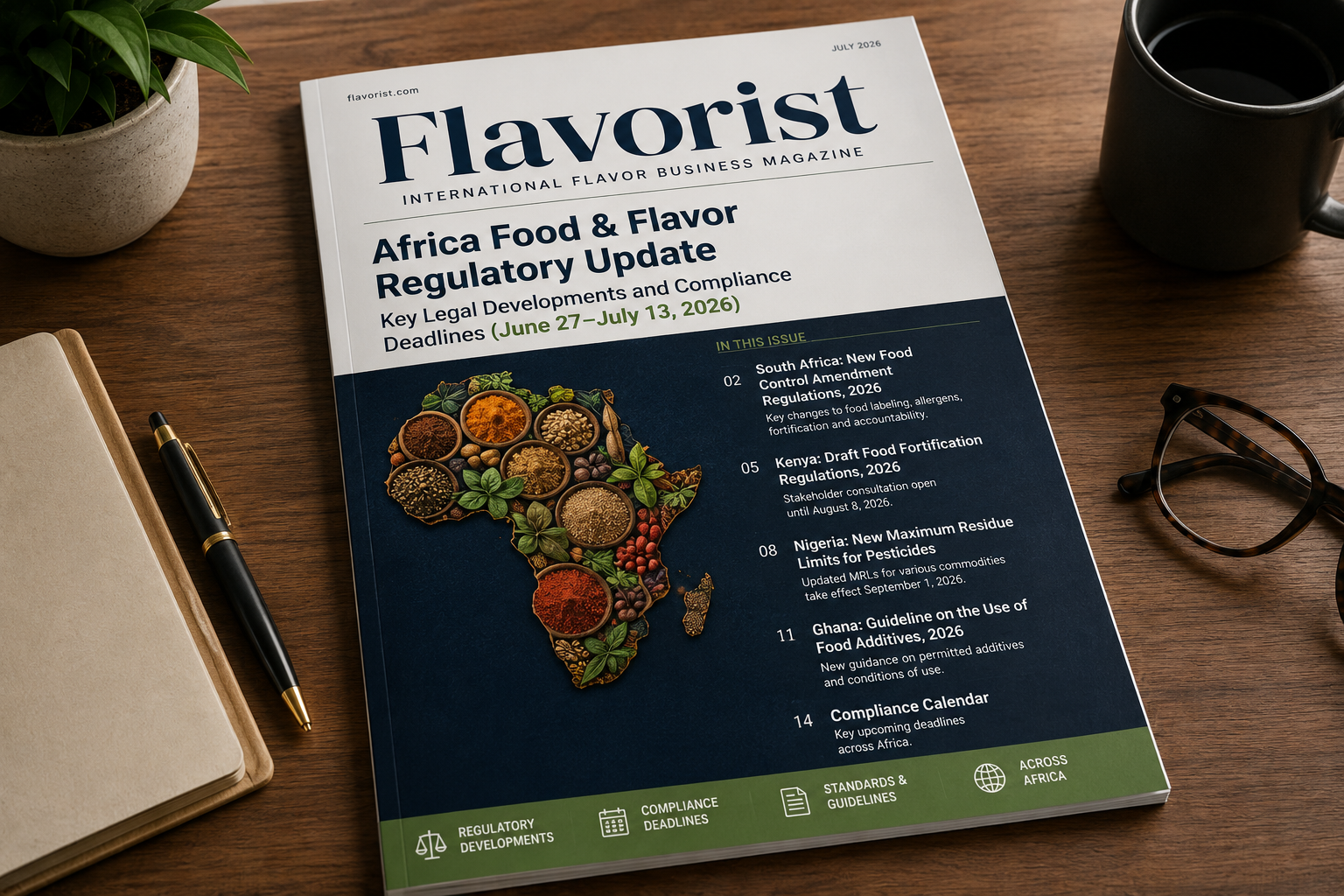
Africa Food & Flavor Regulatory Update: Key Legal Developments and Compliance Deadlines (June 27–July 13, 2026)
East African Community — Burundi, Kenya, Rwanda, Tanzania, Uganda
1. Draft EAC standards for flavoured soft drinks and energy drinks notified to the WTO — July 14, 2026 (filed at the close of the window) The five EAC partner states jointly notified two draft East African Standards directly targeting the flavor industry's core beverage categories: one for water-based flavoured drinks — carbonated and non-carbonated soft drinks (G/TBT/N/BDI/798, G/TBT/N/KEN/2092, G/TBT/N/RWA/1456, G/TBT/N/TZA/1635, G/TBT/N/UGA/2413) and one for water-based flavoured drinks — energy drinks (G/TBT/N/BDI/799, G/TBT/N/KEN/2093, G/TBT/N/RWA/1457, G/TBT/N/TZA/1636, G/TBT/N/UGA/2414). Once adopted, EAC standards typically become mandatory technical regulations across all five markets, governing composition, permitted additives/sweeteners/caffeine levels, labeling and test methods. This is the single most flavor-relevant African development of the period: beverage makers and flavor houses supplying concentrates, emulsions and beverage bases into East Africa should review the drafts and use the ~60-day WTO comment window. A parallel joint notification covering pyrethrum extracts (G/TBT/N/BDI/800 series) was filed the same day, relevant to botanical-extract supply chains. Source: EVS mirror of WTO TBT notifications (with download links to the notified texts)
2. Kenya notifies a draft standard for bay leaf (spices/food additives) — July 8, 2026 KEBS filed WTO TBT notification G/TBT/N/KEN/2091 covering a draft Kenyan standard for bay leaf, classified under food additives/spices. Spice and seasoning standards define quality grades, moisture, extraneous matter, contaminant limits and labeling — directly relevant to seasoning blenders, spice traders and savory-flavor suppliers selling into Kenya. Source: Notification listing and text download (EVS/WTO)
3. Kenya notifies revised conformity-assessment rules: product certification, metrology, laboratories — July 1, 2026 Kenya filed three TBT notifications (G/TBT/N/KEN/2088 on product certification, KEN/2089 on metrology and measurement, KEN/2090 on laboratories). These are horizontal measures, but they matter for food and flavor exporters because Kenya's product-certification and pre-export verification (PVoC) architecture, laboratory recognition and measurement rules determine how imported foods, ingredients and flavor materials are tested and cleared. Companies shipping to Kenya should check whether certification marks, test-report acceptance or lab-accreditation requirements change. Source: EVS/WTO TBT notification list
4. Context from just before the window: EAC cheese and dairy standards wave In the two weeks preceding June 27, the EAC states notified a cluster of draft dairy standards — Caciotta cheese, goat cheese, ricotta, paneer and edible casein products (June 9–12, 2026) — whose 60-day comment periods run through this window and beyond. Dairy processors and suppliers of cultures, enzymes and dairy flavors for the East African market should track these alongside the beverage drafts above. Source: EVS/WTO TBT notification list
South Africa
5. Plant-based "meat analogue" regulations (R.6436 of 2025) take effect — July 2026 The most concrete South African compliance event in the window: the Department of Agriculture, Land Reform and Rural Development's Regulation No. R.6436, published in 2025 under the Agricultural Product Standards Act to govern the sale of meat-analogue products (plant-based sausages, burgers, etc.), comes into effect in July 2026 after a 12-month transition. The rules set protein-content requirements for products using meat-style names, prohibit animal-origin ingredients (with limited vegetarian exceptions such as egg or milk where claimed), and impose country-of-origin and full manufacturer/packer labeling, including a South African address where only a foreign manufacturer address appears. Plant-based brands, their ingredient suppliers and the flavor houses building meat-flavor systems for analogues must have compliant labels and formulations on the market from this window onward. Source: ASC Food Safety analysis of R.6436
6. Dairy standards revision notified at the window's edge (June 23, 2026) and the pending labeling overhaul South Africa filed G/TBT/N/ZAF/176/Add.1/Rev.1, a revision notice on its dairy-products regulation, on June 23 — days before the window opened, with follow-through running into July; dairy exporters to South Africa should verify what changed in the revised text. Meanwhile the country's biggest pending file remains draft R.3337, the replacement for the R.146/2010 labeling and advertising regulations, which is expected to be finalized in 2026 and would introduce mandatory front-of-pack warning labels (high in sugar, salt, saturated fat), restrictions on child-directed marketing, tighter allergen declarations and new claim rules. No final text was gazetted in this window, but it is the item to watch for anyone selling packaged food in South Africa. Sources: EVS/WTO TBT list (ZAF/176/Add.1/Rev.1) | ASC Food Safety guide to SA food legislation and the R.3337 timeline | Draft R.3337 text (Department of Health PDF)
Nigeria
7. NAFDAC signals intensified nationwide food-safety enforcement — early July 2026 In remarks publicized in early July, NAFDAC's Director-General (represented by the Director of Food Safety and Applied Nutrition) warned of the burden of unsafe food and announced the agency is intensifying regulatory systems, laboratory testing, surveillance, industry compliance checks and consumer education, urging consumers to avoid products without proper labeling or NAFDAC registration numbers. While a speech rather than a regulation, it signals the enforcement posture manufacturers and importers should expect in the second half of 2026. Source: Vanguard – NAFDAC raises alarm over unsafe food, pushes nationwide safety reforms (July 2026)
8. Ongoing enforcement backdrop shaping the window: sachet-alcohol ban and trans-fat limits Two earlier Nigerian measures were in active enforcement during June 27–July 13. First, NAFDAC's total ban on spirit drinks in sachets and PET/glass bottles below 200 ml, whose enforcement began in January 2026, remained contested in Federal High Court litigation (SERAP v. Minister of Health), with the Health Ministry affirming in filings that NAFDAC has full statutory power to enforce the ban — beverage companies should assume continued market sweeps. Second, manufacturers faced NAFDAC's 2026 compliance deadline limiting industrially produced trans-fatty acids to no more than 2 g per 100 g of total fat/oil, aligned with WHO best practice; reformulation of fats, shortenings and fried-product systems (and the flavor adjustments that follow) is now an enforcement matter rather than a policy discussion. Sources: Independent – NAFDAC has powers to enforce alcohol ban, Health Ministry says | The Hope – NAFDAC 2026 trans-fat deadline
Egypt and North Africa
9. No major new instrument in the window; enforcement of NFSA registration and mandated standards continues My searches found no new NFSA board decision or ministerial food decree published specifically between June 27 and July 13, 2026. The operative compliance environment remains the NFSA's consolidated framework — mandatory registration of foreign manufacturers for certain categories, mandatory Arabic labeling, binding technical rules on chemical contaminants (Decision 6/2022), pesticide MRLs (Decision 6/2021) and traceability (Decision 16/2022) — plus 2026 ministerial decrees mandating specific Egyptian standards (e.g., Ministerial Decree 57/2026 on non-heat-treated processed meat, notified earlier in 2026). Exporters should monitor NFSA's unified registration portal and WTO notifications for the next tranche of mandated standards. Sources: ChemLinked – Egypt food regulations overview | NFSA unified registration portal
###