Oceania Food & Flavor Regulatory Digest (June 27–July 13, 2026): Key FSANZ, MPI, NZFS & Pacific Islands Compliance Updates
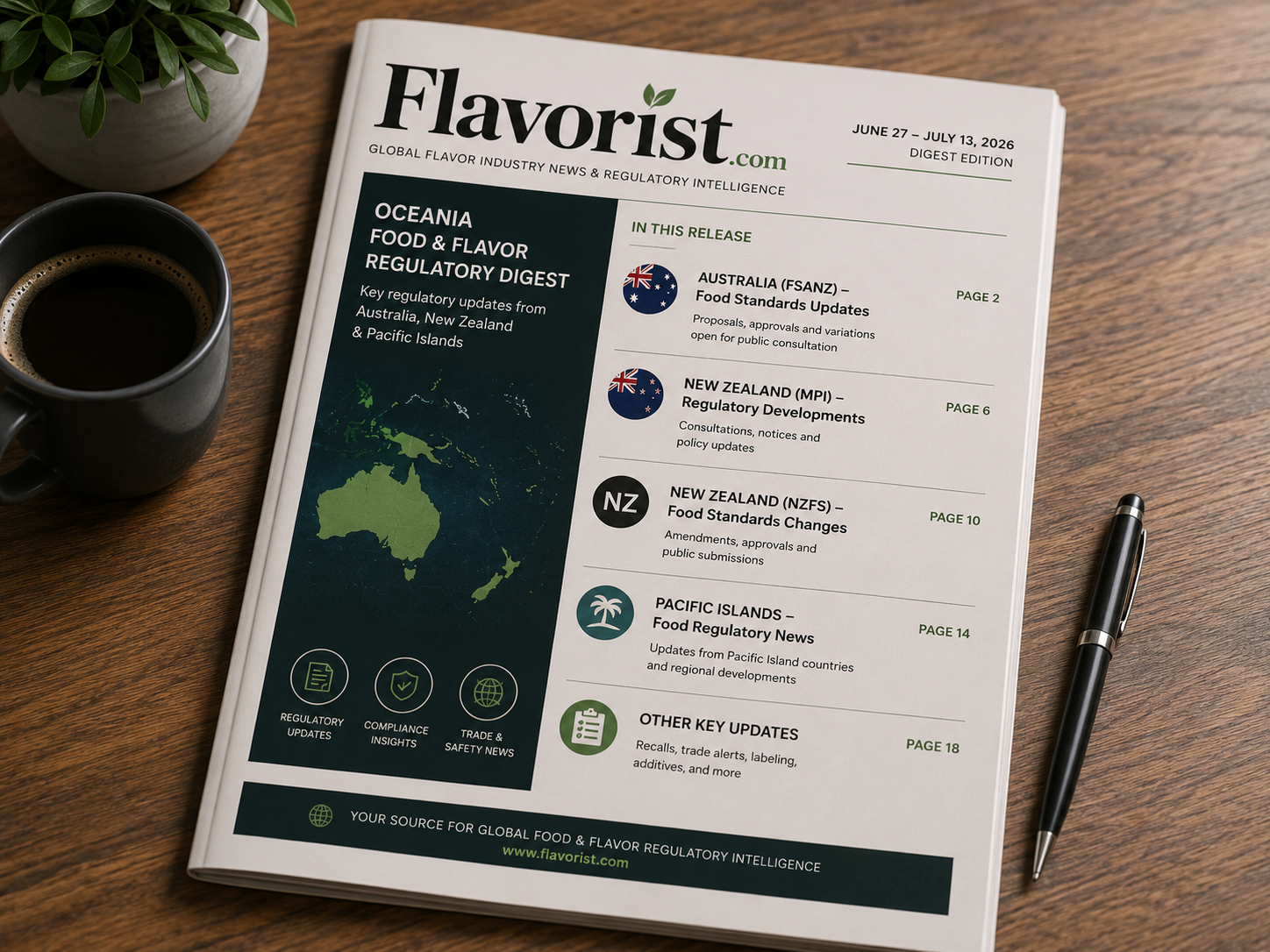
OCEANIA — Food & Flavor Regulatory Digest
June 27 – July 13, 2026
Coverage: Australia / FSANZ, New Zealand / MPI-NZFS, Pacific Islands
Australia / FSANZ (Bi-national)
1. P1067 — Health Star Rating System: final submission deadline passes July 5, 2026
FSANZ Circular 398-26 extended the deadline for submissions on Proposal P1067, the Health Star Rating System, to 5 July 2026. The consultation window therefore closed inside the reporting period, marking the end of FSANZ's first round of stakeholder input on a potential overhaul of Australia and New Zealand's voluntary front-of-pack interpretive nutrition label. P1067 is examining whether the HSR framework should be updated, strengthened, or made mandatory — questions with sweeping implications. For the flavor industry specifically, reformulation to improve nutrition profiles often relies on flavour technologies to reduce sugar, sodium, saturated fat, or energy while maintaining taste. If Health Star Rating requirements become more prominent or mandatory, demand may increase for salt-reduction flavours, sweetness modulators, bitterness blockers, mouthfeel systems, dairy-fat mimetics, and clean-label taste solutions. Manufacturers should have already submitted views; now they should track FSANZ's next assessment report, which will reflect the submissions received. Source: FSANZ Notification Circular 398-26 | P1067 proposal page
2. P1066 — Review of Young Child Formula: original submission deadline July 7, 2026 (extended to July 21)
Food Standards Australia New Zealand (FSANZ) called for submissions on a proposal to develop a modernised regulatory framework for young child formula, commonly referred to as toddler milk. Proposal P1066 – Review of young child formula is considering whether the Australia New Zealand Food Standards Code should be updated to ensure regulatory requirements for young child formula remain fit for purpose and reflect their intended role as a special purpose food. Submissions close on 7 July 2026. A subsequent Circular (400-26) then extended this deadline to July 21. The proposal was triggered by a Food Ministers' Meeting request in November 2024 in response to market developments. FSANZ CEO Dr Sandra Cuthbert said young child formula products are widely marketed for use in children's diets, prompting questions about whether the current framework reflects their intended purpose as supplementary products. "Assessment to date indicates there is a need for greater regulatory clarity to ensure product composition, labelling and representation are consistent with the intended purpose of young child formula as a special purpose food."
The proposal's flavor-industry relevance is direct: FSANZ proposes to align food additive permissions for young child formula with CXS 156-1987. CXS 156-1987, Section B lists certain flavourings that can also be used, and this is the only section relevant or applicable to Proposal P1066 as the age group is equivalent. FSANZ identified 7 new food additives from Codex not currently permitted in the Code and proposed to include them. Flavor houses supplying vanilla, dairy, or sweetener systems for toddler milk, dairy powder manufacturers, and paediatric nutrition ingredient suppliers should review the call-for-submissions report and relevant supporting documents to assess whether the proposed additive alignment and compositional changes require reformulation. Sources: FSANZ news release on P1066 | Notification Circular 396-26 | P1066 supporting document 3 (food additives and technology)
3. A1341 — Cell-cultured duck biomass: public comment open throughout the window (submissions close July 22)
FSANZ opened public comment on Application A1341, which seeks to amend the Australia New Zealand Food Standards Code to permit cell-cultured duck biomass from Pekin duck embryonic stem cells. The proposed use is not a generic commodity approval; FSANZ described the biomass as an ingredient to be combined with other ingredients in foods such as foie gras and pâté. FSANZ stated that its safety assessment found no public health or safety concerns and noted that foods made with the ingredient would need to be labelled "cell-cultured" or "cell-cultivated." This is the second cultivated-animal approval pathway FSANZ has progressed (after an earlier cell-cultured quail approval), signaling a systematic approach to novel proteins. Companies should monitor consumer-facing terminology, allergen and compositional data, and whether flavour or masking systems are needed to make cultivated duck products commercially viable. Submissions were open through July 22, meaning the entire window was active consultation time. Source: FSANZ media release on A1341
4. FSANZ Circular 401-26 (published July 2): A1357 — Steviol glycosides (rebaudioside M and rebaudioside D) via enzymatic conversion accepted
FSANZ published Notification Circular 401-26 on 2 July 2026, notifying that FSANZ completed an administrative assessment and accepted Application A1357 for steviol glycosides (rebaudioside M and rebaudioside D) produced by enzymatic conversion using enzymes produced by Escherichia coli BL21, accepted 26 May 2026. Assessment has commenced and an opportunity to comment will be publicly notified at a later date. Rebaudioside M (reb M) and rebaudioside D (reb D) are high-intensity steviol glycosides with cleaner, less bitter sweetness profiles than the original reb A. If eventually approved, this production route — enzymatic conversion using an E. coli-based enzyme system — would add a commercially scalable pathway for these premium stevia derivatives to the Australian and New Zealand food additive framework. This is directly relevant to beverage formulators, confectionery manufacturers, dairy products, and flavor-modulation systems relying on next-generation stevia sweeteners. Source: FSANZ Notification Circular 401-26
5. FSANZ Circular 402-26 (likely published ~July 9–10): A1344 (milk fat globule whey protein) and A1354 (D-psicose 3-epimerase for D-allulose) enter consultation
Notification Circular 402-26 invites written submissions on Application A1344 — Milk fat globule membrane-enriched whey protein concentrate for use as a nutritive substance in formulated supplementary foods for young children — with submissions due August 6, 2026. It also calls for submissions on A1354 — D-psicose 3-epimerase from Escherichia coli (gene donor: Desmospora sp.) for use as a processing aid for the production of D-allulose — with submissions due August 20, 2026. And FSANZ has accepted A1354 with assessment commenced and an opportunity to comment to be notified later. Both are significant: A1344 relates to an emerging functional dairy protein for paediatric nutrition (milk fat globule membrane is linked to cognitive and immune outcomes), with flavor and formulation implications in growing-up milk and supplementary foods. A1354 concerns D-allulose (also called D-psicose), a rare sugar with near-zero caloric impact widely used in beverages, baked goods, dairy, and confectionery as a sugar replacer — its approval as a processing aid in ANZ would open a major reformulation tool for sugar reduction without taste compromise. Source: FSANZ Notification Circular 402-26
6. DAFF Imported Food Notice 10-26: biosecurity and imported food fee changes, effective July 1, 2026
Australia's DAFF published Imported Food Notice 10-26 on changes to fees and charges for biosecurity and imported food regulatory activity, dated 16 June 2026, concerning changes to fees and charges effective from 1 July 2026. For food and flavour companies, this is a direct cost and planning issue. Importers of flavours, botanicals, spices, sauces, beverage bases, dairy ingredients, proteins, sweeteners, colours, extracts, and finished foods may face changed inspection, testing, or administrative costs from 1 July 2026. Companies should update import budgets, broker instructions, and landed-cost calculations. Source: DAFF Imported Food Notices page
7. FSANZ Circular 403-26 (likely published around July 14–16, exact date unconfirmed): A1321 — Acetolactate decarboxylase processing aid consultation
Notification Circular 403-26 invites written submissions on Application A1321 — Acetolactate decarboxylase from Bacillus licheniformis (gene donor: Brevibacillus brevis) for use as a processing aid — with submissions due August 25, 2026. Acetolactate decarboxylase is a brewing and fermentation enzyme that converts alpha-acetolactate to acetoin rather than diacetyl, thereby preventing off-flavors (buttery, milky diacetyl) in beer and other fermented beverages. If approved, it would be available to brewers, cider makers, kombucha producers, and manufacturers of fermented flavor systems operating under the Food Standards Code. The exact publication date of this circular is unconfirmed; it may fall at or just outside the window's close. Source: FSANZ Notification Circular 403-26
8. A1325 — Steviol glycosides extension to hotplate flour products: assessment commenced
Noted in Circular 396-26 (published May 26, running into the consultation window): assessment of Application A1325 — Extension of use of steviol glycosides in hotplate flour products — has commenced, with an opportunity to comment to be notified at a later date. This would expand permitted steviol glycoside use to pancake, waffle, and crêpe-type products — a relevant extension for flavored batters, sweet coatings, and convenience breakfast systems using stevia sweeteners. Source: FSANZ Notification Circular 396-26
New Zealand
9. NZFS releases guidance to standardize verification at multi-site food businesses — early July 2026
New Zealand Food Safety (NZFS) released new guidance intended to standardize food safety verification checks at multi-site food businesses across the country, establishing national recommendations for onsite sampling intended to improve enforcement consistency while reducing regulatory costs for businesses operating across multiple locations. The guidance addresses disparities between local councils and verification agencies in how they have applied verification requirements. Food Safety Minister Andrew Hoggard explained: "Verifiers check that businesses are following good food safety practices. The new guidance levels the playing field by setting out clear site-sampling guidelines for verifiers." For food and flavor manufacturers operating multiple production sites across New Zealand — including contract manufacturers and companies running satellite blending or packaging operations — this guidance brings predictability to verification costs and audit frequency. Businesses that had faced inconsistent requirements across regions should review the guidance and align their internal compliance programs accordingly. Source: Food Safety Magazine – NZ multi-site verification guidance
10. New Zealand context: Food Notice on Requirements for Registered Food Importers (issued May 2026, effective February 2027)
The Food Notice: Requirements for Registered Food Importers and Imported Food for Sale 2026 was issued 1 May 2026 and effective from 1 February 2027. The window is the period in which companies supplying flavors, ingredients, and food products into New Zealand should be reviewing this notice and planning for its February 2027 implementation. Compliance gaps identified now are far easier to remedy than those found at the effective date. Source: MPI food legislation and notices page
Pacific Islands
No formal regulatory actions from individual Pacific Island nations were identified in public sources for the June 27 – July 13 window. Pacific Forum Island Countries largely rely on Codex Alimentarius, import standards derived from Australia/New Zealand, or national ordinances that are rarely published in searchable international databases. This absence from the digest reflects source availability, not necessarily regulatory inactivity.
###