Kikkoman Opens $560 Million Soy Sauce Production Facility in Wisconsin as U.S. Demand Grows
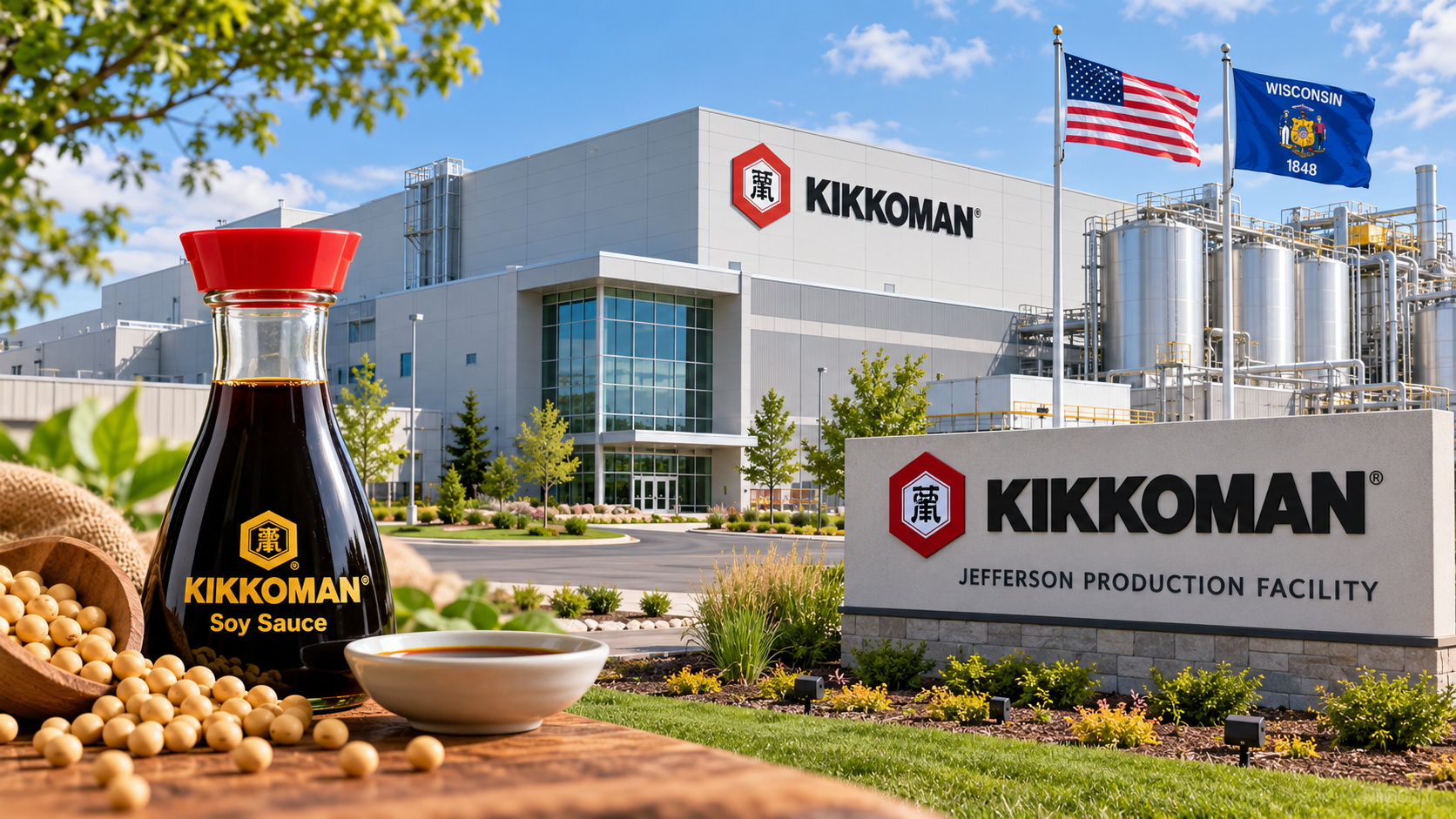
Tuesday September 29, 2026 – Kikkoman Foods has expanded its U.S. manufacturing footprint with the opening of a major new production facility in Jefferson, Wisconsin, a move designed to support growing North American demand for soy sauce, teriyaki sauce and other seasonings.
The 240,000-square-foot Jefferson facility represents an investment of approximately $560 million over a 10-year period and becomes Kikkoman Foods’ third major U.S. production plant. The company already operates facilities in Walworth, Wisconsin, and Folsom, California.
Soy sauce brewing at the new plant began in May 2026, while product shipments are scheduled to start in October 2026. The facility is Kikkoman Group’s ninth soy sauce production base outside Japan.
New Kikkoman Plant Expands U.S. Production Capacity
The Jefferson plant has been designed to serve multiple segments of the food industry, including grocery retail, restaurants and foodservice operators, and food manufacturers.
In addition to Kikkoman's flagship soy sauce, the facility can manufacture teriyaki sauce and other seasonings. Its flexible production configuration accommodates different product viscosities and packaging formats, ranging from glass and BPA-free plastic bottles to industrial and bulk containers.
The investment is particularly significant because Kikkoman says its North American soy sauce business has grown at an average annual rate of more than 6% during the past decade. The company says it has also maintained the leading share of the U.S. soy sauce market for more than a decade.
That growth helps explain why Kikkoman is adding substantial domestic capacity rather than relying exclusively on existing factories or imported products.
Why Kikkoman Chose Wisconsin
Wisconsin has played a central role in Kikkoman's American expansion for more than five decades.
Kikkoman began full-scale U.S. soy sauce production in Walworth, Wisconsin, in 1973, after establishing a U.S. marketing operation in San Francisco in 1957. Its second major U.S. production plant began shipping products from Folsom, California, in 1998.
For the third plant, Kikkoman conducted a nationwide site search. According to the Wisconsin governor's office, the company considered 64 Midwestern locations before choosing a 100-acre site in Jefferson.
Several factors make Wisconsin strategically attractive for soy sauce manufacturing. Kikkoman has highlighted access to agricultural suppliers, suitable water for the brewing process and an established workforce. The state's central U.S. location also provides logistical advantages for distributing products across major North American markets.
The Jefferson factory is part of the city's planned Food & Beverage Innovation Campus, reinforcing the area's ambitions as a center for food manufacturing.
A High-Tech Soy Sauce Factory
Although soy sauce is based on a centuries-old fermentation process, Kikkoman's newest plant combines traditional brewing expertise with modern manufacturing technology.
The Jefferson facility incorporates digital manufacturing systems supporting paperless operations, real-time production-data visualization and improved product traceability. Its flexible layout also gives Kikkoman greater ability to manufacture different sauces and seasonings as consumer preferences change.
The plant is tied to Kikkoman Foods' longer-term environmental objectives. The company says its strategy includes reducing carbon dioxide emissions by more than 50%, lowering water consumption per unit of production by more than 30%, and reaching a 100% recycling rate by 2030.
For a fermentation-based product such as soy sauce, water availability and quality are especially important, making resource efficiency an important part of the manufacturing equation.
Wisconsin Investment Goes Beyond the New Factory
The $560 million Jefferson project is part of an even larger Kikkoman investment in Wisconsin.
The Wisconsin governor's office says that, when the Jefferson project is combined with investment connected to Kikkoman's Walworth operations, the company's investment in the state exceeds $800 million and is associated with more than 80 high-paying jobs in southeastern Wisconsin.
The Wisconsin Economic Development Corporation has committed up to $15.5 million in performance-based Enterprise Zone tax credits. The credits are tied to benchmarks such as capital investment and job creation rather than being provided unconditionally.
Kikkoman is also working with workforce-development organizations and technical-education partners to support recruitment and training for advanced food-manufacturing positions.
Asian Flavors Are Becoming Mainstream in the U.S.
The expansion comes amid a broader shift in American eating habits.
Food Dive notes that Asian flavors are becoming increasingly influential in U.S. retail, particularly among younger consumers. Ingredients and condiments once associated primarily with specialized Asian cooking have increasingly become everyday pantry products.
Soy sauce is a particularly strong example of that transition. It is now used well beyond traditional Japanese, Chinese and other Asian dishes, appearing in marinades, grilled foods, salad dressings, sauces, burgers and fusion recipes.
Kikkoman has spent decades encouraging that crossover. When it began expanding in the United States, the company promoted soy sauce for American foods such as meat dishes rather than positioning it exclusively as an ingredient for Asian cuisine. That localization strategy helped broaden the condiment's appeal.
The current growth of Japanese and broader Asian food culture is creating another opportunity. Food Dive pointed to the increasing popularity of Asian-inspired products and recent food-industry investment in the category, including The Marzetti Company's acquisition of Japanese barbecue sauce brand Bachan's.
Kikkoman's Long History of Global Expansion
Kikkoman's roots stretch back more than 350 years to Japan, but international expansion has become increasingly important to its business.
The company's U.S. journey is notable because local manufacturing began relatively early. The Walworth plant opened in 1973, at a time when large-scale Japanese manufacturing investment in the United States was far less common than it is today. Wisconsin officials describe it as one of the early U.S. manufacturing facilities established by a Japanese company.
More than five decades later, Kikkoman's decision to build another major Wisconsin facility illustrates how much the market has changed: soy sauce has moved from a comparatively specialized imported seasoning toward a mainstream ingredient with applications across home cooking, restaurants and industrial food production.
The Jefferson expansion also supports Kikkoman's Global Vision 2030, under which the company has identified making Kikkoman Soy Sauce a truly global seasoning as a central objective.
What the Jefferson Plant Means for Kikkoman
The new plant addresses several strategic priorities simultaneously.
First, it adds capacity in a North American market where Kikkoman reports sustained growth. Second, domestic manufacturing puts production closer to U.S. agricultural suppliers and customers. Third, flexible production lines allow the company to respond to demand not only for traditional soy sauce but also for teriyaki sauces and a wider portfolio of seasonings.
The plant also strengthens supply resilience by distributing U.S. manufacturing among facilities in Wisconsin and California.
Most importantly, the investment reflects a broader transformation of America's food market. Asian-inspired flavors have moved steadily deeper into mainstream retail and foodservice, while manufacturers are developing products that blend culinary traditions and appeal to increasingly adventurous consumers.
For Kikkoman, a company that began producing soy sauce in Wisconsin more than half a century ago, the $560 million Jefferson facility represents both a substantial manufacturing expansion and a bet that demand for globally influenced flavors will continue to expand across North America.
Key Takeaways
- Kikkoman has opened a 240,000-square-foot production facility in Jefferson, Wisconsin.
- The company plans to invest approximately $560 million in the facility over 10 years.
- Soy sauce brewing began in May 2026, with shipments scheduled to start in October 2026.
- The plant will manufacture soy sauce, teriyaki sauce and other seasonings for retail, foodservice and food-manufacturing customers.
- Kikkoman says its North American soy sauce business has grown by an average of more than 6% annually over the past decade.
- The Jefferson factory becomes Kikkoman Foods' third major U.S. production facility, joining Walworth, Wisconsin, and Folsom, California.
- Wisconsin has committed up to $15.5 million in performance-based tax credits tied to investment and job-creation targets.
- The expansion reflects the continuing mainstream growth of Asian flavors and globally influenced foods in the North American market.
###